Checklist for Accurate Deed Polls
Changing your name legally with a deed poll requires precision to avoid delays or rejections. A deed poll is a formal document that proves your name change and is accepted by UK institutions like HM Passport Office, DVLA, HMRC, and banks. However, small errors - such as incorrect details, improper formatting, or missing signatures - can invalidate the document.
Here’s what you need to focus on:
- Personal Details: Ensure your old name, new name, address, and date of birth match official records. Double-check spellings and follow UK naming rules (e.g., no symbols or numbers in names).
- Document Formatting: Use high-quality A4 paper, sign in wet ink, and have two independent witnesses present. Witnesses must be over 18 and not close relatives or housemates.
- Supporting Documents: Prepare proof of identity (e.g., passport, driving licence) and evidence of previous names if applicable. Certified copies can save time when updating multiple organisations.
- Final Checks: Verify all dates are consistent, avoid post-signing edits, and store originals securely.
To simplify the process, services like Name Change offer pre-validated deed polls, certified copies, and guidance to ensure acceptance by UK authorities.
This guide ensures your deed poll is legally valid, helping you update your records smoothly without unnecessary setbacks.
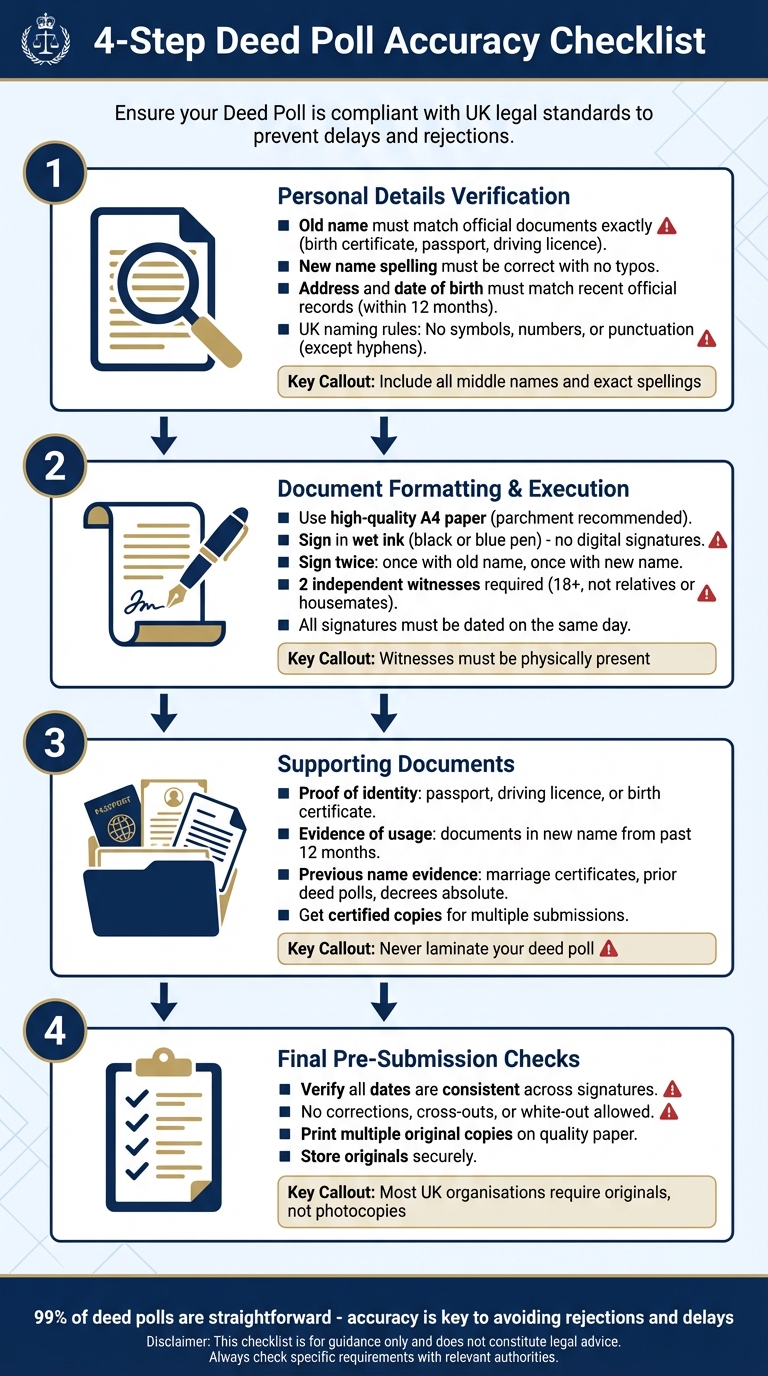
4-Step Deed Poll Accuracy Checklist for UK Name Changes
Personal Details Verification
Getting your personal details correct is essential when creating a valid deed poll. Your old name, new name, address, and date of birth must all align with your existing official records.
Confirm Old Name Details
Your old name must appear on the deed poll exactly as it is shown on official documents like your birth certificate, passport, or driving licence. This means including all middle names, hyphens, and exact spellings. For instance, if your birth certificate states "John Michael Smith-Jones", you must use this full name on the deed poll - not a shortened version like "John Smith-Jones" or "John M Smith-Jones."
If you're reverting to a maiden name after a divorce, your "old name" should match the name currently recorded on your marriage certificate or decree absolute. When signing the deed poll, you must use your current (old) name in front of a witness. Use your existing signature as it appears on official documents. If you're unsure of the exact name registered with organisations, check recent documents like a bank statement, HMRC correspondence, or a letter from your GP.
Check New Name Spelling
Your new name must be spelled exactly as you want it to appear on all future records. Double-check for typos or errors, as even a small mistake would mean creating and signing a new deed poll to correct it.
The UK government has specific rules for acceptable names. Your new name must be pronounceable and cannot include symbols, numbers, or punctuation - except for hyphens in double-barrelled names or established names like O'Hara. Titles such as Mr, Mrs, Sir, Lady, or Doctor cannot be included, and the name must not be offensive or contrary to public interest.
If you're choosing a double-barrelled name, make sure the hyphen is correctly placed. Some organisations, like the Passport Office, may require evidence of your "name in use", such as a bank statement or payslip showing consistent use of your new name. Choose a spelling you are ready to use across all official documents.
Include Accurate Address and Date of Birth
Just like your names, your address and date of birth must match your official records to avoid complications. These details are used to connect your name change to your existing identity in systems like the Electoral Register and Land Registry.
Verify your date of birth against official records. For your address, use a recent utility bill, bank statement, or council tax letter issued within the last 12 months to confirm the exact format. Ensuring these details are accurate and consistent will help avoid delays when updating records with organisations like HM Passport Office, the DVLA, and banks.
Document Formatting and Execution
Once your personal details are verified, the next step is to ensure your deed poll is properly formatted and executed. Meeting specific physical and formatting standards is essential for it to be accepted by government departments and organisations.
Use Appropriate Paper
While there’s no legal requirement to use a specific brand of paper, it’s strongly advised to print your deed poll on heavyweight A4 paper. Parchment paper is an excellent choice due to its durability and professional look, which helps differentiate the original document from photocopies. Many UK institutions require the original document, so using high-quality paper can reinforce its legitimacy. If you’re preparing the deed poll yourself, high-quality A4 paper from a trusted stationery supplier will work just fine. It’s also a good idea to print multiple original copies for distribution to banks, employers, and utility providers.
Signatures and Witness Requirements
Your deed poll must be signed in wet ink using either a black or blue pen. Digital signatures are not accepted. You’ll need to sign the document twice: once with your old name and once with your new name, making the legal name change clear.
You’ll also need two independent witnesses (aged 18 or over) to sign the document. Witnesses cannot be close relatives or people you live with. Suitable options include friends, neighbours, or colleagues who reside in the UK. Witnesses must provide their full name and current UK address, and in some cases, their occupation may also be required. Importantly, witnesses must be physically present when signing, as remote or video witnessing is no longer permitted (this was a temporary measure during Covid that has since been discontinued).
Ensure all signatures are legible, and avoid making any changes, corrections, or using white-out after signing. Such alterations can invalidate the document. Following these guidelines will ensure your deed poll is legally valid and ready for use.
Supporting Documents Checklist
When changing your name, it's crucial to have the right documents ready to verify your identity and name history. Organising these in advance can make the process of updating records with government bodies much smoother.
Proof of Identity
To support your deed poll, you'll need at least one primary identification document. This could be a valid passport, driving licence, or birth certificate.
In addition, many organisations, including HM Passport Office, require "evidence of usage" to confirm that you're actively using your new name. This usually involves providing documents issued within the past 12 months under your new name, such as payslips, bank statements, or letters from your GP, employer, or local council. It's a good idea to update your passport or driving licence first. Having photo ID in your new name simplifies updates with banks and other institutions. Maintaining a complete record of your previous names is equally important.
Evidence of Previous Names
If you've changed your name multiple times, you'll need to provide a full paper trail linking each name change back to your birth certificate. Accepted documents include marriage or civil partnership certificates, decrees absolute (if you've reverted to a maiden name after divorce), prior deed polls, adoption papers, or statutory declarations. This is particularly important for HM Passport Office, which requires a continuous record of your name history. Any missing links may need to be explained through a statutory declaration.
Keep original documents from all name changes in your life. These are essential for high-security applications, such as passports. Also, ensure that the spelling, order, and capitalisation of your name match across all documents to avoid delays in processing.
Certified Copies for Submissions
After gathering your identity and name history documents, you may need certified copies for submissions. Certified copies are verified as true copies of the original by a qualified professional, such as a solicitor or Commissioner for Oaths. These are particularly useful since organisations like HM Passport Office often take 6–10 weeks to process and return documents. Regular photocopies are typically not accepted.
Certified copies allow you to update multiple records at the same time without risking the loss of original documents like your deed poll or birth certificate. However, be aware that obtaining certified copies may come with fees.
"Having a number of certified copies can save a lot of time and stress when changing your name." - Patrice Coughlin, Associate Solicitor, Rayden Solicitors
Before sending any documents, check whether the organisation requires originals or will accept certified copies. It's a good idea to get several certified copies at once to avoid delays. And remember: never laminate your deed poll or supporting documents, as laminated versions are generally not accepted.
sbb-itb-bf1bef6
Final Pre-Submission Checks
After confirming your personal details, formatting, and supporting documents, take a moment to carry out these final checks. Ensuring your deed poll is flawless before submission can save you from unnecessary delays and potential rejections.
Before sending your deed poll to banks, government offices, or other organisations, give it one last review. These steps can help avoid setbacks that might prolong your name change process.
Date Consistency
Make sure the date on your deed poll matches across every section. This includes the dates next to your signature and those of your witnesses. All signatures must be dated on the same day to ensure validity. Inconsistent dates can raise questions about the document's authenticity or lead to outright rejection.
Additionally, ensure the date on your deed poll is earlier than the date you apply for new identification documents, such as a passport or driving licence.
No Post-Signing Alterations
Your deed poll must be free from any visible corrections, crossed-out text, or use of correction fluid. Documents with such issues will be rejected and returned. Authorities require that the spelling, order, and capitalisation of your new name remain consistent throughout the document. If you notice a mistake after signing, you’ll need to create a new deed poll and have it properly signed by your witnesses.
"Check you've completed the forms correctly before you submit them. If the forms have any mistakes in them, they will be sent back to you." - GOV.UK
To avoid errors altogether, print multiple original copies on high-quality paper (such as heavyweight or parchment paper) and have all copies signed by your witnesses at the same time. This ensures you have pristine, unaltered documents ready for submission to different organisations. Keep in mind that many institutions won’t accept photocopies.
Storage and Copies
Most major UK organisations - including HM Passport Office and the DVLA - require the original deed poll, not a photocopy. Processing times for name changes can range from 6 to 10 weeks for some agencies, so having multiple originals allows you to submit applications to several organisations at once, speeding up the overall process.
Store one original deed poll securely and use the others for submissions. If you lose your deed poll, you may need to pay for a replacement or repeat the entire legal execution process. Originals are crucial, as photocopies are rarely accepted.
Using Name Change for Deed Poll Services

Once you've confirmed the details for your deed poll, you might want to explore how Name Change can simplify the process of legally changing your name. Ensuring your deed poll meets all legal standards is a crucial step.
Document Creation
Name Change provides an online validation form that guides you through each required field, helping to avoid any transcription errors. The system ensures your chosen name aligns with UK legal requirements - meaning no numbers, symbols, or punctuation (apart from hyphens) and that the name is fully pronounceable. Once you've submitted your details, the service prepares a deed poll that’s guaranteed to be accepted by UK government departments and private organisations.
They offer two service options:
- Standard Service (£16.95): Includes three certified copies of your deed poll.
- Premium Service (£24.95): Includes three certified copies and features a gold-embossed stamp for an added touch of formality.
Both packages come with detailed execution instructions, ensuring you know exactly how to sign, date, and witness the document properly. This guidance helps prevent common mistakes that could lead to rejection.
But that’s not all - Name Change also provides additional services to make the process even smoother.
Additional Services
For added security and convenience, Name Change offers tracked delivery, ensuring your documents arrive safely and on time. They also provide PDF archiving, giving you permanent digital access to your deed poll. If you ever misplace the original, you can easily order official replacements without needing to repeat the legal process.
Your deed poll pack is delivered in a storage folder, along with a comprehensive guide that lists all the organisations you’ll need to notify, such as HMRC and utility companies. The three certified copies included in the package allow you to contact multiple organisations at the same time. Since most institutions require either original or certified copies (rather than photocopies), having multiple certified copies can save you a lot of time and effort.
Conclusion
Getting your deed poll right the first time is crucial to avoid rejections, delays, and unnecessary complications. Even a small mistake can lead to authorities rejecting your application. While 99% of deed poll applications are straightforward, the most common reasons for rejections are using an invalid template or making errors during the application process.
"Mistakes in the deed poll or related documents, such as misspelled names or incorrect details, can lead to rejections or delays." - MyDeedPoll.co.uk
The impact of such errors goes beyond mere inconvenience. Issues with your deed poll can create discrepancies in official records, potentially causing problems with insurance claims, payroll processing, or even travel arrangements. These challenges highlight the importance of ensuring the process is accurate and error-free, which is where professional services can make all the difference.
To help avoid these pitfalls, Name Change offers a service that eliminates the uncertainty by verifying your chosen name against UK legal requirements - ensuring it contains no numbers, symbols, or unpronounceable elements - before preparing your document. Their service includes detailed instructions, certified copies, and a comprehensive guide to notifying organisations, making it easier to update your records efficiently and correctly.
Whether you opt for the Standard Service at £16.95 or the Premium Service at £24.95, both options guarantee acceptance by UK government departments and organisations. With tracked delivery and permanent PDF archiving included, you can update your records with confidence and peace of mind.
FAQs
What mistakes should I avoid when creating a deed poll?
When creating a deed poll, certain missteps can lead to rejection by government bodies, banks, or other organisations. To avoid these pitfalls, pay attention to the following key points:
Get your witnesses right: You’ll need two independent adults (aged 18 or older) who are not close relatives or your partner. They must sign their full name and provide their address on every original copy of the deed poll.
Presentation matters: The deed poll must be printed on high-quality, heavyweight paper. All original copies need to be signed at the same time – photocopies or low-quality prints won’t be accepted.
Pick a valid new name: Your chosen name must follow legal requirements. It should be pronounceable and cannot include symbols, numbers, or punctuation (aside from hyphens or established characters like in O’Hara). Avoid anything offensive or names that imply a title or commercial suffix, such as 'Ltd'.
Prepare to update your documents: Make sure you have valid photo ID, like a passport or driving licence, as you’ll need this to update your official records. Submitting original signed copies of your deed poll to the relevant agencies will help you steer clear of delays and unnecessary expenses.
What steps should I take to ensure my deed poll is accepted by UK organisations?
To make sure your deed poll is accepted by UK institutions, it's important to follow the correct process. Start by printing it on heavyweight paper, then sign it using a blue or black pen. You'll also need two independent adults, aged 18 or over, to witness your signature. Be consistent - use the exact spelling of your new name on all related documents.
When you submit your deed poll to organisations like HM Passport Office, DVLA, HMRC, or your bank, include recent proof of your new name in use. This could be a payslip, a bank statement, or a letter from your GP. Some organisations might ask for an enrolled deed poll, so it's a good idea to check their specific requirements in advance.
Why do I need certified copies of my deed poll?
Certified copies of your deed poll serve as official proof that your name change is legitimate. Organisations like government departments, banks, and employers often request certified copies to verify the authenticity of your deed poll before they update their records.
These copies are particularly useful when dealing with multiple institutions at once, as they help avoid delays or complications in recognising your name change.