How to Change a Child's Last Name in the UK
Changing a child's last name in the UK involves a legal process that prioritises the child's welfare. Here's what you need to know:
- Consent Required: You need written consent from all individuals with parental responsibility. If consent isn’t granted, you’ll need to apply for a court order.
- Parental Responsibility: Mothers automatically have it. Fathers gain it if married to the mother or named on the birth certificate (specific rules apply by region and date of birth).
- Deed Poll: This legal document formalises the name change. It must be signed by those with parental responsibility and witnessed by an eligible adult.
- Court Order: If consent isn’t possible, apply for a Specific Issue Order through the Family Court. Decisions are based on the child’s best interests.
- Regional Differences: Procedures vary across England, Wales, Scotland, and Northern Ireland. For example, Scotland limits the frequency of name changes, while England and Wales offer an enrolled deed poll option.
Once the name change is complete, you’ll need to update official records like passports, medical files, and school documents.
The process can be straightforward with proper documentation, but legal advice is recommended if disputes arise.
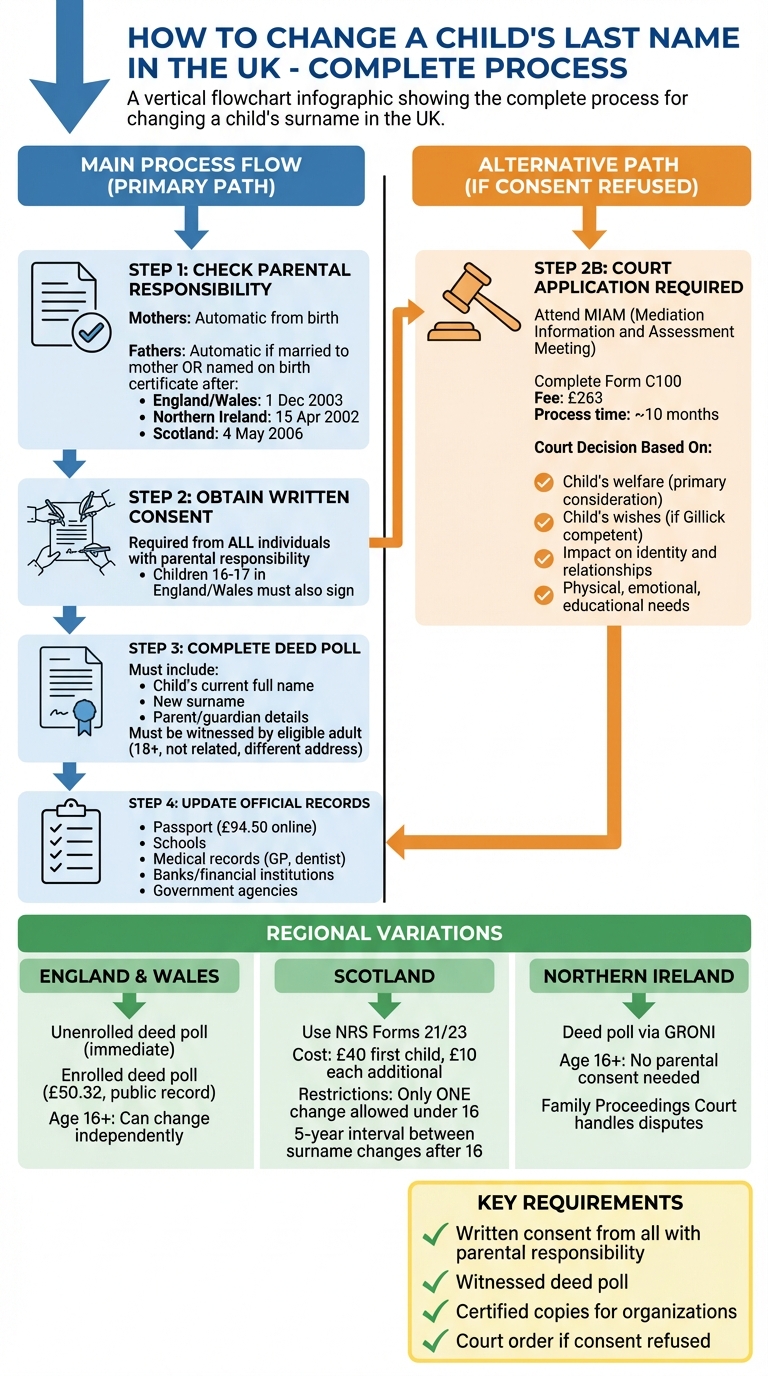
Step-by-step process for changing a child's last name in the UK
Legal Requirements for Changing a Child's Last Name
Parental Responsibility and Consent
To change a child’s last name, you must secure written consent from everyone who holds parental responsibility for the child.
In the UK, mothers automatically have parental responsibility from the moment of the child’s birth. Fathers also gain this responsibility automatically if they were married to the child’s mother at the time of birth. In Scotland, this applies if they were married at the time of conception. For unmarried fathers, parental responsibility is automatically granted if they are named on the child’s birth certificate, provided the child was born on or after:
- 1 December 2003 in England and Wales
- 15 April 2002 in Northern Ireland
- 4 May 2006 in Scotland
Unmarried fathers not listed on the birth certificate can still obtain parental responsibility through a court order, a formal agreement with the mother, or by being appointed as a guardian. Step-parents and other guardians may also gain this responsibility via similar legal processes.
For children aged 16 or older in England and Wales, the rules differ slightly. They can legally change their name without needing parental permission. However, those aged 16 or 17 must personally sign the deed poll to confirm their agreement.
If obtaining consent from all parties proves impossible, you will need to explore legal alternatives.
When a Court Order Is Required
When one or more individuals with parental responsibility refuse to give consent, you must apply to the Family Court for a Specific Issue Order under the Children Act 1989. Without this order, the name change cannot proceed.
There are some exceptions to the consent requirement. For instance, if you can demonstrate that you’ve made reasonable but unsuccessful attempts to locate an absent parent, you may be allowed to proceed without their consent. Seeking legal advice is strongly recommended in such cases. Additionally, if DNA testing reveals that the legal father is not the biological father, his consent may not be necessary.
The court will always base its decision on what is in the best interests and welfare of the child. Before filing an application with the court, you will usually need to attend a Mediation Information and Assessment Meeting (MIAM) with a certified family mediator. However, there are exemptions to this requirement, such as cases involving domestic abuse.
How to Change a Child's Last Name Using a Deed Poll
What Is a Deed Poll?
A deed poll is a formal legal document used to confirm a change to a child's name. Unlike a birth certificate - which serves as a historical record and cannot be altered - a deed poll provides the legal proof required to update official records with the child's new surname.
This document includes three main declarations:
- The former name will no longer be used
- The new name will be used exclusively
- Others are required to address the child by their new name
Once you understand what a deed poll is, the next step is to complete it in line with legal guidelines.
Steps for Completing a Deed Poll
Start by obtaining written consent from all parents or guardians with parental responsibility. Then, prepare the deed poll document, ensuring it includes the child's current full name, the new surname, and the details of the parent or guardian initiating the change.
The document must be signed by the parent(s) with parental responsibility and witnessed by an appropriate individual. The witness must meet specific criteria: they must be over 18 years old, proficient in English, known to you (but not related), and living at a different address. In England and Wales, if the child is aged 16 or 17, they must also sign the deed poll using both their old and new names to confirm their agreement.
Once the deed poll is signed, notify relevant organisations - such as the Passport Office, DVLA, schools, the NHS, and banks - to update their records. It's a good idea to obtain several certified copies of the deed poll, as many organisations will require either the original document or an officially certified copy. In some cases, you may also need to provide a separate letter of consent.
To streamline the process, services like Name Change offer an online form to create your deed poll. Their packages include three certified copies, tracked delivery, and PDF archiving. These documents are guaranteed to be accepted by UK government departments and organisations, eliminating the need for solicitors. Prices start at £16.95 for printed documents with an ink stamp, while a premium option with a gold embossed stamp is available for £24.95.
Changing a Child's Last Name Through the Courts
If you can’t get consent through a deed poll, the Family Court provides another option. When one parent refuses to agree, you’ll need to apply for a Specific Issue Order under the Children Act 1989. This legal step allows the court to decide whether the name change is in the child’s best interests.
Steps to Apply for a Court Order
The first step is attending a Mediation Information and Assessment Meeting (MIAM) unless you qualify for an exemption. Some applicants may also be eligible for a voucher of up to £500 to help cover mediation costs.
Next, you’ll need to fill out Form C100, which can be completed online or sent by post. Once completed, submit the original form along with three copies to your local family court. The application fee is £263, but if you’re receiving benefits or have a low income, you might qualify for help with these fees. The entire process generally takes about 10 months.
If hiring a legal adviser isn’t an option due to financial reasons, organisations like AdviceNow, Support Through Court, or Citizens Advice can provide guidance to help you navigate the family court system.
Once your application is submitted, the court will evaluate several factors to decide what’s best for the child.
Factors Considered by the Court
The court’s main priority is always the child’s welfare. To make its decision, the judge refers to the welfare checklist outlined in the Children Act 1989. This checklist examines various aspects, including the child’s wishes, their physical, emotional, and educational needs, and how a name change might affect their circumstances.
Other considerations include how long the child has used their current surname and the potential impact on their sense of identity or relationship with the other parent. The court will also look at the reasons behind the proposed change. For older children who are considered mature enough - often referred to as "Gillick competent" - their personal preferences may carry significant weight in the decision.
If your proposal is to double-barrel the surname by combining both parents’ last names, your chances of approval may improve. This approach helps preserve the child’s connection to both parents. The court will also take into account the stability of any new family relationships, especially if the name change involves adopting a step-parent’s surname.
sbb-itb-bf1bef6
How to Change a Child's Last Name in Each UK Jurisdiction
While the basic principles of parental responsibility and consent are consistent across the UK, each jurisdiction has its own specific process for officially recording a child's name change. Knowing these differences can help you navigate the system more smoothly. Here's a breakdown of the procedures in each region.
England and Wales
In England and Wales, there are two main ways to change a child's name, both involving a deed poll.
- Unenrolled deed poll: This is a simple option that doesn't require official registration. You can arrange it through a solicitor or a specialist agency. Once signed by all individuals with parental responsibility, the name change takes effect immediately.
- Enrolled deed poll: For £50.32, you can enrol the deed poll with the High Court, making the name change part of the public record in The Gazette. To do this, you'll need to complete forms LOC022, LOC023, LOC024, and LOC028, which are available online or by post.
For children aged 16 or 17, a letter of agreement must be included with the application. At this age, they also have the option to create their own unenrolled deed poll without needing parental involvement.
Scotland
Scotland uses a different system managed by the National Records of Scotland (NRS). While it's not legally required to officially record a name change, doing so updates the birth or adoption certificate, which many organisations may ask for as proof.
- For children under 12 months, use Form 21 to change a forename and Form 23 to change a surname.
- For children between 12 months and under 16 years, Form 23 is used for both forename and surname changes.
Applications must be sent by post, and the cost is £40 for the first family member, with an extra £10 per additional child if applying for multiple children at the same time. A new birth certificate costs £15, or you can request both full and abbreviated certificates together for £25.
Scotland also has restrictions on how often names can be changed. For children under 16, both forenames and surnames can only be changed once. After turning 16, they can apply independently, but are limited to one forename change and three surname changes, with a five-year interval required between surname changes. These changes are recorded in a public register accessible to anyone.
Northern Ireland
In Northern Ireland, changing a child's name typically involves a deed poll, with the process overseen by the General Register Office for Northern Ireland (GRONI) for birth registrations. If there are disagreements over consent, the Family Proceedings Court handles such disputes.
Once a child turns 16, they can apply to change their name without needing parental consent. If full consent from all individuals with parental responsibility cannot be obtained, it's advisable to seek independent legal advice before proceeding. In cases of unresolved consent issues, applying to the court for an order is often the safest approach.
What to Do After Changing a Child's Last Name
Once the deed poll is witnessed, the name change becomes legally binding. The next step is to update all official records so your child's new surname is recognised wherever necessary.
Updating Official Records
Start with the most critical documents. If your child has a passport or needs one, you'll need to apply for a new one. A child's passport costs £94.50 online or £107 with a paper application. Keep in mind that the current passport will be cancelled, and any remaining validity won't carry over. If the passport includes an unexpired visa, check with the issuing embassy or consulate, as the visa may no longer be valid.
When applying for a new passport, you'll need to submit the original deed poll or a certified copy, along with a consent letter from everyone with parental responsibility. For additional support, you can call the Identity and Passport Service Adviceline at 0300 222 0000. Ensure the name on your child’s passport matches the name used for booking travel to avoid complications with airlines or border checks.
Next, inform your child's school or educational institution to update their records. Notify your child's GP and dentist so their medical records reflect the new name. If your child has bank accounts, savings accounts, or Junior ISAs, contact the relevant financial institutions. Additionally, update government agencies like HMRC or the Department for Work and Pensions if your child is linked to any benefits or tax credits, and ensure insurance records are updated too.
Most organisations will require proof of the name change, so it's wise to obtain several certified copies of the deed poll, as photocopies may not be accepted. Confirm the specific documents needed by contacting each institution directly. Once these updates are made, you may still need to address situations where older documents show the previous surname.
Handling Common Issues
Even after updating records, you might run into temporary discrepancies where some documents still display the old surname. Keep the original deed poll or certified copies handy to provide proof when needed. If an organisation refuses to accept the deed poll, remind them it is a valid legal document recognised by all UK government departments and organisations. For additional reassurance, particularly in England and Wales, you could have the deed poll enrolled with the Royal Courts of Justice. This process includes publishing the name change in The Gazette and offers a more widely recognised form of evidence.
Conclusion
This guide has walked you through the legal steps and practical considerations for changing a child's surname in the UK. While the process requires careful adherence to legal requirements, it becomes manageable when you understand the rules. If consent from all parties isn't possible, a court order will be necessary, with decisions always prioritising the child's best interests.
Ensuring you follow the correct legal process is crucial for acceptance by official bodies. Skipping steps or lacking proper documentation can lead to unnecessary delays. Once the deed poll is complete, make sure to update key records like passports, school enrolments, and medical files. Keeping certified copies on hand will save time and effort when proof is needed.
Whether the name change follows a marriage, divorce, or other personal reasons, the legal framework is designed to protect your child's welfare while balancing parental rights. For a secure and widely recognised deed poll, consider using the Name Change service. By taking these steps, you can ensure the process is smooth, legally valid, and in your child's best interests.
FAQs
What can I do if the other parent doesn’t agree to changing my child’s last name?
If the other parent with parental responsibility doesn’t agree to a name change, it’s worth trying to settle the issue amicably first. You could start by discussing your reasons directly with them, bring in a neutral family mediator, or even seek guidance from a Citizens Advice service. Since changing a child’s name by deed poll usually requires the consent of both parents with parental responsibility, finding common ground can save you from potential legal hurdles.
When reaching an agreement proves impossible, you have the option to apply to the family court for a formal name-change order. The court’s decision will focus on what’s best for the child, considering factors like their welfare, the parental relationship, and whether the change would positively impact the child. If the court approves the order, it effectively overrides the other parent’s lack of consent, enabling you to move forward with the name change. With the court order in hand, you can proceed to use a deed poll to update important records, such as passports, NHS details, and school documents.
How do the rules for changing a child's last name vary across the UK?
The process for changing a child's last name varies across the UK, depending on where you live.
In England and Wales, a parent or anyone with parental responsibility can change a child’s surname through a deed poll. However, this requires written consent from everyone with parental responsibility. Once completed, the deed poll is generally accepted by schools, the NHS, and passport offices.
In Scotland and Northern Ireland, the procedure is different, and deed polls may not always be applicable. Each region has its own specific rules, so it’s crucial to check with your local register office or seek advice from a solicitor who understands the regulations in your area.
Because requirements for documents and consent can differ, it’s essential to follow the correct process for your region to ensure the name change is legally valid and recognised by UK government bodies and organisations.
What are the steps to update official records after changing a child’s surname in the UK?
To update official records after legally changing a child’s surname in the UK, here’s what you need to do:
- Get written consent: Everyone with parental responsibility must agree to the name change in writing before moving forward. This step is essential.
- Select the legal method: Most people use a deed poll for this process, as it’s widely accepted for official updates like passports and school records.
- Prepare the paperwork: Fill out the necessary documents, making sure the new surname is clearly stated. These documents need to be properly witnessed, and you might also need a certified copy of the child’s full birth certificate.
- Notify organisations: Provide organisations such as HM Passport Office, the NHS, and schools with a certified copy of the deed poll or updated birth certificate. This ensures the new name is recorded on essential documents like passports and medical records.
- Store documents securely: Keep the original deed poll and updated birth certificate in a safe place for future use.
Following these steps will ensure the child’s new surname is properly recognised by all relevant institutions in the UK.