Deed Poll for Divorce Name Change: What to Know
Changing your name after a divorce in the UK often involves using a deed poll, a legal document that confirms your new name. While some organisations accept a marriage certificate or decree absolute to revert to a maiden name, a deed poll is required if you choose a different name, lack these documents, or face organisations that don’t accept divorce papers. It’s also useful if you want to change your name before the divorce is finalised.
There are two types of deed polls: unenrolled (private and quicker to obtain) and enrolled (officially registered with the Royal Courts of Justice). Both are legally valid but differ in cost, public record status, and acceptance by certain organisations. Once you’ve completed your deed poll, you’ll need to update key documents, such as your passport, driving licence, and bank accounts.
For those seeking convenience, services like Name Change offer pre-drafted deed polls with certified copies and guides for £16.95, saving time and effort compared to creating one independently or enrolling through the High Court (£53.05). Whether you’re reclaiming your maiden name or choosing something new, a deed poll ensures your name change is recognised legally and across all records.
How Deed Polls Work for Name Changes After Divorce
What is a Deed Poll?
A deed poll is a legal document that confirms you've officially adopted a new name for all purposes across the UK. It acts as a formal declaration, committing you to using your new name in every aspect of your life, from government records to everyday transactions.
"A Deed Poll document serves as evidence... it is a legal and official document that binds a single party to a particular course of action." - DeedPoll.com
For a deed poll to be valid, it must be signed in the presence of an independent witness who is at least 18 years old and not related to you. Once signed, the document becomes legally recognised and can be used as proof of your name change with UK organisations.
Now, let’s look at why a deed poll is particularly helpful after a divorce.
Reasons to Use a Deed Poll After Divorce
A deed poll offers several benefits when changing your name post-divorce. While traditional documents like a marriage certificate or decree absolute may be sufficient for some organisations, others - especially banks and building societies - often require a deed poll as additional proof. This is especially true if you encounter institutions that are reluctant to accept divorce papers alone.
If you want to adopt a completely new name - something other than your birth or maiden name - a deed poll is essential. It’s also a practical solution if you’ve misplaced your original marriage certificate or decree absolute, as obtaining a deed poll is often faster and more affordable than replacing those documents.
One of the key advantages of a deed poll is the flexibility it offers. You don’t need to wait for your divorce to be finalised; you can change your name before the decree absolute is issued. This can provide a sense of closure and help you move forward emotionally, even while legal proceedings are still underway.
Unenrolled vs Enrolled Deed Polls: What's the Difference?
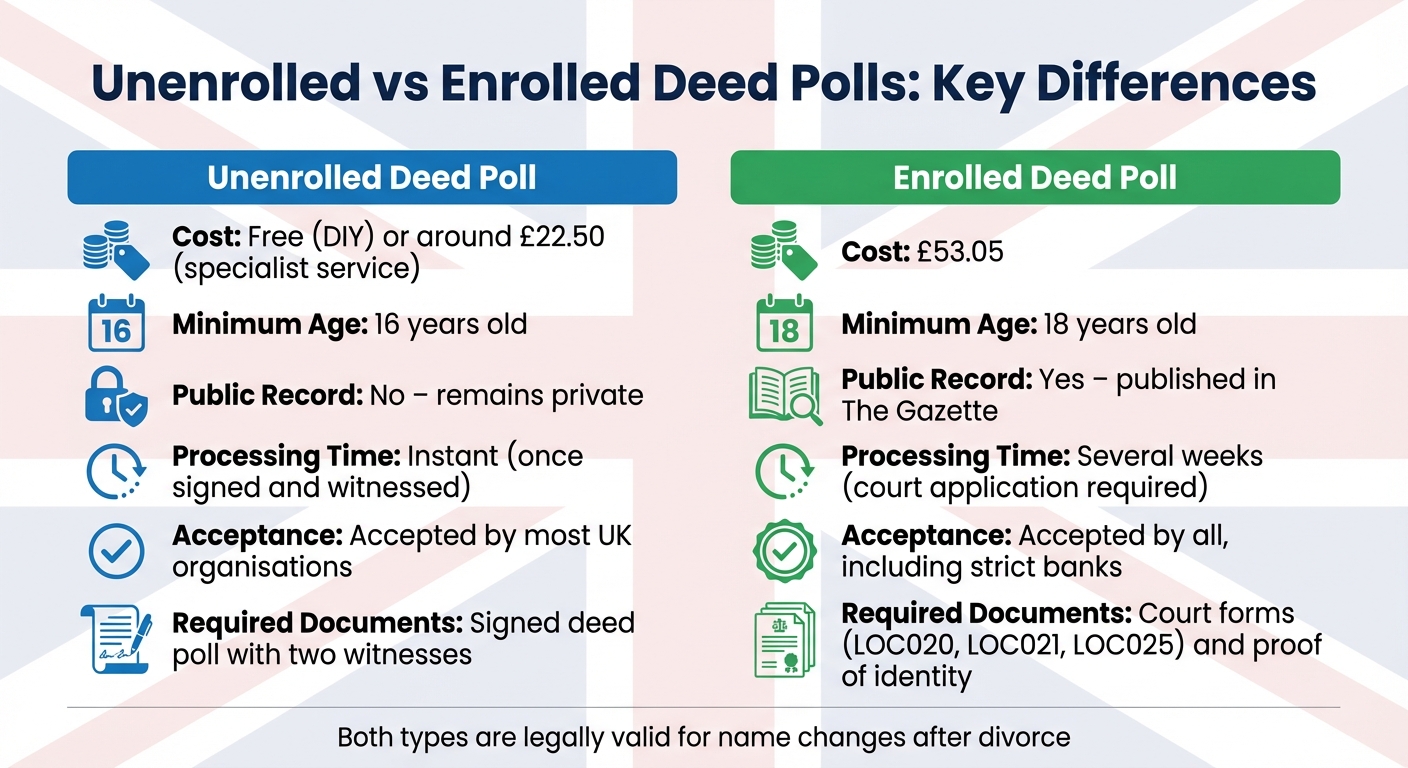
Unenrolled vs Enrolled Deed Poll Comparison UK
After divorce, using a deed poll after divorce can be an important step in reclaiming your identity. But before you proceed, it’s essential to understand the two types available: unenrolled and enrolled deed polls. While both are legally valid for changing your name, they differ in cost, privacy, and how widely they’re accepted by organisations.
An unenrolled deed poll is a private document. You can create one yourself or use a specialist service. It’s available from the age of 16 and doesn’t appear on any public register. Most organisations in the UK, including HM Passport Office and the DVLA, accept unenrolled deed polls without any issues.
On the other hand, an enrolled deed poll is officially registered with the Royal Courts of Justice. This makes your name change a part of the public record, as it’s published in The Gazette. You need to be at least 18 to enrol a deed poll, and the process can take several weeks.
"Some organisations (such as some banks, mobile phone companies or energy providers) may only accept an enrolled deed poll to change your name on their records." - GOV.UK
Before making your decision, it’s a good idea to check with your bank and utility providers to see what they require. While most accept unenrolled deed polls, certain financial institutions may insist on the enrolled version.
Comparison Table: Unenrolled vs Enrolled Deed Polls
Here’s a quick breakdown of the main differences:
| Feature | Unenrolled Deed Poll | Enrolled Deed Poll |
|---|---|---|
| Cost | Free (DIY) or around £16.95 (specialist service) | £53.05 |
| Minimum Age | 16 years old | 18 years old |
| Public Record | No – remains private | Yes – published in The Gazette |
| Processing Time | Instant (once signed and witnessed) | Several weeks (court application required) |
| Acceptance | Accepted by most UK organisations | Accepted by all, including strict banks |
| Required Documents | Signed deed poll with two witnesses | Court forms (LOC020, LOC021, LOC025) and proof of identity |
Understanding these differences will help you choose the option that best suits your needs while ensuring your name change is recognised where it matters.
How to Create an Unenrolled Deed Poll: Step-by-Step
Creating an unenrolled deed poll is a simple process, but it’s important to get it right to ensure organisations accept it. The process involves three main steps: drafting the document with the correct legal wording, having it properly witnessed, and distributing it to the relevant organisations to update your records.
Completing the Deed Poll Document
To be valid, your deed poll must include specific legal wording. It should clearly state that you are renouncing your old name and adopting a new one for all purposes.
Ensure the document includes your full address, the date, and spaces for your old and new signatures. It’s a good idea to print multiple original copies for distribution to organisations that need to update your records. The next step is to have your deed poll witnessed.
Getting Your Deed Poll Witnessed
Sign and date your deed poll in the presence of two independent witnesses. This step is crucial - your witnesses must be present when you sign the document. They cannot sign it before or after you do.
Witnesses must be independent adults aged 18 or over. They should not be related to you, living with you, or in a relationship with you. Each witness must sign the deed poll and provide their full name and address. While a solicitor can act as a witness, it’s not necessary; any independent adult who meets the criteria will suffice. Once the document is signed and witnessed, it’s ready to be distributed.
Distributing and Using Your Deed Poll
Your signed and witnessed deed poll is your proof of a name change until organisations update their records.
Start by updating essential documents like your driving licence and passport, as these must legally reflect your new name. The DVLA processes name changes for free, while the HM Passport Office can be contacted on 0300 222 0000 or by post at PO Box 767, Southport, PR8 9PW.
When submitting your deed poll to organisations, include a covering letter instructing them to update their records. Some banks may require you to visit a branch in person with your original deed poll and valid ID. For other institutions, such as financial or utility providers, it’s best to contact them directly to confirm their requirements for accepting an unenrolled deed poll.
sbb-itb-bf1bef6
Updating Your Official Documents After Changing Your Name
Once you've formalised your name change through a deed poll, the next step is to update all your official records. This isn't just a practical matter - it’s a legal requirement for documents like your driving licence and passport. It’s also important to ensure your bank, utility, and healthcare accounts reflect your new name.
Government-Issued ID
Start by updating your passport and driving licence, as these are your primary forms of legal identification. To update your passport, you’ll need to submit a new application along with your original deed poll and proof of your current name, such as a payslip or a council letter. The cost for a standard adult passport is £93. For your driving licence, fill out form D1 and send it to the DVLA with your current licence and original deed poll. This service is free unless you’re adding a new photograph.
Don’t forget to notify HMRC to update your Income Tax and National Insurance records. You’ll also need to contact your local council to update the electoral roll and your Council Tax details. If you own property, inform the Land Registry to amend the title deeds. Additionally, notify your GP and dentist, as your GP will usually update your central NHS records.
Once these key updates are done, you can move on to your financial and utility accounts.
Bank Accounts and Utility Bills
Updating your bank accounts and utility bills comes next. Most banks require you to visit a branch in person with your original deed poll and identification. To avoid any hassle, it’s a good idea to call your bank ahead of time to confirm the documents they need. Whether you used an enrolled or unenrolled deed poll may also affect their requirements.
For utility providers, mobile phone companies, and credit card issuers, contact their customer service departments to check what documentation they accept. Typically, they will process name changes if you send a copy of your deed poll by email or post, along with a covering letter requesting the update. Be sure to keep a record of all correspondence and follow up if you haven’t received confirmation within a few weeks.
How Name Change Makes the Process Easier

Once you've updated your records, tackling the remaining administrative tasks can feel daunting. Changing your name after a divorce involves plenty of paperwork, witnesses, and updating official records. But it doesn’t have to be a headache. That’s where Name Change steps in, offering a simple way to create a legally recognised unenrolled deed poll - without the need for solicitors or hefty court fees.
What Name Change Offers
Name Change takes care of the legal requirements for your unenrolled deed poll, ensuring it meets the strict standards set by UK government departments like HM Passport Office, the DVLA, and HMRC. With the service, you’ll receive three certified copies of your deed poll. These are crucial since most banks and financial institutions insist on original "wet-signed" documents rather than photocopies. To make things even easier, the service includes a secure storage folder, clear instructions for signing and witnessing, and a comprehensive name change checklist to help you notify all the necessary organisations.
Another standout feature is the PDF archiving service, which keeps a digital copy of your deed poll safe for life. If you misplace your original documents - whether during a house move or while updating accounts - you can quickly access a replacement. The service also provides pre-written covering letters, ready to send to banks, utility providers, and other organisations holding your records.
Additionally, Name Change supports title updates, such as switching from Mrs to Ms or Miss. The standard service includes tracked delivery across the UK, while a premium option adds a touch of sophistication with a gold embossed stamp.
These features work together to streamline your name change process, offering peace of mind as you update your details across various institutions.
Pricing and Service Options
Name Change offers two clear pricing plans to fit different needs and budgets:
| Plan Name | Price | What's Included |
|---|---|---|
| Printed & Posted | £16.95 | 3 certified copies, ink stamp, board-backed envelope, guide, PDF archive, tracked delivery |
| Printed & Posted Premium | £24.95 | 3 certified copies, gold embossed stamp, board-backed envelope, guide, PDF archive, tracked delivery |
Both plans offer a budget-friendly alternative to High Court enrolled deed polls, which cost £53.05. With Name Change, your information stays private and secure, and you can begin updating your records as soon as your documents arrive - usually just a few days after placing your order.
Conclusion
Changing your name after a divorce doesn’t have to feel like an uphill battle. A deed poll serves as legally recognised proof that you’ve let go of your old name and adopted a new one, ensuring it’s accepted by all UK government departments and private organisations. Whether you’re returning to your maiden name, opting for something entirely new, or making the change during a separation rather than waiting for the decree absolute, a deed poll provides the legal clarity you need.
The process involves drafting, signing, and witnessing the deed poll, followed by notifying relevant institutions. Start with your passport and driving licence, as these must reflect your current name and often act as key documents for updating other records.
While you can create a deed poll yourself, many find professional services make the process far smoother. For instance, Name Change offers a convenient package for £16.95, which includes three certified copies, tracked delivery, PDF archiving, and clear instructions tailored to meet the requirements of HM Passport Office, DVLA, and financial institutions. This is a more cost-effective option compared to the £53.05 fee for an enrolled deed poll through the High Court.
FAQs
What’s the difference between an unenrolled and an enrolled deed poll?
An unenrolled deed poll is a private document you can create yourself once you're 16 or older. You can start using it immediately, and while it’s not added to any public record, it’s still legally valid for changing your name.
An enrolled deed poll, however, is officially registered with the High Court and is available for those aged 18 and above. This type is added to the public record and comes with a fee of about £50.32. People often opt for this option when a higher level of formality is needed or if specific organisations require it.
Can I change my name before my divorce is finalised in the UK?
Yes, you can change your name before your divorce is finalised by using a deed poll. However, until the divorce is officially complete with the decree absolute, you might still need to list your marital status as 'married' on some official documents.
A deed poll is a legally binding document that enables you to update your name across records and identification. To avoid any issues, it’s essential that your deed poll is properly prepared so it will be accepted by UK government departments and other organisations.
What documents are needed to update my records after changing my name with a deed poll?
To update your records after a name change using a deed poll, you'll usually need to present your original signed deed poll. Depending on the situation, additional documents might be required, such as your marriage certificate (if relevant) or a photo ID like a passport or driving licence.
These documents are commonly needed when informing organisations like your bank, HMRC, the Passport Office, the DVLA, and other institutions. It's always a good idea to check the exact requirements of each organisation to ensure the process goes as smoothly as possible.