Can You Change a Child's Name Without Consent?
In the UK, changing a child's name requires written consent from everyone with Parental Responsibility (PR). If even one PR holder disagrees, the name change cannot proceed without a court's approval. Courts only allow a name change if it is determined to be in the child's best interests.
Key points:
- Consent is mandatory from all PR holders for children under 16 in England, Wales, and Northern Ireland.
- If consent cannot be obtained, you must apply for a Specific Issue Order (£263 fee).
- Exceptions: If only one parent has PR, they can change the name without needing consent from the other parent.
- In Scotland, disagreements may not prevent a name change, but consultation with all PR holders is still required.
The process involves using a deed poll to formalise the change once consent is secured. For disputes, courts prioritise the child's welfare and consider factors like emotional impact, family connections, and the child’s preferences (if age-appropriate). From age 16, children in most UK regions can change their name independently.
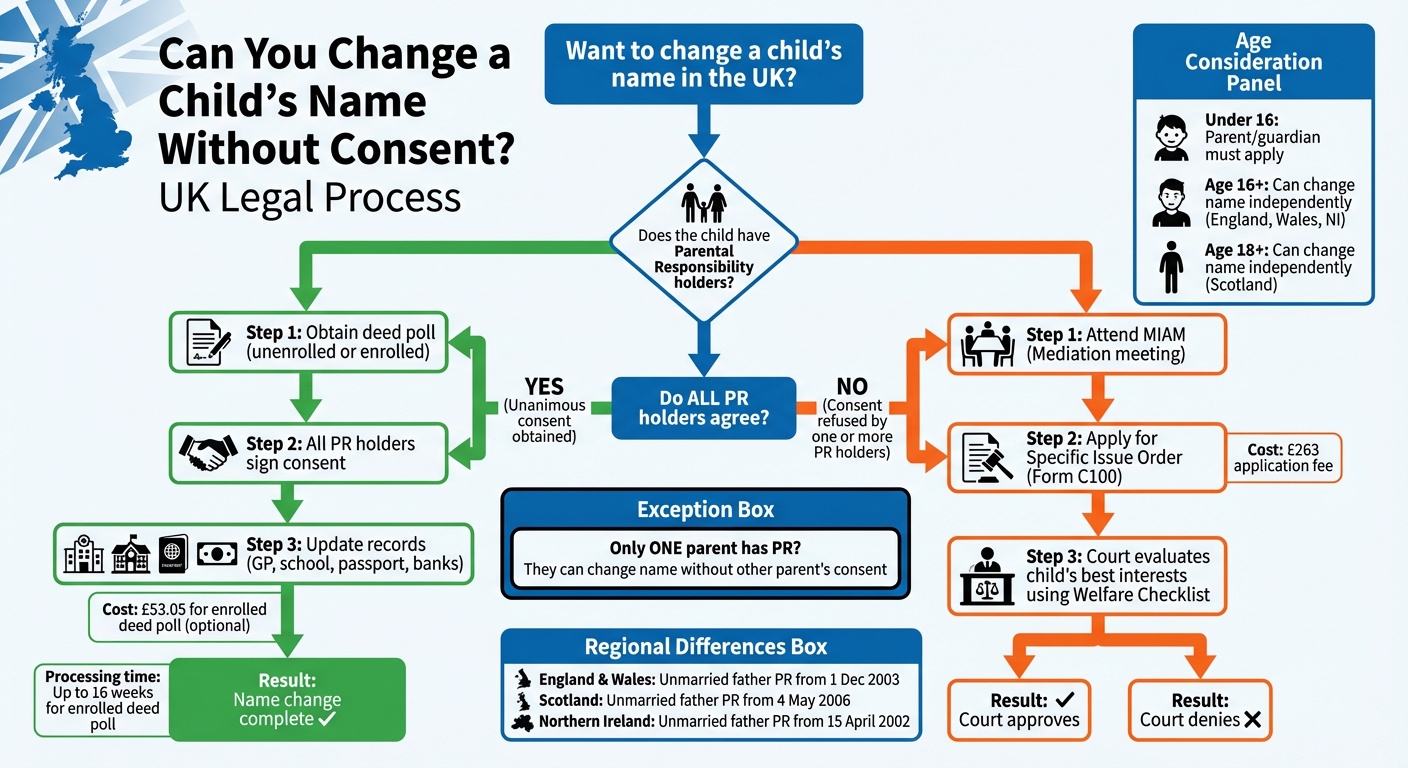
UK Child Name Change Process: Consent Requirements and Legal Steps
Can You Change a Child's Name Without Consent?
In England, Wales, and Northern Ireland, you cannot legally change a child's name without written consent from everyone with parental responsibility (PR). If even one PR holder refuses, the name change cannot proceed via deed poll. In such cases, the only option is to involve the courts.
If unanimous consent isn't possible, a family court can issue a Specific Issue Order, which costs £263 to apply for. This order allows the name change only if the court determines it is in the child's best interests, overriding the need for full agreement.
An exception exists when only one parent holds PR. In this case, they can change the child's name without needing permission from the other parent who lacks PR. However, seeking legal advice is often a wise step to avoid potential disputes later.
In Scotland, the rules are slightly different. While consultations with all PR holders are required, a name change can still proceed even if there is disagreement. This highlights why courts demand compelling evidence when considering changes to a child's surname.
Courts are generally reluctant to approve surname changes. A child's surname is seen as an important part of their identity and connection to their family history. Strong justification is needed to make such a change. As HM Passport Office explains:
The change of a child's surname is fundamental and in any situation of dispute, where both parents have parental responsibility, either the consent of both parents or a court order is necessary.
sbb-itb-bf1bef6
When Consent Is Required
Under the Children Act 1989, a single parent cannot change a child's name without agreement. Parental responsibility (PR) encompasses all the rights, duties, powers, and authority a parent holds concerning their child. While parents can act independently on everyday matters, a name change is considered one of the "few key decisions" that demand the consent of everyone with PR. This rule ensures that such significant decisions prioritise the child's welfare.
As Lord Fraser explained in the House of Lords:
Parental rights to control a child do not exist for the benefit of the parent. They exist for the benefit of the child and they are justified only in so far as they enable the parent to perform his duties towards the child.
This principle applies to both first names and surnames, though courts are generally more lenient with first name changes. A surname change, however, is often seen as more impactful, as it can symbolise a deep connection to an absent parent and is central to a child's sense of identity.
Who Holds Parental Responsibility?
Knowing who holds PR is essential in understanding whose consent is required for a name change.
Mothers automatically have PR from the moment of the child's birth. For fathers, the situation varies depending on their marital status and the child’s birth registration details.
- Married fathers automatically hold PR if they were married to the mother at the time of the child's birth or conception.
- Unmarried fathers have PR if they are named on the birth certificate and the birth was registered after the following dates:
| Region | Unmarried Father PR Start Date |
|---|---|
| England & Wales | 1st December 2003 |
| Scotland | 4th May 2006 |
| Northern Ireland | 15th April 2002 |
Unmarried fathers not listed on the birth certificate, or whose children were born before these dates, do not automatically have PR. They can obtain it through marriage to the mother, jointly re-registering the birth, signing a formal PR agreement, or applying for a court order.
Adoptive parents gain PR through adoption. Similarly, legal guardians appointed by a court or named in a will hold PR. Step-parents, however, do not acquire PR automatically through marriage and must apply for it separately.
Before moving forward with a name change, it is vital to confirm who holds PR to ensure the process complies with legal requirements.
Why Consent Is Necessary
The consent process safeguards children from unilateral decisions that could negatively affect their welfare or identity. Official organisations require written consent from all PR holders before updating any records, guaranteeing that both parents have an equal say in matters that shape their child's future.
If you're considering a name change, and want to change your name by deed poll, check the child's birth certificate for PR details. Pay attention to the date of registration and whether both parents are listed. Additionally, any existing court orders, such as Child Arrangement Orders, may influence who holds PR. Without unanimous written consent, the only way to proceed is by applying to the family court.
How to Change a Child's Name With Consent
When all parties with parental responsibility agree, changing a child's name in the UK is a relatively straightforward process. This involves using a deed poll to legally effect the change and then updating official records to reflect the new name. However, this simplicity relies on unanimous consent - without it, court involvement becomes necessary.
Using a Deed Poll for Name Changes
In the UK, a deed poll is the primary legal document for changing a child’s name. There are two types: unenrolled and enrolled. Most families opt for the unenrolled version, which is widely accepted by organisations such as HM Passport Office, schools, and the NHS. You can obtain this through a solicitor or a specialist agency.
Certain financial institutions, however, may insist on an enrolled deed poll, which is registered with the High Court. This version is published in The Gazette and incurs a fee of £53.05, with processing times of up to 16 weeks. It’s wise to check with your bank or insurer beforehand to determine which type they require to avoid unnecessary delays.
For children aged 16 or 17, an additional step is needed: the child must provide a witnessed letter of consent. This letter must be signed in front of an independent adult (someone over 18 who is not a family member). Additionally, all individuals with parental responsibility must give written consent. These consent letters should be kept with the deed poll, as organisations like HM Passport Office often request both documents.
To ensure the deed poll is correctly prepared and widely accepted, services like Name Change offer assistance. They provide certified copies, PDF archiving, and tracked delivery, making the process smoother and helping you maintain secure records of this critical document.
Updating Organisations and Records
Once the name change is legally formalised, the next step is to update relevant records. Begin with the GP surgery and school, as these updates help establish the new name’s official use - something HM Passport Office requires before issuing a passport in the updated name.
| Organisation Type | Records to Update |
|---|---|
| Government | HM Passport Office, HMRC (Child Benefit), DWP |
| Health | GP Surgery, Dentist, Hospital records |
| Education | Schools, Nurseries, Colleges |
| Financial | Banks, Building Societies, Savings accounts |
Keep the original deed poll or a certified copy, along with the child’s birth certificate, as these documents are often required to verify both the original and new names. Most organisations will not accept photocopies, so having certified copies on hand is essential.
It’s also worth noting that a child’s first name can only be changed on their birth certificate within the first 12 months after registration. After this period, the deed poll serves as the permanent legal proof of the name change.
How to Change a Child's Name Without Consent
If all parties with Parental Responsibility (PR) cannot agree on changing a child’s name, the matter must be resolved in court through a Specific Issue Order under Section 8 of the Children Act 1989. This ensures that any decision prioritises the child’s welfare and adheres to established legal principles. As Lord Mackay remarked in the House of Lords:
"The name of a child is not a trivial matter but an important matter, and is not a question to be resolved without regard to the child's welfare."
Applying for a Specific Issue Order
When court involvement becomes necessary, the process begins by attending a Mediation Information Assessment Meeting (MIAM). This step is required to explore whether the issue can be resolved outside of court. However, exemptions apply in cases involving domestic abuse or urgent safeguarding concerns.
To proceed, you will need to complete Form C100, which can be submitted online or to your local family court. A standard fee is required, but financial assistance may be available if you meet specific income criteria or receive certain benefits. If domestic abuse or safety concerns are relevant, you should also complete Form C1A and submit Form C8 to ensure confidentiality.
If there is an existing Child Arrangements Order, Residence Order, or Special Guardianship Order, you may need to file a free-standing application under Section 13 or 14C instead of a standard Specific Issue Order. Reviewing current court orders is essential before moving forward.
How Courts Decide: Best Interests of the Child
The court’s primary focus is always the child’s welfare. This applies whether you are seeking to change a first name or a surname. Decisions are guided by the "Welfare Checklist" outlined in Section 1 of the Children Act 1989. This checklist considers several factors, including the child’s wishes, emotional and physical needs, and the potential impact of the name change.
| Factor | What the Court Considers |
|---|---|
| Wishes and Feelings | The child’s views, taking into account their age and maturity. |
| Needs | The child’s physical, emotional, and educational requirements. |
| Effect of Change | How the name change might influence the child’s circumstances and relationships. |
| Harm | Any harm the child has experienced or could potentially face. |
| Parental Capability | The ability of each parent to meet the child’s needs effectively. |
The court operates under the "no order principle", meaning an order will only be issued if it is clearly better for the child than making no order at all. As stated in Section 1 of the Children Act 1989:
"The court shall not make the order... unless it considers that doing so would be better for the child than making no order at all."
Applications rooted in adult convenience, such as a desire to distance the child from the other parent, are unlikely to succeed. On the other hand, proposals that aim to integrate the child into a blended family or align their surname with siblings are often viewed more favourably. Courts also tend to support double-barrelled surnames, as they maintain a connection to both parents.
During the process, a Cafcass social worker will likely interview you and provide an independent recommendation focused on the child’s welfare. Be prepared to present clear evidence demonstrating how the name change would benefit the child.
Age Considerations for Name Changes
Age is a key factor in deciding who has the legal authority to change a child's name and how much consideration is given to the child's own preferences. This ties into how parental consent and court involvement vary depending on the child's age.
Legal Age to Change a Name Independently
In England, Wales, and Northern Ireland, young people gain the legal right to change their name independently at 16. In Scotland, however, this threshold is 18. For 16- and 17-year-olds in England, Wales, and Northern Ireland, parental objections generally carry little weight unless a court order - such as a Care Order or Child Arrangements Order - specifically restricts the change until they turn 18.
When using an enrolled deed poll for 16- or 17-year-olds, the application must include a signed and witnessed letter from the young person confirming their consent. The enrolment process costs £53.05 and may take up to 16 weeks to complete. These regulations reflect the process of legally changing your name and the growing importance of personal autonomy as children approach adulthood.
Younger Children's Views and Gillick Competence
For children under 16, a parent or guardian must apply for a name change on their behalf. However, this does not mean their opinions are ignored. Courts take into account the "wishes and feelings" of the child, with greater consideration given to older children, particularly those aged 12 and above. Despite this, the child's best interests remain the primary concern.
The concept of Gillick competence is used to evaluate whether a child under 16 has the maturity and understanding needed to make their own decisions. While a child in this age group cannot legally change their name independently, demonstrating Gillick competence means their views can carry significant weight in the decision-making process.
If a child under 16 strongly advocates for a name change but there is no unanimous parental agreement, the matter must be resolved through a Specific Issue Order. In such cases, the court carefully considers the child’s preferences alongside other welfare factors . Ultimately, while a child’s voice is important, unresolved disputes will still require legal intervention to reach a resolution.
Summary
In the UK, changing a child's name requires the agreement of all parents with parental responsibility. If unanimous consent isn’t achieved, a Specific Issue Order must be sought. Courts will only approve a name change if it is clearly in the child’s best interests, especially when preserving connections to a parent's identity is a factor.
When disagreements occur, mediation is a necessary first step before applying to court. You’ll typically need to attend a Family Mediation Information and Assessment Meeting (MIAM) to demonstrate that you’ve tried to resolve the issue without legal action. This process aims to encourage resolution outside of court wherever possible.
From the age of 16, individuals in England, Wales, and Northern Ireland can legally change their name without parental consent, provided no court order prevents it. If they choose to enrol the name change through the High Court, additional fees may apply.
FAQs
What counts as written consent for a child’s name change?
To change a child’s name, written consent is required from everyone with parental responsibility. This consent needs to be provided in a written format, such as a letter or formal declaration, and must be obtained before applying for a deed poll. Without agreement from all parties involved, the name change cannot go ahead.
What if I can’t contact someone with parental responsibility?
If you can’t get in touch with someone who has parental responsibility, you might need to apply for a court order to move forward with changing the child’s name without their consent. The court will assess the circumstances and make a decision centred on what’s best for the child.
Can I change my child’s name on their passport without the other parent’s consent?
You cannot change your child’s name on their passport without the other parent’s consent unless you have a court order. Since both parents with parental responsibility must usually agree to such changes, any disagreements would need to be resolved through the court.