Parental Consent for Changing a Child's Name
In the UK, changing a child's name requires written consent from all individuals with Parental Responsibility (PR). This legal rule ensures a child's identity and family connections are protected. If consent is withheld, a court order is needed, costing £263. Informal changes (e.g., at schools or GP surgeries) are not officially recognised by organisations like HM Passport Office.
Key points:
- Who has PR? Mothers automatically have PR. Fathers gain it if married to the mother at the child's birth or listed on the birth certificate (after 1 December 2003 in England and Wales). Others with PR include adoptive parents, guardians, or local authorities in specific cases.
- For children under 16: Written consent from all PR holders is mandatory.
- For 16-17-year-olds: They can change their name without consent using an unenrolled deed poll. However, enrolling the deed poll requires consent until 18.
- When one parent refuses: Mediation is required first. If unresolved, a court application (Specific Issue Order) is needed, with decisions based on the child's welfare.
Without proper consent or a court order, official records (e.g., passports) cannot be updated. For a straightforward process, consent letters, a deed poll, and supporting documents (e.g., birth certificates) are essential.
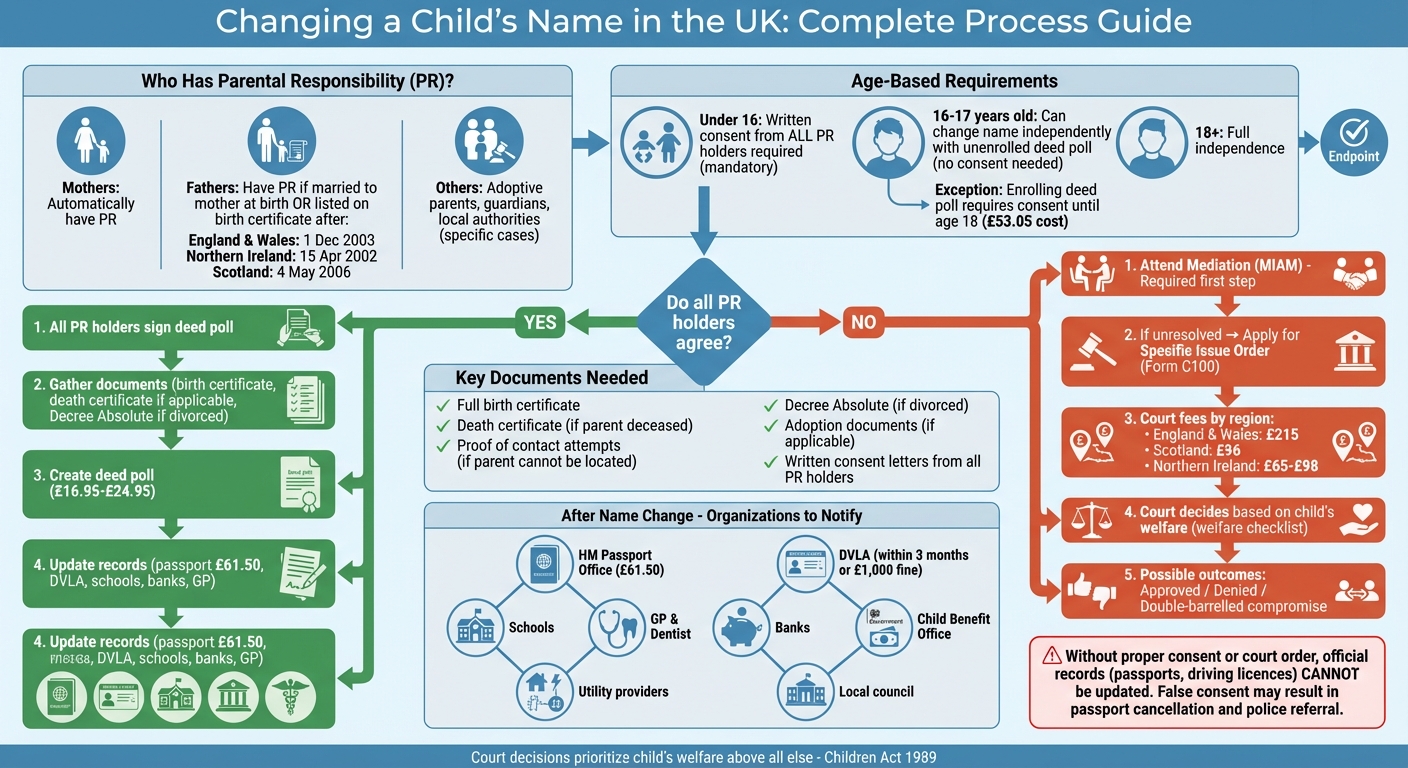
UK Child Name Change Process: Steps, Requirements and Costs
Why UK Law Requires Parental Consent
The Children Act 1989 forms the backbone of the legal framework surrounding parental consent. It introduces Parental Responsibility (PR), granting individuals the authority to make significant decisions about a child's life - such as changing their name. Section 1 of the Act emphasises that the child's welfare is the "paramount consideration" in any court ruling, which is why decisions like name changes are approached with such care. This legal provision ensures that every major decision prioritises the child's best interests.
In the eyes of UK courts, a child's surname is more than just a label; it carries deep personal, familial, and historical significance. Family law solicitor James Thornton explains:
"A child's surname is seen as an important part of their personal, family, and cultural identity. The court will generally be cautious about disrupting the child's existing identity without compelling justification."
This cautious approach not only prioritises the child's welfare but also safeguards their connection to their heritage.
If all parties with PR cannot agree, the matter must be taken to family court. The parent seeking the change must file for a Specific Issue Order under Section 8 of the Children Act 1989. The court will then evaluate the request through the "welfare checklist", which considers various factors, including the child's preferences (based on their age), emotional well-being, and the potential impact of the name change on their overall circumstances.
Understanding Parental Responsibility
Only individuals with Parental Responsibility (PR) have the legal authority to decide on a child's name change. Mothers automatically hold PR, as do fathers if they were married to the mother at the time of the child's birth or conception, or if they are listed on the birth certificate. However, this automatic PR for fathers only applies if the birth was registered after specific dates: 1st December 2003 in England and Wales, 15th April 2002 in Northern Ireland, or 4th May 2006 in Scotland.
Unmarried fathers not listed on the birth certificate can obtain PR by entering into a Parental Responsibility Agreement with the mother or applying for a court order. PR also extends to adoptive parents, legal guardians, individuals with Special Guardianship Orders, and in certain cases, local authorities under Care Orders. Written consent from all PR holders is a legal requirement before a child's name can be changed.
Without this consent, organisations like HM Passport Office, banks, and other official bodies will not update records. If a passport is issued based on false consent, it may be cancelled, and the matter could be referred to the police [16].
These rules remain in effect until the child reaches adulthood.
Name Changes for 16 and 17 Year Olds
When a child turns 16, the legal landscape shifts. At this age, they gain the right to change their own name using an unenrolled deed poll without requiring parental consent. This change aligns with the principle outlined in Hewer v Bryant, where Lord Denning observed that parental rights diminish as a child matures, evolving "from a right of control to little more than advice" by the age of 18.
However, there is a key restriction. If a 16 or 17-year-old wants to enrol their deed poll with the High Court - a process costing £53.05 - they must still provide a witnessed letter of consent from all PR holders. Additionally, if a Child Arrangements Order or Special Guardianship Order is in place, the consent requirement continues until the child turns 18, regardless of whether they use an enrolled or unenrolled deed poll.
sbb-itb-bf1bef6
How to Get Consent from All Parents
Getting Written Consent
The easiest way to obtain consent for a name change is by having everyone with parental responsibility sign the deed poll document. This ensures there’s a clear and formal record of their agreement. If a parent is abroad or prefers not to sign directly, you can instead get their consent through a signed letter. The letter should include the child’s current name, the proposed new name, and a declaration of their agreement. Keep the original deed poll along with all consent letters, as organisations like HM Passport Office, schools, and banks will need them when updating records. A key point to note: HM Passport Office requires written consent, not just verbal or informal acknowledgements.
Once consent is secured, you’ll need to gather the required documents to proceed with the application.
Documents Needed for a Child's Name Change

You’ll need to provide the child’s full birth certificate to confirm their identity and establish parental responsibility. If one of the parents with parental responsibility has passed away, include a copy of their death certificate. In cases where a parent cannot be located, you must show evidence of your efforts to contact them - such as a formal letter sent via Royal Mail’s Signed-For service to their last known address. If you’re divorced and your surname is different, include your Decree Absolute. For adopted children, adoption documents will also be necessary.
Using Name Change for Your Deed Poll
With the consent and supporting documents ready, you can proceed to create your deed poll. Name Change provides a straightforward service for unenrolled deed polls. Their Printed & Posted service (£16.95) and Printed & Posted Premium service (£24.95) include printed documents, three certified copies, an ink stamp, a board-backed envelope, a guide, and PDF archiving. The Premium service also adds a gold embossed stamp for a more formal touch. Both options are accepted by UK government departments and organisations, and you’ll have unlimited access to PDF downloads for your records.
When One Parent Refuses to Consent
Getting a Court Order to Resolve Disputes
When written consent from all individuals with parental responsibility (PR) cannot be secured, the matter often escalates from mutual discussions to legal intervention.
If one parent refuses to give consent, you can apply for a Specific Issue Order under Section 8 of the Children Act 1989. Before proceeding, you must attend a Mediation Information and Assessment Meeting (MIAM) to explore the possibility of resolving the conflict without court involvement. If mediation doesn’t lead to an agreement, the next step is filing a formal application using Form C100 in England and Wales.
Here’s a quick breakdown of court fees:
- England and Wales: £215
- Scotland: Around £96
- Northern Ireland: Between £65 and £98
Once the application is submitted, Cafcass (Children and Family Court Advisory and Support Service) will conduct a safeguarding interview and may prepare a welfare report to assist the court. As Lord Mackay highlighted in the House of Lords:
"The name of a child is not a trivial matter but an important matter, and is not a question to be resolved without regard to the child's welfare."
The judge will rely on the welfare checklist outlined in the Children Act 1989 to assess several factors, including the child’s preferences, emotional and educational needs, and the potential impact of the decision. Courts are generally cautious about approving surname changes, as a surname signifies the biological connection to both parents. To succeed, you must present clear evidence that the change would serve the child’s welfare, not merely satisfy an adult’s preferences.
A double-barrelled surname is often seen as a compromise, as it maintains ties to both parents. Ultimately, the court will only approve a change if it determines that doing so aligns with the child’s best interests.
Evidence the Court May Require
To strengthen your application, you’ll need to provide specific evidence. This may include:
- Proof of parental responsibility, such as a birth certificate or adoption papers.
- Witness statements from both parents detailing their positions on the matter.
- A Section 7 Cafcass welfare report, if requested by the court, to evaluate what would best serve the child’s interests.
If the child is mature enough - typically from around 12 years old - their views will carry substantial weight in the court’s decision. However, informal or unauthorised name changes are unlikely to gain approval unless there’s clear evidence of a benefit to the child’s welfare. For example, in the case of Re T (Change of Name), a mother changed her 6-year-old twins’ surnames without the father’s consent. Despite the children using the new name for seven months, the Court of Appeal ruled that this period wasn’t sufficient to justify the change and ordered the names to revert to the original.
The key takeaway? The court prioritises the child’s welfare above all else, and any decision will hinge on that principle.
Updating Records After the Name Change
Which Organisations to Notify
Once you've secured parental consent and completed the deed poll, the next step is to update your child's records across various organisations. Begin by notifying key entities such as HM Passport Office, DVLA, and financial institutions. You'll need to provide the original or certified deed poll, along with any required documentation showing parental consent, as per UK regulations.
If your child has a driving licence or a Biometric Residence Permit (BRP), ensure that you inform DVLA or the relevant authority within three months. Failing to do so could result in fines of up to £1,000 [30].
For updating a passport, you'll need to submit proof of the new name being used (like a bank statement or school record), the old passport, the original deed poll, and a signed parental consent letter. The cost for applying online is £61.50 [32] [36].
Don't stop there - remember to update other important records. Notify your child's school, GP, dentist, and any banks or financial institutions where they hold accounts [29] [31]. If you receive Child Benefit, inform the Child Benefit Office to ensure tax and benefit records are consistent [38]. Additionally, update records with utility providers, local councils, and other service providers [29].
Making these updates ensures that all official records reflect the name change accurately. Now, let’s look at how Name Change simplifies this entire process.
How Name Change Ensures Document Acceptance
After updating records, Name Change makes the process seamless by providing deed poll documents that meet the requirements of UK government departments and organisations. The service guarantees acceptance of their documents, offering peace of mind during this transition.
With every order, Name Change includes three certified copies of the deed poll, tracked delivery, and PDF archiving for added convenience. The service is available at two price points: the standard option for £16.95 or the premium option for £24.95, which features a gold embossed stamp for an extra touch of formality. Both options come with a step-by-step guide to help you navigate the process of updating your child's official records - no solicitors needed.
Conclusion
Changing a child's name can be a straightforward process when everyone with parental responsibility agrees. Knowing who holds parental responsibility is key - mothers typically have it automatically, while fathers may gain it through marriage or by being named on the birth certificate (in England and Wales, this has applied since 1st December 2003) [40]. For children under 16, written consent is required from all with parental responsibility, whereas 16- and 17-year-olds can proceed independently unless a court order states otherwise [40].
When disagreements arise, mediation is the first step. If mediation doesn’t resolve the issue, you might need to apply for a Specific Issue Order (£263). The court will base its decision on the child’s best interests, considering factors like the reasons for the name change and objections from the other parent.
Once consent is given or a court order is granted, a deed poll legally formalises the name change. This allows you to update records with organisations such as HM Passport Office, schools, and banks. As the Court of Appeal has emphasised:
"The change of a child's surname is fundamental and in any situation of dispute, where both parents have parental responsibility, either the consent of both parents or a court order is necessary."
For a simple and secure way to handle this process, Name Change offers legally recognised deed poll services. Their documents are guaranteed to meet UK government and organisational standards, ensuring your child's identity and welfare are protected. Starting at £16.95, their service includes three certified copies, tracked delivery, and a detailed guide - no solicitor needed.
FAQs
Does my ex need to agree to our child’s name change?
In the UK, if both parents share parental responsibility, you’ll typically need your ex-partner’s consent to legally change your child’s name, particularly on official documents like passports. If they don’t agree, you might have to apply for a court order to resolve the matter. On the other hand, if only one parent has parental responsibility, they can usually move forward without the other parent’s approval. However, it’s always a good idea to attempt reaching an agreement first.
What if I can’t contact a parent with parental responsibility?
If reaching a parent with parental responsibility proves impossible, you might need to apply to the court for permission to change the child’s name without their consent. The court’s primary focus will always be the child’s welfare, and they may agree to the name change if it aligns with the child’s best interests. It’s a good idea to consult a legal expert or a specialist deed poll agency to help guide you through this process.
Will HM Passport Office accept a deed poll without written consent?
HM Passport Office requires written consent from everyone who holds parental responsibility before accepting a deed poll to change a child’s name. This applies to all individuals or organisations with legal responsibility for the child.