Can You Change Your Name Without a Solicitor?
Yes, in the UK, you can change your name without hiring a solicitor. If you're 16 or older, you can create an unenrolled deed poll at no cost, which is legally valid for most purposes, including updating your passport, driving licence, and bank records. Here's a quick overview of the process:
- Unenrolled Deed Poll: Create it yourself using specific wording, sign it in your old and new names, and have it witnessed by two independent adults.
- Enrolled Deed Poll: Optional but more formal. It costs £53.05 and makes your name change a matter of public record.
- Marriage/Divorce: A marriage certificate or decree absolute often suffices for name changes related to these events.
- Scotland: Uses a distinct system, including Form 24 or statutory declarations.
An unenrolled deed poll is the most common and straightforward option, used by over 99% of individuals in the UK. Follow the correct steps, and you can begin using your new name immediately.
Legal Ways to Change Your Name Without a Solicitor
If you're considering changing your name in the UK, there are several legal methods available that don't require hiring a solicitor. The approach you choose will depend on factors like your location, age, and personal circumstances. Below, we break down the main options to help you decide which route works best for you.
One of the most popular DIY methods is through an unenrolled deed poll. This option is available in England, Wales, and Northern Ireland for anyone aged 16 or over. You can create the document yourself using specific wording: "I [old name] of [address] have given up my name [old name] and have adopted for all purposes the name [new name]." Once the document is properly signed in the presence of witnesses, it becomes valid immediately. It's free to create and is suitable for most straightforward name changes.
For those seeking a more formal option, an enrolled deed poll provides added legitimacy. This process involves submitting an application to the High Court, which costs £53.05. Once approved, your name change is published in The Gazette, making it part of the public record. This method is often preferred by individuals whose banks or other organisations require official documentation of the change.
Scotland has its own system for name changes. If you were born or adopted in Scotland, you can use Form 24 to change your forename or surname, though there are specific restrictions on how often this can be done. If you weren't born in Scotland, you can instead use a statutory declaration. This must be signed in the presence of a Justice of the Peace, notary public, or local councillor, providing flexibility for residents with diverse backgrounds.
Another common way to change your name is through life events like marriage, civil partnership, or divorce. In these cases, a deed poll is often unnecessary. A marriage or civil partnership certificate is typically enough to adopt your spouse's surname. Similarly, if you're reverting to a previous name after a divorce, most organisations will accept your decree absolute along with your marriage certificate as proof, or you can use a deed poll after divorce. This approach is particularly convenient for those undergoing these transitions.
sbb-itb-bf1bef6
How to Create an Unenrolled Deed Poll
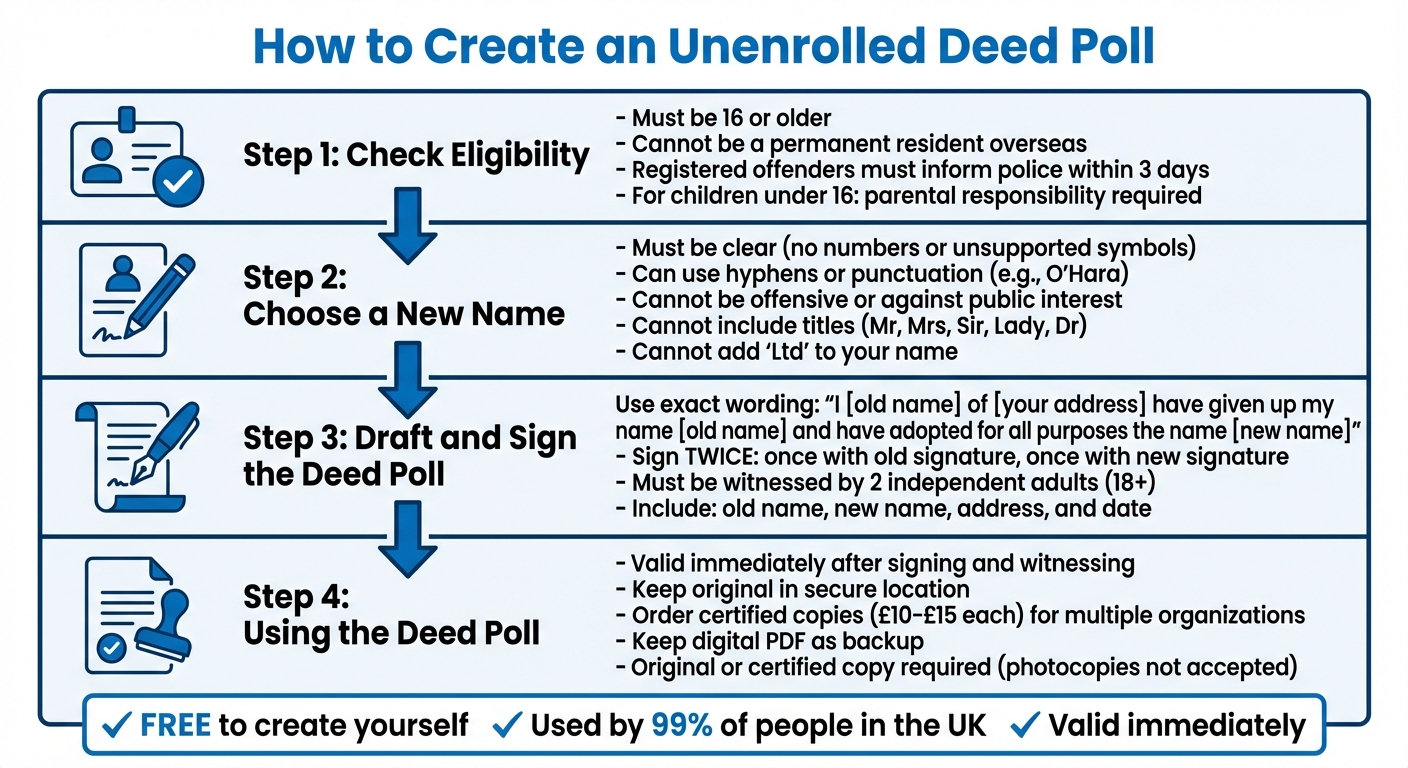
How to Create an Unenrolled Deed Poll in the UK - Step by Step Guide
Creating an unenrolled deed poll is straightforward and doesn't cost anything if you follow the proper steps.
Check Eligibility
To create your own unenrolled deed poll, you must be 16 or older. For children under 16, a person with parental responsibility must handle the process. In most cases, consent is required from everyone with parental responsibility. If parents can't agree on a child's name change, you may need to apply for a "specific issue order" through the courts, which costs £263.
Keep in mind, you can't change your name by deed poll if you're a permanent resident overseas. Additionally, registered sex, violent, or terrorist offenders must inform the police at a designated station within three days of changing their name. Failing to do so is a criminal offence.
Choose a New Name
Your new name must meet certain criteria. It should be clear and free of numbers or unsupported symbols. You can use hyphens or established punctuation (like O'Hara), but the name must not include anything offensive or go against public interest. For example, adding "Ltd" to your name is not allowed.
You also can't use a deed poll to adjust the capitalisation of letters in your name or to change titles such as Mr, Mrs, Sir, Lady, or Doctor.
Using the Deed Poll
"You can use your signed deed poll straight away as proof of your new name." - GOV.UK
Once your deed poll is signed and witnessed, it becomes valid immediately. Keep the original signed document in a secure location. Organisations like the Passport Office and DVLA often require the original or a certified legal copy, as standard photocopies may not be accepted.
Interestingly, over 99% of people in the UK use an unenrolled deed poll to change their name, making it the most common method for this process. After completing your deed poll, you can begin updating your official records with your new name.
Updating Your Records After a Name Change
Once you've signed your deed poll, the next step is updating your records. On average, this involves notifying around 24 organisations over a period of 3–8 weeks, which can take roughly 14 hours in total. Here's a breakdown of how to update both government and everyday accounts to reflect your new name.
Government Documents
Start with your government records. Use your deed poll to update your British passport and driving licence - these updates are typically processed within three weeks. Updating your driving licence early is particularly helpful, as it can speed up verifications with other organisations. You should also inform HMRC, the Department for Work and Pensions (DWP), the Electoral Roll, and your local council to ensure all your official records are consistent.
Banks, Employers, and Everyday Accounts
Next, notify your bank, employer, utility companies, and the NHS. Each organisation may have specific requirements, so check what they need. Some banks, for example, might ask for an enrolled deed poll or an updated passport. Use your deed poll to inform your employer, GP, mobile provider, energy supplier, and insurance companies. Keep in mind that organisations usually require the original deed poll or a certified copy, as photocopies are often not accepted.
Certified Copies and PDFs
It’s a good idea to order multiple certified copies of your deed poll. These typically cost £10–£15 each and allow you to update several organisations simultaneously. Additionally, keeping a digital PDF version can be a handy backup, especially for online submissions.
Conclusion
Changing your name without involving a solicitor is a straightforward and legally valid process when done correctly. An unenrolled deed poll, once signed and witnessed properly, is fully recognised for most purposes, including by government bodies like HM Passport Office, the DVLA, and HMRC. You can even create one at home for free or opt for specialist name change services for added convenience.
To ensure your deed poll is accepted, stick to the government-recommended wording, secure the required signatures, and use independent witnesses. By following these steps, you can update your records and complete the process with confidence.
Although most organisations accept unenrolled deed polls, some, such as certain banks or utility providers, might ask for an enrolled version. This costs £53.05 and is added to the public record. It’s wise to check each organisation’s specific requirements beforehand. Additionally, if you are a registered sex, violent, or terrorist offender, you are legally required to inform the police of your name change within three days. Failing to do so is a criminal offence.
FAQs
What is the difference between an unenrolled and an enrolled deed poll in the UK?
An unenrolled deed poll is a personal document you create to legally change your name. Once it's correctly signed and witnessed, it becomes valid, but it doesn’t result in any public record of your name change.
In contrast, an enrolled deed poll is formally registered with the Royal Courts of Justice. This registration process makes your name change a matter of public record, with the details published in The London Gazette. Many individuals opt for unenrolled deed polls because they’re more straightforward, faster, and maintain greater privacy.
Can a child under 16 have their name changed without involving a solicitor?
Yes, a child under 16 can have their name changed without hiring a solicitor. A parent or anyone with parental responsibility can apply for a deed poll on the child’s behalf, provided that everyone with parental responsibility agrees to the change.
To ensure the name change is recognised by UK government departments and organisations, it's crucial to meet all legal requirements and have the deed poll correctly prepared and signed.
What can I do if my bank refuses to accept an unenrolled deed poll?
If your bank refuses to accept an unenrolled deed poll, you might need to enrol your deed poll with the Royal Courts of Justice. Enrolling it makes the document publicly recorded, increasing the chances of acceptance by banks and other organisations.
The enrolment process involves submitting an application along with the necessary supporting documents. While this step is optional, it’s only required if specific institutions insist on it.