Why Use a Deed Poll for Last Name Change?
Changing your surname in the UK requires formal documentation to ensure legal recognition. While you can use any name informally, official organisations like HM Passport Office, the DVLA, and banks demand valid proof to update records. A deed poll is the most reliable way to formalise a name change and avoid issues with mismatched documents, identity checks, or accessing services.
Key Points:
- Why informal changes fail: Informal name use isn’t legally binding and won’t be accepted by official bodies.
- What a deed poll does: It legally declares you’ve abandoned your old name, adopted a new one, and will use it consistently.
-
Types of deed polls:
- Unenrolled: Private and widely accepted for most purposes.
- Enrolled: Filed with the High Court, creating a public record (£50.32 fee).
- Who needs it: Anyone over 16 can use a deed poll to update records like passports, driving licences, and bank accounts.
A deed poll is simple to create, affordable (starting at £16.95 through professional services), and ensures your name change is recognised across all official documents.
Why Informal Name Changes Don't Work
Official Bodies Won't Recognise Informal Changes
While UK law allows people to use an informal name, official organisations now require proper documentation to acknowledge a name change. The Deed Poll Office explains:
"Changing your name 'by usage' was relatively easy before government departments, companies and organisations began taking personal identity and security issues more seriously following the 9/11 terrorist attacks and the recent increase in identity theft." – Deed Poll Office
Without formal proof, institutions like HM Passport Office won't issue a passport under your new name, the DVLA won't update your driving licence, and HMRC won't amend your tax records. Banks and building societies have also tightened their rules, with many insisting on an enrolled deed poll, which must be registered with the High Court at a cost of £50.32. This lack of consistency across official records can lead to significant complications, as explored below.
Problems With Identity Checks and Documents
Using an informal name creates discrepancies across your official records, leading to disruptions in various processes. For instance, mismatched names can interfere with employment checks, rental agreements, credit applications, and even travel, where airlines and border control require exact name matches. If you've changed your name multiple times informally, you may need to provide every deed poll in chronological order to establish a clear link between your birth name and your current identity.
Misunderstandings About Proof of Name Change
Another issue is confusion over what constitutes valid proof of a name change. Some people mistakenly believe they can use a birth certificate to revert to a maiden or previous name. However, the Deed Poll Office clarifies:
"Generally speaking a birth registration is considered a matter of fact - that is, it was correct at the time it was made - and it cannot be changed." – Deed Poll Office
Documents like birth, marriage, and educational certificates only reflect the name valid at the time they were issued and cannot be altered. A deed poll, unlike informal methods, ensures your name is officially recognised across all records, eliminating these inconsistencies and potential misunderstandings.
sbb-itb-bf1bef6
Why a Deed Poll Is the Right Choice
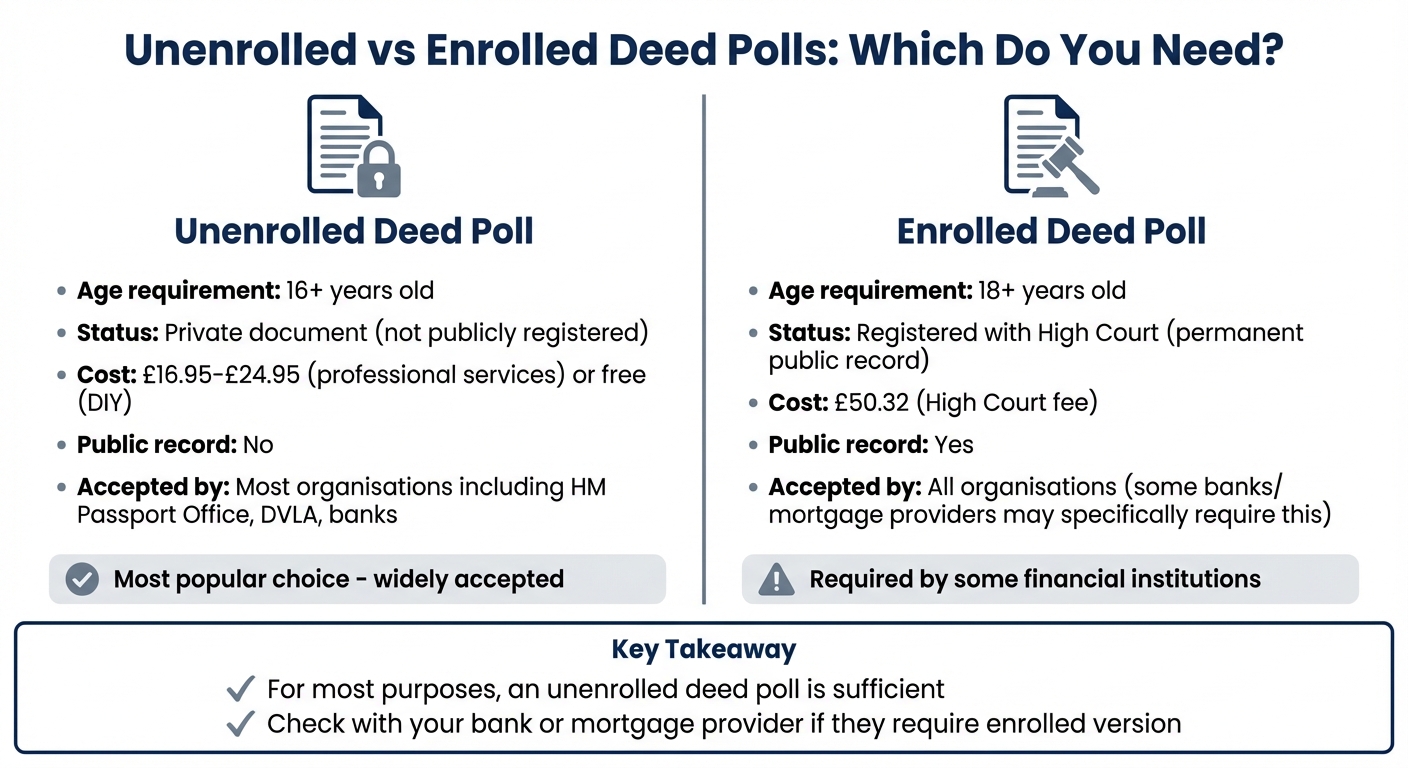
Unenrolled vs Enrolled Deed Poll Comparison UK
What a Deed Poll Is
When it comes to formalising a name change, a deed poll offers a legally binding solution that's hard to overlook. Unlike informal methods, which can lead to complications, a deed poll serves as official proof of your name change. It’s not just a certificate noting a fact - it’s a binding legal declaration.
"A Deed Poll is a legal document – not a certificate. It is a form of legal contract but it differs from legal contracts between two or more parties in that it only concerns one person."
This document outlines three key commitments: giving up your previous name, using your new name consistently, and ensuring others address you by your new name. These clear terms make it easier to understand the two types of deed polls available.
Unenrolled vs Enrolled Deed Polls
There are two main types of deed polls, each tailored to different needs. An unenrolled deed poll is a private document available to anyone aged 16 or older. It’s not registered publicly, making it a popular choice for those who value privacy. On the other hand, an enrolled deed poll is for individuals aged 18 or over and requires submitting the document to the High Court, creating a permanent public record.
For most purposes, including updating your passport, driving licence, or bank details, an unenrolled deed poll is widely accepted. However, some financial institutions may specifically require an enrolled version. It’s a good idea to check with your bank or mortgage provider beforehand to avoid any surprises. This distinction highlights why deed polls are trusted by organisations for official name changes.
Why Organisations Accept Deed Polls
Deed polls are recognised by UK government bodies as the standard proof for name changes because they meet stringent identity verification standards. Over the years, organisations have tightened their processes to ensure secure and reliable identity checks. A properly executed deed poll - signed in the presence of two independent witnesses who are over 18 and unrelated to you - meets these rigorous requirements.
The legal framework of a deed poll provides clarity and accountability. By making three specific declarations in a binding document, you create a transparent and traceable record of your name change. This is why both government agencies and private companies trust deed polls for updating official records consistently and securely. It’s a straightforward and dependable solution for anyone looking to formalise their new name.
Benefits of Using a Deed Poll
Update All Your Records Consistently
A deed poll serves as the official document needed to confirm your legal name change with government agencies and financial institutions. In the UK, organisations like HM Passport Office, the DVLA, and banks typically require either the original deed poll or a certified copy to update their records. This ensures a smooth process for updating your passport, driving licence, bank accounts, and utility bills, as formal evidence is now a standard requirement for identity verification.
Since most organisations won’t accept photocopies, it’s wise to obtain certified copies of your deed poll. Store the original securely, as it acts as a lifelong link between your old and new names, which can be crucial for background or credit checks in the future.
Legal Clarity and Reduced Risk
A deed poll provides a formal legal record by binding you to three key declarations: giving up your previous name, committing to using your new name consistently, and requiring others to address you by your new name. This clear legal framework simplifies background checks, credit applications, and employment verifications by eliminating any confusion about your identity.
For those seeking an extra layer of permanence, enrolling your deed poll through the High Court creates a public record of the change for a fee of £50.32. This ensures absolute clarity and peace of mind when dealing with official processes.
Freedom to Choose Any Last Name
Unlike marriage certificates, which limit you to adopting your spouse’s surname, a deed poll gives you the freedom to choose any last name you wish. Whether it’s altering the spelling of your current name, adding or dropping a hyphen in a double-barrelled surname, or selecting an entirely new name that reflects your identity or personal preferences, a deed poll allows for a wide range of options. However, your chosen name must be pronounceable and cannot include symbols, numbers (other than hyphens), or offensive language.
This flexibility has made deed polls increasingly popular. For instance, one specialist deed poll service has issued over 800,000 unenrolled documents since 2001. Whether you’re adopting a stage name, aligning your name with your gender identity, or simply choosing a name that resonates with you, a deed poll provides the legal foundation to make that change official across all your records. It’s no wonder that a deed poll is considered the most reliable way to legally change your last name in the UK.
How to Change Your Last Name With a Deed Poll
Selecting Your New Last Name
Choosing a new surname in the UK comes with certain legal guidelines. Your new name must include at least one forename and one surname, and it must be completely pronounceable. While symbols, numbers, or punctuation marks are not allowed, exceptions are made for hyphens (for double-barrelled names) and apostrophes (in names like O'Hara).
There are also restrictions on the type of names you can adopt. For instance, names that are vulgar, offensive, or blasphemous are prohibited. You also cannot use titles (like Sir, Lord, or Doctor), honours (such as General or Baron), or anything that could be seen as a commercial term (e.g., Ltd or PLC). Additionally, you cannot use a deed poll to alter the capitalisation of your name or for fraudulent purposes.
Once your chosen surname meets these requirements, you can proceed to create your deed poll.
Creating an Unenrolled Deed Poll
If you’re a UK citizen aged 16 or older, you can create an unenrolled deed poll. To make it legally valid, the document must include three declarations: that you are giving up your previous name, that you will use your new name consistently from now on, and that you require others to address you by your new name exclusively. You’ll also need to sign and date it in front of two independent witnesses. These witnesses must be over 18, unrelated to you, and not living at the same address.
For those who want a hassle-free option, services like Name Change offer professionally prepared deed poll documents. Their basic package starts at £16.95, which includes printed documents, three certified copies, tracked delivery, and PDF archiving. For £24.95, their premium option adds a gold-embossed stamp for a more formal touch. While it’s possible to draft a deed poll yourself for free, using a professional service ensures the wording is legally sound and provides certified copies that many organisations require.
Once your deed poll is signed and witnessed, the next step is to update your records with relevant organisations.
Notifying Organisations of Your Name Change
After completing your deed poll, you’ll need to inform both government bodies and private institutions about your new name. Key organisations to notify include HM Passport Office, DVLA, and HMRC. Updating your passport will cost £93, but updating your driving licence is free unless you need a new photo.
Beyond government agencies, you should also contact your bank, employer, utility companies, credit card providers, pension providers, GP surgery, mobile phone providers, insurance companies, and your local council to update voter registration records. If you’re a registered sex, violent, or terrorist offender, you are legally required to notify the police within three days at a designated police station. Additionally, under English law, you must inform all creditors of your name change.
Conclusion
Exploring the challenges of informal name changes highlights why a deed poll stands out as the most dependable way to legally change your surname in the UK. Recognised by government agencies, banks, and other official organisations, a deed poll provides the formal proof required to update essential records - like passports, driving licences, and bank accounts. As noted by Deed Poll Service:
"A Deed Poll legally binds the person who signs it to a particular course of action as detailed on the Deed Poll document."
This legal commitment establishes a clear and authoritative link between your old and new identity, simplifying record updates and helping to prevent fraud or confusion during identity checks.
Beyond its legal strength, the process is simple and affordable. Unenrolled deed polls can be created for free or through professional services for under £20, while an enrolled deed poll via the High Court costs £50.32. Since 2001, over 800,000 unenrolled deed polls have been issued, reflecting widespread confidence in this method.
Whether you're changing your surname due to marriage, divorce, or personal reasons, a deed poll provides the legal certainty and ease needed to embrace your new identity without hesitation.
FAQs
What’s the difference between an unenrolled and an enrolled deed poll?
An unenrolled deed poll is a private document you can use to legally change your name. Unlike other methods, it isn’t recorded on any public register, making it a more private option. Despite its discreet nature, it’s widely recognised by UK government departments and organisations.
In contrast, an enrolled deed poll is officially registered with the High Court, creating a public record of your name change. This record is then published in The London Gazette. The process involves extra steps, including paying a filing fee, and is less commonly chosen for personal name changes.
Can I choose any last name when using a deed poll?
Yes, you can generally pick any surname you like using a deed poll, but there are a few rules to keep in mind. Your new name must be easy to pronounce, cannot include numbers or symbols (other than hyphens), must not be offensive or go against public interest, and cannot be chosen with the intention to deceive or commit fraud. It's also important to note that a deed poll cannot be used to change titles or adjust the capitalisation of your name in a way that could mislead others.
As long as your chosen surname follows these guidelines, a deed poll offers a straightforward way to legally change your name in the UK.
How do I inform organisations of my name change after getting a deed poll?
Once your deed poll is signed and witnessed, it’s time to start notifying organisations about your name change. Begin by creating a checklist of everyone you need to inform. This typically includes government departments like the Passport Office, DVLA, and HMRC, as well as banks, insurers, utility providers, healthcare services, and your employer. Don’t overlook any clubs, professional associations, or educational institutions you’re connected to.
Most organisations will ask for a certified copy of your deed poll, and some may also require additional documents, such as your passport or driving licence. It’s a good idea to contact each organisation directly to confirm their specific requirements. Some may provide an online form, while others might need a letter or an in-person visit. For example, updating your passport involves submitting a new application along with your deed poll, whereas the DVLA requires form D1 or D2 alongside the document.
Keep a record of all updates and confirmations, and save a PDF copy of your deed poll for easy access in the future. Taking these steps will help ensure your name is updated smoothly across all relevant records.