Government Acceptance of Unenrolled Deed Polls
Unenrolled deed polls are widely accepted in the UK as legal proof of a name change. They are private documents that you can create yourself without court involvement, making them a simple and cost-effective option. Major government departments such as HM Passport Office, DVLA, HMRC, and DWP accept unenrolled deed polls for updating records. However, some private organisations, like certain banks or utility providers, may require an enrolled deed poll for added formality.
Key Points:
- Unenrolled deed polls: Legal and valid for changing your name; requires two witnesses and proper wording.
- Enrolled deed polls: Publicly registered, costs £50.32, and offers more formality but less privacy.
- Government acceptance: HM Passport Office, DVLA, HMRC, and DWP accept unenrolled deed polls without issue.
- Private organisations: Policies vary; some may insist on an enrolled deed poll.
For most individuals, an unenrolled deed poll is sufficient. Ensure your document is correctly prepared and check requirements with specific organisations before submitting.
Legal Framework and Requirements for Unenrolled Deed Polls
Legal Status of Unenrolled Deed Polls
In the UK, an unenrolled deed poll is legally valid without needing registration through the courts. As stated on GOV.UK, "A deed poll is a legal document that proves a change of name". Once signed and witnessed, it takes effect immediately.
The main distinction between unenrolled and enrolled deed polls lies in privacy. Unenrolled deed polls are private documents, meaning they are not published in The Gazette or recorded with the High Court. However, this doesn't diminish their legal effectiveness. UK law supports your right to change your name through common usage, and an unenrolled deed poll serves as official evidence of that change.
With the legal foundation clarified, specific criteria must be met to ensure an unenrolled deed poll is valid.
Requirements for Valid Unenrolled Deed Polls
To create a valid unenrolled deed poll, several conditions must be fulfilled:
- Age Requirement: You must be at least 16 years old to create one independently. For those under 16, parental involvement is required. However, 16- and 17-year-olds can make their own deed poll.
- Required Wording: The document must include specific phrasing. According to GOV.UK, it should state: "I [old name] of [your address] have given up my name [old name] and have adopted for all purposes the name [new name]". This wording confirms you are permanently abandoning your old name in favour of the new one.
- Special Requirements for Offenders: Individuals registered as sex, violent, or terrorist offenders must notify the police within three days of signing the deed poll. Failing to do so is a criminal offence.
- Name Restrictions: The new name must be pronounceable and cannot include symbols or numbers (other than hyphens or apostrophes in established names like O'Hara). Offensive or inappropriate names, as well as changes to titles (e.g., Mr to Sir or Doctor), are not permitted. Altering capitalisation alone is also not allowed.
- Execution Process: The signing process is crucial. You must sign the document twice - once with your old signature and once with your new one - in the presence of two independent witnesses. These witnesses must be at least 18 years old, cannot live at your address, and must not be close relatives.
Government Departments' Policies on Unenrolled Deed Polls
HM Passport Office
The HM Passport Office accepts unenrolled deed polls for updating British passports. To make changes, you’ll need to submit the original deed poll along with two pieces of evidence, such as payslips or utility bills, that show you’re actively using your new name.
According to HMPO's caseworker guidance, these two documents must confirm your new name, but they don’t necessarily need to display your full name as long as the changed name is clear. This was clarified in an update on 2nd April 2025, ensuring applicants understand the requirements.
If you’ve changed your name multiple times, HMPO requires a complete "paper trail" connecting all your previous names. Without this, you’ll need to apply for a statutory declaration instead. Caseworkers are instructed to verify the history and legitimacy of both your old and new names, as well as all supporting documents.
Now, let’s take a look at how the DVLA handles name changes with unenrolled deed polls.
DVLA
The DVLA also recognises unenrolled deed polls for updating both driving licences and vehicle registration documents. To update your driving licence, you’ll need to fill out Form D1 ("Application for a driving licence") and submit it with your original deed poll. For changes to vehicle registration certificates (log books), you’ll need Form V5C.
Unlike HMPO, the DVLA doesn’t require additional documents proving the use of your new name, making the process a bit more straightforward. They do, however, expect you to update your driving licence as soon as your name changes.
Next, we’ll explore how HMRC and the DWP manage records with unenrolled deed polls.
HMRC and DWP
Both HMRC and the Department for Work and Pensions accept unenrolled deed polls without requiring enrolment. This aligns with the UK government’s broader recognition of unenrolled deed polls for official records.
You’ll need to notify HMRC to update records for Income Tax, National Insurance, the Construction Industry Scheme (CIS), Government Gateway accounts, and Child Benefit. Similarly, the DWP’s Pension Service and local authorities handling Housing Benefit should be informed of your name change.
Government bodies such as HM Passport Office do not require you to enrol your deed poll.
How Organisations Accept Unenrolled Deed Polls
In the UK, private organisations generally recognise unenrolled deed polls for updating personal records, but not all institutions follow the same rules. Some may have specific requirements, so it's always best to check in advance.
Banks and Financial Institutions
Most banks in the UK accept unenrolled deed polls as valid proof of a name change. To update your records, you’ll typically need to provide the original signed deed poll or a certified copy - photocopies won’t be accepted. Banks rely on this document to link your previous identity with your new name.
However, some financial institutions only recognise enrolled deed polls. It’s a good idea to contact your bank beforehand to confirm their policy. If you’re dealing with multiple banks or organisations, ordering several original or certified copies of your deed poll can save time, as some may take weeks to return your documents.
Employers and Educational Institutions
Employers and educational institutions are usually willing to accept unenrolled deed polls for updating records like payroll, HR systems, or student registries. Employers will use the deed poll to update official documents, while schools and universities will amend their registers accordingly.
Before submitting your request, reach out to your HR department or school registrar to confirm their specific requirements. Most institutions prefer the original "wet signed" deed poll rather than a photocopy.
Utility Providers and Digital Platforms
Utility companies and digital platforms vary in how they handle unenrolled deed polls. Many accept them without issue, but some - such as certain energy or mobile phone providers - might insist on an enrolled deed poll.
Make sure to notify all relevant providers, including water, electricity, and gas companies, as well as digital platforms like internet service providers, telephone companies, and TV Licensing. Check with each organisation to understand whether they require an unenrolled or enrolled deed poll.
This overview of private sector policies sets the stage for comparing the differences between enrolled and unenrolled deed polls in the next section.
sbb-itb-bf1bef6
Enrolled vs Unenrolled Deed Polls: A Comparison
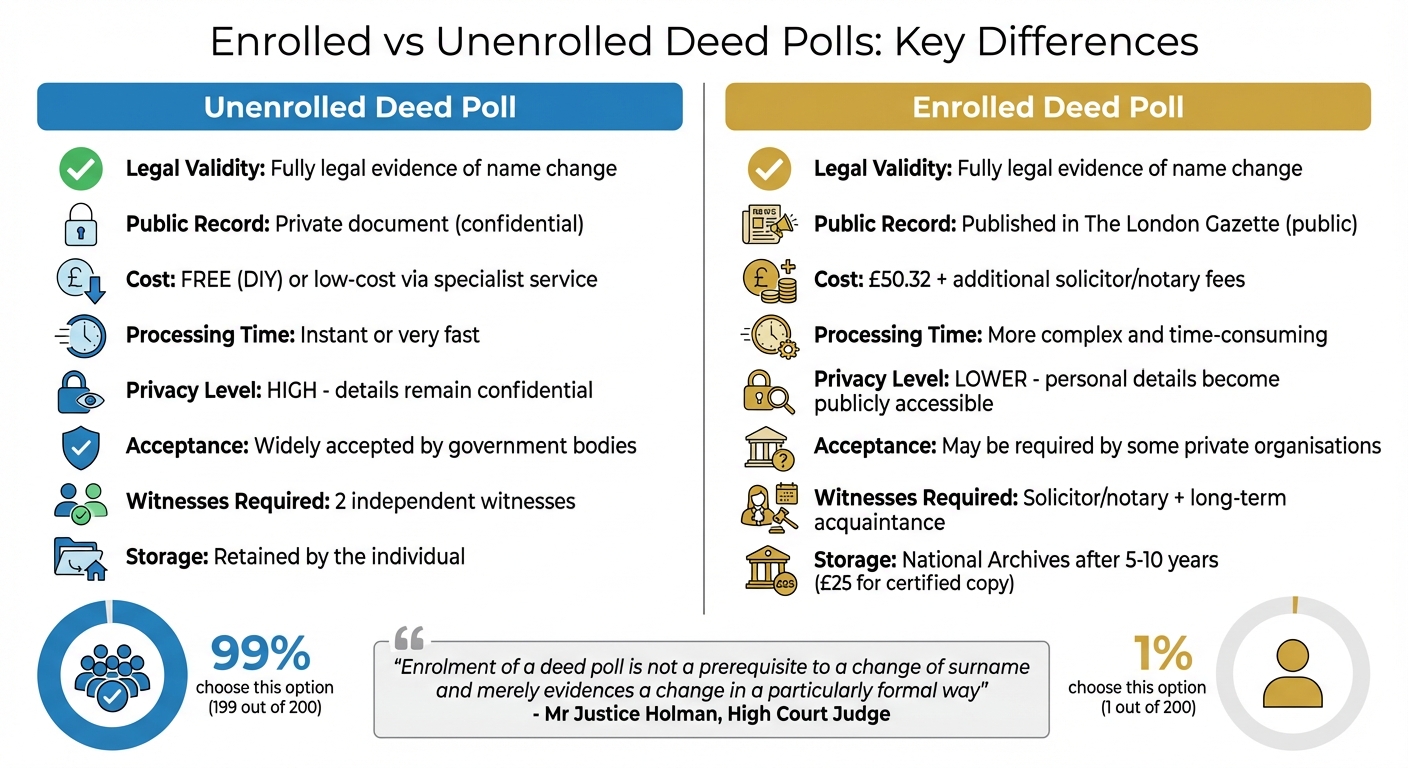
Enrolled vs Unenrolled Deed Polls Comparison Chart UK
Both enrolled and unenrolled deed polls are legally recognised methods for changing your name in the UK. As Mr Justice Holman, a High Court Judge, once explained:
Enrolment of a deed poll is not a prerequisite to a change of surname and merely evidences a change in a particularly formal way.
The main differences between the two lie in privacy, cost, and the level of formality required by different organisations. Let’s take a closer look at these distinctions.
One key difference is public accessibility. An unenrolled deed poll remains private, while an enrolled deed poll is publicly recorded. Details of enrolled deed polls are published in The London Gazette, and the document is stored at the National Archives after 5–10 years. This public record can be a concern for those who value privacy or are changing their name for safety reasons.
Cost is another important factor. Creating an unenrolled deed poll can be done for free if you draft it yourself, or you can use a specialist service for a small fee. On the other hand, enrolling a deed poll costs £50.32 through the High Court, with additional expenses for solicitor services, such as witnessing documents and statutory declarations. If you need a certified copy from the National Archives after five years, there’s an extra fee of £25.
Comparison Table of Enrolled and Unenrolled Deed Polls
| Feature | Unenrolled Deed Poll | Enrolled Deed Poll |
|---|---|---|
| Legal Validity | Fully legal evidence of a name change | Fully legal evidence of a name change |
| Public Record | Remains a private document | Details published in The London Gazette |
| Cost | Free (DIY) or low-cost via specialist service | £50.32 plus additional solicitor/notary fees |
| Processing Time | Instant or very fast | More complex and time-consuming |
| Privacy | High – details remain confidential | Lower – personal details become publicly accessible |
| Acceptance | Widely accepted by government bodies | May be required by some private organisations |
| Witnesses | Requires two independent witnesses | Typically requires a solicitor/notary and a long-term acquaintance |
| Storage | Retained by the individual | Stored at the National Archives after 5–10 years |
When Enrolled Deed Polls May Be Required
While both types of deed polls are valid, there are situations where an enrolled deed poll might be preferred or even necessary. Most UK government departments - such as HM Passport Office, the DVLA, and HMRC - accept unenrolled deed polls without issue. However, some private organisations, including certain banks, mobile phone providers, and energy companies, may insist on the enrolled version.
Lord Justice Ormrod from the Court of Appeal provided clarity on this:
A deed poll is just as effective or ineffective whether it is enrolled or not; the only point of enrolment is that it will provide unquestionable proof.
This additional layer of formality can be especially useful if you need permanent, indisputable evidence of your name change.
If you’re planning to marry abroad or reside overseas, you might also find that foreign authorities require a higher level of formality. In such cases, a deed poll often needs to be witnessed or certified by a solicitor or notary public. Additionally, if you’re married or in a civil partnership and wish to enrol your deed poll, written consent from your spouse is typically required.
Understanding these differences can help you decide which option suits your circumstances. It’s always worth checking with the relevant organisations to determine whether an enrolled deed poll is necessary.
What This Means for Individuals Using Unenrolled Deed Polls
When done correctly, an unenrolled deed poll is legally accepted by major government departments in the UK. For most people looking to change their name, this type of deed poll is entirely sufficient. Organisations like HM Passport Office, DVLA, and HMRC generally recognise these documents without issue. However, some private companies may have stricter requirements.
The key to avoiding complications lies in ensuring your deed poll is properly prepared and meets legal standards. While it's possible to draft your own deed poll for free, professionally prepared versions often encounter fewer objections. This is because they use standardised wording, include essential declarations (such as confirming you’ve abandoned your previous name for all purposes), and adhere to formal legal requirements.
Getting the witnessing process right is equally important. Accurate witness details can prevent unnecessary delays. Once your deed poll is complete, updating your photo ID promptly can serve as additional evidence when dealing with cautious organisations like banks. It’s also a good idea to check each organisation’s specific requirements in advance to avoid surprises.
Using a professional service to prepare your deed poll can make this process much smoother, as explained below.
How Name Change Supports Individuals
To simplify the process, Name Change offers professionally prepared unenrolled deed polls starting at £16.95. These documents meet all legal standards and include the correct wording. The service also provides three certified copies, which is incredibly helpful since many organisations require original or certified documents rather than simple photocopies.
The service comes in two options: the standard Printed & Posted service, which includes a printed document with an ink stamp, and the Premium option for £24.95, which features a gold embossed stamp for an added touch of formality. Both options include tracked delivery, premium presentation, and a guide to help you update your records.
One standout feature is the archiving service. Name Change stores your deed poll as a PDF, so you can download additional copies whenever needed. This is particularly handy if your original documents are lost or damaged. Plus, it eliminates the hassle of creating a new deed poll if an organisation requests a certified copy years after your name change. With this service, you can simply re-order certified copies of your original document, ensuring it’s accepted by UK government departments and organisations when required.
Conclusion
The legal framework and departmental practices firmly establish that unenrolled deed polls are valid documents widely accepted across the UK. In fact, over 99% of individuals who change their name opt for an unenrolled deed poll, with only about 1 in 200 being enrolled with the Ministry of Justice. Key government bodies like HM Passport Office, DVLA, and HMRC routinely accept these documents without issue.
To ensure smooth processing, it's important to prepare your deed poll correctly. This means following the recognised legal format, using the proper wording, including dual signatures, and having it witnessed by independent individuals. These steps help meet legal standards and improve the likelihood of acceptance.
While most organisations accept unenrolled deed polls, some private companies may have stricter requirements. It’s always a good idea to check with specific institutions beforehand to avoid any unexpected complications.
For the majority of name changes, an unenrolled deed poll is both sufficient and practical. It avoids the £50.32 fee and public disclosure involved with the enrolled option. With a well-prepared deed poll and certified copies, you can update your records seamlessly with government departments and most private organisations. This widespread acceptance ensures a straightforward process for managing your name change confidently.
FAQs
Why do some organisations only accept an enrolled deed poll for a name change?
Some organisations might ask for an enrolled deed poll because it’s officially recorded, offering a stronger level of verification for your name change. Being part of a public record, it provides extra assurance of authenticity, which some private companies or institutions prefer for their documentation requirements.
Although most UK government departments and organisations accept unenrolled deed polls, some private entities may require the enrolled version to align with their security standards or internal policies.
What are the advantages of using a professional service to create an unenrolled deed poll?
Using a professional service to create an unenrolled deed poll ensures your document is properly formatted and complies with all government guidelines. This helps minimise the chance of it being rejected by organisations like the Passport Office, DVLA, HMRC, or your bank. These services often go a step further by providing certified copies and pre-written covering letters, streamlining the process of informing relevant organisations.
Other perks can include secure, tracked delivery of your deed poll, digital archiving for easy future access, and options for replacements if the original is lost or damaged. Some providers even offer same-day dispatch and guarantee acceptance by UK government departments and major organisations, making the entire process quicker and less stressful.
What is the process for having an unenrolled deed poll witnessed?
To complete an unenrolled deed poll, you’ll need two independent witnesses to sign the document alongside you. These witnesses must be at least 18 years old, not closely related to you, and must not live at your address. Their role is to confirm they saw you sign the deed poll, ensuring it meets the requirements of organisations like banks and the passport office. Importantly, your witnesses don’t need to be lawyers or officials, but they should be able to verify your identity and signature.
If you’re unsure about the process, a service like Name Change can guide you through it step by step. They also offer certified copies of your deed poll, which can help ensure it’s accepted by UK government bodies and other institutions.