Name Change After Marriage: What You Need to Know
Changing your name after marriage in the UK isn’t automatic - you need to notify organisations and provide the right documents. Here’s what you need to know:
- Marriage Certificate: Sufficient for most name changes, like taking your spouse’s surname or creating a double-barrelled surname.
- Deed Poll: Required for more complex changes, such as using your maiden name as a middle name or creating a new surname.
- Key Updates: Notify the Passport Office, DVLA, HMRC, banks, your employer, and HM Land Registry (if you own property).
- Costs: Updating a driving licence is free, but passport renewal starts at £94.50. Deed poll services range from £16.95 to £53.05, depending on the type.
Act quickly to ensure your name is consistent across official records to avoid delays or issues with legal and financial matters.
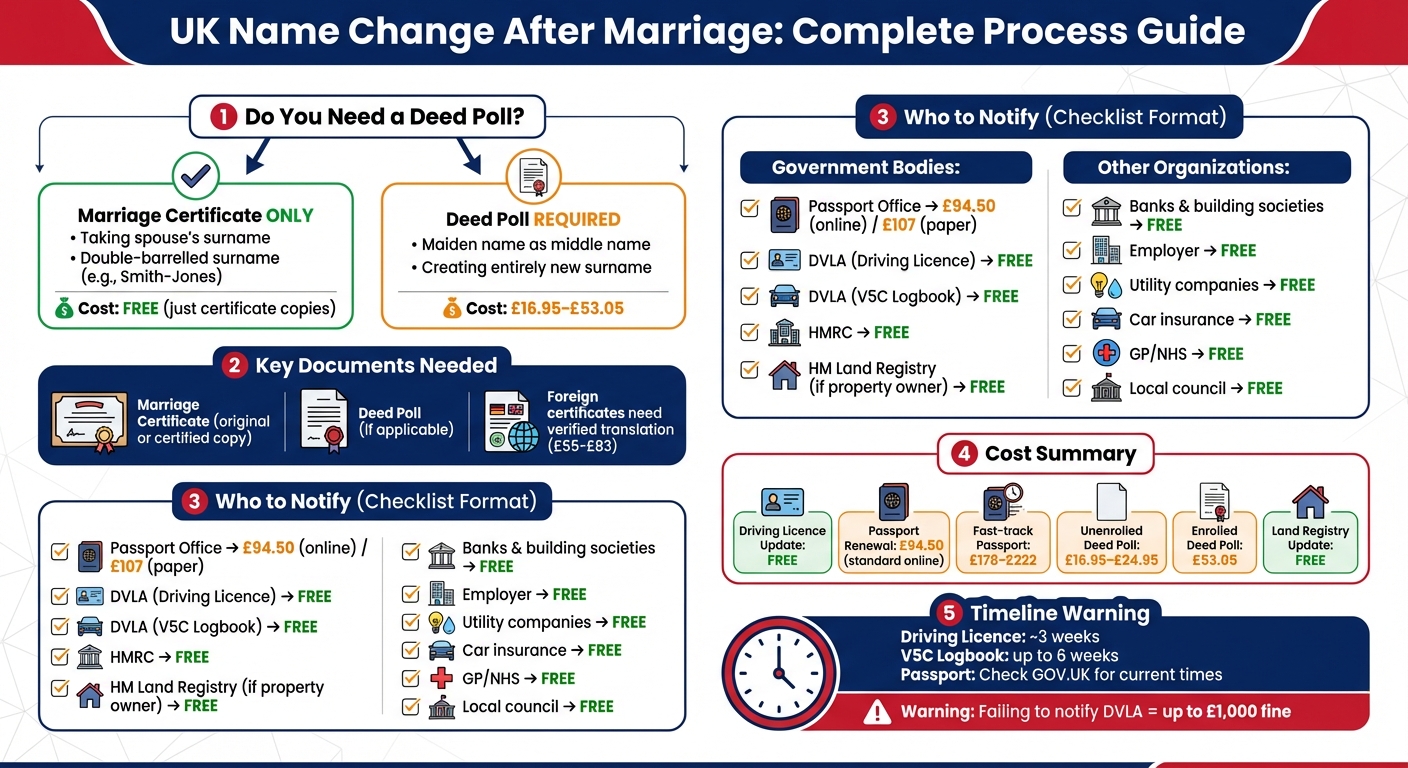
UK Name Change After Marriage: Step-by-Step Guide with Costs
Do You Need a Deed Poll to Change Your Name?
Using Your Marriage Certificate
For most cases of surname changes - whether taking your spouse's surname entirely or combining both surnames into a double-barrelled version (e.g., Smith-Jones) - a marriage certificate is enough. As stated on GOV.UK:
You do not need a deed poll to take your spouse's or civil partner's surname. Send a copy of your marriage or civil partnership certificate to record-holders.
The key is ensuring that your marriage certificate includes both your maiden name and your spouse's surname. This document is widely accepted by UK organisations like the DVLA, HMRC, banks, and the Passport Office for these straightforward name changes. Even if you own property, HM Land Registry will update your name for free using form AP1.
However, if you're considering a name change that goes beyond these standard options, you might need a deed poll.
When You Need a Deed Poll
A deed poll becomes necessary if your name change involves more than just altering your surname. For instance, if you want to move your maiden name to a middle name while adopting your spouse's surname, you’ll need one. The UK Deed Poll Office clarifies:
The reason that your marriage certificate won't work as evidence of name change [for middle names] is that in this case, the change is considered to be in your forename instead of your surname.
Similarly, if you and your spouse decide to create a completely new surname - one that isn’t a simple combination of your current surnames - you’ll need a deed poll. For example, blending "Smith" and "Taylor" into something entirely new like "Smaylor" requires a deed poll, as your marriage certificate cannot serve as evidence for a newly invented surname .
Documents Required for Your Name Change

Your Marriage Certificate
Your marriage certificate is the key document for most name changes following marriage. In the UK, organisations like the DVLA, HMRC, banks, and the Passport Office accept it as evidence when you're adopting your spouse's surname or combining surnames (e.g., Smith-Jones).
You'll need to provide either the original certificate or a certified copy - standard photocopies won't cut it. If you've misplaced the original, you can order a replacement from the General Register Office (GRO) or your local registry office.
For property-related changes, HM Land Registry requires an "official copy" of your marriage certificate when submitting form AP1. Before applying, you can confirm your current details on the Land Register for £7 to ensure everything matches perfectly and avoid unnecessary delays.
Married outside the UK? If your certificate isn't in English, you'll need a verified translation. This translation must be signed, stamped, and dated by a qualified linguist or professional translation agency. The General Register Office charges £83 to check foreign marriage documents, while local register offices charge £55.
If your name change involves adjustments not supported by your marriage certificate, such as altering your maiden name placement or creating a new surname, a deed poll will be required.
Deed Poll Documentation
For name changes that go beyond what a marriage certificate can handle - like moving your maiden name to a middle name or forming a new blended surname - a deed poll is necessary. This legal document acts as formal proof of your name change.
Name Change offers a convenient service for creating unenrolled deed poll documents that meet the requirements of UK government departments and organisations. Their service includes compliant documentation, certified copies, tracked delivery, and PDF archiving for easy access.
Updating Your Records with Government Bodies and Organisations
Updating Your Passport and Driving Licence
Your passport and driving licence are essential documents that prove your new name, so make updating them a priority.
For your passport, you'll need to apply for a full renewal rather than a simple amendment. The standard online application costs £94.50, while the paper application is £107.00. If you need it urgently, fast-track services range between £178.00 and £222.00. Before making travel plans, check processing times on GOV.UK. If time is tight, expedited services can help speed things up.
Updating your driving licence is free. Simply fill out form D1, available at your local Post Office, and send it along with your current licence and marriage certificate to DVLA, Swansea, SA99 1BN. This process typically takes about three weeks, and you’re allowed to keep driving while your application is being processed. Don’t forget to update your V5C (vehicle logbook) as well, which can take up to six weeks to process. Be aware that failing to notify the DVLA could lead to fines of up to £1,000.
Once these key documents are updated, you’ll be ready to notify other organisations of your name change.
Notifying Other Organisations
After updating your passport and driving licence, it’s time to inform other relevant organisations to ensure your name change is fully reflected.
Start with HMRC to update your tax and National Insurance records. This will automatically notify the Department for Work and Pensions (DWP) about your new name, but if you’re claiming benefits or the State Pension, you’ll need to contact the DWP directly. Notify your local council as soon as possible to update your Council Tax and Electoral Roll records - delays here could affect your credit score.
Next, inform your financial institutions, including banks, building societies, mortgage providers, and pension firms. Most will accept your marriage certificate as sufficient proof if you’ve taken your spouse’s surname. Don’t forget your car insurance provider; your policy must match the name on your updated driving licence to remain valid.
Other organisations to notify include utility companies (water, gas, electricity), internet and mobile providers, TV Licensing, your GP (who will update your NHS records), your dentist, and your employer. Most utility companies are fine with photocopies of your marriage certificate, so you don’t need to send the original.
sbb-itb-bf1bef6
Costs and Fees for Changing Your Name
Free Name Changes
Many organisations will update your records for free after marriage. Banks, building societies, employers, utility companies, and GP surgeries typically make these updates when you provide your marriage certificate. Similarly, updating your driving licence with the DVLA or amending the Land Register using form AP1 doesn’t cost a penny. If you’re taking your spouse’s surname or creating a double-barrelled name, your marriage certificate is all you’ll need.
However, if additional documents are required beyond these free updates, you might incur some costs, as outlined below.
Fees You May Need to Pay
One expense to consider is a new passport. HM Passport Office charges for this because they issue an entirely new document. The cost for an online application is £94.50, while a paper application is slightly higher at £107.
You might also need extra certified copies of your marriage certificate, which are available from the General Register Office for about £11 each.
If you’re planning to make changes beyond what your marriage certificate covers - such as altering middle names or creating a completely new surname - you’ll need a deed poll. You can draft an unenrolled deed poll yourself for free or opt for a professional service like Name Change. Their standard service costs £16.95 and includes printed documents, three certified copies, an ink stamp, tracked delivery, and a guide. For £24.95, the premium service adds a gold embossed stamp for a formal touch. Alternatively, an enrolled deed poll through the High Court costs £53.05, which also creates a public record.
How Name Change Can Help
Name Change provides a quick and easy online service to create a deed poll for name changes that go beyond what a marriage certificate allows. The process is designed to be incredibly fast - you can complete the application in just 2 minutes.
The deed poll documents are printed on high-quality paper and include official stamps, ensuring they meet UK legal standards. The standard service costs £16.95 and includes printed documents, three certified copies, an ink stamp, tracked delivery, and a detailed guide. For a more formal touch, the premium option at £24.95 includes a gold embossed stamp.
You’ll receive clear, step-by-step instructions covering everything from signing the deed poll to arranging for two independent witnesses (both over 18, unrelated to you, and not living at your address). There’s even a checklist to help you update all your records.
One of the standout benefits is the guarantee that your deed poll will be accepted by UK government departments and organisations. This eliminates the need for expensive solicitor fees or court appointments. Plus, the service includes PDF archiving, so you’ll always have digital access to your documents.
This method is not only faster but also more affordable than enrolling a deed poll through the High Court. For most post-marriage name changes, an unenrolled deed poll from Name Change provides everything you need - without the hassle of long waits or creating a public record.
Conclusion
Changing your name after marriage can be a straightforward process if you understand the requirements. For most people, using a marriage certificate is enough when taking a spouse's surname or combining surnames into a double-barrelled version. However, if you plan to use your maiden name as a middle name or adopt an entirely new surname, you'll need to use a deed poll.
The key steps are simple: gather the necessary documents - either your marriage certificate or a deed poll - and notify the relevant organisations promptly. This includes the Passport Office, DVLA, HMRC, your bank, and utility providers. If you own property, you’ll also need to submit form AP1 to HM Land Registry, which is free of charge.
Be aware that some organisations, such as certain banks, might require an enrolled deed poll instead of an unenrolled one or a marriage certificate. Double-check their requirements to avoid unexpected costs. For most cases, an unenrolled deed poll will suffice and won’t create a public record.
It's also wise to keep certified copies of your documents, as many organisations will ask for original or certified evidence. Make sure your name is consistent across all official records - such as your passport, driving licence, and property deeds. Even minor discrepancies can cause problems with processes like mortgage applications, so ensuring everything matches will save you trouble down the line.
FAQs
What should I do if my marriage certificate is in a language other than English?
If your marriage certificate is in a language other than English, you’ll need to have it translated into English by a professional. It’s important to ensure the translation is certified by either a sworn translator or an official translation service. This certification is crucial for it to be recognised by UK authorities, especially for legal matters like changing your name after marriage.
How do I make sure my name change is updated everywhere?
To update your name across all records, start by securing a legal deed poll. This document acts as official proof of your name change and is essential for notifying organisations. Key places to contact include HM Revenue & Customs, the passport office, your bank, and your employer. Keep in mind that each organisation may have a specific process, often requiring your deed poll or certified copies.
Having multiple certified copies of your deed poll can make the process smoother. Prioritise updating key documents like your passport, driving licence, and bank accounts first, as these are frequently used for identification. By taking a step-by-step approach, you can ensure your new name is consistently recognised across all official records.
How much does it cost to change my name after getting married in the UK?
In the UK, the cost of changing your name after marriage depends on how you go about it. If you opt for a deed poll, the basic document will cost you about £28.50. If you need extra certified copies for official use, these are usually priced at around £3.75 each.
If you prefer a more comprehensive service, which might include extras like tracked delivery and archiving of your documents, you’re looking at a fee of around £39.50. These charges cover the legal paperwork required to update your name with government departments and other organisations across the UK.