10 Reasons People Change First Names
People in the UK change their first names for various personal, practical, and professional reasons. The process is legal and straightforward through a deed poll, as long as it's not for fraudulent purposes. Here are the top reasons people make this decision:
- Dislike of Birth Name: Many feel their name doesn’t suit them, is outdated, or has negative associations.
- Gender Transition: A critical step for trans individuals to align their name with their identity.
- Religious Conversion: Often symbolic of embracing a new faith or spiritual journey.
- Professional Reasons: Simplifying names for career prospects or branding purposes.
- Cultural Integration: Anglicising or reclaiming names for ease or heritage.
- Making a Nickname Official: Aligning legal documents with a commonly used nickname.
- Honouring Family: Paying tribute to loved ones or reconnecting with family heritage.
- Starting Over: A fresh start for those escaping difficult circumstances, like domestic abuse.
- Family Changes: Reflecting new family dynamics, such as remarriage or adoption.
- Personal Choice: Simply finding a name that resonates better with one’s identity.
In 2015, over 85,000 people in the UK legally changed their names. Whether for personal growth, safety, or practicality, a name change can be an empowering decision.
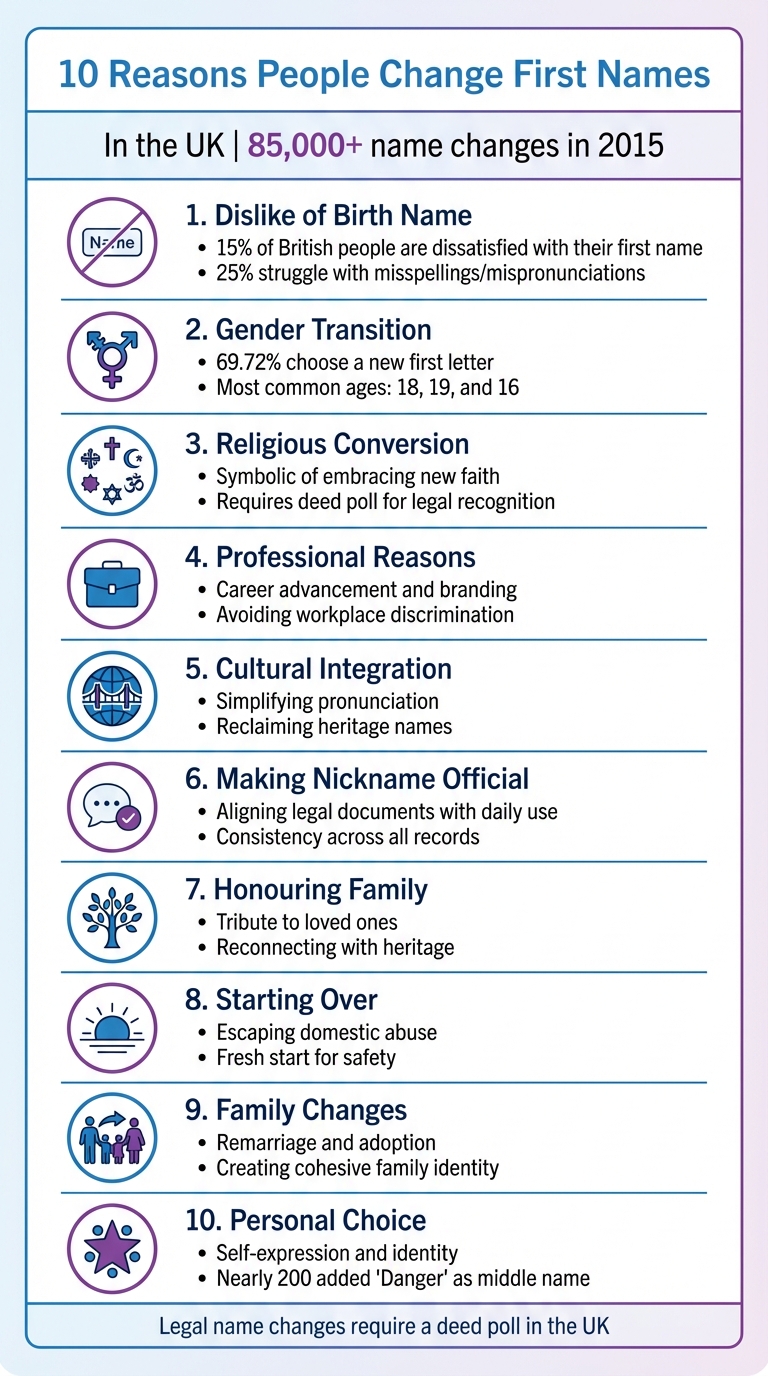
Top 10 Reasons People Change Their First Names in the UK
1. Dislike of Birth Name
Feeling unhappy with your birth name is one of the most common reasons people decide to legally change it. In fact, research reveals that 15% of British people are dissatisfied with their given first names. That’s about one in seven individuals who feel uncomfortable with the name they were assigned at birth. This discomfort often leads to exploring deeply personal motivations for making a change.
The reasons for disliking a name can vary widely. For some, it’s the constant struggle with misspellings or mispronunciations - an issue reported by 25% of individuals. Others may feel their name is too ordinary and doesn’t reflect their individuality, while some find their name overly unusual. Interestingly, nearly half of those unhappy with their name say it feels "old-fashioned".
A name can also have a profound impact on self-esteem. Names that were the target of childhood teasing or are considered "silly" or "embarrassing" can leave lasting scars, causing discomfort well into adulthood. Author Julia Cresswell captures this sentiment perfectly:
It is a way of emancipating yourself from your past, particularly if you have unhappy associations.
For many, their birth name simply doesn’t align with who they are as adults. People often report that legally changing a name they dislike can dramatically boost self-esteem, helping to shed feelings of shame and increase confidence in both social and professional situations. Names like John, James, Susan, Andrew, and Emma frequently make the list of those most commonly disliked. Ultimately, when a birth name feels out of step with personal identity, embracing a new name can be a transformative choice. If you are ready to move forward, you can learn how to change your name legally to better reflect your identity.
sbb-itb-bf1bef6
2. Gender Transition and Identity
For many trans individuals, changing their first name is a key part of affirming their gender. This step helps align their outward presentation with their true identity.
"Changing one's name is a significant step in the journey of gender affirmation for many transgender individuals. It reflects not only their true identity but also their courage to embrace and express their authentic selves."
Data reveals that 69.72% of trans individuals select a new first name starting with a different letter, while 30.28% retain the same initial. Additionally, 80.87% opt to change their middle name. The most common ages for legal name changes are 18 (15.28%), 19 (10.98%), and 16 (8.99%). Among trans men, names like Noah (1.69%), Alex (1.57%), and Charlie (1.45%) are popular choices. For trans women, names such as Jessica (1.84%), Emily (1.47%), and Charlotte or Alice (1.29% each) are frequently chosen. These choices highlight the deep connection between names and personal identity.
legally changing a name also serves as evidence of living in one’s chosen gender, which is often required for obtaining a Gender Recognition Certificate or accessing gender-affirming surgeries. Beyond the legal documentation, this step symbolises a fresh start, paving the way for new personal and professional opportunities.
3. Religious Conversion
For many, embracing a new faith is about more than just belief - it’s a profound gesture of commitment and transformation. A name change often becomes a symbolic milestone, representing the start of a new spiritual chapter.
Different religions have their own traditions when it comes to name changes. In Islam, converts frequently choose names that embody virtues or signify their renewed identity. In Judaism, new members of the faith often adopt a Hebrew name and are referred to as the son or daughter of Abraham and Sarah in religious contexts. Sikhism, on the other hand, has a unique tradition where initiated men take the name "Singh" (meaning "lion") and women adopt "Kaur" (meaning "princess"). This practice, introduced on 13 April 1699, was aimed at eradicating caste-based distinctions. Christianity has a rich history of name changes during baptism, with individuals often selecting names of saints or figures from the Bible. Those entering monastic life may also take on a "name in religion". In Buddhism and Hinduism, spiritual leaders frequently confer new names during initiation ceremonies, further reinforcing the spiritual significance of this act.
The importance of names in religious contexts is also reflected in legal considerations.
Changing your name for religious reasons is a personal decision. Whether you're converting to a new faith, reaffirming your spiritual beliefs, or adopting a name that better reflects your devotion, a name change can be a powerful and meaningful decision.
Some people take this expression of faith even further. For instance, Steve Kreuscher legally changed his name to "In God We Trust".
However, it’s important to note that religious ceremonies alone don’t legally formalise a name change. To make it official, documentation through a deed poll or other legal method is required. For smaller changes, such as adding a middle name after baptism, the UK Passport Office may accept baptism or confirmation certificates as supporting evidence.
Once your name change is legally recognised, don’t forget to update key institutions like HM Passport Office, DVLA, HMRC, and the NHS to ensure all records are consistent.
4. Professional and Career Reasons
While personal motivations often lead to name changes, professional goals can be just as influential. A name is often the first impression in a professional setting, and changing it can sometimes be a calculated career decision. This is especially common in the entertainment world. For example, Elton John was originally Reginald Kenneth Dwight, John Wayne started life as Marion Robert Morrison, and Elle Macpherson was born Eleanor Nancy Gow. These changes were deliberate branding decisions that helped shape their public personas and careers.
Outside of showbusiness, workplace dynamics and biases can also prompt name changes. Many professionals simplify or anglicise their names to avoid potential discrimination during recruitment or to make their names easier to pronounce, fostering smoother workplace interactions. Tony Thorne, a language consultant at King's College London, notes that "people are no longer prepared to live with a name that has been assigned to them anymore". This highlights a growing desire to take control of how one's identity is perceived professionally.
Another important reason for a name change is managing one's online reputation. For instance, Wafah Dufour, a US-born model and niece of Osama Bin Laden, adopted her mother’s maiden name after the events of 11 September 2001. This decision allowed her to distance her professional identity from her uncle’s actions and build her own independent reputation. Such examples show how a name change can help individuals separate themselves from negative associations.
In today’s interconnected business world, simplicity matters. Names that are difficult to pronounce or remember can become barriers to networking and building client relationships. On the other hand, accessible names can enhance communication and open up career opportunities. Some professionals even align their legal names with their social media usernames to maintain consistency across their personal and professional identities.
If you're considering a name change for professional reasons, it’s wise to check how it might be received by employers or professional organisations. Once the change is made through a deed poll, it’s essential to update your details with key institutions like HM Passport Office, DVLA, and HMRC to ensure all your official documents are consistent.
5. Cultural Integration or Anglicisation
Becoming part of British society often involves grappling with challenges like pronunciation and spelling. Foreign names are frequently mispronounced or misspelled, leading many to anglicise their names to make daily interactions smoother. This can help with tasks like booking a table or picking up a parcel, where a simplified name avoids confusion.
For some, anglicising their name goes beyond convenience - it’s a way to combat discrimination. In job applications, for example, having a name that sounds more recognisably British can sometimes help bypass potential bias in the hiring process. It’s an unfortunate reality, but one that influences many decisions.
Interestingly, the reverse is also true. Some people choose to reclaim their original names, undoing past anglicisation to reconnect with their heritage. Whether someone is anglicising or de-anglicising, the aim is often the same: aligning their official name with how they wish to be perceived and known.
If you’re thinking about changing your name, it’s important to know that the Home Office requires consistency. Your chosen name must be used across all official documents, including passports, driving licences, and tax records. Updating your passport, for instance, will require at least two documents - like utility bills or bank statements - showing your new name in use.
For a hassle-free way to handle the legal side of things, services like Name Change offer secure online deed polls. These ensure your new name is recognised by UK government departments and organisations. It’s a practical solution for those balancing personal identity with the realities of everyday life.
6. Making a Nickname Official
If you've always been called "Charlie" instead of Charles, you might find it frustrating when your legal name doesn’t match the one you use daily. Over time, this mismatch can become more than just an annoyance - especially when your nickname feels like a core part of your identity. Many people decide to make their nickname official so that important documents like passports, driving licences, and bank accounts reflect the name they actually go by. This step can be particularly useful in certain professions, where consistency in identity matters.
For those in creative or professional fields, aligning a legal name with a public persona is often a practical move. Whether it’s a stage name or a professional nickname, having the same name across all records helps reinforce a personal brand and avoids confusion.
Making this change involves some legal steps to ensure all your official documents are updated. Typically, this means completing a deed poll, which is recognised by agencies like the Passport Office and the DVLA . As Amphlett Lissimore notes:
A deed poll or statutory declaration is more readily accepted by authorities.
However, the process isn’t always straightforward. The Home Office may take a closer look at name changes that seem unusual or frivolous. If your nickname is unconventional, you might be asked to provide proof - like utility bills or payslips - that shows you’ve been using it consistently across different aspects of your life . Keeping a consistent paper trail is key to avoiding complications down the road.
7. Honouring Family Members
Changing your first name can be a heartfelt way to pay tribute to a loved one or reconnect with your family’s heritage. Some people choose the name of a late grandparent, add a middle name in honour of a respected relative, or even restore an ancestral name that has faded over time. It’s a deeply personal gesture, acknowledging the enduring impact of family bonds. This process often leads individuals to delve into their family history for inspiration.
Exploring genealogical records can uncover original family names that may have been anglicised or altered in the past. By restoring these names, you can strengthen your connection to your roots and lineage. In step-families, adopting a name shared with new family members can also create a stronger sense of unity and belonging.
To make this tribute official, you’ll need to complete a deed poll. Once the change is legally recognised, it’s important to update key documents like your passport and bank accounts to avoid any complications. For those in the UK, services such as Name Change (https://namechange.org.uk) provide a simple and reliable way to navigate the deed poll process, ensuring your new name is acknowledged across all official records and institutions.
8. Starting Over After Domestic Issues
For individuals who have experienced domestic abuse or stalking, changing your first name can be a vital step towards reclaiming safety and building a fresh start. This process is not just about creating a new identity - it’s also a way to shield yourself from being tracked through public records. On a deeper level, it can provide emotional relief, helping to sever ties with past trauma and the negative associations linked to your former name.
To keep your safety intact, it’s crucial to understand the legal implications of changing your name. Opt for an unenrolled deed poll rather than an enrolled one. Why? Because enrolling a deed poll creates a searchable public record in the London Gazette, which might inadvertently expose your new identity to the very person you’re trying to avoid. An unenrolled deed poll, on the other hand, keeps your name change private while still serving as legal proof for updating essential documents like your passport, driving licence, and bank accounts.
The Home Office understands the challenges faced by vulnerable individuals and may offer additional flexibility in certain cases. If your name change is for safety reasons, your application should include evidence from a recognised authority, such as the police, a refuge service, or another accredited organisation. This documentation can make it easier to update your official records and ensure the process runs smoothly.
Once your deed poll is complete, it’s important to update your details with key institutions as soon as possible. Services like Name Change (https://namechange.org.uk) can simplify this step by providing a secure deed poll process, certified copies, tracked delivery, and digital archiving. Make sure your new name is consistently updated with organisations like the DVLA, your bank, and your employer to avoid any complications.
9. Changes in Family Relationships
Family dynamics can shift dramatically through remarriages, adoptions, estrangements, or reconciliations, often leading to changes in names. These adjustments are deeply personal and can reflect a desire to embrace a new chapter or move away from a difficult past.
When families blend through remarriage, name changes can help create a sense of unity. Both children and adults may choose to adopt a new surname to reflect their new family structure. As Colie Christensen explains:
Changing a child's surname... is typically driven by the wish to create a cohesive family identity or to better represent the child's current situation.
This sense of togetherness can be incredibly significant, offering a shared identity that mirrors the new family bonds.
On the other hand, estrangement can also motivate name changes. If a relationship with a parent or relative has broken down, carrying their name might feel like holding onto an unwanted connection. For some, changing their name becomes a powerful way to reclaim their identity and leave behind painful associations.
For children in blended families, changing a first name isn't always straightforward. Consent is required from everyone with parental responsibility. If an agreement can't be reached, families may need to apply to the court using a C100 form, which costs £215. Many families trial the new name socially before making it official.
Whether the goal is to integrate into a new family or break free from the past, a deed poll provides a legal route to finalise the change. Services like Name Change (https://namechange.org.uk) simplify the process, offering packages starting at £16.95. These include certified copies, tracked delivery, and PDF archiving to help update official records smoothly and efficiently.
10. Personal Choice and Self-Expression
Sometimes, changing a name isn't about external influences or family expectations - it’s simply about embracing personal identity. For many, a new name becomes a way to express who they truly are, unconnected to trauma, transition, or societal pressures. In the UK, the law allows anyone to adopt a name of their choice, as long as there’s no intent to deceive or commit fraud.
This freedom has led to some fascinating choices. Nearly 200 people have added "Danger" as their middle name, while others have opted for names inspired by celebrities, whimsical ideas, or even bold political statements. Writer Brinna Blaine beautifully sums up the sentiment behind such decisions:
Find a name that fits not just who you feel you are but who you feel you want to be. Choose a name that makes you feel powerful and strong.
That said, there are practicalities to consider. For instance, HM Passport Office may view names changed for bets or commercial purposes as "frivolous", which could require extra proof that the name is genuinely in use.
If you’re ready to make your new name official, services like Name Change (https://namechange.org.uk) offer packages starting at £16.95. These include certified copies, tracked delivery, and PDF archiving. Whether you’re honouring someone you admire, making a statement, or simply choosing a name that resonates with your identity, the process is straightforward and legally valid throughout the UK. Personal choice remains a key driver behind the ever-changing landscape of names in the UK.
Conclusion
Changing your first name is a deeply personal decision, with reasons as diverse as the individuals making them. It could stem from a gender transition, a religious conversion, a desire to leave behind challenging circumstances, or simply finding a name that resonates more. In 2015 alone, over 85,000 people in the UK chose to change their names by deed poll.
Legally, the process is straightforward. You have the right to change your name at any time, as long as it’s not done for fraudulent purposes. The Deed Poll Office puts it plainly: "So long as you are not changing your name for fraudulent purposes, it doesn't matter what the reason is - it's your right to be known by whatever name you wish". This legal clarity ensures that everyone has the freedom to embrace a name that reflects who they are, whether it's making a nickname official or marking a fresh start.
For those looking to update their records with ease, Name Change (https://namechange.org.uk) offers a simple and efficient service. Starting at £16.95, they provide everything you need, including printed documents, certified copies, tracked delivery, and PDF archiving. Their process is designed to ensure acceptance by UK government departments and organisations, eliminating the need for solicitors.
With a secure and hassle-free approach, taking on a new name becomes an empowering step towards living as your true self. Whatever your reasons - practical, personal, or otherwise - changing your name is a legitimate way to align your identity with who you truly are.
FAQs
How will changing my name affect my legal documents in the UK?
Changing your name in the UK becomes legally valid once you have a proper deed poll. If you're 16 or older, you can create an unenrolled deed poll, while those aged 18 or above can apply for an enrolled deed poll, which is officially recorded by the High Court. However, your new name must meet certain rules: it has to be pronounceable, cannot include symbols or numbers (except for hyphens), and must not be offensive or used with fraudulent intentions.
After obtaining your deed poll, the next step is updating all official records tied to your old name. This includes essentials like your passport, driving licence, tax records, NHS records, bank accounts, and any other services where your name is registered. To make these changes, you'll usually need to provide the original deed poll or a certified copy. Keeping all your records consistent is crucial to avoid complications when travelling, accessing services, or managing finances.
For a smoother experience, Name Change offers a reliable service to create an unenrolled deed poll, supply certified copies, and ensure your new name is accepted by all relevant UK government departments and organisations. This service can help you get started quickly and confidently with updating your records.
How can I change my name for safety reasons in the UK?
If you need to change your name for safety reasons, the process is much like any other name change, but maintaining privacy is absolutely crucial. Start by checking if you qualify for a sealed name change through your local court. In situations where your safety is genuinely at risk, some jurisdictions in the UK allow court orders to remain confidential. If this option isn’t available, you could opt for an unenrolled deed poll, which doesn’t require public notice and is widely recognised by UK government organisations.
Once you’ve obtained the necessary legal document - whether it’s a sealed court order or a deed poll - you’ll need to inform key organisations. These include HM Passport Office, the DVLA, your bank, the NHS, and your local council. Make sure to handle these updates discreetly to protect your privacy. It’s also a good idea to keep certified copies of your name-change document for future use. If you’re feeling unsure or at risk, reaching out to a solicitor or a support service can provide valuable guidance.
For a secure and simple solution, Name Change offers an unenrolled deed poll service that prioritises your privacy while supplying all the documents accepted by UK authorities.
Can changing my name affect my job prospects?
Yes, changing your name can have an impact on your career prospects. Studies indicate that shorter, simpler names are often viewed as more professional, which can influence hiring decisions and even earning potential. A name that's easy to pronounce or spell might help you make a stronger impression in competitive job markets and could stick in the minds of potential employers.
If you're thinking about changing your name for professional reasons, take some time to consider how the new name aligns with both your personal identity and career aspirations.