Ultimate Guide to Local Council Name Change Policies
Changing your name with one UK body does not update your local council records. If I want my council records to match, I need to contact each service on its own.
Here’s the short version:
- Council tax and the electoral register are separate
- I may also need to update:
- housing records
- Housing Benefit
- Council Tax Reduction
- school admissions
- SEND files
- adult or children’s social care records
- Councils usually ask for:
- my old name
- my new name
- my address
- my account or case reference
- proof of the change
- Proof often includes:
- an unenrolled deed poll
- marriage or civil partnership certificate
- final order after divorce or dissolution
- other legal papers, depending on whether you need an unenrolled or enrolled deed poll
- Many councils process online requests in around 5 to 10 working days
- In most cases, the update is free
If I miss one record, I can end up with bills, letters, or support records in different names. That can slow down ID checks, benefit checks, and proof-of-address use. A council tax bill, for example, is often used when opening accounts or dealing with lenders.
The main point is simple: I should gather one accepted name-change document, then update each council service one by one, and check the first new bill or letter that comes back.
Quick comparison
| Record or issue | What I need to know |
|---|---|
| Council tax | Must usually be updated direct with the council |
| Electoral register | Separate from council tax |
| Housing and local support | May affect payments if names do not match |
| Children’s records | Often need consent from all with parental responsibility |
| Adult social care | Should match my legal name |
| Cost | Usually £0 |
| Common processing time | Around 5–10 working days online |
So before I start, I make a short list of every council record that uses my name, send the same spelling and the same proof each time, and keep copies of every reply.
sbb-itb-bf1bef6
Documents councils usually accept as proof of a name change

Councils need proof that connects your old name to your new one. Once you’ve got that sorted, the next job is updating the council records that still show your old details.
Deed polls, marriage certificates and divorce documents
The right document depends on why your name is changing. If you’re changing your name by choice, a deed poll is usually the standard option. If you’re taking a spouse’s surname after marriage or civil partnership, your marriage or civil partnership certificate is often enough on its own.
If you want to change your name after divorce or dissolution, councils will usually accept a final order (formerly decree absolute). If you’ve been widowed, councils normally accept your spouse’s death certificate along with the marriage certificate.
For gender transition, councils generally accept a Gender Recognition Certificate or a statutory declaration.
This is the proof councils check before they update tax, registration and service records.
Unenrolled vs enrolled deed polls: what the difference means in practice
There are two types of deed poll: unenrolled and enrolled.
An unenrolled deed poll is a private document. It becomes valid as soon as it is signed and witnessed. An enrolled deed poll is filed at the Royal Courts of Justice and published in The London Gazette, which means the change becomes part of the public record.
In practice, the big issue is privacy. For most people, enrolling a deed poll isn’t needed just to update council records. Councils usually accept a properly executed unenrolled deed poll as valid proof. Enrolled deed polls tend to matter only in certain legal cases or for some overseas requirements.
Using a deed poll service such as Name Change
If you need to update several records at once, certified copies can make life a lot easier. Some councils ask for an original or a certified copy rather than a plain photocopy.
Name Change provides unenrolled deed polls with certified copies. That means you can send proof to your council and other organisations at the same time instead of waiting for one document to be posted back before you deal with the next update.
Council records you may need to update after a name change
Once you have changed your name legally and have proof, the next job is updating the council records that apply to you. You may not need to change every record. It depends on your situation.
Council tax and the electoral register
Your council tax account is one of the main records to update. It helps to keep council records in step. If names don’t match, bills, registration and related checks can get held up.
The electoral register is a separate record, so it needs its own update. In plain terms, changing one does not change the other.
Housing, council support and local benefits
If you rent from a council or housing association, your tenancy record should show your legal name. The same goes for housing benefit, Council Tax Reduction and similar local support schemes.
These records are used for identity checks and payments. If the name on file doesn’t match your legal name, payments can be delayed or even paused.
One point that catches people out: a name change does not affect your council tax band. Bands are based on the value of the property, not on your personal details.
Education, children's services and social care records
If you have children or use care services, those records should be updated too.
If your children are in the local school system, school admissions records may need changing. Councils also manage Special Educational Needs and Disabilities (SEND) records and children’s social care files. Those records should match your legal name so there’s no hold-up later.
For adults who use social care, the council keeps records in your name as well. Keeping them in step can help avoid admin issues and identity mismatches.
Councils usually update records from the date they’re told, not from an earlier date.
| Council record | Who it typically applies to |
|---|---|
| Council tax account | Most adults (owners and renters) |
| Electoral register | All eligible voters |
| Social housing tenancy | Council and housing association tenants |
| Housing benefit / Council Tax Reduction | Low-income residents |
| School admissions | Parents and guardians |
| SEND records | Children with additional needs |
| Social care files | Adults and children receiving care services |
After you’ve worked out which records apply to you, the next step is sending the right evidence to the council. Most councils then ask for proof of the name change and a short request form, which the next section covers.
How councils process a name change request
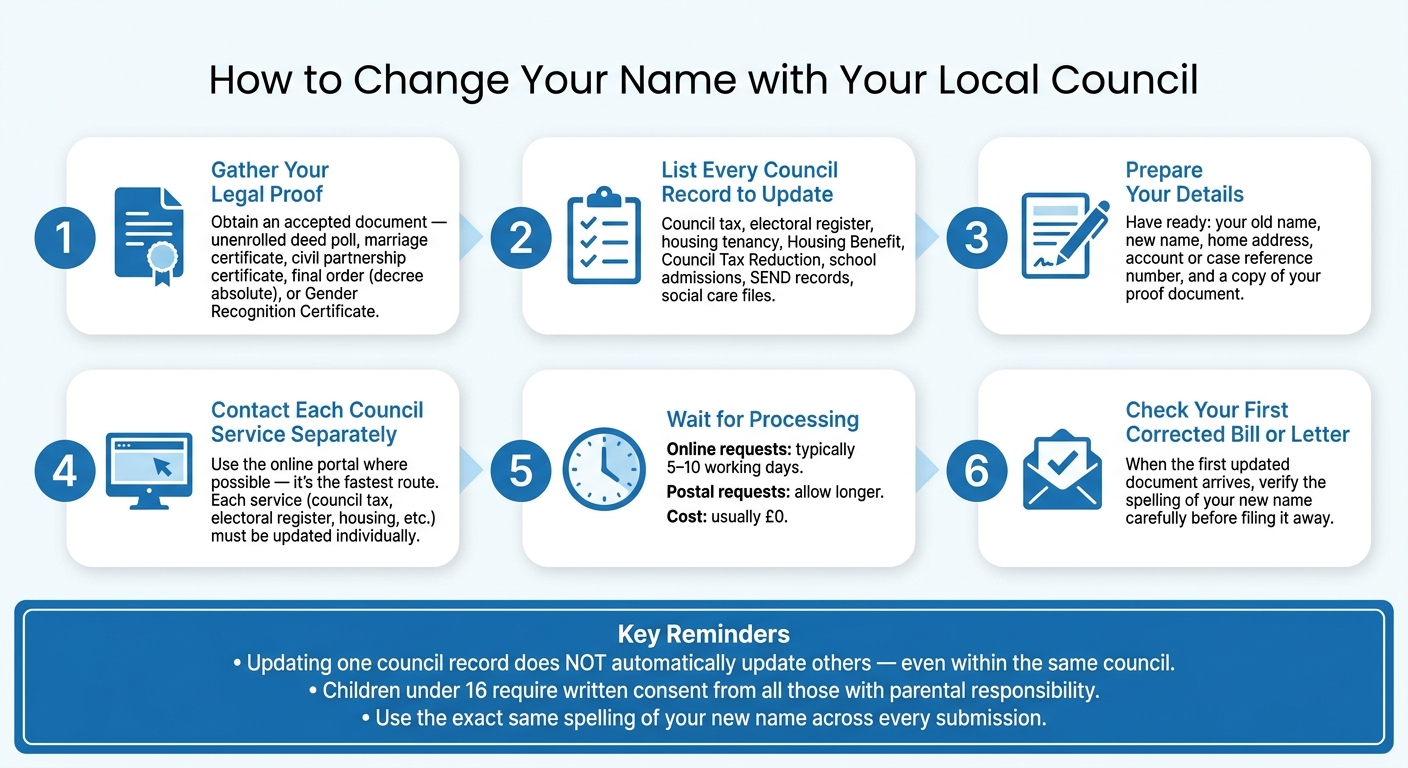
How to Change Your Name with Your Local Council: Step-by-Step Guide
Evidence, forms and contact channels councils typically use
When you ask a council to update your name for council tax, electoral registration, housing or care records, they usually want three things: proof, a form, and your reference number.
In most cases, you'll need to send:
- your account or reference number
- your old name
- your new name
- your address
- a copy of the document that supports the change
Some councils also ask for photo ID, such as a passport or driving licence.
Online portals are usually the fastest route. Most councils now push people towards online forms or upload systems, which makes sense. It cuts out back-and-forth and gives their staff what they need in one go.
The table below shows how the process usually works across common service areas.
| Council Service Area | Typical Reporting Channel | Standard Information Requested |
|---|---|---|
| Council Tax | Online portal, email, phone | Account number, old/new name, proof of change |
| Electoral Register | Online form (GOV.UK) or council portal | Old/new name, address |
| Housing and Benefits | Online portal or in-person | Reference number, proof of name change, income details |
| Education and Social Care | Direct department contact | Case reference number, legal proof, parental consent (for children) |
Processes vary between councils, so follow the authority's own email, upload or portal instructions.
If you're on a joint council tax account, some councils also want consent or a signature from the other account holder before they process the change.
Extra requirements for updating a child's name in council records
Updating a child's name in council records usually involves more checks.
For children under 16, councils will usually need written consent from everyone with parental responsibility. If there isn't agreement, a court order may be needed.
Education and social care records often come with extra checks too. Young people aged 16 or 17 can usually sign their own deed poll and do not need parental consent to update council records. That said, some councils still suggest parental involvement if the deed is going to be enrolled with the Royal Courts of Justice.
Timescales, costs and how councils handle your documents
At most UK local authorities, updating council records is free.
Online submissions are usually processed within 5–10 working days. Postal requests tend to take longer, so if you have to send documents by post, use recorded delivery.
Councils don't all handle paperwork in the same way. Some accept digital uploads, while others ask for original documents instead of photocopies. Once the update is done, check the first corrected record carefully before filing the confirmation away.
Coordinating council updates with other UK records and a final checklist
Council records and national records are updated separately
Council updates still need to be made separately. If your details don’t match across records, that can delay mortgage, benefit and identity checks. So it helps to plan the order before you start.
Even within the same council, systems don’t always link up. Updating your council tax record doesn’t mean your housing benefit record will change too. The safest way to handle it is to treat each council service as a separate job.
A practical order for notifying organisations
Once your legal proof is ready, deal with the top-priority records first. Start with the documents you use most, then work through each council record one by one.
- Obtain your legal proof - a deed poll, marriage certificate or decree absolute. Name Change can produce a professionally drafted unenrolled deed poll with certified copies, which helps if you need to send proof to several organisations at the same time.
- Update national photo ID - apply for a new passport (£94.50 online for an adult renewal) and update your driving licence with the DVLA (free of charge). These usually become your main ID for later updates.
- Notify HMRC - update your National Insurance and tax records using your new photo ID as supporting evidence.
- Contact each council service separately - use the same spelling of your new name every time, and send the same supporting document to council tax, the electoral registration officer, housing benefits and any other department that applies to you.
After that, move through the council departments tied to your day-to-day records. Update each one separately.
Conclusion: Key points to remember
Use this order to cut down the chance of missed updates.
Councils accept a range of valid name change evidence. An unenrolled deed poll, marriage certificate or decree absolute will work for most purposes. Each council service may have its own form and its own evidence check, so handle them as separate tasks. For children’s records, councils will usually need consent from everyone with parental responsibility. When the first bill or letter arrives from each service, check the spelling of your new name carefully.
FAQs
Do I need to tell every council department separately?
Usually, no. If you tell your local council about your name change, often through the council tax department, ask them to update all relevant records at the same time.
That said, council processes can differ. It’s worth checking with your local authority to see whether one notice covers every department, or whether you’ll need to contact any teams separately.
Will changing my name affect my council tax bill or band?
No. Changing your name does not affect your council tax band.
Council tax bands are based on the value of the property, not the name or personal details of the person living there.
If you’ve changed your name legally, you should let your local council know so they can update the name on your bill. But that update won’t change your band or the amount of council tax you pay.
What if my council asks for original documents?
If your local council asks for original documents, you’ll need to send exactly that. The rules can change from one local authority to another. Some will accept digital copies, while others may ask you to show your original ID or deed poll in person.
If you’re posting documents, follow the council’s instructions closely. Some councils want originals, not photocopies, and sending the wrong version can lead to delays or a rejected request.