How to Update Electoral Roll After Name Change
Changed your name? You need to tell your Electoral Registration Office yourself. In most cases, the update is free, and you’ll either ask your council to amend your entry or submit a new voter registration in your new name.
Here’s the short version:
- Contact your local council or Electoral Registration Office (ERO) first
- Check how they want the update sent: online, by email, by post, or on a paper form
- Send proof of your name change, such as:
- an unenrolled deed poll
- a marriage certificate
- a civil partnership certificate
- a decree absolute/final order
- a certificate of naturalisation
- Have your National Insurance number ready
- Keep copies of what you send and any confirmation
- Do it early if an election is close, because councils work to cut-off dates
In other words: if your old name is still on the electoral roll, don’t wait. A mismatch can cause problems with voting, ID checks, or jury service.
A few points matter most:
- If you still live at the same address, your council may let you send a name-change request
- If you have moved home, or your council cannot amend the old record, you may need to register again at GOV.UK
- If you live in Northern Ireland, updates are handled through the Electoral Office for Northern Ireland, and online updates are not available
- If you are an overseas voter, contact the ERO that manages your overseas registration
One point that catches people out: your deed poll provider does not update the electoral roll for you. The document is only your proof. You still need to contact the council.
A name update often needs just a small set of details:
- old name
- new full name
- date of birth
- current address
- date of name change
- National Insurance number
If the council asks for more, it may want a passport or driving licence in your new name.
| Route | When I’d use it | Where it goes |
|---|---|---|
| Name-change request | I still live at the same address and only my name has changed | My local council / ERO |
| New registration | I’ve moved, or my council wants a new application | gov.uk/register-to-vote |
My take: the safest move is to check your council’s process first, then send the proof in the format it asks for. That cuts down delays and helps you get confirmation sooner.
What the electoral register accepts
To update your electoral roll entry, contact your local Electoral Registration Office or register again using your new name.
You can ask your local Electoral Registration Office for a name-change form, or you can submit a new voter registration with your updated details. Your deed poll provider will not update the electoral roll for you. You need to tell your council yourself. The deed poll only acts as proof.
Contact your local Electoral Registration Office first
Before you send anything, check your council’s website or get in touch with its electoral services team. Councils don’t all handle name updates the same way.
Some use an online form. Some accept updates by email. Others want a paper form.
Once you know how your council deals with this, pull together the proof it asks for. That saves time and helps you avoid going back and forth.
When a council may ask for a new registration instead
Some councils can’t change an existing entry. In that case, they may ask you to make a new registration in your new name.
If that happens, have your National Insurance number ready. Overseas voters need to contact the ERO that deals with their overseas registration.
Next, check which documents count as acceptable evidence.
sbb-itb-bf1bef6
Documents you need
Once you know how your council wants you to send the update, get the proof ready.
Your Electoral Registration Office will usually ask for details such as your old name, your new name, your date of birth and your National Insurance number, along with evidence showing the change. It may also ask to see a passport or driving licence in your new name.
Accepted proof of a name change

The proof you need depends on how your name changed.
| Evidence Type | What It Proves | Typical Use |
|---|---|---|
| Unenrolled deed poll | Legal proof of name change | General name changes, adding or removing middle names, changing spellings |
| Marriage certificate | Proof of name change after marriage | Taking a spouse's surname after marriage |
| Civil partnership certificate | Proof of name change after civil partnership | Taking a partner's surname after a civil partnership |
| Decree absolute / final order | Legal dissolution of a marriage or civil partnership | Reverting to a previous name after divorce or dissolution |
| Certificate of naturalisation | Legal name upon gaining UK citizenship | Updating records after becoming a British citizen |
Using a deed poll as evidence
An unenrolled deed poll is legally valid in the UK. It is enough to update your name on the electoral register.
If you are using a deed poll, that will often be all your electoral roll update needs.
Once you have the right evidence, send the update using your council's chosen route.
How to submit the update
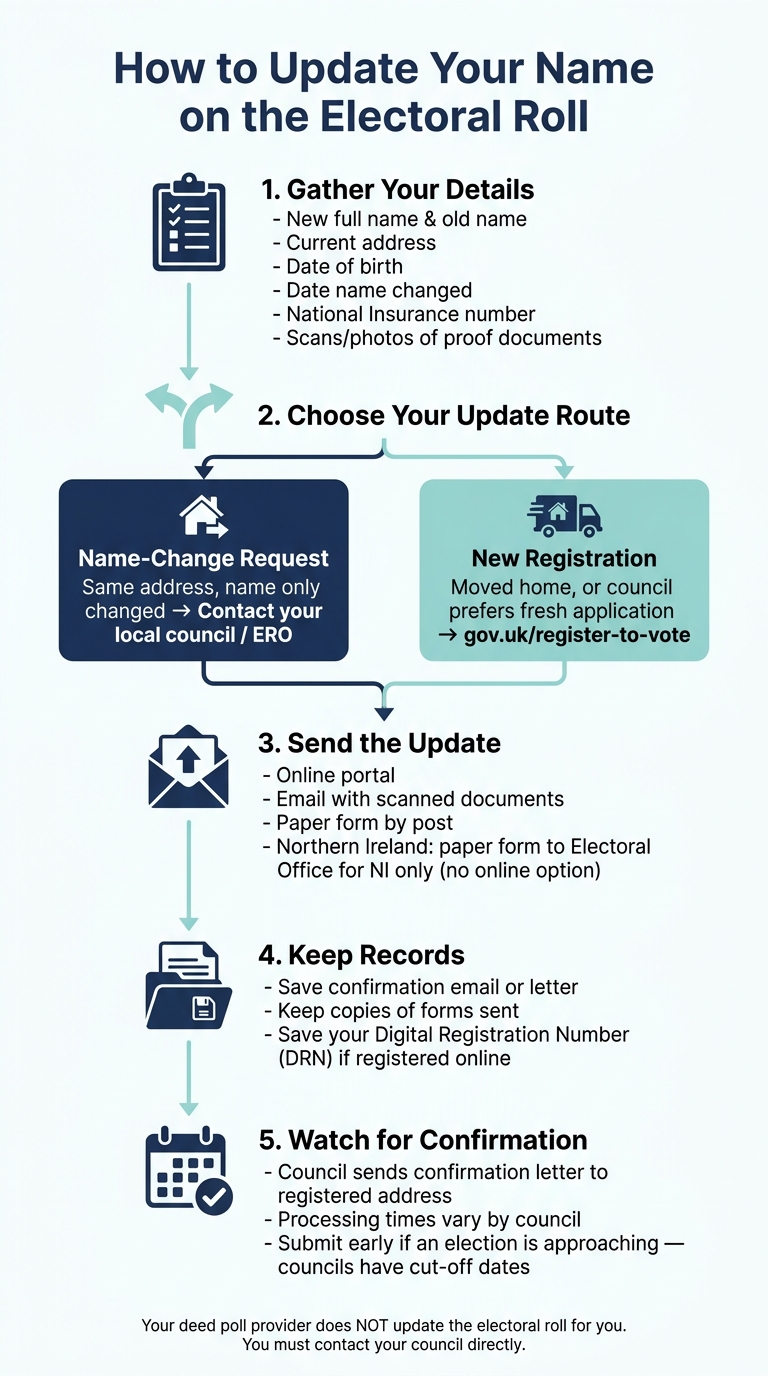
How to Update Your Name on the Electoral Roll: Step-by-Step
Submit your update using the method your council asks for. In plain terms, there are two main routes: a change-of-name request if you still live at the same address, or a new registration if you've moved or your council wants a fresh application.
| Route | When to Use | How to Submit |
|---|---|---|
| Change-of-name request | You are staying at the same address and only your name has changed | Contact your local council for its specific form; submit it via post, email, or an online portal |
| New registration | You have also moved house, or your council prefers a new application | Complete a new application at gov.uk/register-to-vote |
Step 1: Gather your details and copies
Before you contact your council, get everything together first. You’ll usually need your new full name, old name, current address, date of birth, date you legally changed your name, and National Insurance number.
If you’re sending documents online, have a clear scan or photo ready. That saves time and helps avoid back-and-forth later.
Once you’ve got the details ready, send them through your council’s chosen route.
Step 2: Send the request through the council's chosen route
Follow the method your council sets out. Some councils use an online portal where you can upload your form and evidence. Others ask you to email scanned documents or send paper forms by post.
In Northern Ireland, you need to submit a paper form to the Electoral Office for Northern Ireland. Online updates are not available.
After you send it, wait for confirmation before assuming the update is done.
Step 3: Confirm receipt and keep records
After you submit, keep the confirmation letter or email from your council. It’s also worth keeping copies of any completed forms and proof that you sent them.
If you register online, save your Digital Registration Number (DRN). You may need it later for future updates or for postal or proxy voting.
The change usually takes effect once the ERO processes your request.
When the change takes effect and key points to remember
After you submit the update, the main thing to watch is when the change is put in place. Processing times differ from one council to another, and it can take longer if the ERO asks for more details. That’s why it makes sense to send your request as soon as your legal name change is complete.
Timing can make a big difference if an election is coming up. Councils have cut-off dates, and missing one can be a pain, so check your local deadline early.
Once the ERO has processed your request, your council will usually send a confirmation letter to your registered address. It’s also worth updating HMRC, DWP and DVLA at the same time, so your details match across government records.
If you live in Northern Ireland, contact the Electoral Office for Northern Ireland directly or use the "Am I Registered" service, as the annual canvass does not apply there.
FAQs
How long does an electoral roll name update take?
There’s no single statutory deadline for updating your name on the electoral roll.
That said, it’s best to tell your local council as soon as your legal name change is complete. If you wait too long, you could run into delays that affect your voting eligibility.
If you used Name Change for your deed poll documents, this can help provide the evidence needed for your application. Sending your request promptly also helps keep your records in line and protects your right to vote.
Can I vote if my old name is still on the register?
Your legal name should match the name on your voter registration record. If the electoral register still shows your old name, you could run into delays at the polling station or have trouble voting.
To help protect your right to vote, update your details with your local electoral registration office as soon as you can. You’ll usually need to provide the evidence required for your name change.
What if my council refuses to amend my existing entry?
If your local electoral registration office refuses to amend your name, they should give you written notice of the review outcome. That notice should also explain the formal appeals process.
Check that you submitted a formal application with valid documentary evidence, such as an unenrolled deed poll. If the issue carries on, follow your council’s appeal guidance.