Why Apostille Errors Delay Name Changes
Errors in the apostille process can significantly delay legal name changes for use abroad. Here’s what you need to know:
- What is an Apostille? It’s a certificate verifying the authenticity of UK documents for international use, issued by the Foreign, Commonwealth & Development Office (FCDO).
- Why it Matters: Without an apostille, foreign entities like banks, employers, or immigration offices won’t accept your deed poll.
- Common Errors: Missing notary signatures, using unregistered notaries, damaged or laminated documents, or incomplete deed polls often lead to rejection.
- Costs and Delays: Mistakes require reapplication, costing £82–£95 per attempt and adding 15–21 days to the process.
To avoid delays, ensure your deed poll is properly certified using professional name change services, use FCDO-registered professionals, and meet all destination country requirements. A little preparation saves time and money.
Common Apostille Errors That Delay Name Changes
Mistakes in the apostille process can derail your deed poll application, leading to delays and extra costs. Here's a breakdown of five frequent errors that can disrupt the process:
Missing or Incorrect Notary Signatures
The Foreign, Commonwealth & Development Office (FCDO) relies on its database to verify notary signatures. Missing or incorrect signatures, as well as unsigned dates, result in immediate rejection. Only original, hand-signed (or "wet ink") signatures are accepted. As Vital Consular explains:
"If the signature is not original or the date is omitted, it will not be accepted as a valid certification".
To avoid issues, ensure the notary's stamp includes their full name, company name, and business address. Missing any of these details renders the certification invalid.
Using Unregistered Notaries or Solicitors
Documents must be certified by authorised solicitors or notaries. The FCDO checks that the solicitor who signs your documents is registered with the Solicitors Regulation Authority (SRA) and has a valid licence. If the solicitor is not registered, the certification is invalid, and your application will be rejected.
Additionally, UK solicitors are only permitted to certify documents issued in the UK.
Issues with Stamps, Seals, or Signatures
Problems like illegible stamps, missing seals, or incomplete certification formats can delay the deed poll verification process. Laminating your deed poll is another common mistake, as it prevents verification of the document’s originality and leads to rejection. Keep your deed poll unlaminated and ensure all stamps, seals, and signatures are clear.
Submitting Incomplete or Outdated Deed Polls
A valid deed poll must include three key legal declarations: abandoning your old name, adopting your new name for all purposes, and authorising others to use your new name. Missing any of these clauses invalidates the document. As the UK Name Change Team explains:
"A Deed Poll is a formal legal declaration. It must contain specific clauses... If any of these parts are missing or worded incorrectly, the document is invalid".
Witnessing errors can also cause problems. For example, having a family member or someone living at the same address act as a witness will lead to rejection by government bodies like the Passport Office, as they are not considered independent. Other issues, such as crossed-out text, unclear handwriting, or missing dates, can delay identity checks and result in rejection by banks and government offices.
Sending Documents to the Wrong Authority
For UK-issued documents, apostilles must be obtained through the FCDO’s Legalisation Office in Milton Keynes. Sending your deed poll to the wrong authority or attempting to legalise non-UK-issued documents will result in rejection.
It’s also important to understand that an apostille may not be the final step. If your destination country is not part of the Hague Convention (which includes over 120 member states), additional embassy legalisation may be required. Countries like the UAE, Qatar, and Jordan follow a multi-step process, and overlooking this can add weeks to your timeline.
To avoid delays, verify the requirements of your destination country and ensure all documents are UK-issued and properly certified before submitting them to the FCDO’s Legalisation Office.
sbb-itb-bf1bef6
How Apostille Errors Extend Processing Times
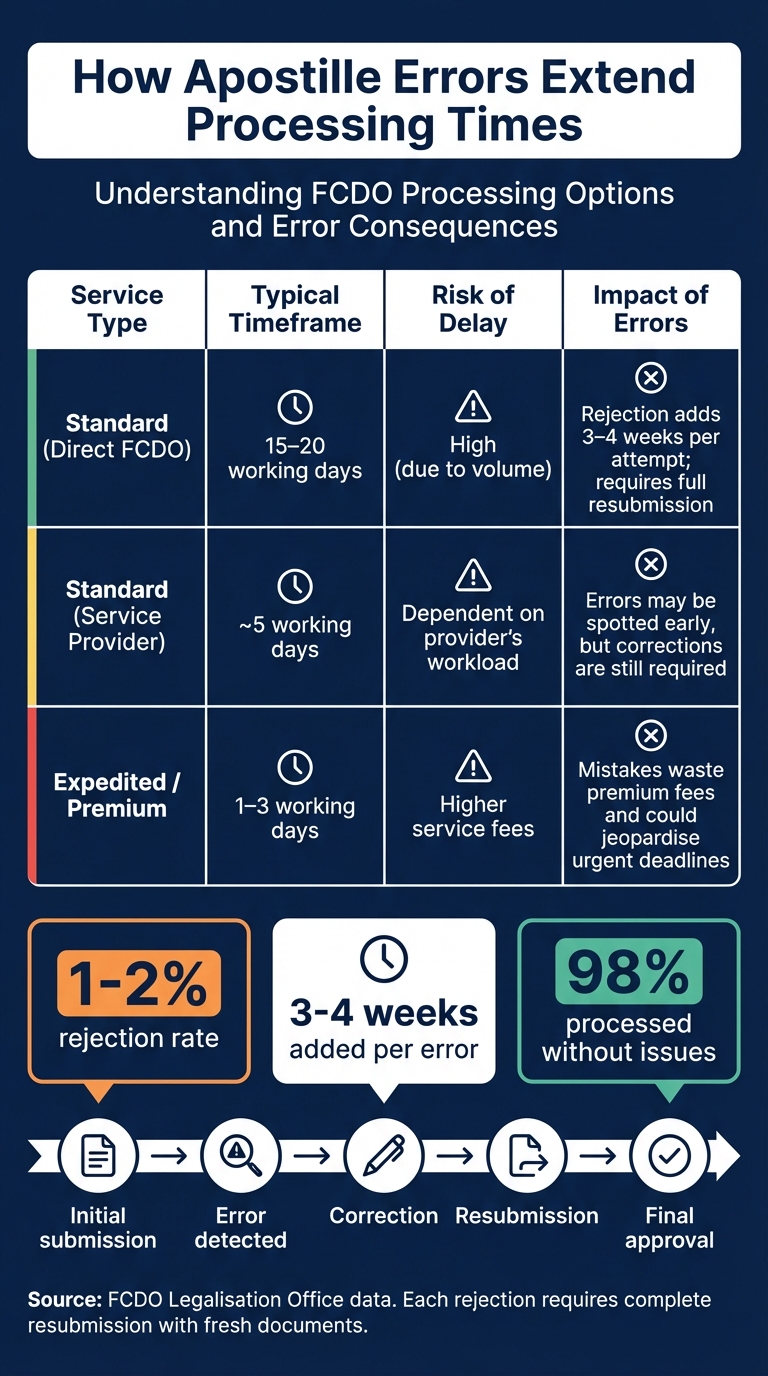
FCDO Apostille Processing Times and Error Impact Comparison
Mistakes in the apostille process can do more than just raise questions about document validity - they can also create frustrating delays in the name change process.
Standard vs Expedited Processing Times
The Foreign, Commonwealth & Development Office (FCDO) provides two processing options for apostilles, but errors can derail either one. Standard processing usually takes 15 to 20 working days, while expedited services promise a faster turnaround of 1–3 working days for an additional fee. However, neither option is immune to the impact of mistakes.
When errors occur in a standard application, the delay can stretch by an additional 3 to 4 weeks per attempt. This is because you’ll need to fix the error, get a new notary certification, and reapply. For expedited services, the stakes are even higher. Mistakes not only waste the extra money paid for speed but also risk missing critical deadlines, such as visa appointments or travel plans.
Here’s a quick breakdown of processing times, risks, and the consequences of errors:
| Service Type | Typical Timeframe | Risk of Delay | Impact of Errors |
|---|---|---|---|
| Standard (Direct FCDO) | 15–20 working days | High (due to volume) | Rejection adds 3–4 weeks per attempt; requires full resubmission |
| Standard (Service Provider) | ~5 working days | Dependent on provider's workload | Errors may be spotted early, but corrections are still required |
| Expedited / Premium | 1–3 working days | Higher service fees | Mistakes waste premium fees and could jeopardise urgent deadlines |
Even with expedited services, verification delays can occur, further extending the timeline. This highlights how even small errors can lead to significant setbacks.
Rejection Rates and Resubmission Delays
Roughly 1 to 2% of apostille applications are rejected. While this may seem like a small percentage, any rejection means starting over from scratch. This includes correcting the error, obtaining fresh original documents, and resubmitting the application. These steps can easily add weeks - or even months - to the timeline for changing your name legally in the UK.
Common mistakes include using a family member as a witness, submitting a photocopy instead of an original document, or sending papers to the wrong authority. Each of these errors results in a complete restart of the process.
A quote from Legalisation4you sums it up well:
"A clean resubmission often moves faster than a slow back and forth about the first outcome".
However, a rejection doesn’t just cost you time - it can also double your fees, as you’ll need to pay for the entire process again. For those with tight deadlines, such as upcoming travel or immigration requirements, these delays can cause serious complications.
How to Prevent Apostille Errors
Avoiding apostille errors is crucial to prevent delays in processing. Here are some practical steps to help you get it right the first time.
Use FCDO-Registered Notaries
The Foreign, Commonwealth & Development Office (FCDO) will only issue an apostille if the signature on your document matches its database. This means your solicitor or notary must already be registered with the FCDO. If they aren't, your application could be rejected. Before hiring someone, confirm their FCDO registration. If they’re not registered, they can apply by submitting their practising certificate details, but this might extend your timeline.
For routine certifications like "true copies" or witnessed signatures, a solicitor is usually enough and costs less (around £12 to £50). However, for complex international matters - or if the destination country specifically requires notarisation - it's safer to use a notary public, though this can cost between £80 and £250.
"The FCDO can only issue an apostille - a form of official authentication - if the document's signature is verified, and many documents require certification before this step." - Rosie Chalmers
Once you've chosen the right professional, double-check all document details to avoid simple errors.
Check All Documents Before Submission
Even minor mistakes can derail your application. Always use original documents with wet ink signatures; photocopies or digital scans are typically rejected unless certified as true copies by a registered professional. Make sure your witness is independent and legally qualified. The certification must include the certifier's full name, signature, date, and a clear statement like "Certified as a true copy of the original".
For notarial acts, check for the raised edges of an embossed seal. This seal should be visible on both sides of the document, confirming its authenticity.
Consider Professional Services
Professional deed poll services can help you avoid common errors from the outset. For instance, Name Change offers deed polls printed on high-quality parchment paper for £16.95 (or £24.95 for a premium version with a gold embossed stamp). Their packages include three certified copies ready for apostille submission, guaranteed acceptance by UK government departments, tracked delivery, and PDF archiving. These services also ensure that your deed poll includes the three key declarations: abandoning your old name, adopting your new one, and authorising its use for all purposes.
Confirm Destination Country Requirements
Different countries have different rules, so it’s essential to check the specific requirements of your destination. Confirm whether the receiving authority needs the document certified by a solicitor or a notary, as this varies by jurisdiction. Also, check if the country is part of the Hague Apostille Convention - over 120 countries accept apostilles. For non-member countries, additional embassy legalisation may be required, which could increase both time and costs. If the document is for use in a non-English-speaking country, you might also need a professional translation alongside the apostille.
Taking these steps can save you time, money, and frustration in the long run.
Steps to Obtain an Apostille for Your Deed Poll
To ensure a smooth apostille process, follow these four key steps carefully.
Prepare Your Deed Poll
Start by preparing a properly formatted deed poll that complies with international standards. A good option is to use services like Name Change, which provide a deed poll along with three certified copies, tracked delivery, and PDF archiving.
Your deed poll must include three essential declarations: that you are giving up your old name, adopting your new name for all purposes, and allowing others to address you by your new name. Make sure the document is signed in the presence of an independent and legally qualified witness.
"A Deed Poll is a simple legal tool, but only when prepared and signed correctly." – UK Deed Poll Office
Once your deed poll is correctly prepared, the next step is obtaining notary certification.
Obtain Notary Certification
To certify your deed poll, visit a notary or solicitor who is recognised by the Foreign, Commonwealth & Development Office (FCDO). You’ll need to present valid photo identification, such as a passport or driving licence, along with proof of address like a utility bill or bank statement.
The notary can certify your deed poll in one of three ways: by witnessing your signature, certifying a "true copy" of the original, or confirming the document as a valid method of name change in the UK. Fees will depend on the provider you choose.
Once certified, you can move on to submission with the FCDO for apostille processing.
Submit Your Documents to the FCDO
Send your certified deed poll to the Legalisation Office in Milton Keynes. The FCDO provides two service options: standard processing, which usually takes 2–5 working days, and a premium next-day service priced at about £79. Always use tracked delivery and respond quickly to any feedback.
The FCDO accepts both original deed polls signed by a notary and notarised certified copies. If you’re relocating abroad, you might find it efficient to submit other documents requiring apostilles - like passports or educational certificates - at the same time.
After submission, be prepared to handle any queries from the FCDO.
Respond Quickly to FCDO Queries
If the FCDO spots an issue, they’ll contact you for clarification or return your documents. Respond promptly to avoid delays. Common problems include unclear notary stamps, missing details, or formatting errors.
Users of professional apostille services often report quick processing and reliable communication, with documents successfully delivered internationally within 3–4 days.
Conclusion
Apostille errors can do more than just delay the legal process of changing your name - they can also increase your overall costs. While about 98% of apostille applications are processed without any issues, the remaining 1% to 2% encounter delays or rejections, often because of avoidable mistakes.
The good news? Most of these delays can be prevented. To minimise the chances of rejection, ensure your deed poll is prepared with the correct legal wording, have it certified by an FCDO-registered notary, and always submit "wet ink" originals rather than copies. One of the most frequent reasons for rejection by HM Passport Office is using a family member as a witness, so make sure your witnesses are independent.
If you're planning to use your name change documents abroad, check the requirements of your destination. Some countries accept e-Apostilles, which are usually processed within two working days, while others may require the standard paper version, which can take up to 15 working days.
Start with Name Change for a deed poll that meets UK legal standards. With the right preparation and certification, you can avoid common mistakes and navigate the international name change process with ease.
FAQs
Do I need a solicitor or notary for my apostille?
You usually don’t need a solicitor or notary to obtain an apostille. Most of the time, government-issued documents with a wet ink signature are eligible for an apostille without needing extra certification. However, it’s crucial to check that your document meets all the required criteria before submitting it to avoid any unnecessary delays.
Will my apostille be accepted in my destination country?
Your apostille will generally be accepted as long as it aligns with the specific requirements of the destination country. However, rejections can occur for various reasons, such as invalid or incomplete documents, errors in issuance, or problems with translations. To prevent unnecessary delays, double-check that all your documents are correctly verified and meet the necessary guidelines.
Can I apostille a certified copy instead of the original deed poll?
A Deed Poll must be notarised or witnessed by a solicitor before a certified copy can be apostilled. According to government regulations, private documents like these need to be certified to meet the requirements for apostille processing.