Why First Name Changes Get Rejected and How to Avoid It
Changing your first name in the UK can be more complicated than you might expect. Applications are often rejected for reasons like formatting errors, offensive names, or insufficient evidence. To succeed, you need to meet strict rules, including providing proof of consistent use and ensuring your name complies with official guidelines.
Here’s what you need to know:
- Avoid offensive or inappropriate names: Vulgar, misleading, or criminally associated names will be rejected.
- Follow formatting rules: Only letters, hyphens, and apostrophes are allowed. Names must be pronounceable and within character limits.
- Provide evidence: At least two documents (e.g., bank statements, utility bills) are required to prove your new name is used officially.
- Ensure consistency: Your name must match across all official documents, including passports and legal records.
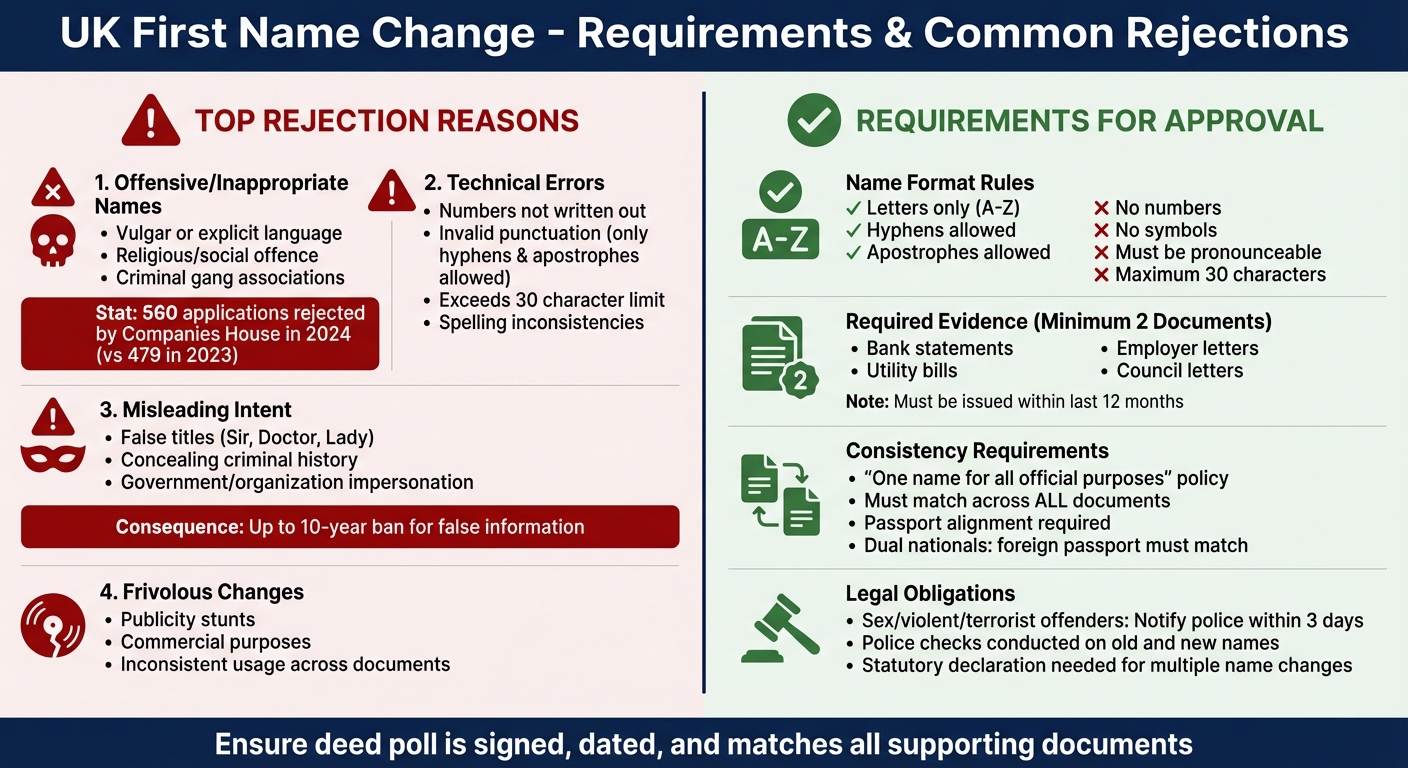
How to Successfully Change Your First Name in the UK: Requirements and Common Rejection Reasons
Why First Name Changes Get Rejected
In the UK, strict rules govern the approval of name changes to maintain the integrity of official documents. Even small mistakes can lead to rejection. Here’s a closer look at the common reasons applications are turned down.
Offensive or Inappropriate Names
Applications are rejected if the proposed name includes offensive language, explicit terms, or anything deemed vulgar. Authorities carefully review both the written and spoken forms of names to ensure they won’t cause offence. Religious and social considerations also come into play - names with inappropriate religious connotations or slanderous meanings are not allowed. Similarly, names linked to criminal gangs, extremist groups, or those that promote racial or religious hatred are strictly prohibited. For example, Companies House rejected 560 applications in 2024 for names deemed offensive or potentially criminal, compared to 479 in 2023.
Technical Errors and Formatting Problems
Names must follow International Civil Aviation Organisation (ICAO) guidelines. These rules prohibit numbers (unless written out), restrict punctuation to hyphens and apostrophes, and limit names to a maximum of 30 characters. Even minor inconsistencies, like spelling "Mathew" instead of "Matthew", require supporting evidence to verify the correct version. Additionally, double-barrelled surnames must include either a space or a hyphen - otherwise, they are treated as entirely new names requiring a deed poll. Beyond formatting, authorities also assess the intent behind the name change.
Misleading or Fraudulent Intent
Names that suggest deception or false authority are a red flag for rejection. Authorities scrutinise applications to ensure they don’t conceal criminal history or create misleading impressions. For instance, names that attempt to obscure someone’s presence on the sex offenders register or imply unearned titles like "Sir" or "Doctor" are not approved. Submitting false information can have serious consequences, including a ban from reapplying for up to 10 years. The Home Office guidance states:
The applicant has used deception if they knowingly submitted a false document. You must consider whether, on the balance of probabilities, the applicant knew they were submitting a false document.
Names that falsely imply connections to the UK government or international organisations are also prohibited.
Frivolous or Non-Genuine Changes
Authorities are quick to reject applications that lack genuine intent. This includes names chosen for humour, publicity stunts, or commercial purposes. To be approved, the new name must be consistently used across all official records, such as bank statements, employer letters, and utility bills. If the documentation suggests the change is temporary or not genuinely adopted in everyday life, the application will fail. Consistency is critical - the UK government adheres to a "one name for all official purposes" policy.
sbb-itb-bf1bef6
Legal Requirements and Documentation Standards
In the UK, the "one name" policy ensures consistency across all official documents. This means your name must appear the same on every official record. Below, we’ll break down the rules for formatting names, the evidence needed, and how to avoid issues during verification checks.
Permitted Characters and Formatting Rules
When it comes to names, there are strict guidelines. Only letters, hyphens, and apostrophes are allowed - numbers, symbols, or unusual punctuation are not permitted. For example, "O'Hara" is fine, but "Mc2Donald" or "Smith&Jones" would be rejected. Names must also be pronounceable, so random strings of letters won’t pass verification. Additionally, applications may be refused if the name is too long to fit on official documents.
It’s also worth noting that you can’t use a deed poll to change the capitalisation of your name (e.g., from "mCdonald" to "McDonald") or to add titles like Mr, Mrs, Sir, Lady, or Doctor.
Evidence of Genuine Use
To prove you are using your new name officially, the Home Office typically asks for two pieces of evidence. This could include documents such as bank statements, utility bills, pay slips, or letters from your local council or employer. If your old and new names are not clearly linked - especially if you’ve changed your name multiple times - you may need to provide a statutory declaration.
Avoiding Red Flags During Verification
Authorities carefully review applications for signs of fraud or criminal intent. The Home Office runs police checks on both your old and new names, particularly if the change isn’t related to marriage or gender recognition. If you’re a registered sex, violent, or terrorist offender, you must inform the police within three days of changing your name to avoid criminal charges.
For dual nationals, it’s crucial that your British passport matches the name on your foreign passport unless there are exceptional circumstances. Following these steps will help ensure your application meets the required legal standards.
How to Avoid Rejection: Practical Steps
To make your application process smoother and avoid unnecessary setbacks, follow these practical guidelines alongside the legal requirements mentioned earlier.
Choosing an Acceptable Name
When selecting a new name, stick to the approved formats. Use only letters, hyphens, or apostrophes, and steer clear of numbers, symbols, offensive words, or titles like "Sir", "Lady", or "Doctor." Names should be easy to pronounce and have a clear personal or cultural basis, rather than seeming frivolous. Keep in mind, titles or business suffixes like "Ltd" cannot be added through a deed poll. Once you’ve settled on a suitable name, you’re ready to gather the necessary documentation.
Preparing Complete Evidence
You’ll need at least two verified documents to support your name change. This includes your deed poll and one recent official document confirming the change. Acceptable examples include bank statements, utility bills, payslips, or letters from your employer or local council - provided they’ve been issued within the last 12 months. If you’ve changed your name multiple times, ensure you provide a full chain of evidence linking back to your birth certificate. Alternatively, a statutory declaration can be used to account for all previous names. For dual nationals, make sure your foreign passport reflects your new UK name before applying for British documents.
Submitting a Clear and Consistent Application
Your deed poll must be signed, dated, and perfectly aligned with all supporting documents. Consistency is key - your new name should appear exactly the same across every piece of evidence. Even minor discrepancies can create complications. The language used in your application should clearly indicate that the name change is both permanent and genuine. Double-check that your new name stays within the character limits for official documents and that all evidence properly links your old and new identities. For those on the sex offenders register or listed as violent or terrorist offenders, it’s mandatory to notify the police of your name change within three days to avoid legal consequences.
If you’re unsure about meeting the requirements, services like Name Change can assist with formatting your deed poll, ensuring proper signatures and dates, and reducing the likelihood of rejection due to technical errors.
Conclusion
Navigating the rules effectively can make the name change process much smoother. To legally change your name, you need to focus on three main aspects: selecting an acceptable name, providing thorough documentation, and proving genuine intent. Authorities take great care in reviewing applications to prevent misuse and ensure name changes are legitimate.
It’s essential to provide at least two pieces of evidence showing that your new name is being used for all official purposes. The HM Passport Office highlights this requirement:
We will only issue a passport when we are certain of the customer's identity and that they use their name for all official purposes.
Consistency is key. Any minor differences in spelling or formatting across your documents can delay or even jeopardise approval. Make sure your deed poll and supporting evidence align perfectly.
To avoid rejection, plan ahead. Check that your chosen name complies with character limits and ensure your application clearly demonstrates that the name is being used permanently and genuinely. By carefully reviewing your application and following these steps, you can streamline the entire process.
FAQs
What are the main reasons first name changes are rejected in the UK?
First name changes in the UK can be turned down for several reasons, mostly tied to the nature of the proposed name. For instance, names that contain numbers, symbols, or punctuation (other than hyphens or apostrophes) are not permitted. Names that are too long for official documents, offensive, obscene, or impossible to pronounce are also likely to be rejected. Similarly, using misleading titles like 'Doctor' or 'Sir' without the proper entitlement is prohibited.
Another key reason for refusal is if the name change appears to be for fraudulent or deceptive purposes. This might include attempts to impersonate someone else or gain unauthorised access to assets. To ensure your name change is accepted, make sure it adheres to these rules and is chosen with honest intentions.
How can I make sure my new name is used on all my documents?
To make sure your new name is updated across all your records in the UK, the first step is to obtain a legally recognised deed poll. This can either be an unenrolled or enrolled deed poll, depending on your preference. It's a good idea to keep certified copies handy, as many organisations will ask for proof when you request changes.
Next, inform key organisations, including your bank, HMRC, the NHS, and the DVLA. When notifying them, provide your deed poll along with any additional documents they might require, such as a recent payslip or utility bill showing your new name. Once these updates are made, remember to adjust your name on digital platforms, online accounts, and subscriptions to keep everything consistent.
When filling out forms or contacting organisations, always use the exact spelling and format of your name as it appears on the deed poll. This avoids any confusion or rejection and ensures your new name is accurately reflected everywhere.
What proof do I need to show that my name change is valid?
To confirm your name change is legitimate, you'll need an official document. This could be a deed poll, a marriage or civil partnership certificate, or a court order. On top of that, you might also need to show proof of using your new name in everyday situations, such as a recent payslip, a utility bill, or a council letter.
Keeping your documents accurate and current is key to avoiding unnecessary delays or complications.