5 Common Issues When Changing Name After Divorce
Changing your name after divorce in England and Wales can be a tedious process. While the law allows you to adopt a new name without legal paperwork, official organisations often require specific documentation. Here's what to expect:
- Different rules for different organisations: Banks, the Passport Office, DVLA, and HMRC each have unique requirements. Some need a deed poll, while others accept a combination of your decree absolute and marriage certificate.
- Extensive paperwork: You may need to notify over 20 organisations, each with its own process. Multiple certified copies of key documents like your marriage certificate and decree absolute are often required.
- Long processing times: Applications can take weeks or even months, especially if errors occur or documents are missing.
- Lost or inaccessible documents: Misplacing original certificates can cause delays. Replacements can be ordered for around £11 each.
- Emotional stress: The process can feel overwhelming, especially when combined with the emotional impact of divorce.
Planning ahead is key. Gather all necessary documents, create a checklist of organisations to notify, and prioritise updates to key identity documents like your passport and driving licence. If you're choosing a new surname, a deed poll can simplify the process. Double-check all submissions to avoid setbacks and save time.
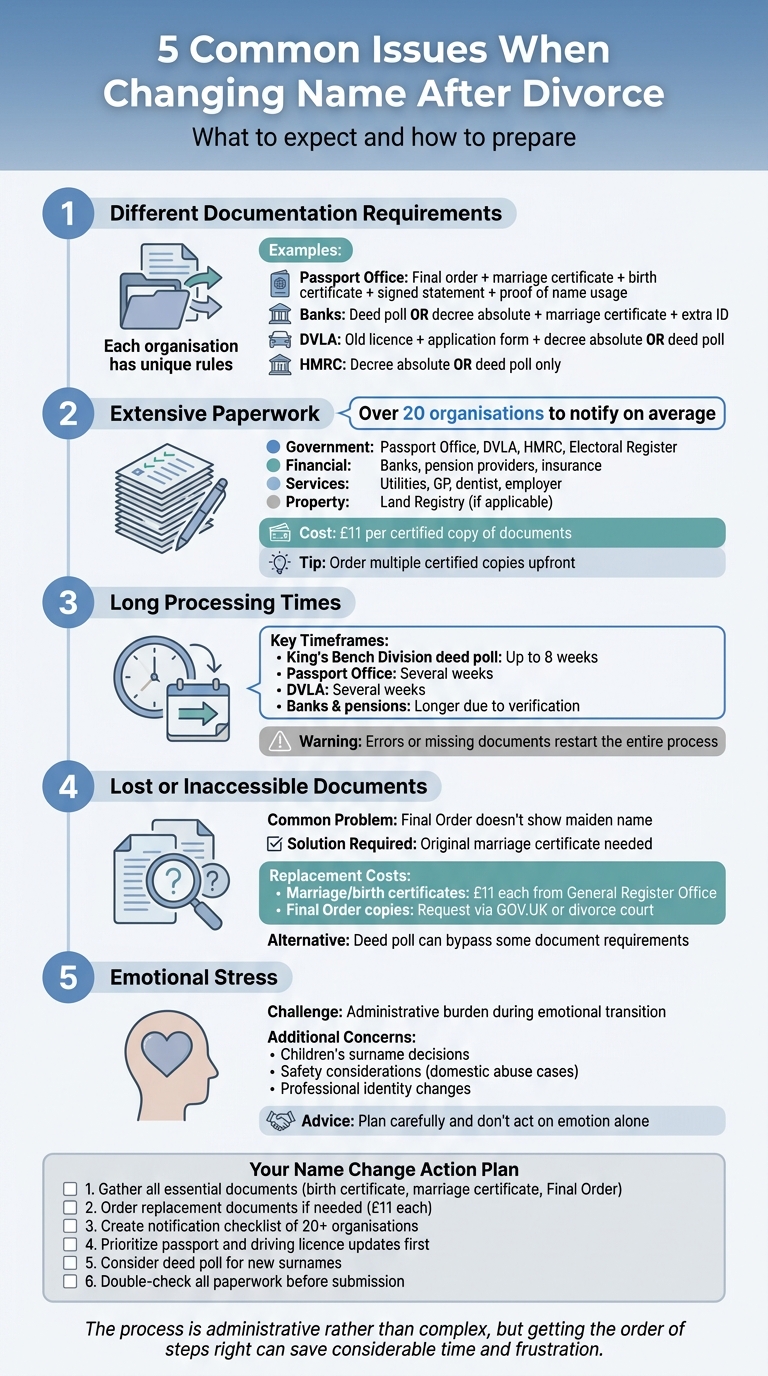
5 Common Name Change Issues After Divorce and How to Navigate Them
1. Different Organisations Have Different Documentation Requirements
Organisation-specific requirements
Different institutions have their own rules when it comes to processing a name change. For example, the Passport Office requires several documents: your final order, marriage certificate, and birth certificate. On top of that, you’ll need to provide a signed statement confirming the name change is "for all purposes" and proof that you’re already using the new name - examples include a payslip or a council tax letter.
Banks and building societies are slightly different. They’ll accept a deed poll or a combination of your decree absolute and marriage certificate, but they’ll also ask for extra identification. The DVLA, on the other hand, needs your old driving licence, a completed application form, and either your decree absolute or deed poll. Meanwhile, HMRC usually only asks for your decree absolute or deed poll.
"Different organisations have different rules. Passport offices normally accept deed polls or a marriage certificate with decree absolute. Banks and building societies accept deed polls but may ask for further proof of identity." - London-Law.co.uk
If you’re part of a professional body, the process can get even more complicated. For instance, organisations like the General Medical Council (GMC) or the Solicitors Regulation Authority (SRA) have their own procedures for updating professional registers. Property owners face additional hurdles too - changing a name on property deeds requires a separate application to the Land Registry.
All these differences in documentation requirements can make the process feel like a legal and administrative maze.
Legal and administrative complexities
The type of name you’re adopting also plays a big role in determining what paperwork you’ll need. If you’re reverting to your maiden name, it’s usually straightforward - you’ll just need your marriage certificate and decree absolute. But if you’re creating a double-barrelled surname or choosing an entirely new name, a formal deed poll is almost always necessary.
Things can get even trickier if you have dual nationality or own property overseas. In these cases, your UK deed poll might need additional legalisation, such as an apostille, to be recognised abroad. These added steps can make the process more time-consuming and complex.
sbb-itb-bf1bef6
2. Large Volume of Paperwork and Notifications
Time investment and delays
Managing the sheer amount of notifications after a divorce can feel like an uphill battle. On average, people need to update their name in over 20 places. This includes government bodies like the Passport Office, DVLA, and HMRC, as well as banks, utility companies, insurance providers, healthcare providers (like your GP and dentist), employers, and even the electoral register.
"The average person needs to change their name in over 20 places! Save time and frustration with [a name change kit]." - NewlyNamed
Each of these updates involves paperwork, and most organisations require official documents. It's essential to have multiple certified copies of your decree absolute, marriage certificate, and sometimes your birth certificate. Photocopies are often not accepted, and each certified copy costs around £11. Ordering several copies upfront can help avoid delays later. Unfortunately, the need for extensive paperwork is a common obstacle for many, particularly since every organisation has its own process.
Organisation-specific requirements
The challenge isn’t just the number of notifications - it’s also the fact that every organisation handles updates differently. For example, banks might require an in-person appointment with your decree absolute, while pension providers may ask for a deed poll to be sent by post. If you are unsure of the requirements, you can read more on how to change your name legally in the UK. You’ll also need to update your local council for council tax, inform your landlord or the Land Registry if you own property, and notify professional bodies like the General Medical Council or Solicitors Regulation Authority if applicable.
A checklist can help you stay organised, but even with one, you’ll need to juggle varying timelines and methods. Some updates can be done online, while others require physical mail or face-to-face meetings. This administrative maze can take weeks - or even months - to navigate, as you track which organisations you’ve notified and which still need attention. It’s a time-consuming process that demands both patience and persistence.
3. Long Processing Times and Scheduling Problems
Time investment and delays
Once the mountain of paperwork is submitted, the next hurdle is the waiting game. Processing delays can become a significant issue. For instance, a King's Bench Division deed poll application might take up to 8 weeks to finalise. This is a common part of the process of changing your name by deed poll in the UK. Then there's the Passport Office and DVLA, which also require several weeks to update their records. Financial institutions, especially pension providers and investment firms, tend to take even longer due to their intricate verification processes.
The frustration builds when you're dealing with multiple organisations at once. Imagine applying for a new passport, only to find out your bank needs that updated passport as proof before they can process your name change. Each delay creates a domino effect, slowing down the entire process.
Organisation-specific requirements
Scheduling adds another layer of complexity. Some updates require in-person appointments, which can be tricky to organise. Stefan Donnelly, Associate at Birketts, explains:
"Changing your name can take time and it can be stressful – especially if you have issues tracking down the relevant paperwork."
Even small mistakes, like a missing document or a minor error, can result in application rejection. Sarah Ryan, Account Manager at Lawhive, highlights the importance of being thorough:
"If your application is sent back, you'll need to restart the entire verification process, adding weeks or months to your timeline."
This becomes even more challenging when you're coordinating with several institutions, each with their own requirements and timelines. Missing one detail could mean juggling multiple rescheduled appointments and further delays.
4. Lost or Hard-to-Access Original Documents
Document accessibility
Misplacing important paperwork can create significant hurdles during the name-change process. For instance, the Final Order issued after a divorce doesn't include your maiden name, which means organisations will ask for your original marriage certificate to confirm your identity. Sarah Chapman, a Paralegal at Hegarty, highlights the issue:
"The Final Order is insufficient on its own. This is because it doesn't reference the previous name, only the married one, whereas the marriage certificate does show the previous name as well as the other party's surname indicating what the married name would be."
If you've lost your marriage or birth certificates, replacements can be ordered from the General Register Office at around £11 per certificate. Similarly, copies of the Final Order must be requested via GOV.UK or the court that handled your divorce. These additional steps not only delay the process but also add to the overall cost, making an already tedious task even more frustrating.
Legal and administrative complexities
The requirements set by organisations like HM Passport Office make the process even more challenging. For example, they may ask for your birth certificate, a signed declaration confirming the name change applies universally, and proof of name usage (such as a payslip or council tax letter). Crucially, they often require original documents or certified copies, which can be tricky to manage.
This becomes particularly problematic when multiple institutions need the same document at the same time. For instance, you can’t send your only original marriage certificate to several banks simultaneously. Ordering extra certified copies upfront can help avoid this issue. Alternatively, if you’ve lost your original marriage certificate or don’t want to wait for the Final Order, a deed poll can serve as valid legal proof of your name change. Services like Name Change even provide certified copies with tracked delivery, making it easier to update records across various organisations without unnecessary delays.
5. Emotional Stress Combined with Administrative Tasks
Emotional impact
Divorce is a challenging experience, and when you add the burden of handling complex paperwork, it can feel overwhelming. Changing your name after a divorce often carries deep emotional significance - it’s a way to mark the end of a chapter. But the reality of informing numerous organisations while trying to process your emotions can make the situation even harder. As Sarah Chapman, a Paralegal at Hegarty, puts it:
"The process can be long including having to notify everyone of your new name so it's important to think things through before you reach a decision."
The situation becomes even more complicated when children are involved. Concerns about whether they’ll share your surname, potential confusion at school, or disagreements with an ex-partner over their name can add another layer of stress. For those who’ve experienced domestic abuse, the stakes are even higher. In these cases, changing a name might not just be symbolic - it could be a crucial step for safety, often requiring legal guidance and support. All of this emotional strain is compounded by the practical challenges of delays and scheduling.
Time investment and delays
Without a clear plan, managing the name change process can feel like a full-time job. Brad Askew, Legal Tech Founder at LegalDocuments.co.uk, underscores the importance of careful consideration:
"A name carries weight, both personally and professionally, so resist the urge to act on emotion alone."
Creating a written checklist can help you stay organised and reduce stress. Start by tackling the most critical updates first, like your passport and driving licence, before moving on to other organisations. Make sure you gather all the necessary documents early - such as the Final Order, marriage certificate, and birth certificate - to avoid unnecessary delays caused by missing paperwork. If time is of the essence, using a deed poll can speed things up, bypassing the need to wait for court documents.
Conclusion
Changing your name after a divorce can come with its fair share of hurdles. From dealing with varying documentation requirements to managing extensive notifications, long processing times, document accessibility issues, and the emotional toll - it’s essential to be prepared for each step.
Planning ahead can make all the difference. As Brad Askew, Legal Tech Founder, explains:
"The process itself is administrative rather than complex, but getting the order of steps right can save considerable time and frustration."
To streamline the process, start by gathering essential documents like your birth certificate, marriage certificate, and Final Order. If any are missing, request replacements as soon as possible to avoid unnecessary delays.
Make a checklist of organisations to notify, such as HMRC, DVLA, banks, and utility providers. Prioritise updating key identity documents like your passport and driving licence before moving on to others.
If you're adopting a new surname, you’ll need a deed poll. Services like Name Change offer a secure and straightforward way to prepare and certify these documents.
Finally, ensure all your paperwork is accurate and complete. As Sarah Ryan advises, double-checking your documents can prevent setbacks and keep you on track. With thoughtful preparation and a clear plan, you can navigate these challenges and take this step forward with confidence.
FAQs
Do I need a deed poll after divorce?
In the UK, if you want to legally change your name after a divorce, you'll typically need to use a deed poll. This document ensures that your new name is officially recognised by government bodies and other organisations.
What order should I update my documents in?
Start by updating your key government records, like your passport, driving licence, and tax records. These documents often serve as proof when you need to update details with other organisations. Prioritising these updates makes the process smoother when tackling other changes later on.
How can I change my name if I’ve lost my certificates?
If you've misplaced your certificates, you can still proceed with a name change by using alternative forms of identification. Documents like a payslip or a letter from your local council can serve as proof. Additionally, you can order certified copies of your birth or marriage certificates online, which can be used to support your application. These records are essential for updating your details and finalising the name change process after a divorce.