Checklist for Updating Records After Divorce
Divorce changes your legal and personal details, and it's essential to update your records promptly to avoid issues with taxes, travel, finances, and services. Here's a quick guide to help you navigate the process:
- Government Records: Update your passport (HM Passport Office), driving licence (DVLA), tax records (HMRC), and Council Tax (local council). Notify the NHS to ensure your medical records are accurate.
- Financial Institutions: Inform your bank, mortgage provider, and pension schemes. Use your Final Order, marriage certificate, or deed poll (choosing between enrolled or unenrolled) for proof of name change.
- Employers: Notify your HR department to update payroll, benefits, and pension details. Check your payslip to confirm changes with HMRC.
- Utilities and Services: Update energy, water, insurance, broadband, and subscription accounts. This ensures your details are consistent across all providers.
- Key Documents: Gather your Final Order, marriage certificate, and birth certificate. Use certified copies to avoid delays.
Start with government agencies as their updates often serve as proof for other organisations. Keep a checklist and track your progress to ensure all updates are completed efficiently.
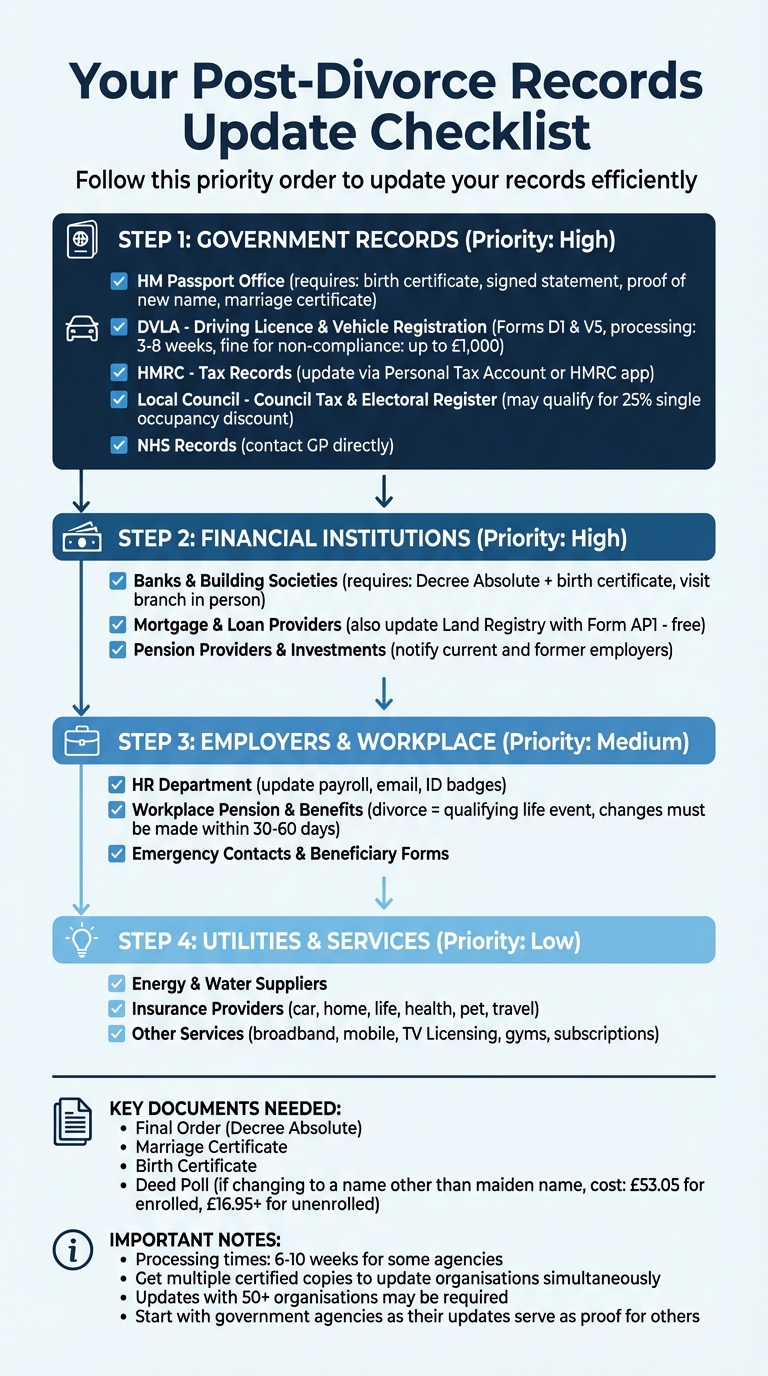
Step-by-Step Checklist for Updating Records After Divorce in the UK
Government Departments and Agencies to Notify
Updating your information with government departments should be at the top of your to-do list after a divorce. These organisations manage key aspects of your legal identity, and keeping your records accurate helps you avoid issues with taxes, travel, and everyday services. Once these updates are sorted, it’s easier to notify banks, utility providers, and other services.
HM Passport Office
To update your passport, you’ll need to submit several documents: your birth certificate, a signed statement confirming your name change, proof of your new name (such as a payslip or council letter), and your marriage certificate showing both names. Processing times can vary, so don’t leave this to the last minute if you’ve got travel plans.
DVLA (Driving Licence and Vehicle Registration)
For changes to your driving licence and vehicle logbook, you’ll need Form D1 and Form V5, along with either your decree absolute and marriage certificate (if returning to a maiden name) or a deed poll. The DVLA typically processes these updates within three to eight weeks. Use a black-ink pen, send your documents via Royal Mail Special Delivery, and keep a photocopy of your current licence before posting. While waiting for your updated licence, you’re still legally allowed to drive. However, failing to update your licence could result in a fine of up to £1,000.
HM Revenue and Customs (HMRC)
Inform HMRC about your divorce by logging into your Personal Tax Account or using the HMRC app. This ensures your tax records are up to date and helps prevent any tax-related issues. If you’re receiving Child Benefit, you’ll need to notify HMRC about your relationship change separately from your general tax record update.
Local Council (Council Tax and Electoral Register)
Reach out to your local authority to update your details for Council Tax and the Electoral Register. You’ll likely need to provide your decree absolute or deed poll as proof. If your household situation has changed, you might qualify for the 25% single occupancy Council Tax discount, so it’s worth checking.
NHS Records
Make sure your GP surgery and any other healthcare providers are informed of your name change. Contact your GP directly with the necessary proof to ensure your prescriptions, appointments, and medical correspondence are updated and sent to the right name and address.
Financial Institutions and Accounts
Once you've updated your government records, it's time to notify your financial institutions. Informing your banks, mortgage providers, and pension funds about your name change helps avoid any record inconsistencies.
Banks and Building Societies
Most major banks, such as HSBC, will ask you to visit a branch in person to update your name and signature card. To revert to your maiden name, you'll need to provide your Decree Absolute and original birth certificate. Some banks may also request your original marriage certificate to connect your previous and current names. If you're adopting a name other than your maiden name, a deed poll will be required instead. It's worth confirming with your bank whether they accept unenrolled deed polls.
Many banks prefer you to update your driving licence or passport first, as they often require photo ID showing your previous name during the process. Once your name change is processed, your bank will issue updated debit and credit cards automatically.
Don't forget to ensure your property-related financial records are updated as well.
Mortgage and Loan Providers
Mortgage providers typically require the same documents as banks: your Decree Absolute, birth certificate, and possibly your marriage certificate. If you own property, you'll also need to update your name with the Land Registry by submitting Form AP1. This process is free of charge.
Failing to update the Land Registry could cause delays when remortgaging, as lenders conduct thorough identity checks against the register. Additionally, English law requires you to notify all creditors about your name change, ensuring proper alignment of your financial records.
Pension Providers and Investments
After taking care of your bank and mortgage accounts, turn your attention to your pensions and investments. Notify both current and former employers if you have frozen or preserved pension schemes. Pension providers and investment platforms will usually ask for your Decree Absolute and birth certificate, or a deed poll if you're adopting a new name.
For ISAs, investment accounts, or shareholdings, contact the relevant share registrars to update your details. Credit reference agencies like Experian and Equifax generally update your records automatically once your new name is in use across other financial accounts, so there's no need to contact them directly.
Employers and Workplace Records
Once you've notified government and financial institutions, it's time to ensure your workplace records reflect your updated legal identity. Start by contacting your HR department as soon as possible to find out what documents they need from you.
Notifying Your Employer
To update your records at work, you'll need to provide your Decree Absolute. If you're choosing a name other than your maiden name, you'll need to submit a deed poll instead. HR will then update key areas such as payroll, email accounts, directories, and even your ID badges.
This step is essential for keeping payroll and tax records accurate. You can also update your name with HMRC online or through their app. To confirm everything is in order, check your next payslip to ensure your employer’s payroll system has synced with HMRC.
Don’t forget to update emergency contact details and beneficiary forms for death-in-service benefits. These often still list a former spouse.
Updating Pension and Benefits Schemes
Beyond general employment records, make sure your pension and benefits information is updated to reflect your new legal identity.
You’ll need to contact your workplace pension provider directly to ensure your details are accurate for any future claims. If you have frozen or preserved pensions from previous jobs, reach out to those former employers as well.
Divorce is considered a "qualifying life event", which means you can make changes to your employee benefits - like health, dental, or life insurance - outside the usual open enrolment period. However, these changes typically need to be completed within 30 to 60 days of your divorce being finalised.
Lastly, review and update the beneficiary designations on your life insurance policies and retirement accounts. Keep in mind that a divorce decree doesn’t automatically update these.
Utilities and Service Providers
Once you've updated your government, financial, and workplace records, it's time to tackle your utilities and service providers. Keeping your details consistent across all accounts is crucial to avoid headaches down the line. A quick review of your bank statements can help you identify recurring payments and subscriptions that need updating.
Energy and Water Suppliers
Get in touch with your electricity, gas, and water providers to update your records using your legal change documents. While most companies will accept photocopies, some may require an enrolled deed poll, which you can obtain through the High Court for £53.05. If you've moved recently, this is also the right time to update your address. Additionally, consider removing a former spouse from joint accounts or closing shared accounts and opening new ones in your name.
Insurance Providers
Make sure to update all your insurance policies - whether it's car, home, life, health, pet, or travel insurance. Most insurers will ask for your legal change documents, and many now offer the convenience of uploading these through their online portals. Once your insurance details are sorted, you can move on to updating other key services.
Other Service Providers
Don't forget about broadband, mobile, TV Licensing, gyms, subscription services, and magazine deliveries. Many telecom providers allow you to upload photocopies of your documents via their online systems, making the process quicker and easier. Updating these accounts early can also help you establish a paper trail - utility bills in your updated name can serve as proof of address or identity for other organisations.
To streamline the process, consider ordering multiple certified copies of your change documents. This can save time, especially as some updates might take 6-10 weeks to process.
sbb-itb-bf1bef6
Required Documentation and Evidence
Before you can update your records, it’s important to gather the necessary documents to support your name change.
Decree Absolute as Evidence
Your Decree Absolute - now officially referred to as a Final Order - is the key document needed when reverting to your maiden name. Most UK government bodies, such as HM Passport Office and the DVLA, will accept your Final Order, provided you also include your original marriage certificate and, where necessary, your birth certificate. Together, these documents establish a clear legal link between your previous and new names.
If your Final Order doesn’t display both your married and maiden names, your marriage certificate will serve as the legal connection. For passport updates, you’ll also need to include a signed statement declaring that the name change applies "for all purposes" and provide evidence of your new name in use, such as a recent payslip or council tax bill.
Some organisations, including banks and financial institutions, may require all of these documents for complete identity verification. These records ensure legal consistency across all notifications to government bodies, financial institutions, and service providers. If you need replacement certificates, you can order them from the General Register Office for approximately £11 each.
Deed Poll for Name Changes
A deed poll is required if you want to adopt a name other than your maiden name - whether it’s a completely new surname or a double-barrelled one. It’s also necessary if you’re changing your name before your divorce is finalised or after separating without legal dissolution.
Unenrolled deed polls are legally valid and take effect immediately, offering a simpler and more affordable option. Enrolled deed polls, on the other hand, create a public record and typically cost around £53.05.
"Private and public organisations are legally required to accept an unenrolled deed poll that meets the government's requirements, regardless of company policy or the state of your document." – Amelia Hansford, PinkNews
For a hassle-free process, Name Change provides an unenrolled deed poll service starting at £16.95. This includes three certified copies, tracked delivery, and PDF archiving.
Certified Copies and Originals
Certified copies are treated as legally equivalent to originals, making it easier to update multiple institutions simultaneously while keeping your original documents safe.
"Having a number of certified copies can save a lot of time and stress when changing your name." – Patrice Coughlin, Associate Solicitor, Rayden Solicitors
To create certified copies of an unenrolled deed poll, an independent witness can sign a photocopy to confirm it matches the original. This approach allows you to update your records without risking your original documents.
If your original Decree Absolute has been lost, you can request a replacement from the court that handled your divorce or through the official GOV.UK service.
With these documents prepared, you’ll be ready to move forward with updating your records.
Planning and Preparing for the Process
Updating your records after a divorce can mean notifying more than 50 organisations. Having a well-thought-out plan can help you avoid missing anything and save time. With a structured approach, you can manage everything smoothly, from updating government and financial records to everyday services.
Creating a Master Checklist
Once you’ve updated your key records, it’s time to tackle the rest with a clear plan. Start by identifying all the organisations that hold your details. Go through your bank statements, emails, and records to ensure you account for everything - this could include gym memberships, loyalty programmes, professional associations, and online subscriptions.
After identifying these, prioritise them. Begin with documents like your passport or driving licence, as they are often required as proof for other updates, such as with banks or libraries. Then, organise the remaining updates into tiers:
- High priority: HMRC, DVLA, banks, mortgage providers
- Medium priority: Employers, pension providers, GP
- Low priority: Utilities, clubs, social media accounts
Make a note of which organisations need original documents (e.g., the Passport Office) and which accept photocopies or digital updates.
Gathering Required Documents
Before reaching out to any organisation, gather all the necessary documents in one place. Typically, you’ll need your Final Order, original marriage certificate, and birth certificate to prove the legal link between your names. If you need to legally change your name in the UK for reasons other than returning to a maiden name, a deed poll may be required. To save time, get certified copies of these documents from the General Register Office. This way, you can update multiple organisations at once without waiting for originals to be returned.
Tracking Your Progress
Many organisations won’t send formal confirmation once they’ve updated your details. To stay organised, create a tracking log. For each organisation, record the date you submitted your request, the method you used (post, email, or in-person), and any documents provided. Keep in mind that some government agencies might take 6 to 10 weeks to process changes, so patience is key.
To confirm updates, check your online accounts and monthly statements manually. If you’re retired, notify the DWP directly. If you’re employed, your employer may handle updates with HMRC through payroll. Use your tracking log to follow up on any updates that seem delayed.
Conclusion and Next Steps
Now that you’ve got your master checklist ready, it’s time to wrap up those updates.
After a divorce, it’s essential to update your records with key organisations - starting with government agencies like the HM Passport Office, DVLA, and HMRC. These updates often act as the foundation for changes with other institutions. Once those are sorted, move on to financial institutions, employers, and service providers in a systematic way.
Most organisations will accept your Final Order and marriage certificate as proof of your name change. However, if your name change isn’t reflected on these documents, a deed poll is the go-to option for universally accepted proof. Keep in mind that some agencies can take 6 to 10 weeks to process changes. To avoid delays, consider getting multiple certified copies so you can submit requests to different organisations simultaneously.
As updates are confirmed, stay organised by keeping a log of all notifications. Record the dates, methods, and documents used for each update, which will help you follow up quickly if there are any delays. It’s also worth manually checking your online accounts and statements to ensure everything has been updated correctly.
For a smoother deed poll experience, Name Change offers a convenient service tailored to UK name changes. They provide legally compliant deed poll documents along with certified copies, tracked delivery, and PDF archiving. This service ensures acceptance by all relevant government departments and organisations, cutting through much of the stress and administrative hassle.
With your Final Order, marriage certificate, and birth certificate in hand, use your master checklist to align all your records efficiently.
FAQs
What documents do I need to update my name with UK government agencies after a divorce?
If you need to update your name with UK government agencies after a divorce, you'll typically need to provide documents that connect your new name to the one currently on file. The most commonly required documents include:
- Final decree or divorce order: This confirms the legal recognition of your divorce.
- Original marriage or civil partnership certificate: This shows the name you are reverting from.
- Original birth certificate: This establishes your birth name.
- Deed poll (if applicable): A legal document formalising your new name. Certified copies are generally accepted.
- Proof of your new name in use: Examples include a recent payslip, council letter, or other official correspondence.
For updating your passport, you'll also need to provide a signed statement confirming that you're reverting to your previous surname for all purposes, along with evidence of your new name in use. If you need a legally recognised deed poll, the Name Change service offers a simple and secure option, including certified copies and delivery approved by UK government departments.
How can I update my name with my bank or financial institutions after a divorce?
If you need to update your name with your bank or financial institution, you can usually do this either by visiting a branch in person or through their online services, depending on their specific process. You’ll generally be required to provide a certified copy of your decree absolute or a witnessed deed poll, along with a valid photo ID, such as a passport or driving licence.
After reviewing your documents, the bank will update your name across all your accounts, cards, and any related services. It’s a good idea to contact your bank directly to check their exact requirements and procedures.
What should I do if my divorce decree doesn’t include my maiden name?
If your divorce decree doesn’t include your maiden name, you’ll need to provide proof of it to make the change official. Start by getting a certified copy of your birth certificate or any other document that verifies your maiden name. From there, you have two main options: you can request a corrected decree from the court or create a deed poll to legally go back to your maiden name.
Once you’ve secured the corrected decree or deed poll, use it along with your birth certificate as supporting evidence when updating your details with government agencies and other organisations.