Top 7 Tips for Updating Records After a Middle Name Change
Changing your middle name? Here's what you need to know: updating your records is critical to avoid identity issues, fines, or service disruptions. Start with a legally recognised deed poll, then update key documents and accounts in the right order. Here's a quick summary:
- Get multiple certified copies of your deed poll: You'll need originals or certified copies for organisations like HM Passport Office, DVLA, and banks.
- Update your passport first: Submit your deed poll and proof of use for the new name. Processing can take up to 10 weeks.
- Notify the DVLA: Update your driving licence and vehicle records by post to avoid fines.
- Contact HMRC: Update your tax records via your Personal Tax Account or by phone.
- Inform your bank and financial institutions: Visit your bank with your deed poll and updated ID.
- Update NHS records: Notify your GP to ensure your medical records match your new name.
- Notify utility providers and other services: Don’t forget council tax, insurance, and subscriptions.
Act quickly to ensure consistency across all records. Mismatched documents can lead to delays, identity verification problems, or even legal issues. Services like Name Change can simplify this process with deed poll packages starting at £16.95.
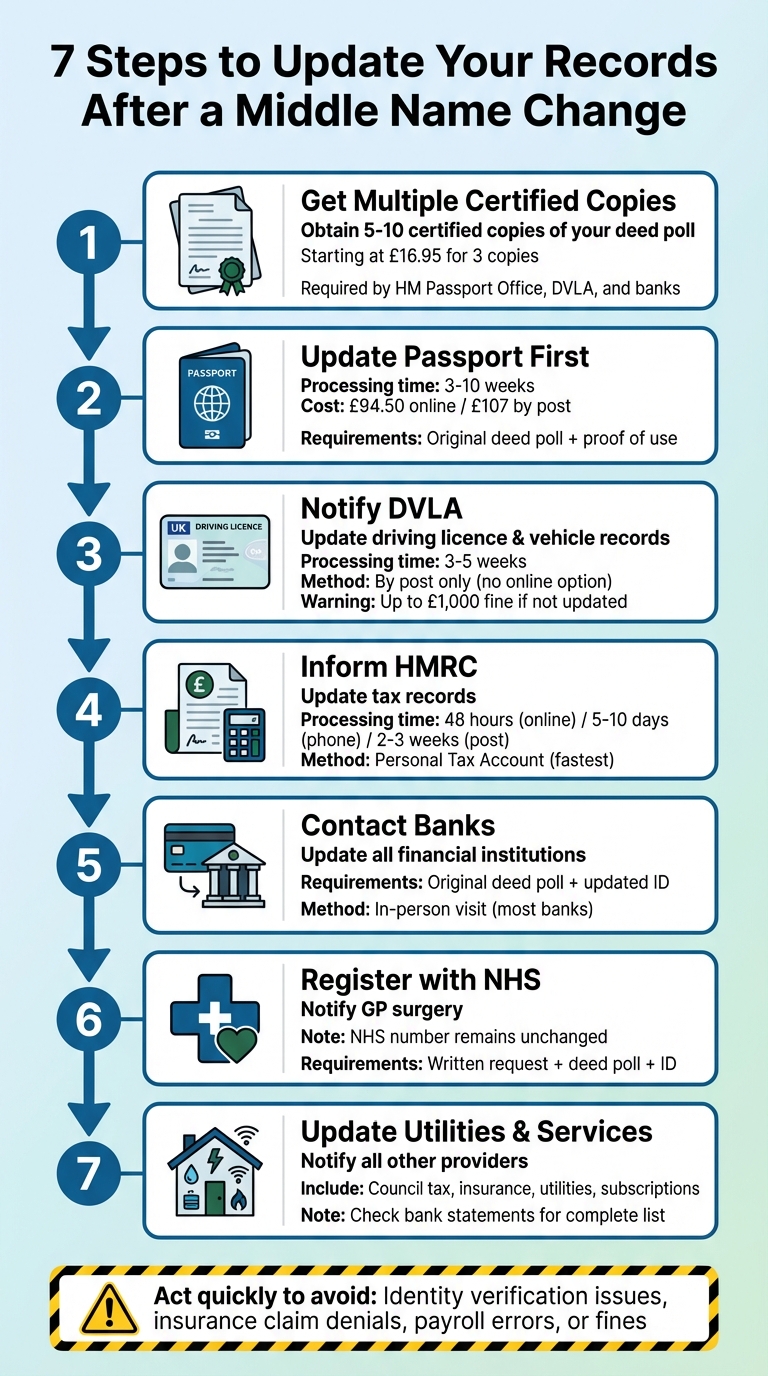
7-Step Process for Updating Records After Middle Name Change
1. Get Multiple Certified Copies of Your Deed Poll
Changing your middle name often means notifying a long list of organisations - sometimes as many as 30 to 40. These might include your passport office, the DVLA, your bank, utility providers, and even the NHS. With so many updates to make, having multiple copies of your deed poll is a practical necessity.
Some organisations, like HM Passport Office, the DVLA, and banks, insist on receiving an original or a certified copy of your deed poll. Photocopies simply won’t cut it. If you only have one original, you could end up stuck waiting for one organisation to return it before you can move on to the next.
"Multiple certified copies enable simultaneous updates across departments."
To avoid delays, request several certified copies when you apply for your deed poll. Having 5–10 certified copies allows you to send them to multiple organisations at the same time. For example, you could send one to the Passport Office, another to the DVLA, and others to your bank or utility providers all at once.
If you're using a service like Name Change, their standard package (£16.95) includes three certified copies, which is enough to cover the most urgent updates. Keep your original deed poll safely stored at home for future reference.
2. Update Your Passport with HM Passport Office First
When updating your passport to reflect a new middle name, it’s important to start by updating another official record to demonstrate that the new name is actively in use. HM Passport Office requires two key pieces of evidence: proof of a legal name change via a deed poll and an official document - such as a driving licence, bank statement, or utility bill - that shows the new middle name. This ensures your application is backed by reliable documentation.
"If the customer has changed their middle name, we can accept evidence which only shows the middle name's initial. Almost all the evidence we accept contains their forename and surname only." – HM Passport Office
Applying for a passport update can be done online for £94.50 (for adults) or through a paper form for £107. Generally, processing takes about three weeks, but during busier times, it’s wise to allow up to 10 weeks. Keep in mind that any remaining validity on your current passport will not be transferred to the new one.
To complete your application, you’ll need to submit your old passport, the original deed poll with wet signatures, and evidence that your new name is in use. Before making any travel plans, double-check that the details on your updated passport align with all other records.
3. Notify DVLA for Driving Licence and Vehicle Records
If you've changed your name, it's essential to update your driving licence and vehicle records with the DVLA. Failing to do so could result in a fine of up to £1,000. Unlike many organisations, the DVLA requires all name change updates to be done by post, as there is no online option available. This means you'll need to handle the process carefully to avoid delays or errors.
To update your driving licence, you'll need to complete form D1 (for cars and motorcycles) or D2 (for lorries and buses). These forms are available at most large Post Offices. Along with the completed form, you'll need to include your original deed poll and your current driving licence – photocopies or certified copies won't be accepted. Ensure you fill out the form in black ink, use CAPITAL LETTERS, and include your full new middle name. Send your documents using a secure, trackable postal service like Royal Mail Special Delivery, and include a pre-paid, self-addressed envelope for the return of your documents. Processing typically takes 3 to 4 weeks, but applications involving a deed poll may take up to 5 weeks.
For your vehicle log book (V5C), write your new full name in Section 3 (for the newer style) or Section 6 (for the older style). Attach a short letter explaining the name change and include a copy of your deed poll. Make sure not to tick the "new keeper" box, as this is only for vehicle ownership transfers. Once submitted, it can take up to 6 weeks to receive your updated log book.
Important Addresses:
- For driving licence updates, send your application to:
DVLA, Swansea, SA99 1BN - For V5C updates, send to:
DVLA, Swansea, SA99 1BA.
It's crucial to post these applications separately to the correct addresses. Both updates are free unless you've lost your original documents. During the processing period, you can continue driving as long as your previous licence is still valid. If your vehicle tax is due within the next four weeks, make sure to tax your vehicle online before sending off your V5C, or you can handle both processes at a Post Office that deals with vehicle tax.
4. Inform HMRC to Update Tax Records
After changing your middle name, it's crucial to update your HMRC records to avoid tax errors or interruptions to benefits. As GOV.UK advises: "Tell HMRC straight away – if you do not, you could pay too much tax, or get a tax bill at the end of the year". HMRC provides several ways to report your name change, each with different processing times.
The quickest option is to use your Personal Tax Account on GOV.UK. You can upload your deed poll certificate and update your details online, with changes processed within 48 hours. If you're paid through PAYE (whether salary or pension), your Self Assessment records will automatically update as well. To access these services, you'll need your National Insurance number. Another option is the HMRC app, or you can call 0300 200 3300, where updates take 5–10 working days. If you prefer, you can post your documents, but this method takes longer - typically 2–3 weeks. Keep in mind that inconsistencies between your updated documents and HMRC records may cause issues with online updates.
One common issue is a mismatch between your updated passport or driving licence and HMRC's records, which can cause the online identity verification system to fail. If this happens, contact HMRC immediately. To reduce wait times, call as soon as the lines open at 8:00 am; enquiries are generally quieter before 10:00 am.
After HMRC updates your records, remember to notify your employer. Additionally, update any business or Child Benefit records separately.
sbb-itb-bf1bef6
5. Contact Your Bank and Financial Institutions
After sorting out your details with HMRC and DVLA, it's time to make sure your financial records reflect your new name. Keeping everything consistent across your accounts helps avoid any potential headaches down the line.
Most UK banks will ask you to visit a branch in person to update your name. You'll need to bring your original deed poll along with a secondary form of ID, such as an updated passport or driving licence.
Each bank has its own requirements. Some might ask for a witnessed deed poll and proof of your previous name (like an old passport or driving licence). Others may require a government-issued photo ID that already shows your new name. In some cases, banks will accept certified copies of your deed poll by post. If you're going this route, include your account number, details of the products you hold with the bank, and samples of both your old and new signatures.
Under Article 16 of the GDPR, banks are obligated to update incorrect personal data promptly. If a bank insists on only accepting enrolled deed polls (which cost £53.05), you can point out this regulation. As long as your unenrolled deed poll meets government requirements, it should be accepted. Keep in mind that some security features, like Barclays' secure chat, might take up to 10 working days to update after your name change.
Don't forget to update other financial accounts too. This includes mortgage providers, investment accounts, share registrars, Premium Bonds, insurance policies, and even the Student Loans Company. If necessary, request new cards and chequebooks. Lastly, make sure to update your name on the electoral roll through your local council - this helps prevent any credit-related issues.
6. Register the Change with NHS and GP Surgery
Begin by notifying your GP surgery. Most NHS systems automatically update records, but some hospital services may require separate notification.
Reach out to your GP practice to obtain their name change form. Submit your request in writing, along with your original deed poll (e.g., from Name Change) and a form of identification. As the Nottingham Centre for Transgender Health explains:
"You can change your name, title, or gender with the NHS at any time by telling your General Practitioner (GP) (doctor) or GP practice".
Although it’s not a legal requirement, many GP practices might ask for a legal name change document. The Rotherham NHS Foundation Trust highlights:
"Your GP may ask to see a legal name change document like a deed poll or statutory declaration. It is not a legal requirement that you present documentation, but some GPs will consider it good practice to request this".
If your GP doesn’t update your records promptly, you can remind them of their obligations under Article 16 of UK GDPR, which requires personal data to be corrected without undue delay.
Once your GP has updated your records, your new name will appear on prescriptions, test results, and appointment letters. Your NHS number will remain unchanged unless you are also altering your gender marker. To confirm the update, check your details via the NHS App or your GP practice's online services.
7. Update Utility Providers and Other Services
Once you've updated key government records, it's time to inform your utility providers - this includes gas, electricity, water, and sewerage services - as well as your phone and internet companies. You'll need to provide your deed poll as proof when making these updates.
Your local council should also be high on your list. Make sure your Council Tax records and the Register of Electors are updated promptly. This is especially important because credit reference agencies often rely on the electoral roll to verify your identity. Any inconsistency here could negatively impact your credit score. Similarly, notify all your insurance providers - whether it's motor, home, life, health, or pet insurance. Any mismatch between your updated name and the name on your insurance records can lead to complications. For instance, if your driving licence shows your new name but your motor insurance does not, it could cause problems with claims.
Don't stop at the basics. Go through your bank statements to identify other services you use, such as TV Licensing, gym memberships, professional organisations, or loyalty programmes, and update them too. Most utility companies allow you to upload a scanned copy of your deed poll through their online portals. However, some providers, particularly in the energy or mobile sectors, may require an enrolled deed poll. Be sure to check their specific requirements.
Always request written or email confirmation once your details have been updated. Inconsistent records across services could potentially be seen as fraudulent. Keeping everything aligned will make the transition smoother and help avoid any verification issues in the future.
Conclusion
Changing your middle name doesn’t have to be a daunting task if you tackle it step by step. Start with your government-issued photo IDs, then move on to organisations like HMRC, your bank, the NHS, utility companies, and any other relevant services. Acting quickly and following a clear checklist can help ensure all your records are updated smoothly. This approach can save you from unnecessary headaches in your day-to-day life.
Delays in updating your name could lead to serious issues, like denied insurance claims, payroll errors, or even permanent mistakes in official records. For example, students might find their qualifications recorded under the wrong name if schools or universities aren’t informed before exams.
"Having your correct name on file is important if you have to make a claim." - FreeDeedPoll.org.uk
To make the process easier, consider using Name Change's deed poll pack. It includes everything you need: essential documents, certified copies, and straightforward instructions to update your records efficiently. Starting at just £16.95, the service provides printed and posted documents along with three certified copies, ensuring your deed poll is accepted by UK government departments and major organisations.
FAQs
What are the consequences of not updating my middle name on official records?
If you fail to update your middle name on all official records, your documents will continue to show your previous name. This mismatch can cause delays or even rejections when dealing with organisations that require consistent and accurate identification. Updating all records to reflect your new name ensures smoother dealings with banks, government offices, and other institutions, saving you from unnecessary hassles.
How many certified copies of my deed poll do I need?
If you're planning to notify multiple organisations or institutions about your name change, the number of certified copies you'll need will depend on how many places require them. Having several copies on hand can make the process smoother, especially if you need to send them to multiple locations simultaneously.
It's a good idea to request at least 2–3 certified copies. This should cover banks, government departments, and other organisations you need to inform. Some places might return the copies after they're done, but others may keep them for their records, so it's always wise to have extras ready.
Can I update my name on my driving licence online with the DVLA?
No, the DVLA doesn’t provide an online option for updating the name on your driving licence. To update your name, you’ll need to fill out a paper form – D1 for car or motorcycle licences, or D2 for lorry or bus licences – and send it by post to the DVLA.
Make sure to include all necessary documents, such as your deed poll or other legal proof of your name change, to prevent any delays in processing.