Deed Poll Delivery Costs Compared
If I need the short answer: standard post is the cheapest, tracked post is the safest low-cost middle option, and timed next-day delivery is only worth paying for when the deadline is tight.
From the figures in this article, deed poll delivery runs from free up to £62.95. The gap is large, but the main trade-off is simple:
- Lower cost usually means slower post and no tracking
- Tracked delivery gives proof it arrived, but not much time saved
- Priority usually means same-day dispatch, not next-day arrival
- Next working day adds full tracking, a signature, and a set delivery time
- Saturday delivery is there for Friday orders that cannot wait until Monday
A few points stand out straight away:
- Standard delivery: about £0–£4.00
- Tracked / Signed-For: about £5.30
- Priority processing: about £4.50–£6.00 extra
- Next working day by 1 pm: about £10.95–£14.00
- Next working day by 9 am: about £54.00–£59.95
- Saturday by 1 pm: about £8.49–£18.00
- Saturday by 9 am: about £58.00–£62.95
When choosing a delivery method, consider how many deed poll documents you need to send to various organizations simultaneously.
What I take from this is simple: paying a little more can cut 2–4 working days if it moves your order to same-day dispatch, but paying £54+ for a 9 am slot often buys only about 4 hours over the 1 pm service.
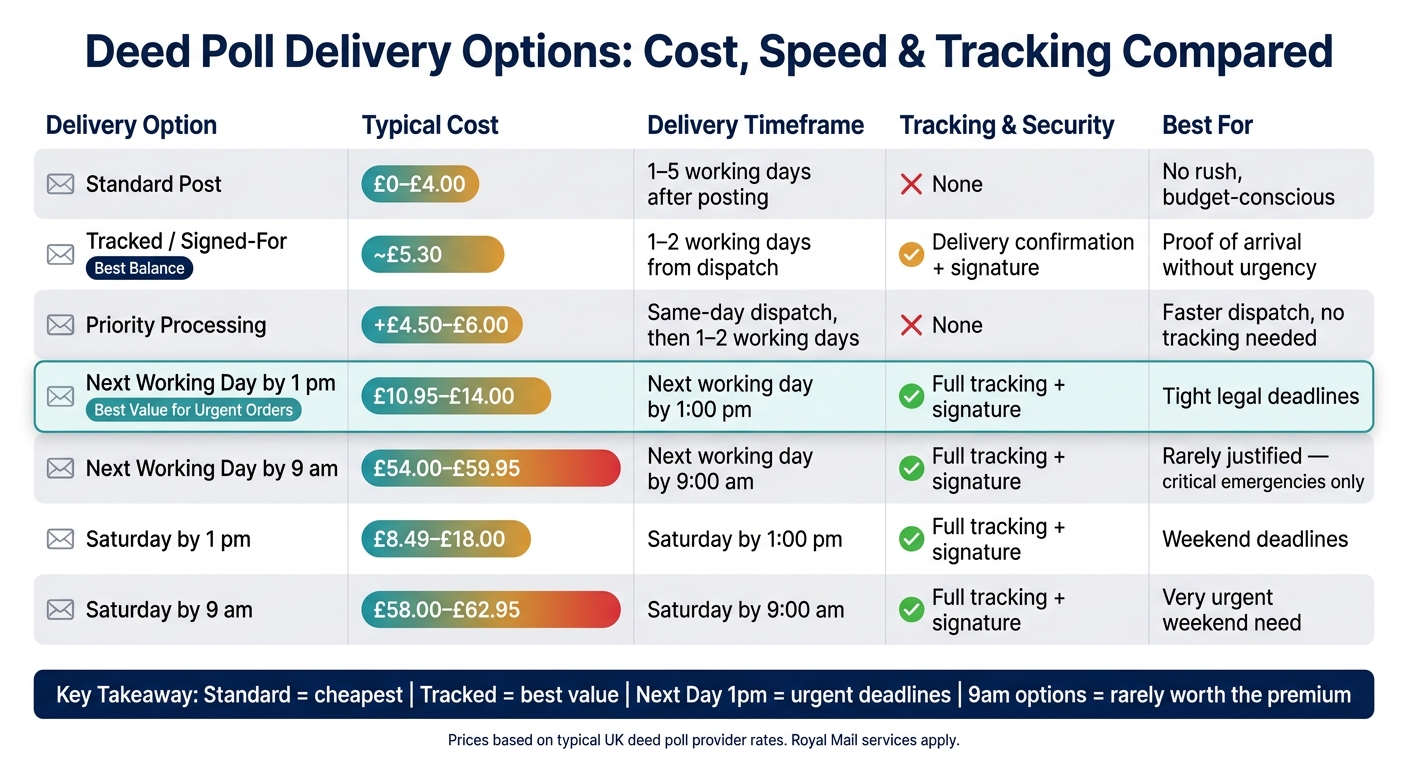
Deed Poll Delivery Options: Cost, Speed & Tracking Compared
Quick Comparison
| Option | Usual cost | Usual timing | Tracking / proof | Best fit |
|---|---|---|---|---|
| Standard | £0–£4.00 | 1–5 working days after posting | None | No rush |
| Tracked / Signed-For | ~£5.30 | 1–2 working days after dispatch | Delivery confirmation + signature | Proof of arrival |
| Priority | +£4.50–£6.00 | Same-day dispatch, then 1–2 working days post | Usually none | Faster dispatch |
| Next working day 1 pm | £10.95–£14.00 | Next working day by 1 pm | Full tracking + signature | Tight deadline |
| Next working day 9 am | £54.00–£59.95 | Next working day by 9 am | Full tracking + signature | Very rare cases |
| Saturday 1 pm | £8.49–£18.00 | Saturday by 1 pm | Full tracking + signature | Weekend need |
| Saturday 9 am | £58.00–£62.95 | Saturday by 9 am | Full tracking + signature | Very urgent weekend need |
In short, if I wanted the best mix of cost, timing and proof (and had confirmed what address you post to), I would look at tracked delivery first, then priority if dispatch delay is the main problem, and next working day by 1 pm only when a fixed deadline is close.
sbb-itb-bf1bef6
1. Standard delivery
Standard delivery covers the lowest-cost Royal Mail options. In most cases, you’ll pay between free and £4.00, depending on the provider and the postage class you pick.
Cost
Standard delivery usually costs £0–£4.00. Some providers include free 2nd Class post, while others charge £1.55 for 2nd Class or £2.90–£4.00 for 1st Class.
One small detail is worth checking: free 2nd Class post can mean folded documents sent in an A5 envelope. If presentation matters to you, that’s something to look at before you order.
Delivery timeframe
Royal Mail 1st Class post usually arrives within 1–2 working days after posting. 2nd Class post normally takes 3–5 working days.
That said, the postal estimate isn’t the whole story. Many providers need 2–4 working days to prepare the documents before they even go in the post, so the total wait is often longer than the Royal Mail window alone suggests.
Tracking
Standard 1st and 2nd Class post does not include tracking or signature confirmation. If the documents go missing, you won’t have tracking updates or delivery proof to help trace them.
Best use case
Standard delivery makes sense when keeping the cost down matters more than speed. For example, it can work well if you’re not up against a passport or driving licence deadline.
If proof of delivery matters, tracked delivery is the next step up. For more guidance on choosing the right option, visit our help and support page.
2. Tracked delivery
Tracked delivery sits in the middle ground between standard post and faster premium services. It usually adds a signature on delivery, but without the higher cost that often comes with next-day options.
So what are you paying for? Proof of delivery, not a faster arrival.
Cost
Royal Mail's Recorded Signed-For service costs £5.30, which is about £1.30–£2.00 more than standard 1st Class post. That’s a small extra charge if you want proof that the item arrived.
Some providers build tracked delivery into the package price. For example, Name Change includes it in Printed & Posted from £16.95.
Delivery timeframe
Tracked delivery is commonly around 1–2 working days from dispatch. In practice, that’s often similar to standard post.
The main difference over standard post is proof of delivery, not speed. Delivery time is usually 1–2 working days from dispatch.
Tracking
Recorded Signed-For usually gives delivery confirmation, not live tracking.
That means you can check that the documents were delivered, but you won’t get detailed location updates while they’re in transit.
Best use case
Tracked delivery is a sensible option for deed polls because they are legal documents. If you want proof of delivery without paying for faster postage, Recorded Signed-For gives a solid middle option.
One thing to note: someone must be available to sign.
If speed matters more than proof of delivery, priority delivery is the next step up.
3. Priority delivery
Priority delivery usually means same-day processing and posting, not faster postage. So yes, it’s faster than standard handling times. But it’s not a replacement for tracked or next working day delivery.
Cost
Expect to pay around £4.50–£6.00 extra for faster handling, not a faster postal service.
Delivery timeframe
If you apply before the cut-off - usually 3:00 pm or 3:30 pm, Monday to Friday - your documents are usually posted the same working day. They then tend to arrive by Royal Mail 1st Class in 1–2 working days.
Without priority, posting is usually delayed by 2–4 working days.
Tracking
Most priority services use untracked Royal Mail 1st Class. Priority delivery does not add tracking or proof of delivery.
Best use case
Priority delivery makes sense when you want your documents posted sooner but don’t need tracking or next-day delivery.
If you need a guaranteed arrival date, next working day delivery is the next step up.
4. Next working day delivery
Next working day delivery is the fastest option, and it’s also the priciest. It’s built for applications that need to arrive by a set time on the next working day. The biggest gap is in the price, especially if you compare 1:00 pm delivery with 9:00 am delivery.
Cost
Next working day delivery by 1:00 pm usually costs £10.95–£14.00. If you need it there by 9:00 am, the price jumps to £54.00–£59.95.
That extra cost also gets you full tracking and a signature on delivery. So you’re not just paying for speed. You’re paying for tighter timing and clearer proof that it arrived.
Delivery timeframe
These services are usually sent through Royal Mail Special Delivery. That means delivery is guaranteed by either 9:00 am or 1:00 pm on the next working day.
To catch the cut-off, your application normally needs to be submitted before 3:00 pm or 3:30 pm, Monday to Friday. Miss that window, or place your order over the weekend, and dispatch will usually happen on the next working day. In plain terms, delivery shifts back by a day.
Tracking
You get full tracking and a signature on delivery, which gives you proof that the item was received. That matters when timing isn’t the only issue and you also need confirmation that it got there.
Best use case
This option makes sense when the deadline is tight, such as a passport renewal, a driving licence update, or another urgent deadline. Since someone needs to sign for it, make sure a person will be available at the delivery address.
Use it when speed matters enough to justify the higher price.
5. Saturday or premium delivery
Saturday delivery fills the Friday-to-Saturday gap that standard next working day services leave behind. Royal Mail Special Delivery usually guarantees delivery from Monday to Friday only. So if you place an order on Friday and pick standard next-day delivery, your documents may not turn up until Monday. Saturday delivery fixes that problem.
Cost
The price depends on the delivery time you choose. Saturday delivery by 1:00 pm usually costs between £8.49 and £18.00. If you need Saturday 9:00 am delivery, expect to pay £58.00 to £62.95.
It also tends to cost more than the matching next working day service, often by around £3.00 to £5.20. In plain terms, you're paying extra for speed over the weekend.
Delivery timeframe
Most providers need payment by 3:00 pm to 4:00 pm on Friday. Miss that cut-off and your documents will most likely arrive on Monday instead.
Tracking
Saturday delivery is sent via Royal Mail Special Delivery. That means full tracking and a signature on receipt.
For the 9:00 am service, delivery can start as early as 6:00 am. So someone needs to be there to sign for it. If no one answers the door, the item goes to the local sorting office.
Best use case
This option works well if you need documents for a weekend appointment or an early Monday passport application. For most urgent weekend deadlines, the 1:00 pm Saturday guarantee is the better fit. The 9:00 am service makes sense only in a small number of cases where every hour matters.
The main trade-off comes down to cost, speed and security.
Cost, Speed and Security Trade-offs
As you move up the delivery ladder, the price goes up. But the extra speed or added peace of mind you get doesn’t always go up in the same way. Sometimes you pay a little more for a lot more convenience. Other times, you pay a lot more for only a small time saving.
Here’s how the main options compare:
| Delivery Tier | Typical Cost | Main benefit | Tracking & Security | Best For |
|---|---|---|---|---|
| Standard | £0–£4.00 | Baseline | None | Non-urgent orders |
| Priority | +£4.50–£6.00 | Saves 2–4 days by moving to same-day dispatch (if ordered before the cut-off) | None (1st Class post) | Best overall value |
| Recorded/Signed-For | ~£5.30 | No speed gain | Signature on delivery | Reassurance without urgency |
| Next Day by 1 pm | £10.95–£14.00 | Guaranteed next working day | Full tracking + signature | Urgent legal deadlines |
| Next Day by 9 am | £54.00–£59.95 | About 4 hours earlier than 1 pm | Full tracking + signature | Rarely justified |
| Saturday by 1 pm | £8.49–£18.00 | Weekend arrival | Full tracking + signature | Weekend convenience |
For many orders, Priority delivery hits the sweet spot. Paying about £4.50–£6.00 more can move your order to same-day dispatch, as long as you place it before the cut-off. (Note that processing times may vary during the Christmas period.) That can shave 2–4 days off the wait, which is a big step for a fairly modest extra charge.
The jump to a guaranteed next working day service is where prices start to climb fast. This usually adds £10.95–£14.00. You are paying more, but you also get full tracking and a signature on delivery, which matters when timing is tight and you need proof the item arrived.
The 9 am option sits at the top end on price. At £54.00–£59.95, it gets your documents there only about 4 hours earlier than the 1 pm service. For most people, that’s hard to justify. Unless those few hours matter a great deal, it’s often money spent for very little gain.
For deed polls, tracked delivery can be a smart middle option. It gives you proof of delivery without paying for a timed premium service. Name Change includes tracked delivery as standard.
The next section weighs the pros and cons of each method.
Pros and Cons of Each Delivery Method
Each option is a trade-off between price, speed, and peace of mind. Some are cheap but basic. Others cost more, but give you proof of delivery or a set arrival time.
Here’s where each one makes sense:
| Delivery Method | Pros | Cons | Best For |
|---|---|---|---|
| Standard (1st Class) | Lowest price | No tracking; no delivery confirmation | Non-urgent orders with no deadline |
| Tracked delivery | Proof of delivery | Not a guaranteed timeframe; costs more than standard | Reassurance that it arrived |
| Priority delivery | Same-day dispatch before the cut-off | Additional fee on top of postage; no tracking | Those who need the document sent quickly but can accept standard Royal Mail transit times |
| Next working day (1 pm) | Guaranteed arrival; signature required for security | Higher cost (£10.95–£14.00); someone must be home to sign | Urgent name changes tied to passport or bank appointments |
| Next working day (9 am) | Earliest arrival; before business hours | Very high cost (£54.00–£59.95); requires availability from early morning | Rarely justified - only for critical legal emergencies |
| Saturday delivery | Weekend delivery | Premium pricing; narrow ordering window, usually Friday before 4:00 pm | Weekend deadlines |
A couple of points stand out.
Standard (1st Class) is the cheapest route, but it’s also the most bare-bones. If timing doesn’t matter and you don’t need proof that the document got there, it does the job.
Tracked delivery gives you more peace of mind. You can see that it arrived, which matters if you’re sending something important and don’t want to guess whether it made it.
Priority delivery helps when the main issue is getting the document out the door fast. You pay extra for same-day dispatch before the cut-off, but once it’s in Royal Mail’s hands, you’re still dealing with normal transit times.
The two next working day options are where speed becomes the main selling point. The 1 pm service is the more sensible choice for most urgent cases, especially if the name change links to a passport appointment or a bank visit. The 9 am option is much more expensive at £54.00–£59.95, so it only makes sense when timing is tight enough to justify that kind of spend.
Saturday delivery can be useful if a weekday arrival won’t work, but it comes with premium pricing and a small ordering window, usually Friday before 4:00 pm.
One more thing: if no one is there to sign, Royal Mail may hold the item at the local sorting office. That can add at least one extra day, which rather defeats the point of paying more for speed.
Conclusion
The right deed poll delivery option comes down to three things: your budget, your deadline, and whether you want proof that it arrived.
Tracked delivery gives you the best balance of price and peace of mind. You pay a little more, but you get proof of delivery.
Standard delivery is the lowest-cost choice if your order isn’t urgent.
Next working day delivery makes sense when time is tight, and the 1 p.m. option is often the best value.
Saturday delivery is more of a specialist choice for weekend deadlines, and it costs more.
Put simply: a standard deed poll is the cheapest, tracked gives the best value, and timed delivery only makes sense when the deadline is tight.
FAQs
Which deed poll delivery option is best value?
The best value comes down to timing. If your order isn’t urgent, Name Change includes free tracked delivery with all printed deed poll orders.
If you need it sooner, the expedited service is available for an extra £5.95. Orders placed before 3 p.m. are prepared the same working day and sent by Royal Mail Tracked24.
When is priority delivery worth paying for?
Priority delivery makes sense if you need your documents in a hurry.
Standard delivery usually takes three to four working days. Priority delivery moves things along with same-day dispatch if you apply before the cut-off time.
That can mean you receive your deed poll by the next working day.
Do I need tracked delivery for a deed poll?
Tracked delivery isn’t a legal requirement for a deed poll. But whether you want it comes down to your situation and how soon you need to update records like your passport or DVLA details.
It can give you peace of mind because you can keep an eye on where the document is during delivery. Name Change includes free tracked shipping with all printed deed poll orders.