Deed Poll Rules for Under-18s
Changing a child’s name in the UK involves specific rules based on age and consent requirements. Here's what you need to know:
- Under 16: A parent or guardian with parental responsibility must apply. Written consent from all individuals with parental responsibility is required. If there's disagreement, a court order is necessary.
- Aged 16-17: They can create an unenrolled deed poll independently. For enrolled deed polls, their written, witnessed consent is required, even if initiated by a parent. Exceptions apply if they are married or in a civil partnership.
- Types of Deed Polls:
- Unenrolled: Private, quicker, and widely accepted.
- Enrolled: Officially recorded with the High Court (£53.05 fee) but published in The Gazette. Processing takes up to 16 weeks.
- Consent Disputes: If consent is withheld, mediation or a court order (£263 fee) is needed, with the child's welfare being the top priority.
- Limitations: Names must be pronounceable, cannot include symbols or numbers, and titles (e.g., Mr, Dr) cannot be changed.
Always check with organisations (e.g., banks, passport office) to confirm whether they require an enrolled or unenrolled deed poll before proceeding.
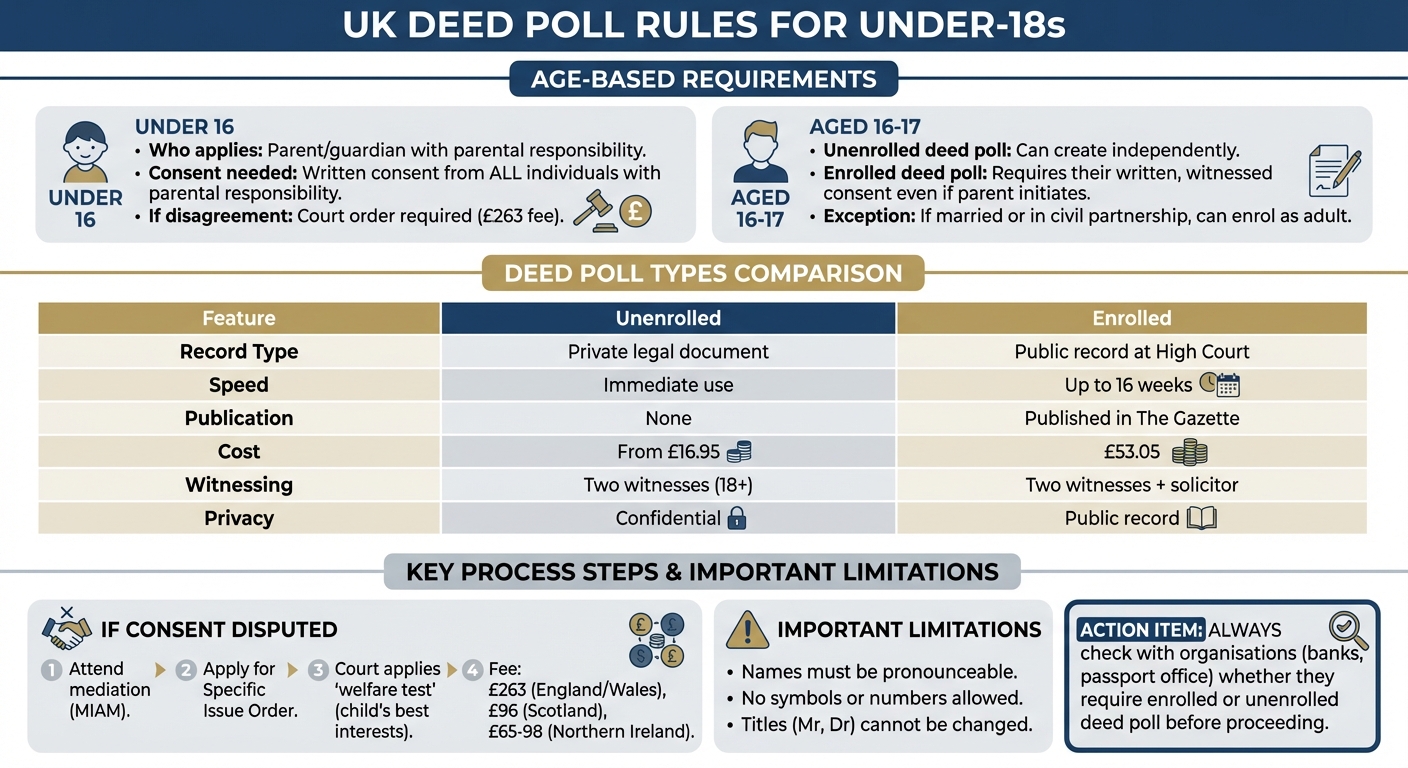
UK Deed Poll Rules for Under-18s: Age-Based Requirements and Process Comparison
Who Can Apply for a Minor's Name Change

Rules for Parents and Guardians
If a child is under 16, only a parent or legal guardian with parental responsibility can apply for a deed poll to change their name. Mothers automatically hold parental responsibility, while fathers have it if they were married to the mother at the time of the child's birth or if they are named on the birth certificate (for births registered after December 2003).
Both parents must agree to the name change. If one parent does not consent, the matter must be resolved through a Specific Issue Order from the court, which involves a fee of £263. The court will only approve the name change if it is determined to be in the child’s best interests.
The next section explains the rules for 16- and 17-year-olds who wish to handle their own name change.
Legal Rights of 16- and 17-Year-Olds
Once individuals turn 16, they can create an unenrolled deed poll on their own. However, if a parent decides to enrol a deed poll for a 16- or 17-year-old (which costs £53.05), the young person must provide a witnessed letter of consent. Without their agreement, parents cannot proceed with a name change.
There is an exception for those aged 16 or 17 who are married or in a civil partnership - they can enrol a deed poll as an adult without needing any parental involvement.
For 16- and 17-year-olds under a Child Arrangements, Residence, Special Guardianship, or Care Order, consent from everyone with parental responsibility is still required.
Consent Requirements for Under-16s
Getting Consent from All Persons with Parental Responsibility
In England, Wales, and Northern Ireland, changing the name of a child under 16 requires the written consent of all individuals with parental responsibility before a deed poll can be issued. This principle was clearly outlined by Mr Justice Holman in the High Court:
Where two or more people have parental responsibility for a child then one of those people can only lawfully cause a change of surname if all other people having parental responsibility consent or agree.
It’s important to note that parental responsibility doesn’t disappear if a parent has been absent or out of contact. Even in such cases, their legal consent is still required. Without this written agreement from everyone with parental responsibility, the name change is considered unlawful and could be challenged or reversed by relevant institutions.
These consent rules are a crucial part of the name change process for minors under 16.
When Consent is Disputed
If there’s disagreement among those with parental responsibility, the situation becomes more complex. In such cases, you’ll need to apply for a Specific Issue Order from the family court. The application fees vary: £263 in England and Wales, £96 in Scotland, and either £65 (Magistrates' Court) or £98 (County Court) in Northern Ireland.
In England and Wales, before heading to court, you’ll usually need to attend a Family Mediation Information and Assessment Meeting (MIAM). This step aims to resolve disputes without involving the court. However, if mediation doesn’t work and the case proceeds to court, judges will apply the "welfare test." This means the court’s primary focus will be on what’s in the best interests of the child. As the Deed Poll Office explains:
The courts' paramount consideration is the welfare of the child, so if - weighing everything together - they believe a change of name would be in your child's best interests, they should allow it.
The next section will detail the documents and steps required to complete the application process.
Documents and Steps for Applying
Required Documents
To apply for a deed poll for a minor, you'll need to gather the following documents:
- A child's full birth certificate (include adoption papers if applicable).
- Proof of parental responsibility, such as written consent from all responsible parties or a court order.
- A photocopy of your decree absolute, final order, or ex-partner's death certificate (if relevant).
- Your marriage or civil partnership certificate, if your current surname is different from the one on the child's birth certificate.
- For children aged 16 or 17, a formal letter of consent from the child, stating their old and new names, witnessed by someone over 18 who is not related to them.
- A letter of consent from your current partner, if you're in a new marriage or relationship.
- A certified translation of any documents not in English or Welsh.
Step-by-Step Process
Once you've assembled the necessary documents, the application process will vary depending on whether you're applying for an unenrolled or enrolled deed poll.
For Unenrolled Deed Polls (Usually for 16- and 17-Year-Olds)
- Prepare the deed poll document with the correct legal wording.
- Sign the document in front of two witnesses who are over 18 and not related to the applicant.
- Notify relevant organisations to update their records.
- Services like Name Change can assist by providing documents, certified copies, and tracked delivery starting from £16.95.
For Enrolled Deed Polls
- Fill out forms LOC022, LOC023, LOC024, and LOC028.
- Sign LOC022 in the presence of two witnesses, while the other forms must be signed in front of a solicitor.
- Pay the £53.05 fee to the High Court Fees Office.
- Submit the completed forms, supporting documents, and payment reference to the Deed Poll Office, Royal Courts of Justice.
- Processing can take up to 16 weeks, so double-check all forms for accuracy before submission.
sbb-itb-bf1bef6
Unenrolled vs Enrolled Deed Polls for Under-18s
When deciding between an unenrolled or enrolled deed poll, it's important to understand how they differ in terms of process, privacy, and acceptance. Both are legally valid, but each serves different needs.
Unenrolled Deed Polls
An unenrolled deed poll is a private legal document that isn’t officially recorded by the courts. It’s a straightforward and quick option that suits most families. All you need are two witnesses aged 18 or older, and the document is ready to use for updating records with organisations like HM Passport Office, schools, or the DVLA.
For children under 16, a parent or guardian must arrange the unenrolled deed poll. However, those aged 16 or 17 can complete it independently, as explained earlier. Services like Name Change offer unenrolled deed polls starting at £16.95, which include printed documents, certified copies, tracked delivery, and a handy guide.
The key benefit of an unenrolled deed poll is privacy. The name change remains confidential, with no public record created. This makes it an excellent choice for families prioritising safety or those who prefer to keep personal matters private.
If your situation requires a public record, consider the enrolled deed poll option.
Enrolled Deed Polls
An enrolled deed poll is a more formal process that records the name change with the King's Bench Division of the High Court. This involves completing four specific forms (LOC022, LOC023, LOC024, and LOC028), paying a £53.05 fee, and having certain documents signed in the presence of a solicitor.
Once enrolled, the name change is published in The Gazette, a public record accessible to anyone. Processing can take up to 16 weeks, making it a slower option than the unenrolled deed poll. If privacy or safety is a concern, you can request that only the first name or surname is published, though approval is not guaranteed.
| Feature | Unenrolled Deed Poll | Enrolled Deed Poll |
|---|---|---|
| Record Type | Private legal document | Public record at the High Court |
| Speed | Immediate use once signed | Up to 16 weeks processing time |
| Publication | None | Appears in The Gazette |
| Cost | From £16.95 (via Name Change) | £53.05 |
| Witnessing | Two witnesses (18+) | Two witnesses + solicitor |
| Citizenship Requirement | None | Must be British, Commonwealth, or British dependent territories citizen |
For most situations, an unenrolled deed poll is sufficient. However, some organisations - like certain banks, mobile phone providers, or energy companies - may specifically ask for an enrolled deed poll. To avoid unnecessary hassle or expense, reach out to the organisations you plan to update and confirm their requirements in advance. A quick check can save you both time and money.
When an Enrolled Deed Poll May Be Required
Requirements from Organisations
While most government bodies are fine with unenrolled deed polls, some private organisations - like banks, mobile phone providers, and energy companies - might insist on an enrolled version.
The policies of these organisations can differ: some are happy to accept unenrolled deed polls, while others are stricter about requiring enrolment. To save yourself time and unnecessary costs, it's always a good idea to check with the specific organisation beforehand to understand their rules.
Important: If the deed poll is for someone aged 16 or 17, some organisations may not accept an unenrolled version.
Avoiding Publication in The Gazette
Enrolling a deed poll means it will be published in The Gazette, making it part of the public record. However, if privacy is a concern, you can submit a brief explanation when applying. In certain cases, a judge might agree to limit what gets published - such as only revealing the child's first name or surname.
Conclusion
To wrap up, changing a child's name by deed poll involves a straightforward legal process, but it varies depending on the child's age and location. For children under 16, an application must be made by someone with parental responsibility. In England, Wales, and Northern Ireland, written consent is required from all individuals with parental responsibility. In Scotland, a single applicant can proceed, provided they have consulted others involved.
For those aged 16 and 17, the process is more independent - they can change their name themselves. However, if a parent chooses to enrol the deed poll, the minor must provide a signed, witnessed letter of consent.
When deciding between an unenrolled and an enrolled deed poll, consider your needs and the requirements of the organisations involved. An unenrolled deed poll offers privacy and is widely accepted, while an enrolled deed poll may be necessary for specific institutions. Always check what's required before making your choice.
If there's disagreement over parental consent, a Specific Issue Order may be needed. This involves a £263 fee following mediation.
Following the correct legal steps from the outset ensures the name change is universally recognised and avoids unnecessary complications. Getting the right consent and documentation early on will make updating records much easier.
FAQs
What happens if one parent doesn’t agree to a name change for a child under 16?
If one parent opposes a name change for a child under 16, things can get a bit tricky. Typically, consent from everyone who has parental responsibility is needed to proceed. If that agreement isn't possible, you might have to turn to the courts for a resolution.
The court's decision will focus on what serves the child's best interests, carefully considering their welfare and unique situation. While it's always better to try and work things out with the other parent first, going to court becomes the next step if an agreement remains out of reach.
Can a 16- or 17-year-old change their name by deed poll if they are married or in a civil partnership?
Yes, 16- and 17-year-olds who are married or in a civil partnership can change their name by deed poll without needing court approval. Being in a legally recognised union gives them the freedom to make this choice on their own.
For anyone aged 18 or over, name changes can also be recorded through the High Court if needed. However, this process isn’t required for minors who fall under the criteria mentioned above.
Why do some organisations ask for an enrolled deed poll instead of an unenrolled one?
Some organisations might ask for an enrolled deed poll because it establishes an official public record of your name change. This record is maintained by the Royal Courts of Justice for five years, offering an extra layer of verification that some institutions - like passport services or government agencies - may need for legal or security reasons.
Although an unenrolled deed poll is legally valid and generally accepted, certain organisations favour the added reliability of an enrolled deed poll when handling official record updates or issuing critical documents.