Checklist: Choosing the Right Deed Poll Type
Want to change your name in the UK? You’ll need a deed poll – the legal document for officially recording your new name. There are two types: unenrolled and enrolled.
- Unenrolled Deed Poll: Private, quicker, and affordable. Accepted by most organisations like HM Passport Office, DVLA, and banks. No public record.
- Enrolled Deed Poll: Publicly recorded via the Royal Courts of Justice. Typically used for legal matters like adoption, inheritance, or international recognition. Involves fees, a court process, and publication in The Gazette.
Key Considerations:
- Privacy: Unenrolled keeps your details private. Enrolled publishes them publicly.
- Cost: Unenrolled is cheaper (from £16.95). Enrolled involves court fees and solicitor costs.
- Speed: Unenrolled is immediate. Enrolled takes 1–3 months.
- Legal Needs: Enrolled may be required for specific legal or international purposes.
For most, an unenrolled deed poll is sufficient. Enrolled is only necessary in specific legal scenarios. Choose based on your priorities: privacy, cost, and purpose.
What Is an Unenrolled Deed Poll?
An unenrolled deed poll is a private legal document used to officially record a name change in the UK. Unlike enrolled deed polls, it doesn't appear in any public records. Once signed, dated, and witnessed, the document becomes legally valid immediately - no need for court applications or waiting periods.
Legal Standing and Acceptance
Although it’s a private document, an unenrolled deed poll carries full legal authority for most name changes in the UK. It is widely accepted by key organisations such as HM Passport Office, the DVLA, HMRC, the NHS, banks, and employers. This means you can use it to update your passport, driving licence, bank accounts, and medical records.
"An unenrolled deed poll is, however, still recognised by Government agencies such as the Passport Office and the DVLA and is a quicker, more affordable, and more private option." - Sarah Chapman, Paralegal, Hegarty
However, it’s important to note that a deed poll doesn’t amend historical records like birth or marriage certificates. Instead, it serves as additional evidence of your new name.
Practical Benefits of Unenrolled Deed Polls
The main advantages of an unenrolled deed poll are speed, privacy, and affordability. You can start using your new name immediately after signing the document. Since it’s not published in the London Gazette or any public record, your personal details remain private. Additionally, without the need for court enrolment or solicitor-led processes, the costs are kept low.
For example, Name Change simplifies the process for £16.95. This includes printed deed poll documents, three certified copies, tracked delivery, and PDF archiving. These documents are guaranteed to meet the requirements of UK government bodies - no solicitor needed.
Unenrolled Deed Poll Requirements Checklist
To ensure your deed poll meets legal standards, it must include the following:
- Three core declarations: that you are abandoning your old name, adopting your new name exclusively, and intending to use your new name at all times
- Your full former name and new name, clearly stated
- Your signature in wet ink (digital scans aren’t accepted by HM Passport Office or the DVLA)
- The date of signing
- At least one independent witness: over 18, not a family member, and not living at your address - with their full name, address, and occupation included
- Proper legal drafting to avoid rejection
Using imprecise wording can result in rejection, so it’s worth considering a professionally prepared document to ensure everything is correct.
sbb-itb-bf1bef6
What Is an Enrolled Deed Poll?
An enrolled deed poll is a formal document that records a name change through the Royal Courts of Justice in England and Wales (or in Belfast for Northern Ireland). Unlike unenrolled deed polls, this process creates a permanent public record under the Enrolment of Deeds (Change of Name) Regulations. It's a more formal option for those who need or want their name change to be publicly accessible. In Scotland, however, name changes are handled differently, being recorded in the Register of Births through the National Records of Scotland.
What Enrolment Involves
The process of enrolling a deed poll includes a formal court procedure and the publication of your name change in The Gazette. This ensures that your name change is permanently recorded.
"Enrolling a deed poll means officially recording your change of name with the Royal Courts of Justice (for England and Wales). This formal court process places your name change on public record." - Prime Deed Polls
After five years, enrolled deed polls are transferred to the National Archives, where they can be accessed for legal or genealogical purposes. Retrieving a certified copy from the archives requires paying a fee and visiting in person.
When You May Need an Enrolled Deed Poll
For most people in the UK, using an unenrolled deed poll is sufficient. However, there are specific cases where an enrolled deed poll might be necessary or preferred:
- Legal proceedings, such as adoption or matters involving the Children Act, where a court may require a formally enrolled document.
- Inheritance issues, where a permanent official record can provide clearer evidence of your name change.
- International recognition, as some foreign governments or officials may only accept an enrolled deed poll.
- Personal preference, for those who want their name change safeguarded by a government body and recorded permanently.
"If you are changing your name for legal reasons (such as adoption or a change in marital status), you may need an enrolled deed poll." - Sarah Chapman, Paralegal, Hegarty
While these examples highlight when enrolment might be beneficial, it's crucial to confirm with the relevant organisation or authority before proceeding. For instance, neither HM Passport Office nor the DVLA requires an enrolled deed poll.
Enrolled Deed Poll Requirements Checklist
The enrolment process is more involved than using an unenrolled deed poll and comes with additional steps:
- Court application forms and fees: You will need to submit these to the Royal Courts of Justice, which may include solicitor fees.
- Statutory declaration: A solicitor must witness a declaration from someone who has known you for over 10 years.
- Consent from a spouse or civil partner: If you're married or in a civil partnership, their written consent is required.
- Publication in The Gazette: Your old name, new name, and home address will be permanently recorded online and made publicly accessible.
"The details of your change of name, including your old and new name, your home address will be permanently published on the public record and the internet." - Sarah Chapman, Paralegal, Hegarty
Given the added complexity, cost, and potential privacy concerns, an enrolled deed poll is only recommended when there's a clear and specific need for it.
Checklist: Which Deed Poll Type Is Right for You?
Answering these questions can help you figure out the most suitable deed poll type for your needs.
Privacy and Public Record
If keeping your details private is a top priority, an unenrolled deed poll is the better option. It doesn't create a public record, ensuring your personal information stays confidential. This can be particularly important if you're changing your name due to sensitive reasons, like family estrangement or moving on from a difficult past. In such cases, having your old and new names, along with your home address, permanently available online could pose risks.
"The details of your change of name, including your old and new name, your home address will be permanently published on the public record and the internet." - Sarah Chapman, Paralegal, Hegarty
On the other hand, an enrolled deed poll means your details are permanently recorded in The Gazette. Think carefully about whether you're comfortable with this level of public visibility.
Speed, Simplicity, and Cost
An unenrolled deed poll is quick and straightforward, as it doesn’t require a court application. Once signed, it's ready for immediate use. Enrolment, however, takes longer - usually 1 to 3 months - and involves added expenses. The court fee is £50.32, plus solicitor fees. If you need a certified copy of the enrolled deed poll from the National Archives (after the five-year transfer period), it costs an additional £25 and requires an in-person visit.
Acceptance by Organisations
Most UK organisations, including HM Passport Office and the DVLA, accept an unenrolled deed poll without any issues. An enrolled version is rarely necessary for domestic purposes. However, if you're dealing with foreign legal bodies, it's worth checking their specific requirements, as some may prefer an enrolled deed poll for international legal matters.
Legal or Personal Circumstances
There are certain situations where enrolment might be necessary. For example, it could be required during Children Act proceedings, some inheritance disputes, or if a court specifically requests a formally enrolled document. If a solicitor or legal advisor recommends enrolment for your particular case, it's wise to follow their guidance. Otherwise, for everyday name changes, enrolment adds extra steps without offering additional legal validity.
Future Evidence and Personal Preference
"Once enrolled or recorded, the change becomes permanently searchable for legal and genealogical purposes." - Prime Deed Polls
If you'd like your name change to be permanently recorded for legal clarity or genealogical purposes, an enrolled deed poll provides that assurance. For most people, however, safely storing an unenrolled deed poll in your own records is more than sufficient. The next section will provide a side-by-side comparison to help you make your final decision.
Unenrolled vs Enrolled Deed Polls: A Comparison
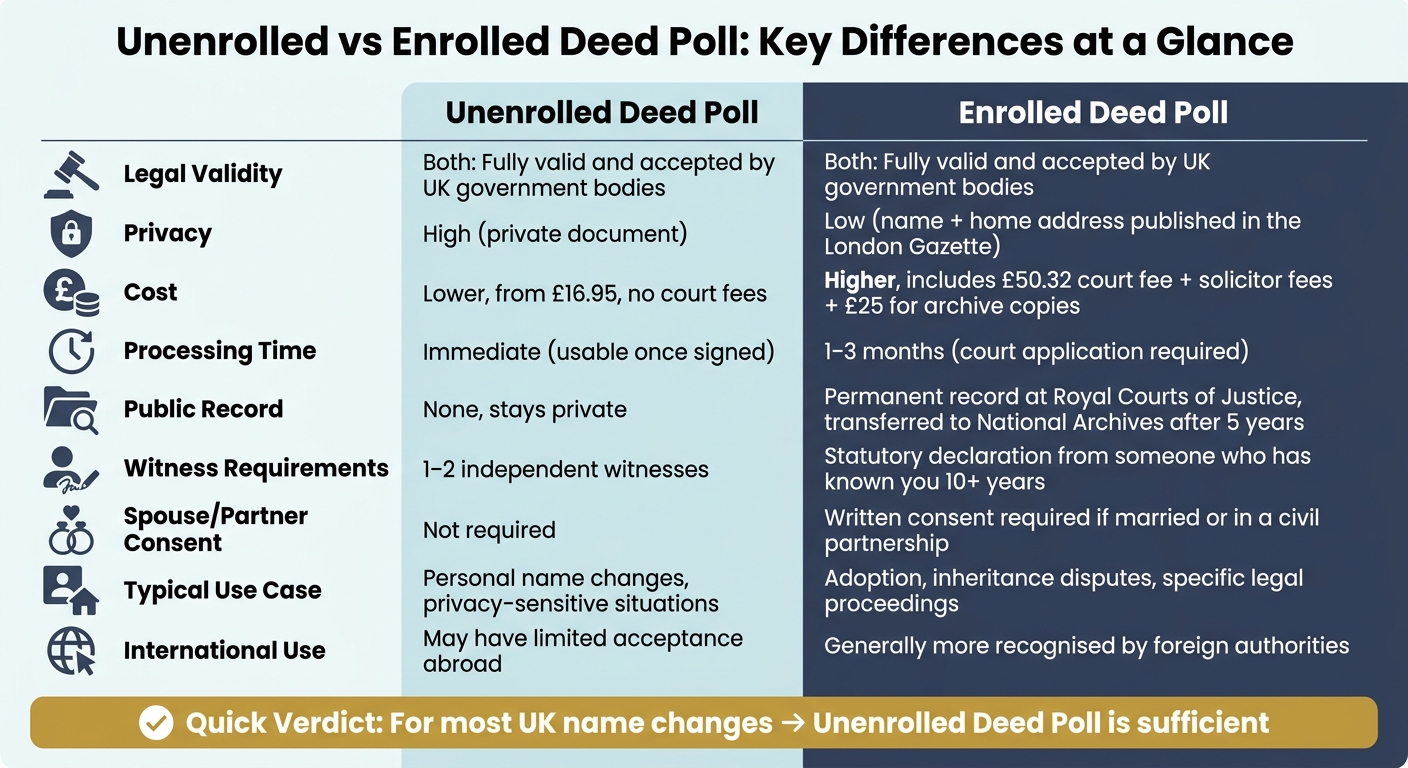
Unenrolled vs Enrolled Deed Poll: Key Differences at a Glance
Comparison Table
In the UK, both unenrolled and enrolled deed polls hold the same legal validity. However, they differ in terms of privacy, cost, complexity, and the situations they are best suited for. Here's a breakdown of the key differences:
| Feature | Unenrolled Deed Poll | Enrolled Deed Poll |
|---|---|---|
| Legal Validity | Fully valid; accepted by UK government bodies | Fully valid; no additional legal standing over unenrolled |
| Privacy | High; remains a private document | Low; name and home address published in the London Gazette |
| Cost | Lower; no court or enrolment fees | Higher; includes court, solicitor, and publication fees |
| Processing Time | Immediate; usable as soon as signed | Longer; involves a court application process |
| Public Record | None; remains private | Permanent; recorded at the Royal Courts of Justice |
| Witness Requirements | 1–2 independent witnesses | Statutory declaration from someone who has known you for 10+ years |
| Spouse/Partner Consent | Not required | Written consent needed if married or in a civil partnership |
| Storage | Kept by the individual | Held by the court; transferred to the National Archives after 5 years |
| Typical Use Case | Personal name changes, privacy-sensitive situations | Specific legal proceedings like adoption or inheritance disputes |
| International Use | May have limited acceptance abroad | Generally more recognised by foreign authorities |
This table provides a clear overview to help you weigh the options and choose the deed poll type that fits your requirements.
Quick Decision Summary
For most people in the UK looking to change their name, an unenrolled deed poll is the practical choice. It is accepted by organisations like HM Passport Office, the DVLA, banks, and others. With its faster process, lower cost, and private nature, it meets the needs of the majority.
An enrolled deed poll, on the other hand, is typically necessary only in specific cases, such as when required by a court or professional body for legal matters like adoption or inheritance. Otherwise, enrolling adds unnecessary cost, time, and creates a public record without offering extra legal benefits. If you're unsure which option works best for your situation, consulting a solicitor or comparing a deed poll vs statutory declaration can provide clarity tailored to your circumstances.
Conclusion
For most people in the UK, an unenrolled deed poll is sufficient. It’s legally valid, widely accepted, and ensures your personal details remain private. On the other hand, an enrolled deed poll is more suited to situations involving legal matters like adoption, inheritance, or cases under the Children Act. Otherwise, it tends to add unnecessary costs, time, and complexity.
Your decision should reflect your priorities - whether that’s maintaining privacy, keeping costs low, ensuring a quick process, or creating a permanent public record. If your name change involves international documents, legal complications, or enrolment while married, consulting a solicitor may be helpful for tailored advice.
When you're ready to move forward with an unenrolled deed poll, Name Change offers a secure and straightforward service that complies with UK government requirements.
FAQs
Will an unenrolled deed poll update my birth certificate?
An unenrolled deed poll won't change the name on your birth certificate. However, it can serve as supporting evidence to update your name on various other official records. This makes it a practical and commonly accepted method for legally changing your name in the UK.
Who can witness my deed poll?
Your deed poll needs to be witnessed by someone with the authority to oversee legal documents. This could be a solicitor, a commissioner for oaths, or a court officer. The witness must be present when you swear or affirm the statutory declaration and is required to sign the declaration form as well. This step ensures the process is legally binding.
When would I actually need an enrolled deed poll?
If you need a permanent public record of your name change for legal or official reasons, you'll require an enrolled deed poll. This is commonly necessary in cases such as adoption or marital status changes. An enrolled deed poll is a more formal document, as it’s officially recorded with the UK courts, making it ideal for certain legal requirements.