Enrolled vs Unenrolled Deed Polls: Key Differences
A deed poll is a legal document in the UK used to officially change your name. There are two types: unenrolled and enrolled. Both are legally valid, but they differ in cost, privacy, and processing time. Here's what you need to know:
- Unenrolled deed polls are private, inexpensive (around £20–£30), and processed quickly. They are accepted by most UK organisations, including HM Passport Office, DVLA, and banks.
- Enrolled deed polls are public records, with your details published in The London Gazette. They cost £53.05 (plus solicitor fees), take up to 16 weeks, and are sometimes required for specific legal or formal situations.
Quick Comparison
| Feature | Unenrolled Deed Poll | Enrolled Deed Poll |
|---|---|---|
| Privacy | Private | Public (published in The London Gazette) |
| Cost | £20–£30 | £53.05 + solicitor fees |
| Processing Time | A few days | Up to 16 weeks |
| Legal Validity | Fully valid | Fully valid |
| Acceptance | Accepted by most organisations | Accepted universally |
| Public Record | No | Yes |
For most people, an unenrolled deed poll works perfectly due to its privacy and simplicity. However, consider an enrolled deed poll if required by specific organisations or legal circumstances.
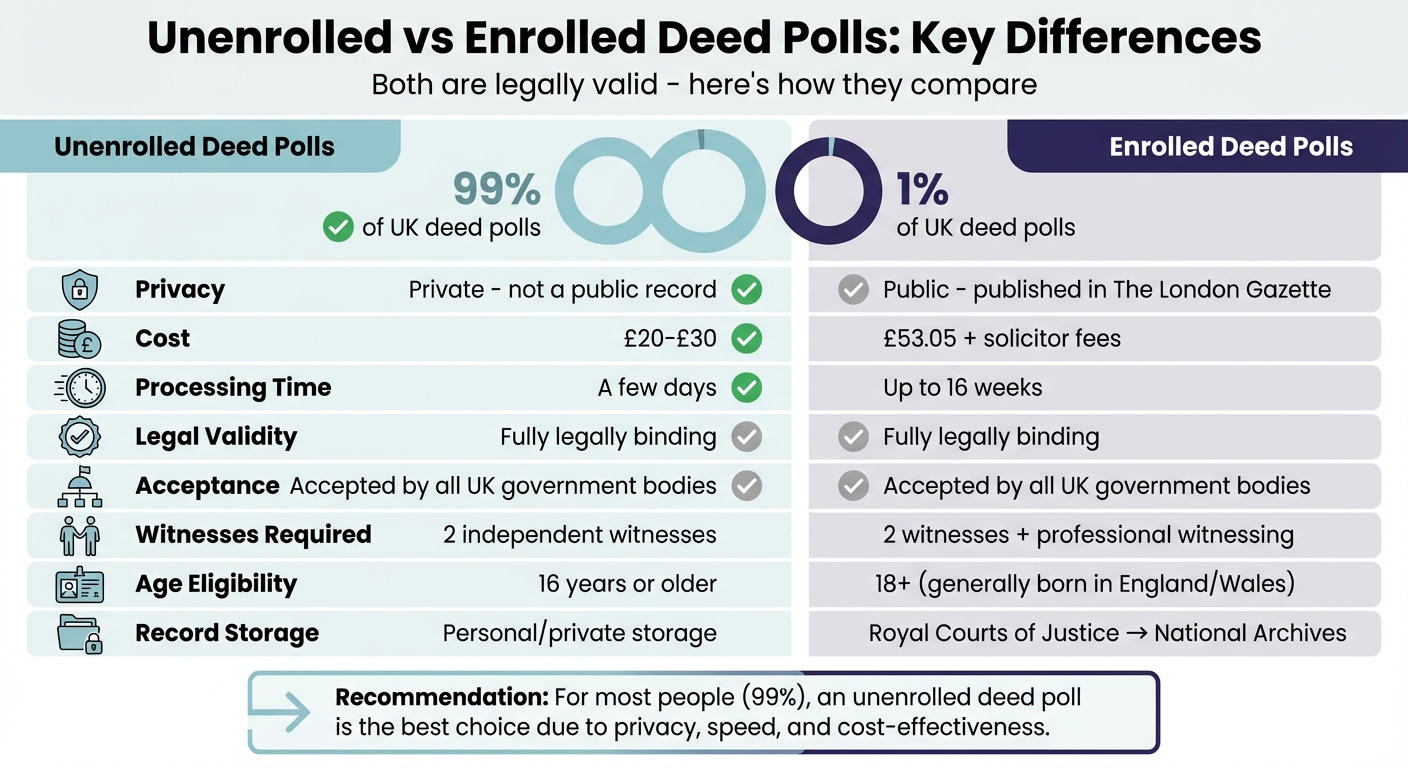
Unenrolled vs Enrolled Deed Polls Comparison Chart
Unenrolled Deed Polls
What is an Unenrolled Deed Poll?
An unenrolled deed poll is a private legal document that officially confirms your name change without being registered with a court or government body. Once signed in the presence of two independent witnesses, it serves as valid proof of your new name. Unlike enrolled deed polls, it remains entirely confidential and is not published in The London Gazette. Interestingly, almost 99% of deed polls in the UK fall into this category. Here’s why many people prefer this discreet option.
Main Features of Unenrolled Deed Polls
Unenrolled deed polls are popular for their privacy, affordability, and quick turnaround. One of their biggest advantages is keeping your name change a private matter, shared only with the organisations you inform. These documents are widely accepted by major UK institutions, including HM Passport Office, the DVLA, HMRC, banks, and employers. As Mr Justice Holman explained:
Enrolment of a deed poll is not a prerequisite to a change of surname and merely evidences a change in a particularly formal way.
In terms of cost, unenrolled deed polls are much cheaper, typically ranging from £16.95 to £24.95, and they’re processed within a few days. In contrast, enrolled deed polls cost around £53.05 and can take weeks or even months to finalise.
How to Get an Unenrolled Deed Poll
Obtaining an unenrolled deed poll is simple and designed to prioritise privacy and speed. Services like Name Change ensure your deed poll meets government standards and provide certified copies through tracked delivery. For example, their standard service costs £16.95 and includes three certified copies, an ink stamp, and a guide, while their premium service at £24.95 offers additional features like PDF archiving and unlimited downloads.
Once you receive the document, you’ll need to sign it in front of two independent witnesses. These witnesses must be over 18, unrelated to you, and live at separate addresses. It’s also a good idea to order multiple certified copies, as you’ll need them to notify approximately 24 organisations - a process that could take about 14 hours in total.
sbb-itb-bf1bef6
Enrolled Deed Polls
What is an Enrolled Deed Poll?
An enrolled deed poll is a formal document registered with the Royal Courts of Justice in London. Once registered, the name change is published in The London Gazette, making it a matter of public record. These records are initially stored in the Enrolment Books of the Senior Courts for 5–10 years before being transferred to the National Archives at Kew for permanent safekeeping. Interestingly, only about 1% of deed polls in the UK are enrolled, which shows just how uncommon this option is.
Main Features of Enrolled Deed Polls
The process of enrolling a deed poll is more involved than obtaining an unenrolled one. To apply, you need to be at least 18 years old and generally born in England or Wales. The application process includes completing specific forms, providing a statutory declaration from someone who knows you well, and having signatures witnessed by an authorised professional. All these steps add to the complexity and cost.
The fees for enrolling a deed poll are £53.05, not including solicitor fees. The entire process can take up to 16 weeks. After five years, if you need a certified copy from the National Archives, you'll need to pay around £25 and visit in person to obtain it. These strict requirements mean enrolled deed polls are relatively rare and are typically used when additional legal assurance is necessary.
When You Might Need an Enrolled Deed Poll
For most situations, an unenrolled deed poll is sufficient. However, there are some specific instances where an enrolled deed poll might be required. Certain organisations or companies may insist on an enrolled deed poll to update their records. It may also be necessary in cases involving complex legal matters, inheritance disputes, or situations where extra verification is crucial.
As Lord Justice Ormrod once explained:
"[T]he purpose of enrolment is only evidential and formal. A deed poll is just as effective or ineffective whether it is enrolled or not; the only point of enrolment is that it will provide unquestionable proof [that the deed poll has been executed], if proof is required. No more."
Before proceeding, check with the organisation in question to see if an enrolled deed poll is mandatory. Many accept the private version, unless a court or government body insists on enrolment. Bear in mind that enrolling your deed poll makes your old name, new name, and home address permanently searchable online via The London Gazette. This public nature can raise privacy concerns for some individuals.
Main Differences Between Enrolled and Unenrolled Deed Polls
Deciding between an enrolled and unenrolled deed poll depends on understanding what makes them distinct. Both options come with different implications for privacy, cost, and processing time. Here's a closer look at how they differ.
One major distinction is privacy. An unenrolled deed poll is a private document, entirely under your control. On the other hand, an enrolled deed poll becomes part of the public record, with your personal details published in The London Gazette.
Cost and processing time also vary significantly. Unenrolled deed polls are relatively inexpensive, costing between £20 and £30, and can be processed within a few days. In contrast, an enrolled deed poll involves a £53.05 court fee (plus solicitor fees) and may take up to 16 weeks to complete. Additional professional witnessing is also required for the enrolled option.
For a clearer comparison, here’s a detailed table:
Comparison Table
| Feature | Unenrolled Deed Poll | Enrolled Deed Poll |
|---|---|---|
| Privacy | Private; not a public record | Public; details published in The London Gazette |
| Cost | Free to ~£30 | Approximately £53.05 plus solicitor fees |
| Processing Time | A few days | May require up to 16 weeks |
| Legal Validity | Fully legally binding | Fully legally binding |
| Acceptance | Accepted by all UK government bodies | Accepted by all UK government bodies |
| Public Record | No | Yes (recorded at the Royal Courts of Justice) |
| Witnesses | Two independent witnesses | Two witnesses plus additional professional witnessing |
| Storage | Personal/private | Initially at the Royal Courts of Justice, then transferred to the National Archives |
| Eligibility | Available to anyone 16 or over | Generally for individuals 18+ and born in England or Wales |
This breakdown highlights the practical considerations for each option, helping you decide which deed poll aligns best with your needs.
Which Type of Deed Poll Should You Choose?
For most people in the UK, an unenrolled deed poll is perfectly suitable. To help you decide, let’s break down the key benefits of each option. If you’re changing your name after marriage, divorce, or simply for personal reasons, an unenrolled deed poll usually ticks all the boxes. Below, we’ll explore the advantages of both types to guide you in making the right choice.
Benefits of Unenrolled Deed Polls
One of the biggest advantages of an unenrolled deed poll is privacy. It’s completely private, meaning there’s no public announcement or permanent record available for others to access. This makes it ideal if you want to keep your name change discreet.
Another benefit is the speed and cost. Unenrolled deed polls can be processed in just a few days, whereas enrolled ones can take up to 16 weeks. They’re also much more affordable, with packages offering tracked delivery and certified copies. In contrast, an enrolled deed poll comes with a government fee of £53.05, not to mention any potential solicitor charges.
Flexibility is another reason many choose this option. Anyone aged 16 or over can use an unenrolled deed poll, while enrolled deed polls are only available to those aged 18 and above. Additionally, unenrolled deed polls don’t require spousal consent, which can be a relief if you’re married or in a civil partnership but separated.
Benefits of Enrolled Deed Polls
While unenrolled deed polls work for most scenarios, there are specific instances where an enrolled deed poll is the better choice. For example, some organisations - such as banks dealing with complex inheritance matters - may insist on a public record of your name change. In such cases, it’s best to contact the organisation directly to check whether an unenrolled deed poll, if properly witnessed, would be acceptable.
Enrolled deed polls are officially recorded at the Royal Courts of Justice and later transferred to the National Archives. This creates a permanent legal record, which can be helpful for certain legal proceedings or formal requirements. Though less common, this level of documentation might be necessary for some unique situations.
Legal Validity and Acceptance
When it comes to changing your name in the UK, both unenrolled and enrolled deed polls hold the same legal authority. They are equally binding under UK law and carry identical weight in terms of validity. The key difference lies in whether the name change is entered into the public record.
Government departments across the UK - including HM Passport Office, the DVLA, HMRC, and the NHS - accept unenrolled deed polls as valid proof of a name change, provided they are properly executed (signed, dated, and witnessed). This means you can use an unenrolled deed poll to update your passport, driving licence, tax records, and medical records without issue.
Private organisations, such as banks, utility companies, mobile providers, and employers, also generally accept unenrolled deed polls. However, it’s worth noting that some institutions may have stricter policies and require an enrolled deed poll instead. If you’re unsure about a specific organisation’s requirements, it’s always a good idea to check with them beforehand.
For UK passport applications using an unenrolled deed poll, you’ll need to provide evidence of consistent use of your new name. This could include documents like an updated driving licence or a bank statement showing the new name.
To ensure the credibility of your deed poll, witnesses must be at least 18 years old and cannot be related to you or living at the same address. Following these guidelines helps establish the document’s legitimacy.
Conclusion
When deciding between an unenrolled and enrolled deed poll, it’s all about what suits your situation best. For most people - around 99% - an unenrolled deed poll is the preferred choice. Why? It’s private, cost-effective, and widely accepted by major government departments and most organisations. On the other hand, enrolled deed polls cater to specific needs, like court requirements, inheritance complexities, or certain international legal matters. Keep in mind that the enrolment process is more detailed and takes more time.
Legally, both options carry the same weight. As Lord Justice Ormrod explained:
A deed poll is just as effective or ineffective whether it is enrolled or not; the only point of enrolment is that it will provide unquestionable proof... if proof is required. No more.
The key difference lies in privacy. An unenrolled deed poll keeps your name change entirely private. In contrast, an enrolled deed poll makes your old name, new name, and home address publicly available in The London Gazette, where it remains on record permanently. This makes it crucial to weigh your privacy needs against any requirement for public documentation.
If you’re unsure, an unenrolled deed poll is generally the safer starting point. Before opting for the enrolled route, check with the organisation requesting it to confirm whether they’ll accept a properly executed unenrolled deed poll. By assessing your circumstances and considering the factors mentioned here, you can make an informed decision.
For those ready to proceed, Name Change offers a simple service to obtain unenrolled deed polls. They provide certified copies, tracked delivery, and guaranteed acceptance by UK government departments, covering the needs of the vast majority looking to change their name.
FAQs
What are the benefits of choosing an enrolled deed poll over an unenrolled one?
When you want your name change to be officially recorded and made public, an enrolled deed poll is the way to go. This involves registering the deed poll with the Royal Courts of Justice and having the change published in The London Gazette.
Certain organisations or legal processes may require an enrolled deed poll because it offers a more formal and recognised record. That said, for most day-to-day situations, an unenrolled deed poll is usually enough and much simpler to arrange.
What should I know about the privacy of an enrolled deed poll?
When you use an enrolled deed poll, your name change is officially recorded and becomes publicly accessible. This means your previous name, your new name, and the date of the change are added to the court’s register and may be published in outlets like The London Gazette. This makes it possible for anyone to search for and view these details.
If privacy or security is a concern, you can request that certain information is kept out of publication. However, this request isn’t always guaranteed. For those prioritising privacy, an unenrolled deed poll might be a better option, as it doesn’t require public disclosure.
Do any organisations specifically require an enrolled deed poll?
In the majority of situations, an unenrolled deed poll is enough to change your name and is commonly accepted by UK government departments, banks, employers, and various other organisations. Instances where an enrolled deed poll is required are quite rare and typically pertain to specific legal or administrative needs.
If you're uncertain whether you need an enrolled deed poll for your particular case, it’s a good idea to contact the relevant organisation directly to clarify their requirements.