Deed Poll vs. Birth Certificate Corrections
When dealing with name discrepancies in the UK, you have two main options: Deed Poll or Birth Certificate Correction. Each serves a different purpose and depends on your specific situation, so it's worth comparing name change methods to find the right fit.
- Deed Poll: Used to legally change your name without needing evidence of an error. It’s fast, affordable (£20 online), and widely accepted for updating official documents like passports and driving licences. However, it doesn’t alter your birth certificate.
- Birth Certificate Correction: Fixes factual errors in your birth record, such as misspellings or incorrect details. This process requires evidence from the time of birth, is more complex, and costs between £40–£55. Approval isn’t guaranteed, and the original record is updated with a note rather than being replaced.
Quick Comparison
| Factor | Deed Poll | Birth Certificate Correction |
|---|---|---|
| Purpose | Legal name change | Correct factual errors at birth |
| Speed | Fast (days) | Slower (weeks) |
| Cost | £20 | £40–£55 |
| Evidence Required | None | Proof from time of birth |
| Effect on Record | Does not change birth certificate | Updates birth record with a note |
If you lack evidence for a correction or need a simple name change, a Deed Poll is often the better choice. If correcting your birth record is essential and you have supporting evidence, pursue a Birth Certificate Correction.
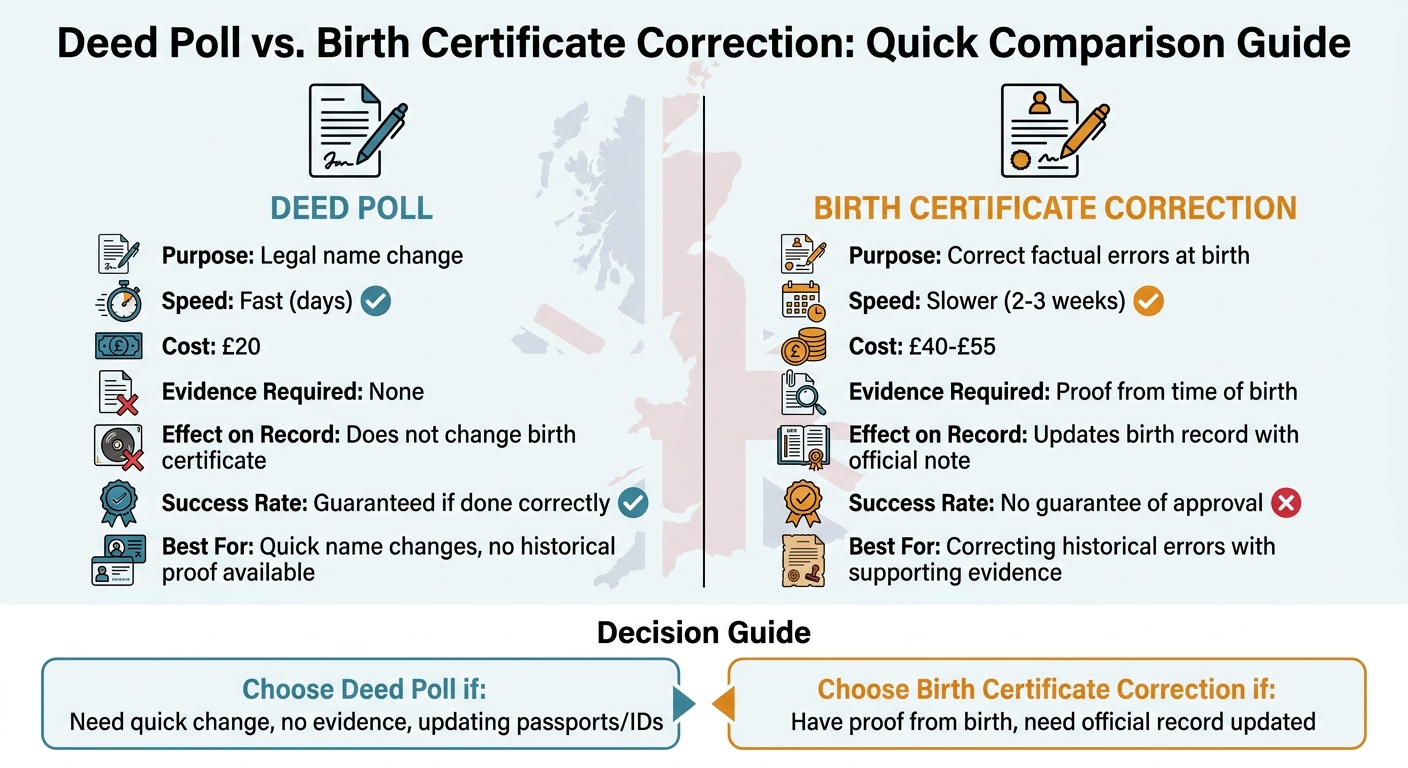
Deed Poll vs Birth Certificate Correction Comparison UK
What Is a Deed Poll?
A deed poll is a legal document used to confirm a name change. It provides the necessary proof to update your details with organisations like government departments, banks, and other institutions. In the UK, there's no central authority to register a name change. Instead, the change becomes legally valid as soon as you start using your new name. However, most organisations will ask for a deed poll before they update your records.
The process is straightforward. You don't need to prove an error in your original name. Instead, the deed poll simply records the switch from your old name to your new one. As the Deed Poll Office explains:
In law, you can simply adopt a new name and start using it.
This document formalises the change for all official purposes.
Deed polls are widely recognised across the UK. Government bodies like HM Passport Office and DVLA accept them as proof of a legal name change. Banks, such as HSBC, also accept witnessed deed polls, as long as you provide evidence of your previous name alongside the document.
Key Features of a Deed Poll
A deed poll offers flexibility and is accessible to anyone aged 16 or older. For those under 16, parental consent is required.
The process is quick and straightforward. Once you have the original deed poll, you can notify organisations immediately. If you need to contact multiple institutions, certified copies can be requested. To validate the document, a witness is required. The witness must be over 18, live in the UK, and be independent – they cannot be a relative, partner, or someone you live with.
These characteristics make deed polls a practical solution for various name change situations.
Common Uses for a Deed Poll
Deed polls are used in a variety of situations involving name changes. One common use is to correct a spelling error. For example, if your name was misspelt on your birth certificate but you've always used the correct spelling, a deed poll formalises this adjustment. Other uses include adding or removing middle names, adopting a new surname, or making official a name you've been using informally.
In cases where you can't provide evidence to correct details on a birth certificate, a deed poll offers a practical alternative. It's also commonly used for non-correctional name changes, such as adopting a new name after a divorce or simply choosing a different name for personal reasons.
What Is a Birth Certificate Correction?
A birth certificate correction is a formal process to fix errors made during the original registration of a birth. This process relies on evidence from the time of the birth to support the correction. It’s different from a deed poll, which is used to record a name change rather than correct an error.
Corrections are limited to mistakes in the original record, such as misspelt names, incorrect details about a parent's occupation, or errors in paternity information. They do not cover changes made later, like updating a parent's surname after marriage. Once a correction is approved, the original record remains unchanged, but an official note is added in the margin to explain the error. Full birth certificates include this note, while short versions only display the corrected information.
Eligibility for Birth Certificate Corrections
Corrections are only allowed for specific errors, such as:
- Spelling mistakes in a child’s or parent’s name
- Incorrect details about a parent’s occupation
- Paternity errors, which must be supported by an approved DNA test or court order
To apply for a correction, you’ll need strong evidence - documents from around the time of the birth that prove the original registration was incorrect. Without these, it’s unlikely the correction will be approved.
In England and Wales, there’s one exception: you can change a child’s forename within the first year of birth. This costs £40 and is considered a "change" rather than a correction.
Before applying, it’s best to contact the Register Office where the birth was registered. They can confirm the requirements and guide you through the process. The application fee for a correction in England and Wales is £83 or £99, and replacement certificates cost £12.50 each.
Processing Time and Regional Variations
The time it takes to process a birth certificate correction depends on where you are in the UK. In England and Wales, it varies based on the local Register Office and whether General Register Office approval is needed. Fees here are £83 or £99, plus extra for replacement certificates.
In Scotland, corrections are usually completed within two weeks. Northern Ireland takes around three weeks. Both Scotland and Northern Ireland allow name changes for children and adults on birth certificates. This differs from England and Wales, where adults can only make changes through a Gender Recognition Certificate.
Because of the time, cost, and evidence required for corrections, many people opt to change your name by deed poll instead. It’s quicker, less expensive, and doesn’t require supporting documents.
Deed Poll vs. Birth Certificate Corrections: Main Differences
When deciding between a deed poll and a birth certificate correction, it’s all about your specific needs. A deed poll is used to officially change your name or identity moving forward, while a birth certificate correction is meant to fix factual errors that were present at the time of your birth. While both can address name-related issues, they serve entirely different purposes.
It’s essential to understand this difference to choose the right option. A deed poll does not require historical evidence, whereas a birth certificate correction does. As the Deed Poll Office explains:
Correcting a name on a birth certificate is difficult and there is no guarantee of success.
Comparison Table
| Factor | Deed Poll | Birth Certificate Correction |
|---|---|---|
| Primary Goal | To legally change a name or identity | To fix a mistake in the historical record |
| Speed | Fast (often immediate or within days) | Slower (typically 2–3 weeks, depending on the region) |
| Cost | £20 (online) | Approximately £40–£55, depending on the region |
| Evidence Required | None | Proof that the original details were wrong at birth |
| Acceptance | Widely accepted for passports and IDs | Generally accepted, but limited in scope and more difficult to obtain |
| Effect on Record | Does not change the original birth certificate | Amends the original record or adds an official note |
When to Use Each Method
- Opt for a deed poll if you need a quick, straightforward way to change your name legally in the UK for personal or professional reasons, or for official documents like passports. At just £20, it’s affordable and recognised by all UK government departments. Keep it alongside your birth certificate, as it acts as the legal link between your original name and your current one.
- Choose a birth certificate correction only if you have solid proof - such as DNA evidence or historical documentation - that the details recorded at birth were incorrect. This route is more expensive, slower, and approval isn’t guaranteed, but it ensures the official record reflects the corrected information.
How to Get a Deed Poll for Name Corrections
Now that you know what a deed poll is, here's how to get one specifically for fixing errors in your name.
You can apply online or request a form by post to obtain a deed poll for correcting your name. Once your application is processed, you’ll receive the official deed poll document certifying your corrected name. After signing it, you’ll need to use the original document to update your details with organisations like HM Passport Office, DVLA, your bank, and others. Keep in mind, most institutions will only accept the original document, so make sure you store it safely while making updates.
A deed poll is particularly helpful if your birth certificate has an error and you can’t provide the necessary historical evidence to amend it. It serves as legal proof of the change from the name on your birth certificate to the one you actually use.
Using Name Change for Deed Polls

Name Change simplifies the whole process, making it straightforward and reliable. For £16.95, you’ll get three certified copies of your deed poll, an ink stamp, tracked delivery in a sturdy board-backed envelope, a step-by-step guide, and PDF archiving with unlimited downloads. If you prefer, the £24.95 premium option adds a gold embossed stamp for an extra touch.
All documents come ready to sign with clear instructions, so there’s no need for a solicitor. This hassle-free approach is one reason why many people choose a deed poll over trying to correct their birth certificate for name errors.
sbb-itb-bf1bef6
How to Correct a Birth Certificate
Fixing a mistake on a birth certificate is a more detailed process than changing your name through a deed poll in the UK. It requires proof that the original information was wrong. Errors like a misspelt name or an incorrect occupation can be amended, but adding information - such as a father’s name after marriage - requires re-registering the birth. This process demands strict documentation, making it more rigorous than a deed poll.
To start, contact the Register Office where the birth was originally registered. They will guide you on the required documents and whether the correction can be handled locally or needs approval from the General Register Office (GRO). Supporting evidence, such as hospital records, baptismal certificates, or court orders, must be provided. Application forms must be completed by hand and include original signatures before submission.
Fees for corrections are either £83 or £99, with an extra £12.50 for each new certificate issued. Once approved, the original record is not erased but updated with a note explaining the correction. Full birth certificates will include this note, while short certificates will reflect only the revised details.
Regional Requirements Across the UK
The rules for changing names on birth certificates differ across the UK. England, Wales, Scotland, and Northern Ireland each have their own fees, requirements, and processing times. It’s essential to check with your local Register Office for specific details. Keep in mind, these are recorded changes rather than corrections of factual errors. This variation in procedures is one reason why some people choose a deed poll for a faster, simpler solution.
Pros and Cons of Each Method
Let’s dive into the benefits and drawbacks of the two methods discussed earlier.
A deed poll stands out for its speed and ease. It’s a quick, affordable process - costing around £20 online - and doesn’t require evidence to prove an error in the original birth registration. Plus, it’s widely accepted by UK authorities like the Passport Office and the DVLA. However, the downside is that a deed poll doesn’t modify your birth certificate. Instead, it creates a separate document that you’ll need to present alongside your original birth record.
On the other hand, a birth certificate correction updates the official historical record, ensuring that your primary identity document reflects accurate information. This can be crucial for legal matters, such as marriage or applying for a mortgage. But there are hurdles: you’ll need to provide evidence from the time of birth, and even then, success isn’t guaranteed. As the Deed Poll Office cautions:
Correcting a name on a birth certificate is difficult and there is no guarantee of success.
Here’s a quick comparison of both methods:
Advantages and Disadvantages Table
| Feature | Deed Poll | Birth Certificate Correction |
|---|---|---|
| Evidence Required | None | Proof from time of birth |
| Success Rate | Guaranteed if done correctly | No guarantee of success |
| Changes Birth Record | No (creates a supplementary document) | Yes (updates the historical record) |
| Acceptance | Widely accepted (Passport Office, DVLA) | Universally accepted as primary ID |
| Surname Changes | Allowed for adults and children | Generally not allowed in England & Wales |
Conclusion
Deciding between a deed poll and a birth certificate correction depends entirely on your circumstances and the evidence you have.
If you possess evidence from the time of birth proving the original registration was incorrect - such as a DNA test showing paternity errors or historical records highlighting a spelling mistake - a birth certificate correction is the right option. This process updates the official historical record, ensuring your primary identity document reflects the truth. However, it can be a complex process, and approval isn't guaranteed. Costs vary between £40 and £55, depending on where the birth was registered.
For most people, a deed poll is quicker and easier. Priced at just £20 for an online application, it’s affordable, straightforward, and widely recognised by UK government bodies like the Passport Office and DVLA. The only limitation is that it doesn’t amend your birth certificate, meaning you’ll need to present both documents together when necessary.
If you’re looking for a simple way to handle a deed poll, Name Change offers a secure service, including certified copies and tracked delivery for peace of mind.
Understanding these differences makes it easier to select the right path for updating your records.
FAQs
Will a deed poll let me change my passport and driving licence?
Yes, a deed poll is a legally recognised document in the UK for changing your name. It allows you to update your name on official records like your passport and driving licence, ensuring they reflect your new name accurately.
What proof do I need to correct a birth certificate in the UK?
To make corrections to a birth certificate in the UK, you’ll need to provide documentary evidence that supports the requested change. The type of evidence required depends on the nature of the correction. For instance, if you’re removing incorrect details about a father, this may involve submitting a DNA test result, a court order, or similar supporting documents. For other amendments, such as changes to personal details, you’ll need to supply relevant documents. These will then be reviewed by either the local register office or the General Register Office (GRO).
Do I need a deed poll if my birth certificate name is spelt wrong?
If there’s a spelling mistake on your birth certificate, you don’t always need a deed poll to sort it out. You can ask for a correction if you can prove the original information was wrong. This is a different process from using a deed poll and usually works for fixing errors. However, if you want to officially change your name for any other reason, a deed poll will be necessary.