Deed Poll vs. Marriage Certificate: What You Need
When changing your name in the UK after marriage, the document you need depends on the type of name change you’re making. A marriage certificate is sufficient for straightforward changes like taking your spouse’s surname or creating a hyphenated double-barrelled name. However, if you want to make more complex changes - such as blending surnames, moving your maiden name to a middle name, or altering your first name - you’ll need a deed poll.
Key Points:
- A marriage certificate is accepted for simple surname changes and by most organisations (e.g., banks, HM Passport Office, DVLA).
- A deed poll is required for non-traditional changes, like creating a new surname or modifying your first or middle name.
- Marriage certificates are free (with extra copies available for a small fee), while deed polls cost £19–£22.50 for unenrolled versions or £53.05 for an enrolled deed poll.
- Both documents ensure your updated name is legally recognised, but a deed poll offers more flexibility for custom changes.
Below is a quick comparison to help decide which option suits your needs.
Quick Comparison
| Feature | Marriage Certificate | Deed Poll |
|---|---|---|
| Primary Use Case | Taking spouse’s surname or double-barrelled name | Changing first, middle, or last name |
| Cost | Free (additional copies: ~£11 each) | £19–£22.50 (unenrolled), £53.05 (enrolled) |
| Processing Time | Immediate (certificate already exists) | Same day (unenrolled), up to 16 weeks (enrolled) |
| Accepted By Organisations | Yes, for standard surname changes | Yes, for all name changes |
| Middle Name Changes | Not applicable | Required |
| Blended/Custom Surnames | Not applicable | Required |
Choose based on the type of name change you want to make. For standard changes, a marriage certificate is enough. For personalised or complex changes, a deed poll is the way to go.
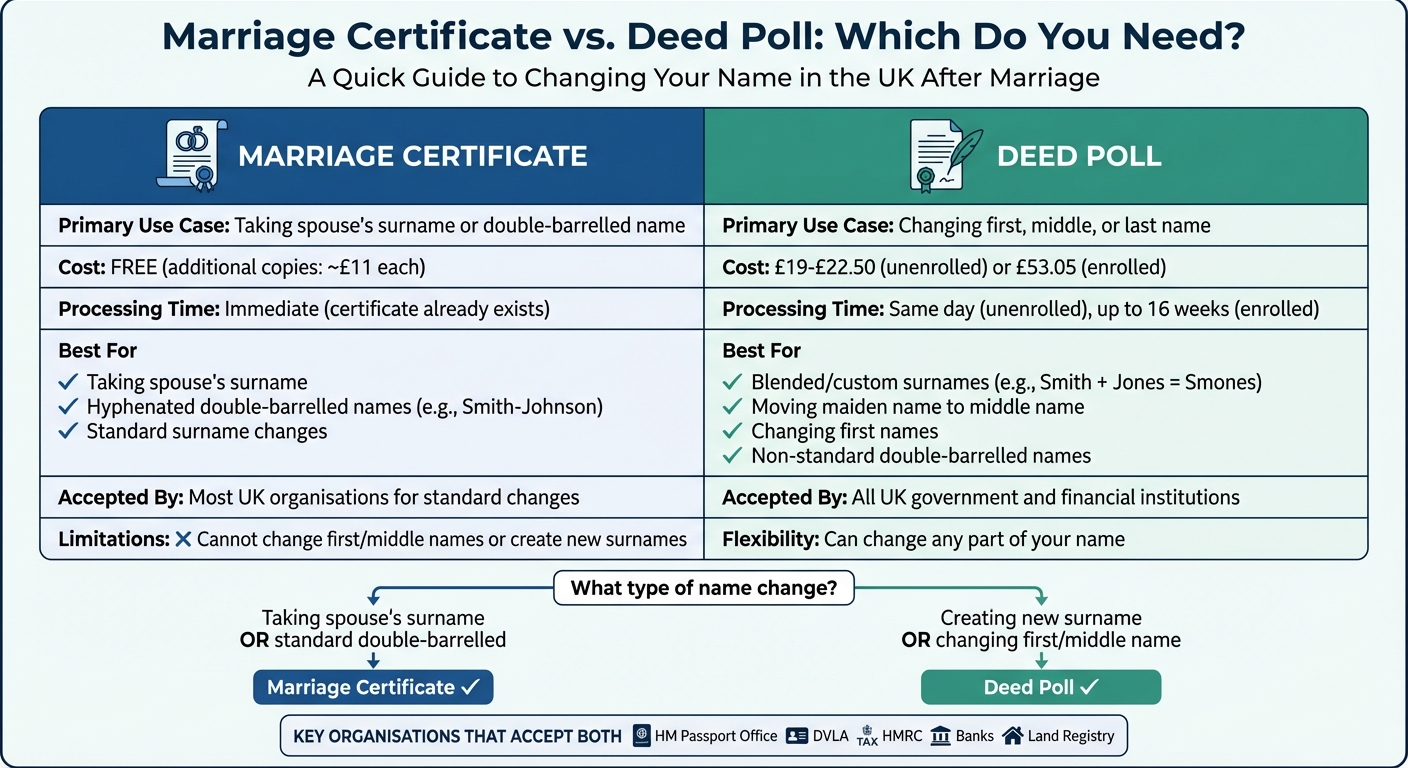
Marriage Certificate vs Deed Poll Comparison for UK Name Changes
When a Marriage Certificate Is Enough
There are situations where a marriage certificate is all you need to legally update your surname. In the UK, if you're taking your spouse's surname, your marriage certificate serves as sufficient proof. Every organisation is required to accept it as evidence of your name change, whether you're in a same-sex marriage or a civil partnership.
The certificate is also valid for creating double-barrelled surnames. This applies whether the names are hyphenated (e.g., Smith-Johnson) or left as two separate words (Smith Johnson), as long as both original surnames appear on the certificate. Additionally, you can use the certificate to change your title - like switching from Miss to Mrs, Ms, or Mx - although it's worth noting that titles aren't legally part of your name.
Taking Your Spouse's Surname
Your marriage certificate acts as legal confirmation of your new surname, eliminating the need for extra paperwork. Rebecca Franklin, a divorce and family lawyer at Woolley & Co, Solicitors, explains:
Most government departments, banks, and service providers will accept your marriage certificate as proof of your new name.
It's important to use the official certificate issued by the registrar. Once your new surname is legally established, updating your personal records becomes a straightforward process.
Updating Official Documents
Here's a quick overview of organisations that accept a marriage certificate for name updates:
| Organisation | Accepts Marriage Certificate? | Notes |
|---|---|---|
| HM Passport Office | Yes | Covers double-barrelled names; cost: £88.50 |
| DVLA | Yes | Free to update your driving licence |
| HMRC | Yes | Updates tax and National Insurance records |
| HM Land Registry | Yes | Use Form AP1; no fee for name changes |
| NHS / GP / Dentist | Yes | Updates your full medical record |
| Local Authorities | Yes | For Council Tax and the Electoral Roll |
It's a good idea to update your passport and driving licence first, as these are often used as primary identification by banks and other organisations. For property owners, updating the Land Registry is particularly important. HM Land Registry advises:
It's common for lenders to refuse to lend money unless your details exactly match the register.
The good news? There's no fee to update your name on the property register after marriage.
Notifying Financial Institutions
Once your key documents are updated, you can start notifying financial institutions. Banks and credit providers generally require your original marriage certificate to process a surname change. Many banks will ask you to visit a branch in person, so ordering multiple certified copies from the registrar can make this process smoother.
Utility companies - such as gas, electricity, water, and internet providers - also tend to accept marriage certificates, though some may allow name changes without formal proof. On average, people in the UK need to notify around 24 different organisations after a name change. Having extra copies of your certificate on hand can save time and effort.
If your situation falls outside these marriage-specific rules, you may need to change your name by deed poll. Next, we’ll look at situations where a deed poll is necessary.
sbb-itb-bf1bef6
When You Need a Deed Poll
A marriage certificate is fine for straightforward surname changes, but when it comes to more complex or non-traditional name changes, you'll need a deed poll. Here's a closer look at when this legal document becomes essential.
Non-Standard Name Changes
If you're thinking about creating a completely new surname by combining two existing ones, a marriage certificate won't cut it. For instance, merging "Smith" and "Johnson" into "Smithson" would require a deed poll, as the certificate only records surnames as they were at the time of marriage.
Similarly, if you're opting for an unhyphenated double-barrelled surname or if a husband wants to take his wife’s surname, many organisations won't accept a marriage certificate as sufficient proof. In these cases, a deed poll is often the best way to ensure your new name is recognised consistently across all records.
Changes Beyond Marriage
Marriage certificates are limited - they only document existing surnames. If you want to change your first or middle names, such as moving your maiden name to a middle name, a deed poll is necessary. The same applies if you're reverting to your maiden name after a divorce. Some organisations, especially if the divorce isn't finalised, will insist on a deed poll to process the change.
These situations highlight the need for legal clarity, which is why a deed poll is often required to confirm and validate your new name.
Why Organisations Require Deed Polls
Organisations rely on deed polls for clear, official proof of name changes. As GOV.UK explains:
A deed poll is a legal document that proves a change of name.
For non-traditional changes, a marriage certificate simply doesn't provide the level of clarity required. Banks, energy companies, mobile providers, and many other institutions have policies that demand a deed poll to ensure your records are consistent and up to date. This prevents confusion and ensures your identity is properly documented across all official records, from passports to bank accounts.
Marriage Certificate vs. Deed Poll: Comparison Table
Decide which document suits your needs with this side-by-side comparison.
Comparison Points
This table highlights the key differences in the name change process, helping you choose the right document.
| Feature | Marriage Certificate | Deed Poll |
|---|---|---|
| Primary Use Case | Changing to a spouse's surname or adopting a double-barrelled name | Changing any part of your name (first, middle, or surname) |
| Cost | Free if you already have the certificate | £19 to £22.50 |
| Processing Time | Instant, as the document already exists | Quick application; same-day processing available |
| Acceptance | Generally accepted for standard surname changes | Accepted by all UK government and financial institutions |
| Middle Name Changes | Not applicable (only covers surnames) | Needed for changes like moving a maiden name to a middle name |
| New/Blended Surnames | Not applicable | Required for such changes |
| Documentation Needed | Original or certified copy from the GRO | Signed and witnessed legal document |
A marriage certificate is ideal for simple surname changes. However, for more personalised modifications - like adding a maiden name as a middle name or creating a new surname - a deed poll offers the flexibility you need.
How to Change Your Name Using a Marriage Certificate
Changing your name after marriage is a straightforward process, but it requires some organisation. Here’s how to update your records using your marriage certificate. Keep in mind that only the official marriage certificate issued by the register office is legally valid.
Getting Certified Copies
Start by ordering several certified copies of your marriage certificate. You can request these from the General Register Office (GRO) or your local registry office. Having multiple copies makes it easier to notify various organisations - like banks, the Passport Office, and insurance providers - without risking the loss of your original certificate in the post.
If you were married abroad and your marriage certificate isn’t in English, you’ll need a professional translation. This must be signed, stamped, and dated by the translator, and it should accompany the original certificate.
Once you have your certified copies (or translations, if applicable), you’re ready to inform the necessary authorities.
Notifying Relevant Authorities
Begin by updating your records with government bodies. For a new passport, apply through HM Passport Office and ensure the issue date reflects your new marital status. To update your driving licence, complete the D1 form (available at Post Offices) and send it to the DVLA along with your marriage certificate. You can also update your tax and National Insurance details by logging into your Personal Tax Account online and notifying HMRC.
If you own property, you’ll need to submit Form AP1 to HM Land Registry, which is free of charge. Ensure the name on the property register matches your updated name, as lenders require this for consistency.
Next, inform financial institutions such as banks, building societies, credit card companies, and insurance providers. They’ll usually accept an original or certified copy of your marriage certificate. Don’t forget to notify utility companies, your employer’s HR department, your local council (for Council Tax and the Electoral Roll), your GP surgery, and service providers like mobile and internet companies.
Tips for a Smooth Process
There’s no legal deadline for changing your name after marriage, so you can update your records at your own pace - even years later. However, make sure your travel bookings match the name on your passport to avoid complications. Keep your documents organised and track the updates you’ve made.
Lastly, remember that all UK organisations are legally required to accept your marriage certificate as proof of a name change if you’re adopting your spouse’s surname.
How to Get a Deed Poll
If you need a deed poll instead of relying on your marriage certificate, the process is straightforward. You can choose between an unenrolled deed poll - a private document accepted by most organisations - or an enrolled deed poll, which is registered with the Royal Courts of Justice and published in The Gazette. Around 60,000 people in the UK legally change their name by deed poll each year, but only about 1% opt to enrol their deed poll. Here's a breakdown of how to apply for both types.
Completing the Deed Poll Application
For an unenrolled deed poll, you’ll need to draft a document with the required wording to formally renounce your old name and adopt your new one. If you’re 16 or older, you can create this type of deed poll. Once the document is ready, sign it using both your old and new signatures in front of two independent witnesses. These witnesses must be at least 18 years old and cannot live with you.
If you’re looking to apply for an enrolled deed poll, there are additional steps involved. This process, which costs £53.05, is available to those aged 18 or older. You’ll need to fill out forms LOC020, LOC021, and LOC025 and provide proof of citizenship for the UK, Commonwealth, or British Dependent Territories. One of your witnesses must be a British or Commonwealth citizen who has known you personally for at least 10 years. Additionally, you’ll need to sign a statutory declaration in front of a solicitor, commissioner for oaths, or court officer before submitting your documents to the Royal Courts of Justice in London.
Costs and Timescales
Once your application is complete, it’s important to consider the costs and how long the process will take. An unenrolled deed poll can be created for free or through a specialist service. For example, Name Change offers an online service starting at £16.95, which includes printed documents, three certified copies, tracked delivery, and a guide to help you. Their premium option at £24.95 adds a gold embossed stamp for a more formal presentation. Both options include unlimited PDF downloads and are guaranteed to be accepted by UK government departments and organisations.
Unenrolled deed polls are effective immediately, while enrolled deed polls may take up to 16 weeks to process. To save time when notifying organisations of your name change, it’s a good idea to order two to four original copies of your deed poll. This way, you can contact multiple organisations simultaneously without waiting for documents to be returned.
Making Sure Your Deed Poll Is Accepted
Once your deed poll is ready, double-check that it meets all the necessary requirements. Properly executed deed polls are legally binding, but some organisations may have specific preferences. Most UK institutions, including the DVLA and HM Passport Office, accept unenrolled deed polls. However, some banks and financial institutions might require an enrolled deed poll, so it’s best to confirm their policies beforehand.
Your new name must follow certain rules - it should be pronounceable, free of symbols or numbers (except hyphens), and must not be offensive or against public interest. Before applying for a new passport, update your driving licence and bank records to provide proof of your new name. Additionally, if you’re a registered sex, violent, or terrorist offender, you are required to notify the police of your name change within three days.
How to Choose Between a Marriage Certificate and a Deed Poll
When deciding how to handle a name change, understanding the differences between a marriage certificate and a deed poll is crucial. Here's a breakdown to help you choose the right option.
Type of Name Change

For straightforward changes - like taking your spouse’s surname or creating a standard double-barrelled name - a marriage certificate is usually all you need. Most UK organisations accept it for these types of changes.
However, if your plans involve something more intricate - such as moving your maiden name to a middle name, merging surnames into a new one (e.g., Smith and Jones becoming Smones), or even creating a completely new surname - you’ll need a deed poll. As Cécile Mazuet-Eller, Founder and Managing Director of NameSwitch, explains:
A deed poll is required if you are seeking to create a new surname or adding or removing a middle name.
Before making a decision, it’s a good idea to check with organisations like your bank or mortgage provider. While many accept marriage certificates for simple changes, some may insist on a deed poll for non-traditional or double-barrelled names. Also, if your marriage certificate is from outside the UK and isn’t in English, using a deed poll can often save time and money compared to obtaining a certified translation.
Timeframes and Urgency
Both options take a similar amount of time to update official documents. For instance, the DVLA and UK Passport Office typically process name changes in about three weeks. While a marriage certificate is issued immediately, an unenrolled deed poll can be created online within minutes and delivered in just a few days.
If you’ve booked travel under your current name, it’s best to wait until after your trip to update your passport. Consistency across travel documents is essential. Alternatively, you can apply for a post-dated passport up to three months before your wedding, though it won’t be valid until after the ceremony. Remember, there’s no deadline for updating your name - you can do it whenever it suits you.
Aside from timing, cost and convenience are key factors to consider.
Cost and Practicality
For standard changes, a marriage certificate is the most cost-effective option. You’ll receive one free copy on your wedding day, and additional certified copies from the General Register Office are available for a small fee. Ordering 2–4 extra copies can be helpful if you need to notify multiple organisations at once.
Deed poll costs vary depending on the type. An enrolled deed poll via the High Court costs £53.05, whereas unenrolled deed polls are typically less expensive, ranging from £13 to £22.50. For example, Name Change offers an online service starting at £16.95, which includes printed documents, three certified copies, tracked delivery, and a guide. Their premium service, priced at £24.95, includes a gold embossed stamp for a more formal touch.
If both partners want a double-barrelled name, one partner can change their name by deed poll a couple of months before the wedding. After the ceremony, the other partner can use the marriage certificate to adopt the new name. Keep in mind, failing to notify the DVLA of your name change could result in a fine of up to £1,000.
Conclusion
Deciding how to change your name depends on the specific type of change you’re making. For simpler changes, like adopting your spouse’s surname or creating a hyphenated name (e.g., Smith-Jones), a marriage certificate is an affordable and commonly accepted option.
However, for more complex changes - such as altering your first name or creating an entirely new surname - a deed poll is required. As GOV.UK explains:
A deed poll (enrolled or unenrolled) is a legal document that proves a change of name.
It’s important to check with key organisations about their requirements. There’s no rush to change your name after marriage - you can do it whenever it’s convenient. Taking the time to confirm what’s needed with institutions like your bank or mortgage provider can save you from unnecessary delays or complications later on.
Both a marriage certificate and a deed poll are recognised across the UK. The right choice comes down to your specific situation and the type of name change you wish to make.
FAQs
Do I need a deed poll to change my middle name after marriage?
You don’t need a deed poll to change or add a middle name after marriage if it’s part of the name change process. Your marriage certificate serves as sufficient proof for this.
However, if you're planning to create an entirely new middle name or combine names in a unique way, a deed poll will be necessary. For simpler changes, most organisations will accept your marriage certificate to update their records.
Will my bank accept a marriage certificate for a double-barrelled surname?
Whether your bank will accept a marriage certificate to update your surname to a double-barrelled version depends entirely on their specific policies. Government bodies like the DVLA and Passport Office typically accept a marriage certificate for this type of change. However, many banks may insist on a deed poll to process an official name change. It’s always best to contact your bank directly to clarify their requirements and confirm whether a marriage certificate will suffice or if you’ll need to provide a deed poll.
Should I update my passport or driving licence first after changing my name?
It's usually a good idea to start by updating your passport, particularly if you have travel plans coming up. A passport with your new name serves as a solid piece of evidence for the change and can make updating other documents much smoother. Once your passport is sorted, the next step is to update your driving licence, which is another essential form of identification.