Legal Requirements For Adding A Middle Name
Adding a middle name in the UK is straightforward when you follow the correct legal steps. The key is using a deed poll, which is a legal document proving your name change. Here's what you need to know:
- Adults (16+): You can add a middle name independently using an unenrolled or enrolled deed poll. The name must be pronounceable, non-offensive, and free of unapproved symbols or numbers. Witnesses are required for signing.
- Children (Under 16): Consent from all individuals with parental responsibility is mandatory. If there's disagreement, a court order is needed.
- Updating Documents: Notify organisations like HM Passport Office, DVLA, and banks to update your records. A deed poll is essential for this process.
- Enrolled vs Unenrolled: Most people choose unenrolled deed polls for privacy and cost (£15–£35). Enrolled deed polls (£53.05) are publicly recorded and may be required in specific cases.
Consistency across all records is crucial to avoid identity issues. A deed poll ensures your new name is legally recognised by government and private organisations. Follow the outlined steps to avoid delays or complications.
What is a Deed Poll and Why Do You Need One?
Definition of a Deed Poll
A deed poll is a formal legal document used in the UK to provide proof of a name change. It allows you to alter any part of your name, whether that means adding or removing middle names, adjusting spellings, or changing hyphenation. Essentially, it acts as a legal declaration that your previous name has been replaced.
There are two types of deed polls: unenrolled and enrolled. An unenrolled deed poll is created privately by an individual, while an enrolled deed poll is registered with the High Court and added to the public record. Interestingly, over 99% of people in the UK opt for an unenrolled deed poll, with only about 1 in 200 being enrolled. While you can start using a new name informally, a deed poll provides the legal proof required to update official records. This proof is typically necessary because organisations such as government departments and banks demand it to process name changes.
Why a Deed Poll is Required
A deed poll is essential because official organisations won't recognise your new name without formal documentation. As the Home Office explains:
"All applications to change names must be supported by documentary evidence which resemble the acquired name and show the linkage to the previous name, such as a marriage certificate or a deed poll."
Institutions like HM Passport Office, the DVLA, and banks require this evidence to verify your name change. Without it, updating critical documents such as your passport or driving licence becomes difficult. While marriage certificates or decree absolutes can sometimes be used for surname changes (e.g., adopting a spouse's name or reverting to a maiden name), a deed poll is the standard method for adding or modifying middle names.
sbb-itb-bf1bef6
Legal Requirements for Adding a Middle Name
Requirements for Adults
If you're 16 or older, adding a middle name is relatively straightforward. You can do this through a deed poll without needing anyone else's approval. However, there are specific legal rules your new middle name must follow.
The name must be pronounceable and cannot include unapproved symbols, numbers, or punctuation - though hyphens and apostrophes are allowed. It also cannot be offensive, misleading (such as including terms like "Ltd"), or feature trademarked words unless you have written permission. Additionally, you cannot use a deed poll to change titles (e.g., Mr, Mrs, Dr) or simply alter capitalisation.
For an unenrolled deed poll, you'll need two independent witnesses aged 18 or older. These witnesses should not be close relatives or people living with you. If you opt for an enrolled deed poll, you'll need a declarant who has known you for at least 10 years, is a British or Commonwealth citizen, and is a UK householder. Enrolment also comes with a fee of £53.05.
If you're listed on any relevant offender register, you must notify the police within three days. Additionally, if you're a permanent resident overseas, you generally cannot change your name using a UK deed poll.
Requirements for Children Under 16
For children under 16, the process involves additional steps and permissions. While the basic deed poll process is the same, all individuals with parental responsibility must consent to the change, as adding a middle name constitutes a full name change.
If those with parental responsibility cannot agree, you’ll need to obtain a Specific Issue Order from a court, which costs £263. The HM Passport Office is strict about this requirement. They will not accept a statutory declaration simply stating that the other parties are aware of the change. Explicit consent or a court order is mandatory. As the HM Passport Office states:
The change of a child's surname is fundamental and in any situation of dispute, where both parents have parental responsibility, either the consent of both parents or a court order is necessary
- HM Passport Office.
To issue a passport in the new name, you must demonstrate that the name is being used for all official purposes. The same character rules for middle names apply as they do for adults. If you choose to enrol the deed poll, be prepared for processing times of up to 16 weeks.
Enrolled vs Unenrolled Deed Polls
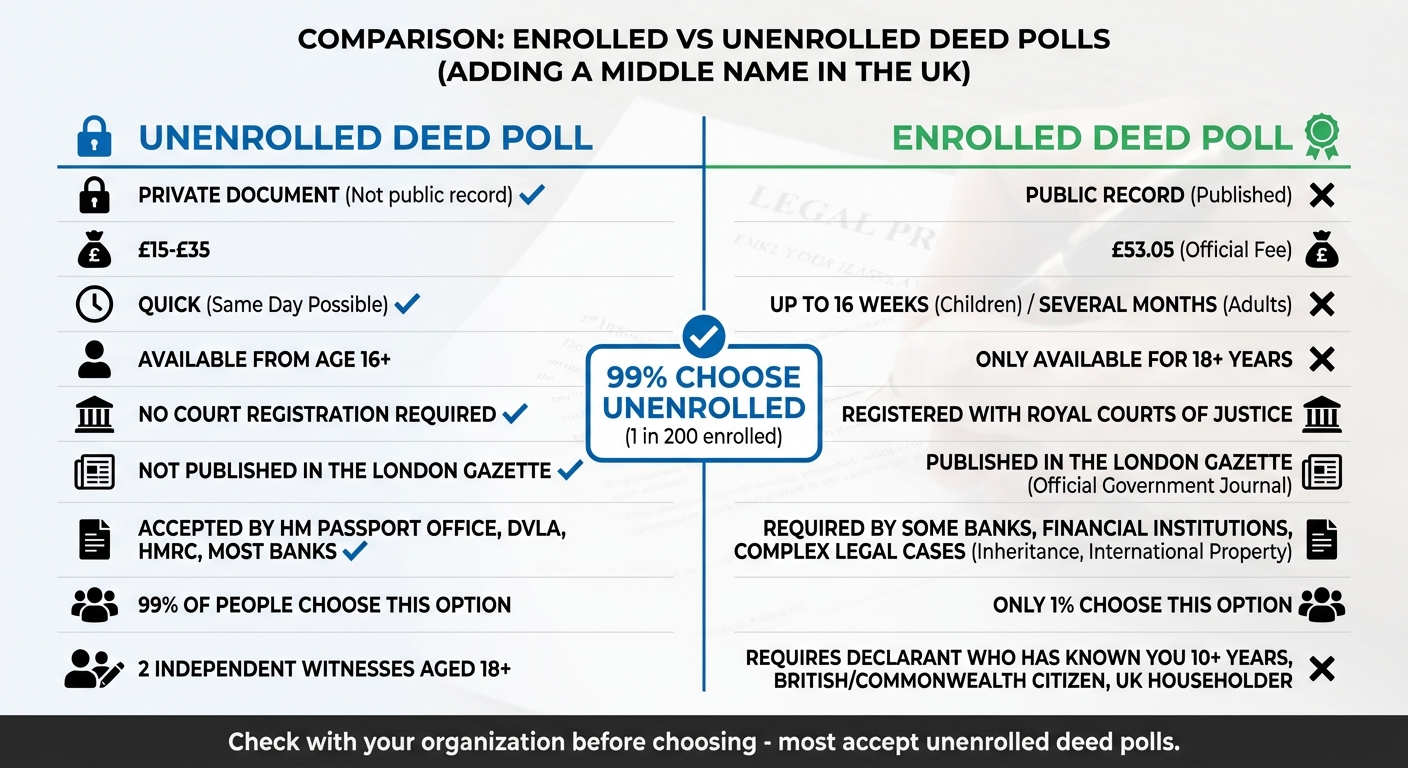
UK Deed Poll Types Comparison: Enrolled vs Unenrolled
Differences Between Enrolled and Unenrolled Deed Polls
When adding a middle name, you can choose between an unenrolled or enrolled deed poll, depending on your preferences for privacy and processing. An unenrolled deed poll is a private document, signed with a witness, and widely accepted by key UK organisations like HM Passport Office, the DVLA, and HMRC. On the other hand, an enrolled deed poll is registered with the Royal Courts of Justice, published in The London Gazette, and comes with a fee of £53.05.
The unenrolled option does not involve court registration. You simply create the document, sign it with a witness, and use it to update your records. By contrast, an enrolled deed poll is formally recorded and published in The London Gazette - the official government journal - making the name change part of the public record. Enrolment can take several months to complete and is only available to those aged 18 or older, whereas unenrolled deed polls can be used from the age of 16. Interestingly, only about 1% of deed polls are enrolled. Most people opt for the unenrolled option because it is quicker, less expensive, and keeps the name change private.
These key differences highlight that an enrolled deed poll may offer additional legal weight in certain situations.
When You Might Need an Enrolled Deed Poll
While most individuals adding a middle name find an unenrolled deed poll sufficient, there are specific scenarios where an enrolled deed poll might be necessary. For example, in complex legal cases involving inheritance or international property, some banks or financial institutions may insist on an enrolled deed poll. According to GOV.UK:
Some organisations (such as some banks, mobile phone companies or energy providers) may only accept an enrolled deed poll to change your name on their records
.
Before starting the enrolment process, it’s essential to check with the relevant organisation to confirm their requirements. Choosing the right type of deed poll ensures your new middle name is consistently recognised across all official records.
How to Add a Middle Name Using a Deed Poll
Creating and Signing Your Deed Poll
Adding a middle name through a deed poll is a simple process, but it needs to be done correctly to ensure it's legally valid. For an unenrolled deed poll, you must include a specific legal declaration: "I [old name] of [address] have given up my name [old name] and have adopted for all purposes the name [new name]". This statement confirms that you're officially giving up your old name and adopting the new one, including the added middle name.
When signing the deed poll, use permanent black or blue ink - pencils or erasable ink are not acceptable. Make sure to sign it using your current (old) name, not your new name. You’ll need two independent witnesses who are over 18 years old. These witnesses cannot be relatives, your spouse, or your partner, and they must be physically present when you sign the document. Witnessing via electronic means or video calls isn’t legally valid.
If you’ve ordered multiple copies of the deed poll, each copy must be signed in wet ink by you and your witnesses. Avoid making any corrections, using correction fluid, or including unclear handwriting, as these can invalidate the document. Carefully review the deed poll for any errors to ensure it meets all legal standards.
Mistakes to Avoid
Even after correctly signing the deed poll, certain mistakes can still cause issues. One common error involves invalid witnesses. Your witnesses must not be your spouse, partner, or close relatives, and using someone who lives at your address may lead to problems with stricter organisations.
Another frequent issue is incomplete signatures, which will make the deed poll invalid. Keep in mind that the HM Passport Office has a 30-character limit for first names, which includes all middle names combined. If your middle names exceed this limit, you can request an abbreviated version for the main passport page, with the full name recorded on the observations page.
If you are a registered sex, violent, or terrorist offender, it’s mandatory to inform the police about your name change within three days. Failing to do so is a criminal offence. Additionally, avoid using symbols, numbers, or punctuation (except hyphens or established name formats) in your new name. Offensive terms or titles like "Lord" or "Doctor" are also prohibited.
For enrolled deed polls, statutory declarations must be printed on single-sided paper, as double-sided documents may be rejected. Double-check all character limits and ensure you’ve met any notification requirements to avoid complications when updating official records.
Updating Your Official Documents
Which Organisations to Notify
Once you've signed your deed poll, the next step is to update your records with both government and private organisations. This ensures your name change is fully recognised across all areas of your life. Legally, you must update your driving licence immediately, inform the police within three days if you're a registered offender, and update your Biometric Residence Permit (BRP) within three months.
Start by updating your driving licence and contacting HM Passport Office. These documents will serve as evidence of your new name when updating other records. Other essential updates include notifying HMRC (which automatically updates your National Insurance records), your bank or building society, your employer, your GP, your local council (for council tax and voter registration), and utility companies. If you own property, HM Land Registry will need proof of your identity in both your old and new names.
It's a good idea to update at least one official document, such as your driving licence, before applying for a new passport. The driving licence process is straightforward, free, and provides the necessary proof for your passport application. Keep a certified copy of your old driving licence for any future verification needs.
The table below summarises the documents required, processing times, and any fees involved for key organisations.
Documents Needed and Processing Times
Different organisations have their own rules for updating your details. Most government agencies and financial institutions will require the original deed poll or a certified copy, while some utility providers and smaller service companies may accept a photocopy. Note that certain banks may only accept an "enrolled" deed poll, so it's worth checking with your bank beforehand.
| Organisation | Documents | Processing Time | Fee |
|---|---|---|---|
| DVLA (Driving Licence) | Deed poll, current licence | "Forthwith" (Legal requirement) | Free |
| HM Passport Office | Deed poll, "use of name" evidence (e.g., payslip, bank statement), old passport | 3 weeks (renewals); 6 weeks (first adult passport) | £94.50 (Adult online) |
| Home Office (BRP) | Deed poll, passport in new name | Within 3 months (Legal requirement) | Not specified |
| HMRC | Deed poll | Not specified | Free |
| Banks / Building Societies | Deed poll (some require enrolled version) | Immediate (in-branch) to 2 weeks | Free |
| Local Council | Deed poll | Not specified | Free |
| Police (Registered Offenders) | Deed poll | Within 3 days (Legal requirement) | Free |
If you're planning any travel before updating your passport, make sure all bookings (flights, hotels, visas) match the name on your current passport. Keep in mind that a deed poll cannot be used to change names on historical records like marriage, adoption, or decree absolute certificates.
Ensuring your records are updated is the final step in securing full legal recognition of your new middle name.
Other Factors to Consider
After updating your official records, there are a few practical aspects to bear in mind regarding your new middle name.
Name Length Limits in the UK
While there’s no legal restriction on name length in the UK, practical limits are enforced by government agencies and deed poll services. For example, HM Passport Office generally restricts forenames (including middle names) and surnames to 30 characters each on the main personal details page. The DVLA is even stricter, often limiting the total name to 30 characters on a driving licence.
If your name exceeds these limits, the Passport Office might print the full version on the observation page rather than the main page. Additionally, names longer than 90 characters (including spaces) may require extra verification. To avoid issues, ensure your forenames fit within the 30-character limit to prevent truncation or rejection by HM Passport Office.
It’s also worth noting that some deed poll providers may charge more if your total name exceeds 150 characters, as this requires additional administrative work. If you’re considering a long middle name, test how it fits on standard government forms to avoid problems with computer systems. This step complements earlier advice on deed poll requirements.
Keeping Your Name Consistent Across All Records
Once your documents are updated, it’s vital to maintain consistency across all your records. A uniform name across official documents is essential to avoid identity verification problems. Policies require a single, consistent name to ensure alignment between your passport, driving licence, and other official records. Discrepancies can cause complications when dealing with banks, employers, or government departments.
"Your name is legally established by consistent usage; any discrepancy can invalidate your change."
- Deed Poll Office
To protect your legal identity, ensure your deed poll is reflected across all records. Start by updating your passport and driving licence to establish consistency. Then notify other organisations, such as banks, utilities, employers, and HMRC, providing evidence of your updated name. Check online banking portals, payroll systems, and physical correspondence (like bank cards and tax letters) to confirm the changes have been processed. Inconsistent records could lead to HM Passport Office refusing to issue a passport in your new name or relegating it to an observation while retaining your old name on the main details page.
Conclusion
Adding a middle name in the UK is a simple process when you follow the correct legal steps. A deed poll is essential for updating your official documents. This document serves as proof of your name change, allowing you to update your passport, driving licence, and other records. It ensures recognition by government departments, banks, and employers, while also reducing the risk of rejection.
By adhering to these procedures, you can maintain consistency across your records and minimise the risk of fraud. As the Home Office explains: "The policy is focussed on... deterring, disrupting and detecting those who change their names in order to commit crime or avoid detection".
For most people, an unenrolled deed poll (costing between £15 and £35) will suffice. However, some organisations might require an enrolled deed poll, which costs £53.05 .
It's important to keep your original deed poll in a safe place, as you'll need it for future updates. Make sure your new name is easy to pronounce and avoids numbers, symbols, or offensive language. If applicable, notify the police within three days of the change.
Consistency across all records is key to avoiding identity verification problems. With proper documentation, you can prevent complications and ensure your name change is legally recognised. Over 1,000,000 UK residents have successfully used deed poll services to change their names, proving it’s a well-established and widely accepted process when handled correctly.
FAQs
Will adding a middle name affect my passport or travel bookings?
Adding a middle name through a deed poll won’t affect your passport or travel arrangements. In the UK, the passport office treats middle names similarly to surnames, meaning the name must be clearly and consistently shown on the deed poll. To prevent any complications, make sure all your documents align.
What if one parent won’t consent to a child’s middle name change?
If one parent does not agree to changing a child's middle name, you can seek permission from the Family Courts. The court will grant approval only if it believes the name change serves the child's best interests.
How do I prove I’m using my new middle name after the deed poll?
To make your new middle name official, sign your deed poll in the presence of two witnesses. These witnesses must be over 18 and cannot be close relatives or people you live with. Once signed, your deed poll is legally valid.
Next, update your personal records, such as your passport, driving licence, and bank accounts. You'll need to provide your signed deed poll along with proof of using your new name, like bank statements or official correspondence displaying the updated name.