How to Notarise a Deed Poll for Overseas Use
If I want to use a UK deed poll abroad, the deed poll alone is often not enough. In many cases, I need notarisation first, then an apostille from the FCDO, and for some countries, embassy attestation after that.
Here’s the short version:
- I check with the foreign authority first
- I confirm if they want the original deed poll or a certified copy
- I take the deed poll, photo ID, and proof of address to a Notary Public
- I send the notarised document to the FCDO Legalisation Office
- I pay £45 per document for the apostille
- I allow around 15 to 20 working days for postal processing
- If the country is outside the Hague Apostille Convention, I may need embassy attestation too
- If the authority asks for a translation, I check when it must be done
A few facts matter straight away. The Hague Apostille Convention covers 120+ countries. The FCDO is the only UK body that can issue an apostille. And the FCDO will not legalise laminated documents.
The main risk is doing the right step in the wrong order. I start with the receiving authority’s rules, not with the notary. That helps me avoid paying for certification that the overseas office may reject.
This guide boils the process down into the checks, papers, and steps I need before I send a deed poll overseas.
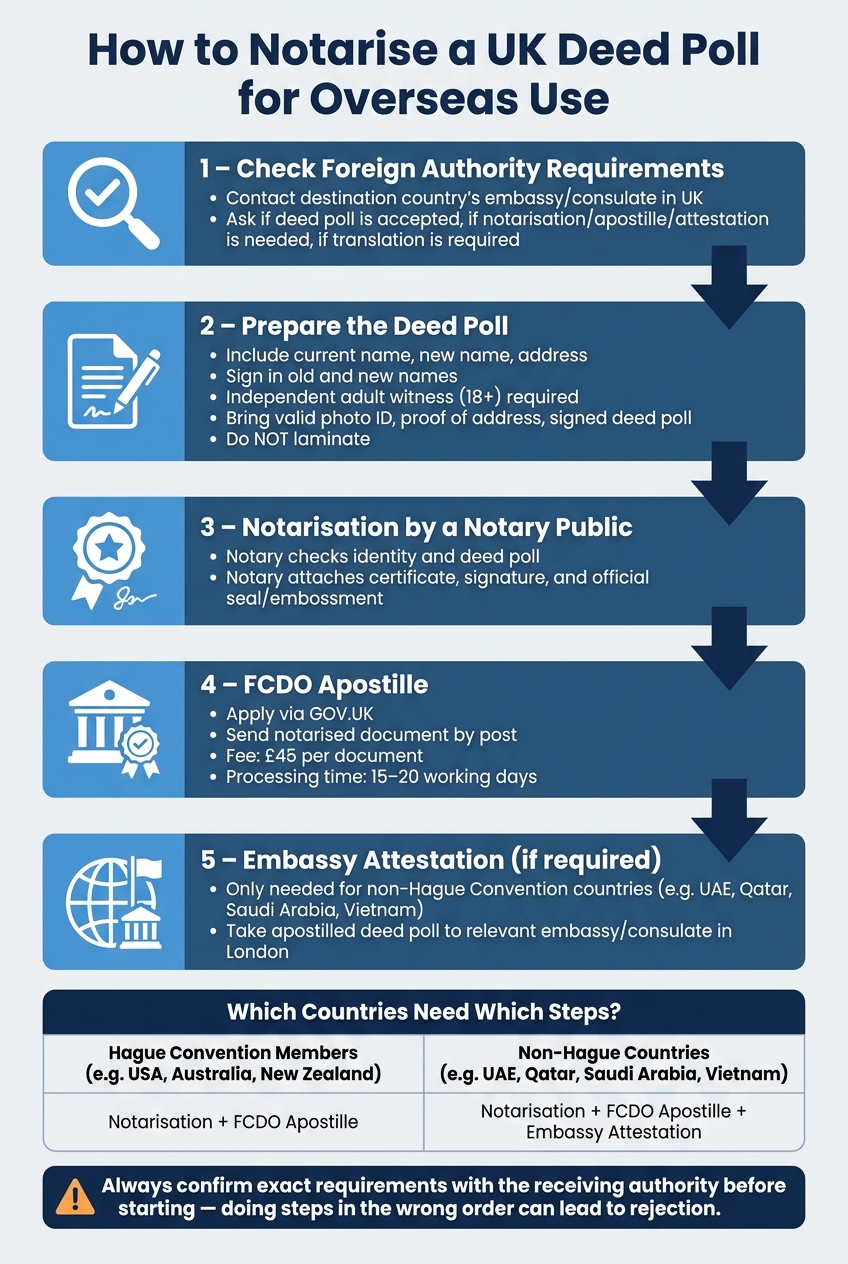
How to Notarise a UK Deed Poll for Overseas Use
Step 1: check the foreign authority's exact requirements
Check the receiving authority's rules before you notarise anything. The rules change from country to country, so guessing can cost you time and money.
Who to contact and what to ask
Start with the embassy or consulate of the destination country in the UK. British embassies and consulates may point you in the right direction, but they do not legalise documents. If you're already abroad, contact the local authority that has asked for the document. That answer will tell you whether notarisation on its own is enough, or if you also need an apostille or embassy attestation.
When you get in touch, ask:
- Is the UK deed poll accepted?
- Must it be certified by a Notary Public?
- Is an apostille required?
- Is embassy attestation also needed?
- Is a certified translation required?
- Must the document be legalised within a set time limit?
You should also ask whether the document needs to be the original, a translation, or a recently legalised version.
One more thing matters here: does the authority want the original signed deed poll, or will a notarised copy do? Some bodies insist on the original. Others are happy with a copy, which lets you keep the original tucked away safely.
Country-specific rules that affect the process
Common-law countries often accept UK deed polls more easily than civil-law countries. Civil-law countries are more likely not to recognise informal deed polls, and they may ask you to follow their own court-based process instead.
Some authorities accept only certification by a Notary Public, not certification by a solicitor. Why? Because notaries are treated as public officials, and their authentication carries weight across borders.
If you're a non-British national living in the UK, also check with your home country's embassy. A UK deed poll might not be enough to update a foreign passport or records held overseas. If you have dual nationality, the rules may differ for each country.
Once you've confirmed what the receiving authority wants, you can move on to preparing a deed poll in the UK that can be notarised.
sbb-itb-bf1bef6
Step 2: prepare a deed poll that can be notarised
Once you know what the receiving authority wants, draft the deed poll to fit those rules.
Core wording and signatures the deed poll must include
For use overseas, the deed poll should set out your current name, your new name and your address. It also needs to say that you are adopting the new name for all purposes.
You should sign and date the deed poll in both your old and new names. After that, an independent adult witness aged 18 or over must witness it. Add the witness’s full name and address as well.
Keep the new name simple. Avoid symbols, numbers and unusual punctuation. Hyphens and apostrophes are usually fine.
Using an existing deed poll or signing a new one before a professional
You can sign a new deed poll in front of a practising UK solicitor or Notary Public. Or, if you already have a signed deed poll, you can take it in for certification.
If the original is being certified, the solicitor or notary may add wording to say they have no reason to doubt its authenticity. If you’d rather keep the original safe, they can certify a copy instead. In that case, they will use wording confirming that it is a true copy of the original seen by them.
That means you can send the certified copy abroad and keep the original with you.
Match the certification method to what the authority asks for. For formal overseas use, a Notary Public is usually the safer option.
Documents to bring to the notarisation appointment
Before you book the appointment, get the papers together that the notary will need. Bring:
- valid photo ID
- proof of address
- the signed deed poll
If the deed poll is for a child, you’ll need more than that. Bring the birth certificate, proof of parental responsibility, and written consent from everyone with parental responsibility, or the relevant court order.
Do not laminate the deed poll or mount it on card. The FCDO will not legalise laminated documents.
Once the deed poll is ready, the next step is notarisation and apostille.
Step 3: notarise the deed poll and obtain an apostille
Do these steps in this order: notary first, then the FCDO apostille, and then embassy attestation if the country asks for it.
What happens at the notary appointment
At the appointment, the notary will check your identity and address using your photo ID and proof of address. They’ll also look over the deed poll to make sure it has been signed and witnessed in the right way.
If you haven’t signed the deed poll yet, that’s usually fine. You can sign it in front of the notary, which means the notary can witness and certify it in the same appointment. If the deed poll has already been signed, the notary will inspect it and may add a statement to confirm that it is genuine.
Once the notary is satisfied, they attach a formal notarial certificate and add their personal signature and official seal or embossment.
The apostille then confirms the notary’s signature and seal for use abroad.
If the overseas authority will accept a copy, ask the notary to certify a copy and legalise that instead.
Once the notary has certified the document, it is ready for FCDO legalisation.
How to apply for an apostille from the FCDO
Apply through GOV.UK, then send the notarised document by post to the FCDO Legalisation Office. The fee is £45 per document, and postal processing usually takes 15 to 20 working days.
The FCDO no longer has a public counter service, so you’ll need to use the post or a registered agent.
When embassy attestation is needed after the apostille
If the destination country is outside the Hague Apostille Convention, the apostilled document needs one more legalisation step.
| Destination | Required steps |
|---|---|
| Hague Convention members (e.g., USA, Australia, New Zealand) | Notarisation + FCDO apostille |
| Non-Hague countries (e.g., UAE, Qatar, Saudi Arabia, Vietnam) | Notarisation + FCDO apostille + embassy attestation |
For non-Hague countries, take the apostilled deed poll to the relevant embassy or consulate in London for attestation before sending it abroad.
Common problems, checks to make, and a summary of steps
Mistakes that cause delays or rejection
Even after notarisation and apostille, small mistakes can still lead to rejection abroad.
A deed poll may be turned down if it hasn't been certified in the exact form required by the foreign authority and the FCDO. If the receiving authority asks for notarisation, a solicitor's certification may not be enough. The FCDO also rejects laminated documents. And if the notary doesn't sign and seal the document properly, the apostille application will fail.
One simple but often missed check: look over the notarial certificate before you leave the appointment.
Checks to make before sending documents abroad
Before you post anything, compare the final document pack against the receiving authority's exact rules.
Check whether the foreign authority wants the original document or a notarised and apostilled copy. If a copy is allowed, apostille that copy and keep the original somewhere safe. Also confirm whether you need a certified translation. In some countries, the translation must be done after the apostille, not before.
If you're updating records with several institutions at the same time, it often makes sense to prepare multiple notarised and apostilled copies. That can save hassle later.
Key points to take away
Pay close attention to the most common failure points:
- incorrect certification
- document condition
- translation timing
- whether the authority wants the original or a copy
Also check embassy attestation rules before sending anything abroad.
| Step | Action | Who |
|---|---|---|
| 1 | Confirm requirements | You |
| 2 | Prepare deed poll | You / notary |
| 3 | Notarisation | Notary |
| 4 | Apostille | FCDO |
| 5 | Embassy attestation (if needed) | Embassy |
FAQs
Can I notarise a deed poll copy instead of the original?
Yes. You can notarise a certified copy of your deed poll instead of the original.
Whether you should use the original or a copy comes down to what the foreign authority asks for. For legalisation, the copy must be checked and certified as a true copy by a UK solicitor or notary public. It’s best to check first, as some authorities may ask for the original.
How do I know if embassy attestation is required?
It depends on the country where you plan to use your deed poll.
If that country is not a member of the Hague Apostille Convention, you may need embassy or consular legalisation after notarisation and the apostille.
Rules can vary from one country to another, so it’s best to contact that country’s embassy or consulate in the UK before you go ahead. They can confirm the exact process for your case.
When should a deed poll translation be done?
A deed poll often needs to be translated if you plan to use it in a country where English isn’t the main language. That comes up a lot in cases such as immigration, civil status records, court proceedings, property transactions, banking, employment registration, and academic records.
The exact rules depend on the country. In some cases, you’ll need an apostille first, followed by a certified or sworn translation. Some authorities may also ask for notarisation.