Legal Requirements for Deed Polls in the UK
Changing your name by deed poll in the UK is straightforward, but it requires a properly executed deed poll to update official records like passports, driving licences, and bank accounts. Here’s what you need to know:
- What is a Deed Poll? A legal document declaring you’ve given up your old name and adopted a new one. It’s required for official name changes.
- Key Requirements:
- Use the correct wording to declare your name change.
- Sign the document with "wet ink" (no electronic signatures).
- Have two independent adult witnesses sign and provide their details.
- Witness Rules: Witnesses must be over 18, not related to you, and not living at your address. Examples include colleagues or neighbours.
- Overseas Rules: If you live abroad, a solicitor or notary public must witness your deed poll for international recognition.
- Certified Copies: Use certified copies to protect your original document while updating records. These must be officially endorsed by qualified professionals.
- Enrolled vs Unenrolled: Enrolled deed polls are public records, while unenrolled ones are private but equally valid under UK law.
Mistakes in formatting, signatures, or witnesses can lead to rejections, so ensure your deed poll meets the legal standards. Whether you’re in the UK or overseas, following these steps will help you avoid delays in updating your official documents.
Legal Requirements for a Valid Deed Poll
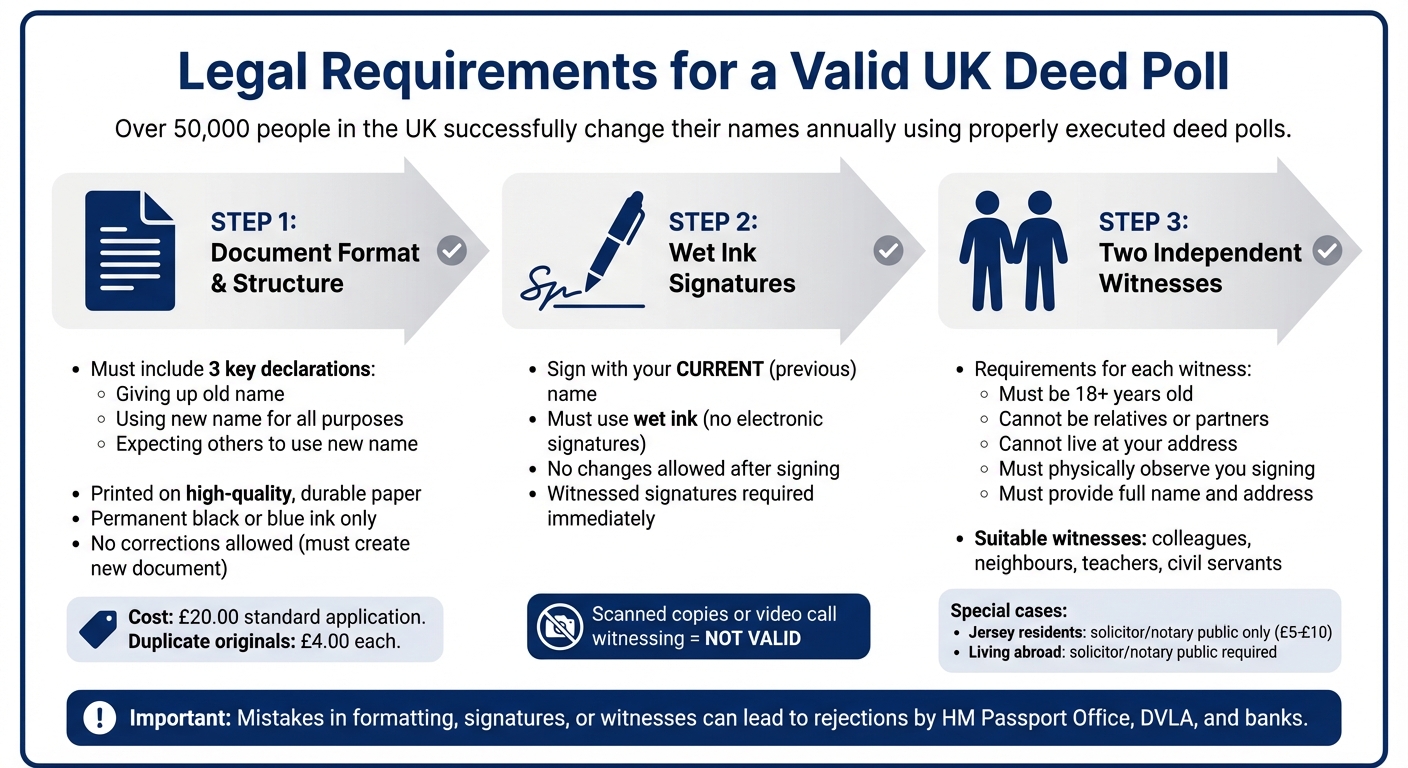
UK Deed Poll Requirements: 3-Step Legal Validation Process
A deed poll is a formal legal document that must meet specific standards to be recognised by UK government departments and organisations. Ensuring it meets these standards from the outset can save you from delays or rejections when updating official documents like your passport, driving licence, or bank accounts.
The process hinges on three main requirements: correct document format, wet ink signatures, and two independent witnesses. These steps are crucial to ensure your deed poll complies with UK legal standards. Over 50,000 people in the UK have successfully changed their names using properly executed deed polls.
Document Format and Structure
The deed poll must include precise wording that confirms three key declarations: that you are giving up your old name, that you will use your new name for all purposes, and that you expect others to use your new name. This specific language is required by organisations like HM Passport Office.
The document itself must be printed on high-quality, durable paper using permanent black or blue ink. Materials like pencils, erasable ink, or correction fluid are not acceptable. Any errors mean you’ll need to create a completely new document.
If you need to provide the deed poll to multiple organisations, you can order duplicate originals. Each copy must be signed individually with witnesses, and each is treated as an original document. The typical cost for a standard application is around £20.00, with duplicate originals available at about £4.00 each.
How to Sign Your Deed Poll
When signing your deed poll, you must use your current (previous) name as it appears on the document. While this might seem unusual, it’s because you are declaring that the person with your current name is adopting a new one. This signature validates the declaration.
OfficialDeedPoll.org explains, "Your witness should physically see you sign and then sign the paper document themselves (wet ink)."
Wet ink signatures are a strict requirement. Electronic signatures, scanned copies, or signatures witnessed via video calls are not legally valid for deed polls.
Once the document is signed, no changes can be made. Even minor corrections will invalidate the deed poll. Before signing, double-check the spelling, order, and capitalisation of your new name to avoid issues when submitting it to organisations like the DVLA or Passport Office.
Witness Requirements
Witnesses play a key role in confirming the authenticity of your signature. You need two independent adult witnesses, both of whom must be at least 18 years old. They cannot be relatives, partners, or anyone who lives at your address. Suitable witnesses include colleagues, neighbours, teachers, or civil servants - essentially anyone who knows you but is independent.
Each witness must understand the significance of the document. They must physically observe you signing it, then immediately sign it themselves and provide their full name and address. Ensure their details are written clearly, as illegible witness information is a common reason for rejection by organisations.
deedpoll.org.uk states, "Your witness can be anyone so long as they are at least 18 years of age; know you and are independent of you i.e. not a relative or partner or someone living at the same address."
For British nationals living in Jersey or abroad, or for foreign nationals residing in the UK, you may need a solicitor or notary public to witness your deed poll. Solicitors typically charge between £5 and £10 for this service.
sbb-itb-bf1bef6
Deed Polls in Special Circumstances
Executing a Deed Poll from Overseas
If you're a Briton living abroad, you can still execute an unenrolled deed poll, but there are extra steps involved to ensure it's recognised internationally. For instance, your deed poll must be witnessed by a solicitor or notary public to meet international standards. While this isn’t mandatory for UK validity, it helps ensure that foreign authorities accept the document.
In addition, if you need to use your deed poll for official purposes abroad - like updating local records or for marriage - you'll likely need an Apostille. This legalisation certificate authenticates your document for use in other countries. Without it, many overseas authorities might reject your name change.
For those permanently living overseas, enrolling a deed poll with the Royal Courts of Justice isn’t an option. However, an unenrolled deed poll works for updating your British passport and most other UK documents. The Home Office will require proof that you’re consistently using your new name for official purposes before making changes to your passport while you’re abroad.
Different regions and specific citizenship rules may also affect the witnessing process. For example, Jersey has its own requirements, and foreign nationals face additional considerations.
Jersey Residents and Foreign Nationals
In Jersey, deed polls must be witnessed exclusively by a solicitor or notary public. The Jersey Passport Office won’t accept signatures from neighbours or colleagues. Typically, solicitors charge between £5 and £10 for witnessing.
"Note that if you live in Jersey, the Jersey Passport Office requires deed polls to be witnessed by a solicitor or notary public." – Deed Poll Office
Foreign nationals in the UK must update their foreign passport or ID before the Home Office will recognise a name change on UK documents like Biometric Residence Permits (BRPs). The name on your non-British passport takes precedence over a UK deed poll or marriage certificate.
However, there are exceptions. If you’re a recognised refugee, stateless person, or have been granted Humanitarian Protection and cannot contact your national authorities, you may not need to update your foreign passport first. For most other foreign nationals (excluding Commonwealth citizens), enrolling a deed poll isn’t an option, so an unenrolled version is your only choice.
Certified Copies and Acceptance by Organisations
How to Get Certified Copies
A certified copy is essentially a photocopy of your original deed poll that has been officially endorsed by a qualified professional, confirming it as a "true copy of the original". Most UK government departments won’t accept plain photocopies - they’ll ask for either the original deed poll or a certified copy. This means you can keep your original safe while using certified copies for official purposes.
To get a certified copy, you’ll need to bring both your original deed poll and a photocopy to an authorised professional. This could be a solicitor, notary public, barrister, magistrate (Justice of the Peace), or Commissioner for Oaths. The certifier must write the statement, "Certified to be a true copy of the original seen by me", then sign and date it. They should also include their printed name, occupation, address, and telephone number. Keep in mind, the certifier cannot be a relative, partner, or someone living at your address.
The cost for certification varies. Solicitors and notaries typically charge about £5 per document, while the Post Office offers certification for £8.75 (up to three documents). However, it’s important to note that HM Passport Office does not accept certifications done by the Post Office.
Once you’ve obtained your certified copies, you’ll be ready to start submitting them to the relevant organisations.
Getting Your Deed Poll Accepted
After securing certified copies, the next step is ensuring that your deed poll and supporting documents meet the requirements of the organisations you’re dealing with. Start by updating your primary identification documents, such as your passport or driving licence. Having photo ID in your new name can make the process of updating your details with banks and other institutions much smoother.
For when changing your name on your passport, HM Passport Office requires your deed poll along with a secondary "name in use" document, such as a bank statement or utility bill, issued within the last 12 months. The DVLA, on the other hand, requires the original deed poll when you submit your D1 or D2 application form to update your driving licence.
It’s crucial that your deed poll and any supporting documents consistently show your new name. Avoid laminating your deed poll or certified copies, as many government departments, including HM Passport Office, won’t accept laminated documents. If you’ve changed your name more than once, you’ll also need to provide a clear chain of documents that link your current name back to your birth name or previous passport.
Name Change offers a service that guarantees acceptance by UK government departments and organisations. With every order, they provide three certified copies, tracked delivery, and a helpful guide to make updating your records as straightforward as possible.
Enrolled vs Unenrolled Deed Polls
Once you've ensured your deed poll meets the legal requirements, the next step is deciding if your document will remain private or be made part of a public record.
Both enrolled and unenrolled deed polls are equally valid under UK law. For most personal name changes, there’s no obligation to enrol your deed poll, which is why the majority opt for the unenrolled option.
The key distinction lies in privacy and public access. An unenrolled deed poll is a private document under your control. On the other hand, an enrolled deed poll is recorded permanently at the Royal Courts of Justice and published in The Gazette, the UK’s official journal of record. This makes your name change accessible to anyone, whether they’re employers, genealogists, or members of the public, now or in the future.
"At common law a surname is the name by which a person is generally known, and the effect of changing it by deed poll is only evidential and formal. However, enrolment provides unquestionable proof of the execution of the deed." - T.H. Bingham, Master of the Rolls
Both types of deed polls are recognised by HM Passport Office, the DVLA, and most banks. However, unenrolled deed polls are ready for use immediately after being signed and witnessed. Enrolled deed polls, by contrast, require several weeks or even months for court processing. Enrolling a deed poll incurs a fee of £53.05, along with additional expenses for statutory declarations and the mandatory Gazette advertisement. Meanwhile, unenrolled deed polls only involve the cost of preparing the document. If you need assistance, you can change your name by deed poll online in just a few minutes. Deciding between the two depends on your priorities, such as privacy and budget.
Comparison: Enrolled vs Unenrolled Deed Polls
| Feature | Unenrolled Deed Poll | Enrolled Deed Poll |
|---|---|---|
| Legal Status | Legally valid private document | Officially recorded at the Royal Courts of Justice |
| Acceptance | Accepted by HM Passport Office, DVLA, and banks | Accepted by all UK organisations |
| Public Record | Private; not published | Public; published in The Gazette |
| Cost | Lower cost | £53.05 enrolment fee plus additional costs |
| Processing Time | Immediate | Several weeks to months (court processing) |
| Privacy | Maximum privacy; not searchable | Permanently searchable by the public |
Conclusion
A deed poll must meet strict legal criteria to be valid. Organisations like HM Passport Office and the DVLA will reject applications if the deed poll is not properly executed. Even small mistakes can lead to rejection.
To ensure validity, your deed poll must be signed in the presence of an independent witness who is at least 18 years old. If you're a British national living overseas or in Jersey, the document must be witnessed by a solicitor or notary public. For changing a child's name, you need consent from all individuals with parental responsibility.
Some individuals have additional obligations. For example, undischarged bankrupts and those on the Violent and Sex Offender Register must follow specific notification rules. Failing to do so could result in criminal charges. These measures are in place to ensure all official records are updated smoothly.
To simplify the process, Name Change offers a secure service for creating legally valid unenrolled deed polls, ensuring they meet UK legal standards and are accepted by the relevant authorities.
FAQs
Can I sign a deed poll electronically?
Yes, in the UK, you can sign a deed poll electronically, provided the electronic signature meets the legal standards for validity. As long as it complies with the required regulations and is executed correctly, electronic signatures are accepted for deeds.
Who can’t be a witness for my deed poll?
To have your deed poll witnessed, the person must be at least 18 years old and independent of you. This means they cannot be a relative, your partner, or someone who lives with you. The witness should have no personal ties to you that might compromise their impartiality.
Do I need an enrolled deed poll for a UK passport?
No, you don’t need an enrolled deed poll to change your name for a UK passport. A standard deed poll that complies with legal requirements and is accepted by HM Passport Office will suffice. Just make sure it’s correctly formatted, properly signed, and witnessed.