How Long Do UK Agencies Take for Name Changes?
If I legally change my name in the UK today, most core updates take about 3 to 4 weeks, while a full sweep across all accounts often takes up to 2 to 3 months. The deed poll itself works as soon as it is signed and witnessed, but each agency then updates its own records on its own timetable.
Here’s the short version:
- Passport: about 3 weeks, but first-time adult applications in a new name can take around 6 weeks
- HMRC: online profile updates can show in 48 hours, but PAYE may take 2 to 6 weeks
- DVLA licence: often 1 to 3 weeks
- V5C logbook: often 4 to 6 weeks
- Banks and employers: often same day to 2 weeks, depending on checks and whether they need photo ID first
A few points matter most:
- Online requests are often faster than post
- Errors slow things down - wrong spellings, missing signatures, copies where originals are asked for
- Order more than one certified copy if you want to contact places at the same time
- Start with passport or driving licence if your bank wants matching photo ID
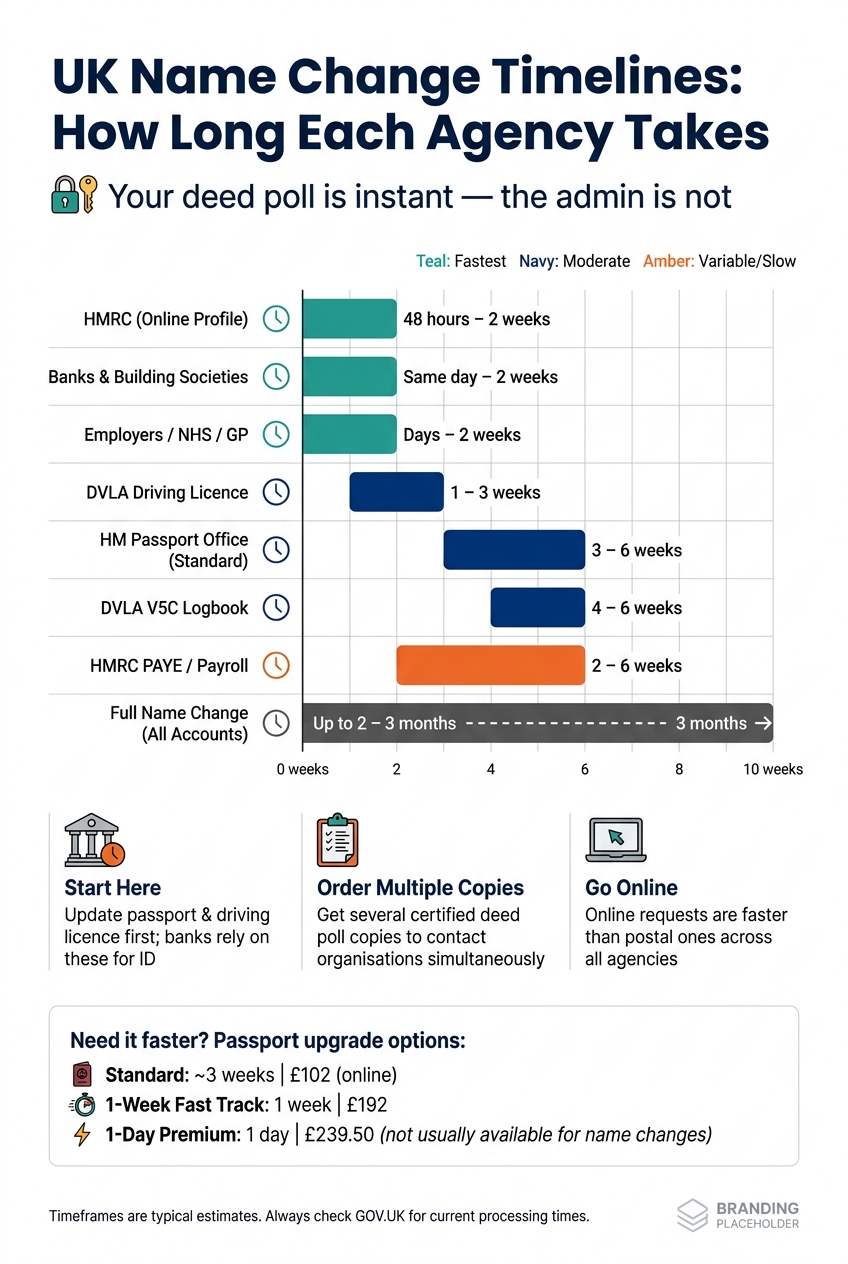
UK Name Change Timelines: How Long Each Agency Takes
Quick Comparison
| Organisation | Usual first update | Typical timeframe | Main delay risk |
|---|---|---|---|
| HM Passport Office | New passport | 3 to 6 weeks | Busy travel periods, missing proof of new name use |
| HMRC | Online tax profile | 48 hours to 2 weeks | PAYE taking longer than account update |
| DVLA | Driving licence | 1 to 3 weeks | Postal processing |
| DVLA V5C | New logbook | 4 to 6 weeks | Separate paper process |
| Banks | Account record or card | Same day to 2 weeks | Need for matching ID |
| Employers / NHS / education | Internal record | Days to 2 weeks | Payroll cycles or admin backlogs |
Put simply: your deed poll is instant, but the admin is not. If I wanted the process to move with fewer hold-ups, I’d send complete documents first time, do the big ID records early, and handle as many updates in parallel as possible.
sbb-itb-bf1bef6
HM Passport Office: how long a passport name change takes
A standard passport name change usually takes about 3 weeks. If you're making a first-time adult application in a new name, it normally takes around 6 weeks.
Once you have a deed poll and one document showing your new name in use, HM Passport Office is often one of the fastest places to update. That said, it's still smart to check the latest GOV.UK processing times before you book travel.
If you still have a valid passport, you can't just amend the name on that document. You need to apply for a new 10-year passport, and any time left on the old passport won't be added on.
The table below shows the standard and urgent services side by side.
Standard and urgent passport services
| Service Type | Typical Timeframe | 2026 Fee (Adult) | Deed Poll Accepted? |
|---|---|---|---|
| Standard (Online) | ~3 weeks | £102 | Yes |
| Standard (Postal) | ~3 weeks | £115.50 | Yes |
| 1-week Fast Track | 1 week | £192 | Yes |
| 1-day Premium | 1 day | £239.50 | No - not usually for name changes |
If 3 weeks feels too long, there is a faster route. The 1-week Fast Track service costs £192 and cuts the wait to seven days. The 1-day Premium service is generally not available for name changes.
Common reasons passport applications take longer
Passport applications need one document showing your new name, such as:
- a bank statement
- a utility bill
- a tax record
That document should be dated within the last 12 months.
Most delays come down to simple paperwork problems. Common ones include unsigned deed polls, photocopies instead of originals, name mismatches, or laminated documents. If you've changed your name more than once, include a clear paper trail linking everything back to your birth certificate or previous passport.
Busy travel periods can slow things down quite a bit. In peak seasons, standard processing can stretch to up to 10 weeks, so applying early is the safest move if you've got a trip planned.
For comparison, HMRC and DVLA usually take longer to update.
HMRC and DVLA: how long tax and driving records take to update
HMRC updates usually start online, but PAYE and payroll often take longer to catch up. DVLA is slower, as licence and logbook changes are dealt with by post and tend to take a few weeks.
HMRC timeframes for tax, PAYE and National Insurance records
The fastest way to update your name with HMRC is through your Personal Tax Account on GOV.UK. Online changes usually show in your account profile within 48 hours. You’ll need your National Insurance number and proof such as a deed poll or marriage certificate.
But here’s the bit that catches people out: a fast online update doesn’t mean every HMRC record changes at the same time. PAYE and payroll changes can take 2 to 6 weeks to appear on payslips, and letters or notices may still trail behind the online update. Once you’ve updated HMRC, it’s worth telling your employer as well, so payroll and tax records match up.
If you’d rather deal with HMRC by phone or post, phone updates tend to take 5 to 10 working days. Postal applications usually take 2 to 3 weeks, though in busy periods they can take 4 to 6 weeks.
DVLA works more slowly because both driving licence and logbook updates depend on documents being sent by post.
DVLA timeframes for driving licences and V5C logbooks
Updating your driving licence usually involves filling in a D1 form and posting it with your deed poll. Your replacement licence will often arrive within 1 to 3 weeks, and there’s no fee for the update.
The V5C vehicle logbook is handled separately and can take up to 6 weeks. You’ll need to send the original logbook, your deed poll, and a cover letter explaining the name change. If your vehicle tax is due within 4 weeks, sort the tax before posting the V5C, or update it and tax it during the same Post Office visit.
If you don’t tell the DVLA about a name change, you could be fined up to £1,000. And if your new V5C still hasn’t arrived after 4 weeks, contact the DVLA.
HMRC and DVLA update times at a glance
For a side-by-side view, here are the usual timings.
| Record Type | Usual Update Method | Where Change Appears First | Timeframe |
|---|---|---|---|
| HMRC Tax & NI | Online (Personal Tax Account) | Online Account Profile | 48 hours – 2 weeks |
| HMRC PAYE / Payroll | Automatic sync via HMRC | Employer Payslip | 2 – 6 weeks |
| Driving Licence | Post (D1 Form + Deed Poll) | Physical Photocard | 1 – 3 weeks |
| Vehicle Logbook (V5C) | Post (V5C + Cover Letter + Deed Poll) | Physical Document | 4 – 6 weeks |
Banks, employers and other organisations: what updates faster or slower
Once your government records are sorted, most private organisations tend to be easier to deal with. In many cases, they move faster than government departments. But there’s a catch: some can change your record on the spot, while others still want documents sent by post or need time to issue a new card.
Banks, credit cards and everyday financial accounts
Many high-street banks ask you to go into a branch with your original deed poll and photo ID. The account itself can often be changed there and then. Your replacement debit card, though, usually takes 3 to 7 working days to arrive by post.
Credit card providers often accept documents by post and usually finish the update within 1 to 2 weeks.
The good news is that your account number, sort code and Direct Debits stay the same. Online-only banks may let you do everything through their app, or they may ask for documents in the post. It varies, so it’s best to check with your provider before you start. If you haven't started yet, you can explore professional name change services to simplify the process.
Employers, pensions, NHS and education records
Employers can often update HR systems within a few days of getting your deed poll. That said, your new name may not show on your payslip until the next payroll cycle. Pension records often work much the same way, with updates taking 1 to 2 weeks once HR has dealt with the change.
NHS and GP records are often among the faster ones, with updates often done within days. Schools and universities usually update student records within days to 2 weeks. If you need certificates reissued, that usually takes longer and may come with a fee.
Typical timeframes outside government
The table below shows the usual pace for the most common updates.
| Organisation Type | Evidence Commonly Requested | What Updates First | Typical Timeframe |
|---|---|---|---|
| Banks & Building Societies | Original deed poll & photo ID | Account record (often same day in-branch); cards by post | 1–2 weeks |
| Credit Card Providers | Original deed poll (by post) | Account record; new card follows | 1–2 weeks |
| Employers | Deed poll (original or copy) | HR system; payslip on next payroll cycle | Days to 2 weeks |
| NHS / GP Surgery | Deed poll (photocopy often accepted) | Digital record | Days to 2 weeks |
| Pension Providers | Deed poll (original or copy) | Digital record | 1–2 weeks |
| Utility Companies | Photocopy, scan or phone notification | Account record | Immediate to 1 week |
Some banks won’t change your name until you can show photo ID that already matches your new name. In that case, the clock doesn’t start until your passport or driving licence has been changed first. Sorting your passport or driving licence early often makes later checks with banks and other account providers much smoother.
These are often the fastest updates to get done, but they still depend on having the right proof ready.
Conclusion: realistic timelines and how to avoid delays
In practice, your deed poll becomes valid as soon as it’s signed and witnessed. What takes longer is learning how to change your name legally in the UK and getting every record updated. Most key records - passport, DVLA, HMRC and your main bank account - are usually changed within 3 to 4 weeks. A full switch across all accounts can take up to 2–3 months, depending on how many organisations you need to contact.
After that, timing varies by organisation. One of the biggest factors is how you send the request. Online updates are often faster than postal ones, and busy periods tend to slow passport processing more than anything else.
Start with your passport and driving licence. That matters because many banks and other organisations rely on government-issued photo ID to check your new name. If those are done first, the rest often moves more smoothly.
It also helps to have several copies of your deed poll ready from the start. Sending your applications to the Passport Office and DVLA at the same time - instead of waiting for one document to come back before sending the next - can save weeks.
The fastest route is usually simple: handle the priority updates first, and do them in the right order.
Key points to remember
- Update your passport and driving licence first. These usually make it easier to change your name with banks and other organisations that need proof of identity. Plan around the slowest likely turnaround and leave extra time during busy periods.
- Send complete, consistent evidence first time. Incomplete or wrongly witnessed deed polls often cause delays. Name mismatches across records can also create problems with Direct Debits and security checks.
- Use parallel processing. Order enough certified copies to contact several organisations at the same time instead of dealing with them one by one.
FAQs
Which records should I update first?
Update your passport and driving licence first. These are the main types of photo ID that most other organisations use when they process a name change.
Both HM Passport Office and the DVLA will usually ask for an original deed poll. Because of that, it often makes sense to order more than one original so you can send applications to both at the same time.
Once your new photo ID arrives, you can then update your bank, HMRC, employer and pension providers.
Can I travel while my passport is being changed?
It’s not advised. You need to send your current passport to HM Passport Office while your application is being processed.
HM Passport Office also needs your original name change documents. That means you won’t have the travel ID you need until the process is finished and your documents are sent back.
What documents cause the most delays?
The biggest reason applications get held up is simple: people send a photocopy or digital scan instead of an original, wet-ink signed deed poll. HM Passport Office and the DVLA do not accept copies, so those documents are often rejected. And that can slow your application down by quite a bit.
Another common problem is errors or missing details on the application form. If the form isn’t filled in properly, it can be invalid. In that case, you may have to start all over again.
Name Change recommends ordering multiple original copies. That way, you can update several organisations at the same time instead of doing them one by one.