Who to Inform After Changing Last Name by Deed Poll
Changing your name by deed poll in the UK is just the first step. To make your name change official, you must notify key organisations to update your records. Failing to do so can lead to legal, financial, or administrative issues. Here's what you need to know:
- Government Documents: Update your passport, driving licence, and tax records with HM Passport Office, DVLA, and HMRC. Missing this step could result in fines or invalid documents.
- Financial Institutions: Inform your bank, credit card providers, and pension companies to ensure uninterrupted access to accounts and accurate records.
- Utilities & Services: Notify your council for Council Tax, electoral register, and utility providers like gas, water, and broadband.
- Employment & Education: Update your employer, payroll, and any professional or educational records to keep everything consistent.
- Other Organisations: Don’t forget healthcare providers, landlords, mortgage companies, and travel cards.
Key Tip: Most organisations require your original deed poll or a certified copy. Start with your passport, driving licence, and primary bank account to make other updates easier.
Avoid penalties and ensure your records are accurate by acting promptly. This guide provides everything you need to know, including documents required and costs involved.
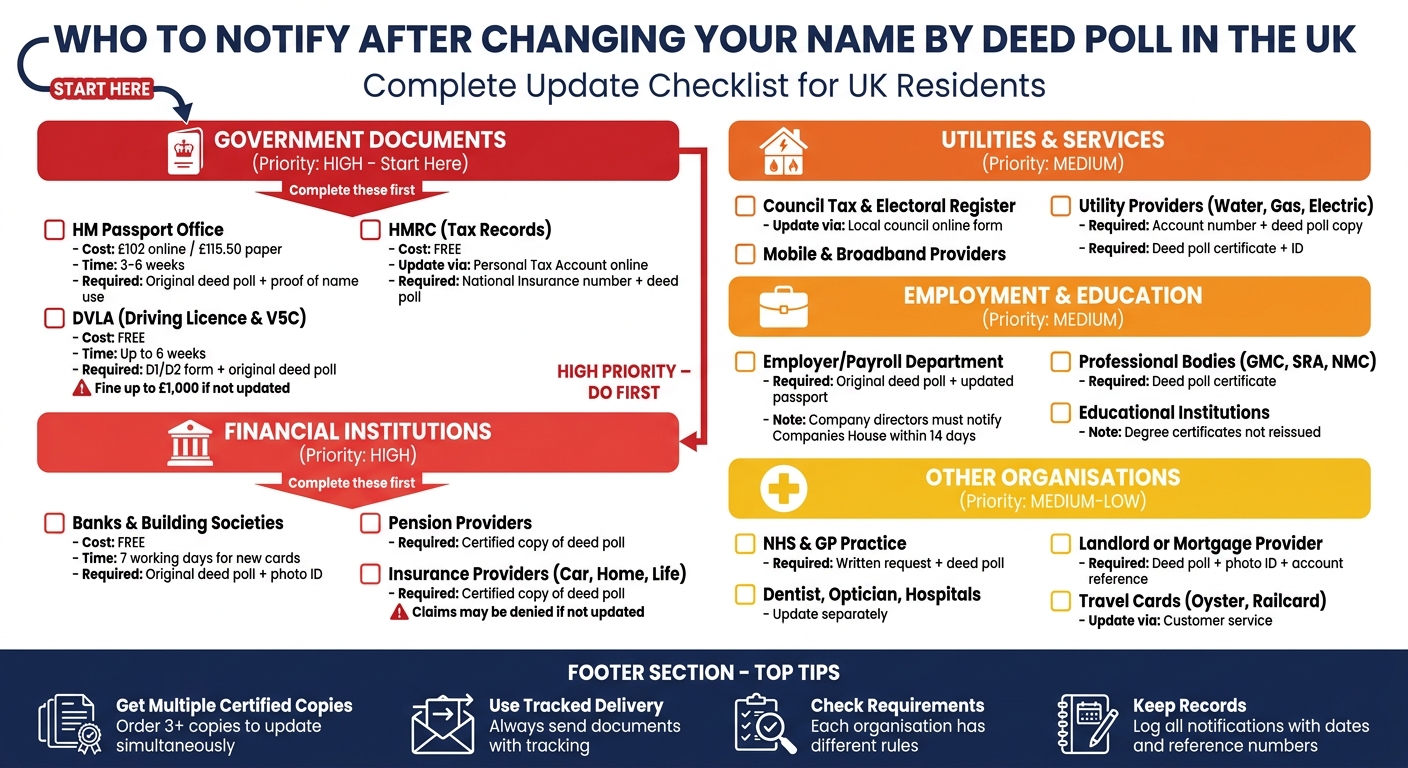
Complete Checklist for Updating Records After UK Name Change by Deed Poll
Government Documents
When changing your name in the UK, updating your government-issued documents should be a top priority. These documents are essential for establishing your legal identity.
HM Passport Office
You can’t simply amend your current passport - you’ll need to apply for a completely new 10-year passport to reflect your new name. To do this, you’ll need your original deed poll and one piece of "use of name" evidence, such as a driving licence, UK bank statement, utility bill, or tax record dated within the last three months.
It’s a good idea to update your driving licence or bank account first, as these can serve as evidence for your passport application. An online application costs £102 for adults (£61.50 for children), while paper applications processed through the Post Office cost £115.50. Processing times are usually around three weeks for renewals and up to six weeks for first adult passports.
A few things to keep in mind:
- Your new passport will have a new number and won’t extend the validity of your old one.
- Don’t book travel until your new passport arrives, as your name must match your travel bookings exactly.
- If you hold dual nationality, update your non-British passport before applying for your British one.
- Changing your name could invalidate any unexpired visas in your old passport, so consult the relevant embassy or consulate if this applies to you.
Once your passport is sorted, the next step is to update your driving licence and vehicle log book with the DVLA.
DVLA (Driving Licence and Vehicle Log Book)
Updating your driving licence and vehicle log book (V5C) with the DVLA is free, but these updates must be done separately as one doesn’t automatically update the other.
For a driving licence name change, you’ll need to apply by post. Use a D1 form (for cars and motorbikes) or a D2 form (for lorries and buses), which you can get from most Post Offices. Submit the completed form with your current photocard licence and your original deed poll to the DVLA. The process can take up to six weeks. Remember, failing to notify the DVLA of a name change can result in a fine of up to £1,000.
To update your vehicle log book, fill out the relevant section with your new name, include your original deed poll, and add a short cover letter. If your vehicle tax is due within the next four weeks, tax it online before submitting your log book or visit a Post Office to handle both at the same time. If you haven’t received your updated log book after six weeks, you may need to pay £25 for a replacement.
After addressing your travel and vehicle documents, it’s time to notify HMRC to ensure your tax and National Insurance records are up to date.
HMRC (Tax Records)
Your tax and National Insurance records won’t be automatically updated when you change your name - you must notify HMRC directly. The fastest way is through your HMRC Personal Tax Account on GOV.UK. Log in, select "Change your name", and follow the instructions. Be sure to have your National Insurance number, current contact details, and deed poll information handy.
If you can’t use the online service, you can contact HMRC by phone or post. They may request copies of your deed poll. Keep in mind that updating HMRC doesn’t automatically update your employer’s payroll records, so you’ll need to inform your HR department separately. This ensures that PAYE submissions match HMRC records and avoids any processing issues.
If you receive Child Benefit, make sure to update those records specifically to keep payments and correspondence accurate. Self-assessment users should check that their new name is correctly displayed in their Self-Assessment profile before filing their next tax return. Always use the exact spelling and order of your new name as it appears on your deed poll to prevent any mismatches.
sbb-itb-bf1bef6
Financial Institutions
Once you've updated your government records, the next step is to notify your financial institutions. This ensures uninterrupted access to your accounts, valid insurance coverage, and a consistent credit history. Banks, pension providers, and insurance companies all need to be informed about your name change.
Banks and Building Societies
While your financial information stays the same, you'll need to inform your bank to receive new cards and update your records. For high-street banks like Lloyds, HSBC, or Barclays, this typically involves visiting a branch with your original deed poll and a valid photo ID. On the other hand, digital-only banks such as Monzo or Starling may allow you to complete the process through their mobile apps.
The good news? UK banks don't charge for this update. Your new cards should arrive within seven working days, and your old ones will either deactivate once the new cards are activated or after 7–10 days. During this period, it’s wise to have a backup payment method handy. Also, destroy any old cheques, as those issued under your previous name will no longer be valid.
Your credit history remains intact. Banks notify credit agencies like Experian and Equifax about your name change, linking your old and new names through a "financial association." Be sure to inform credit card and loan providers promptly to avoid any issues with your credit file. If you have a joint account, the name change can usually be processed without the other account holder present, though the update will apply to the entire account profile.
Once your bank records are sorted, it’s time to move on to your pension providers.
Pension Providers
It's important to notify your occupational pension scheme about your name change to ensure your contributions and future benefits are recorded accurately. Contact your pension provider directly - they’ll likely ask for a certified copy of your deed poll and may also require additional ID verification.
This applies to both workplace and private pensions. Updating these details now avoids complications when you access your pension or retire. Keeping your records consistent across all providers simplifies administration down the line.
Insurance Providers
Your insurance policies are just as important to update as your government documents. Whether it’s car, home, or life insurance, the name on your policies must match your legal identification. If not, claims could be denied due to mismatched details.
You’ll need to contact each insurer individually, as updating one policy won’t automatically update others, even if they’re all with the same company. For car insurance, discrepancies can lead to claim issues, so it’s crucial to provide a certified copy of your deed poll - some insurers may even ask to see the original. Similarly, home and life insurance records should be updated to ensure beneficiaries and property details are accurate.
Check if there are any fees involved and aim to make these updates before your policy renewal to avoid unnecessary complications.
Utilities and Services
Once you've updated your details with financial institutions, it's time to focus on your household services and utilities. Keeping these records up-to-date ensures your bills, direct debits, and service contracts reflect your new name, helping you avoid payment issues and ensuring your credit file stays consistent. You’ll also need to notify local government and service providers to ensure everything runs smoothly.
Council Tax and Electoral Register
Your local council must be informed of your name change for both Council Tax and voter registration. Most councils now provide an online "Report a change of name" form where you can upload a scanned copy of your deed poll certificate. Before submitting, check that your name already appears on your Council Tax bill. If it doesn’t, call the council to ensure you're added to the account first.
For updating the electoral register, you’ll need to contact your local Electoral Services team. This can usually be done via email, phone, or an online enquiry form. Some councils offer a streamlined process where updating your Council Tax automatically informs the elections department. If this isn’t the case, you may need to use the GOV.UK "Register to Vote" service to ensure your voting rights are updated under your new name.
Utility Providers
Your water, electricity, and gas providers will also need to know about your name change. Most companies allow updates via phone or your online account, but some may require an original deed poll or a certified copy sent through tracked delivery. When contacting them, have your account number and current billing details ready. Updating these promptly helps prevent any issues, such as failed payments.
Mobile Phone and Broadband Providers
Telecommunications providers - whether for mobile phones, landlines, or broadband - will also need your updated details. Check if they accept digital scans of your deed poll or if they require physical copies. Many companies offer dedicated "Change of Name" forms, accessible online, by post, or even by fax. Typically, you’ll need to provide your deed poll certificate and updated identification. Once your utilities are sorted, you can move on to informing your employer and educational institutions to keep all records consistent.
Employment and Education
Workplaces and educational institutions keep essential records for tax, payroll, and professional registration purposes. It's important to update them promptly so that documents like your P45, P60, and qualifications reflect your new legal name. Once you've updated your government and financial records, focus on notifying your employer and educational institutions to ensure consistency across all official records.
Employer or Payroll Department
Let your HR or Payroll department know about your name change as soon as your deed poll is complete. Employers need to maintain accurate "Right to Work" records, and they'll require your original deed poll along with your updated passport to confirm your new identity. Moving forward, payslips, P45s, and P60s will display your new name, while older documents remain valid when accompanied by your deed poll. Your employer will also update internal systems like email addresses, ID badges, and security access.
If you're self-employed, make sure to update your details through your HMRC Personal Tax Account so that your National Insurance contributions are correctly allocated. For company directors, it's mandatory to notify Companies House within 14 days using form CH01.
Professional Bodies and Qualifications
Reach out to any regulatory bodies you belong to - such as the General Medical Council, Solicitors Regulation Authority, or Nursing and Midwifery Council - to update your licence information. Most organisations accept deed poll certificates via their online platforms or by post. It's also crucial to inform your professional indemnity insurer to ensure your cover remains valid. If you hold professional qualifications or are a member of trade associations, update these records as well to maintain uniformity across your credentials.
Educational Institutions
Most UK universities won't reissue degree certificates after a name change. Instead, you'll need to present your original certificate alongside your deed poll to verify the link between your old and new names. If you're currently enrolled, contact your registrar or student support services to update your records. This will ensure your email address, student ID, and any future transcripts reflect your new name. Alumni can typically update their details through the university's alumni office, ensuring accuracy for any future reference requests from employers.
Other Organisations to Notify
When changing your last name, it’s not just government bodies and financial institutions that need to be informed. Many other organisations hold records tied to your identity, and failing to update them could lead to issues with healthcare, housing, or even daily travel.
NHS and GP Practices
Your GP practice should be one of the first healthcare organisations you notify. Updating your records here often triggers changes across other NHS systems. Most practices require a signed written request - some even provide specific forms for this purpose. While it's not always a legal requirement, many GPs will ask to see your deed poll as part of their process. After your GP updates your details, double-check that your NHS app and any patient portals are also updated.
Other healthcare providers, like dentists, opticians, and hospitals, maintain separate records, so you’ll need to contact them individually. If you’re undergoing treatment at a hospital, notify them directly to avoid disruptions, as updates from GP records may not sync automatically. Additionally, confirm that you’re still scheduled for any medical screenings, as name changes can sometimes interfere with these reminders. Don’t forget to inform private health, life, and dental insurance providers - your policy must reflect your legal name to remain valid.
Landlord or Mortgage Provider
If you’re renting, let your landlord know about your name change to ensure future tenancy agreements or renewals are accurate. For mortgage providers - often banks or building societies - you’ll likely need to visit a branch with your deed poll and updated photo ID. Including your mortgage account or tenancy reference number can help speed up the process. Homeowners should also notify the Land Registry to update property deeds. Be sure to include a covering letter explaining your name change, and check whether they require the original deed poll or if a certified copy will suffice.
Travel Cards (e.g., Oyster, Railcard)
To avoid disruptions during travel, update your travel cards, such as Oyster or Railcards, by contacting the provider’s customer service or submitting an online request. Typically, you’ll need to provide your deed poll and account details. Keeping your travel documents consistent with your new legal identity is essential.
"Consistency is key. Any discrepancy between identification documents and travel books may result in delays, denied boarding, or other travel disruptions."
Lastly, don’t forget to update any loyalty programmes linked to your travel accounts. Keep a record of your submission dates and reference numbers for tracking purposes.
Tips for Updating Your Records
After notifying key organisations, here are some practical tips to make updating your records smoother and less stressful.
Get Multiple Certified Copies
It’s a good idea to order several certified copies of your deed poll so you can update multiple organisations at the same time. Some institutions, especially those with stricter security measures, require either the original or a solicitor-certified copy.
For instance, you might want to update your Passport, Driving Licence, and Primary Bank Account all at once. These documents often act as primary proof of identity and can make updating other organisations much easier. With multiple copies, you can send one to the Passport Office, another to the DVLA, and take a third to your bank branch - all within a short timeframe. Services like Name Change often provide three certified copies as part of their standard offering, which should cover most immediate updates.
Use Tracked Delivery
When sending your deed poll, always opt for tracked delivery. Organisations like the HM Passport Office and DVLA require you to send original documents, so losing them in the post could cause significant delays and force you to reorder replacements. Tracked delivery ensures you have proof of postage and delivery, offering extra security for your documents.
Most government agencies, including the Passport Office, will return your original documents via secure post once they’ve processed your application. Keep a record of your tracking numbers and posting dates to follow up quickly if needed and to monitor the status of every certified copy you’ve sent.
Check Each Organisation's Requirements
Different organisations have different rules when it comes to updating your records. For example:
- The Passport Office requires your original deed poll along with evidence that you’re already using your new name, such as a recent bank statement or payslip.
- HMRC allows you to update your name online via your Personal Tax Account, making the process much simpler.
- Banks often need you to visit a branch in person with your deed poll and photo ID.
- Many utility providers accept high-quality photocopies sent by post.
If you’re updating professional registers, like the General Medical Council, be aware that they may have stricter requirements. For instance, they might ask for both old and new passports in addition to your deed poll. Always double-check what each organisation needs before sending anything to avoid rejected applications or wasted time.
These steps can help make the process of updating your records much easier and more efficient.
Conclusion
Changing your last name by deed poll is relatively simple, but the real work lies in notifying all the relevant organisations. From the HM Passport Office and DVLA to your bank, employer, and GP surgery, each plays a role in maintaining your official identity. Overlooking even one could result in legal or administrative headaches.
The best approach is to tackle the process step by step. Begin with your passport, driving licence, and primary bank account. These are key identity documents, and updating them first makes it easier to handle changes with other organisations. Keep in mind that driving with an outdated licence is a summary offence and could lead to a fine of up to £1,000, so it’s important to act quickly.
Once the main documents are sorted, create a detailed log of all further notifications. Record the organisations you’ve contacted, along with reference numbers and dates, to ensure nothing is missed. This will help you maintain consistency across financial, employment, and healthcare records. Don’t forget to update any professional bodies, like the GMC or SRA, to ensure your qualifications remain valid.
For added convenience, services like Name Change can streamline the process. They provide professionally prepared deed poll documents, accepted by UK government departments, along with certified copies and tracked delivery. This allows you to notify multiple organisations at once, saving time and reducing hassle during your updates.
FAQs
What order should I update organisations in?
It's a good idea to follow a specific order when updating organisations after changing your last name by deed poll. Here's a suggested sequence to make the process smoother:
- Government agencies and official documents: Begin with your passport, driving licence, and HMRC records.
- Financial institutions: Notify your bank, credit card providers, and any loan companies.
- Utility providers: Update your details with gas, electricity, water, and internet companies.
- Healthcare providers: Inform your GP, dentist, and opticians of the change.
- Employer and HR: Ensure payroll and employment records reflect your new name.
- Insurance providers: Update your health, car, home, and life insurance policies.
- Memberships and subscriptions: Don’t forget clubs and professional organisations you’re part of.
Focusing on government and financial updates first is crucial, as these are often the most important and can impact other changes.
Do I need the original deed poll or will a certified copy do?
Most organisations are fine with a certified copy of your deed poll. However, government bodies such as HM Passport Office usually insist on seeing the original document. It's always a good idea to double-check the specific requirements of the organisation you're informing to prevent any unnecessary delays.
How long does it usually take to update everything?
After changing your name by deed poll, updating your details with various organisations can take different amounts of time, depending on their processes. For example, updating documents like your driving licence or passport might take a few weeks, while some changes could happen faster. Although there’s no fixed deadline for these updates, it’s a good idea to inform organisations soon after signing your deed poll. This helps ensure your records are updated without unnecessary delays.