Top Myths About Unenrolled Deed Polls Debunked
In the UK, changing your name legally is simpler than you might think. Both unenrolled and enrolled deed polls are legally valid, but unenrolled deed polls are far more common, used in 95% of cases. They’re cheaper (typically under £20), quicker to process, and maintain your privacy since they aren’t published in public records. Despite misconceptions, unenrolled deed polls are widely accepted by major organisations like the Passport Office, DVLA, and banks. Here's what you need to know:
- Unenrolled Deed Polls: Private documents, signed and witnessed, with no court involvement. Fully valid under UK law.
- Enrolled Deed Polls: Registered with the Royal Courts of Justice and published in The London Gazette. Costs £50.32 and takes longer.
Both are equally valid for updating official records. Enrolment is optional and mainly used for specific legal or historical reasons. Unenrolled deed polls are the practical choice for most people.
Myth 1: Unenrolled Deed Polls Are Not Legally Valid
The idea that an unenrolled deed poll isn’t legally valid is a misunderstanding. In England, you’re free to adopt any name you wish. Your legal name is essentially established by how you use it in daily life, and a deed poll serves as formal proof of your decision to abandon your old name and adopt a new one.
Lord Justice Ormrod clarified this in the Court of Appeal:
"A deed poll is just as effective or ineffective whether it is enrolled or not; the only point of enrolment is that it will provide unquestionable proof, if proof is required. No more." – Lord Justice Ormrod, Court of Appeal, D v B (orse D)
An unenrolled deed poll becomes legally binding as soon as it’s correctly signed, dated, and witnessed. It doesn’t require court approval, a judge’s involvement, or registration with the government. According to official GOV.UK guidance, anyone aged 16 or older can create a deed poll and start using their new name immediately. This straightforward process often leads to confusion about the need for court enrolment.
Legal Standing of Unenrolled Deed Polls
For an unenrolled deed poll to be valid, it must meet a few simple criteria:
- Clearly state that you’re abandoning your old name and adopting a new one for all purposes.
- Be properly executed, meaning it’s signed and dated in front of independent witnesses (over 18, unrelated to you, and not living at your address).
- Express your permanent intention to use the new name.
These straightforward steps explain why over 95% of name changes in the UK are done using unenrolled deed polls. Properly executed unenrolled deed polls are widely accepted for updating official records, making them a practical and effective option. This clarity helps debunk myths surrounding the enrolment process.
sbb-itb-bf1bef6
Myth 2: Enrolment with the Courts Is Mandatory
Contrary to popular belief, you don’t need to enrol with the Royal Courts of Justice for a name change to be legally valid in the UK. Enrolment is completely optional, and an unenrolled deed poll holds the same legal authority under English common law as an enrolled one.
In fact, the numbers speak for themselves - only about 1% of deed polls are enrolled, highlighting how rare enrolment actually is. The optional nature of this process doesn’t diminish the legal validity of your name change, as confirmed by long-standing legal practices and these statistics.
The Role of Enrolment
Enrolment essentially creates a permanent public record of your name change. When you enrol a deed poll with the Royal Courts of Justice, it is published in The London Gazette, an official government publication. This means both your old and new names become permanently searchable online.
While this might sound appealing for record-keeping purposes, enrolment is far from popular due to its downsides. Many people avoid it because of the lengthy process, higher costs, and the loss of privacy. For instance, enrolling costs £50.32 in court fees alone and can take several months to complete. In contrast, an unenrolled deed poll can be completed almost immediately. For those who prioritise privacy or have safety concerns, an unenrolled deed poll is often the better choice.
Given these factors, enrolment is typically reserved for specific situations. These include cases where it’s court-ordered, required for certain international legal purposes, or when someone wants to create a permanent public record for historical reasons. If an organisation requests proof of a public record, it’s best to confirm with them whether enrolment is actually necessary. Ultimately, these points underline that both enrolled and unenrolled deed polls are equally valid under the law.
Myth 3: Government Bodies Do Not Accept Unenrolled Deed Polls
Let’s clear up a common misconception: the idea that government bodies won’t accept unenrolled deed polls. This belief often stops people from pursuing a simple name change. The truth? All major UK government departments recognise legally executed unenrolled deed polls as valid proof of a name change. Both enrolled and unenrolled deed polls carry the same legal weight, and this extends to their acceptance by key government organisations.
Examples of Acceptance
For instance, HM Passport Office accepts unenrolled deed polls when issuing or renewing passports. In some cases, they might ask for extra documents, like a bank statement, to confirm your 'name in use'. Similarly, the DVLA accepts them for updating driving licences, and HMRC uses them to update tax records and National Insurance details.
Other examples include:
- The NHS, which accepts them for updating medical records.
- The Department for Work and Pensions for benefits and pensions.
- HM Land Registry, which recognises them via Form AP1.
Unenrolled deed polls are also widely accepted by high street banks, schools, universities, and employers.
"The UK Passport Office accepts unenrolled deed polls as full legal proof of a name change. You do not need to enrol your deed poll to update your passport." – UK Deed Poll Office
While it’s rare, some foreign embassies or older trust documents might request an enrolled deed poll. However, for almost all UK purposes, an unenrolled deed poll works perfectly well.
Myth 4: Unenrolled Deed Polls Expire Over Time
Let’s clear up another common misunderstanding: the idea that unenrolled deed polls somehow expire. This simply isn’t true. Once you’ve properly executed a deed poll, it remains valid indefinitely. There’s no expiry date, no need to renew it, and no looming deadline to update your records with it.
A deed poll is a permanent record of your name change. Whether you use it to update your passport immediately or years down the line, it holds the same legal weight as it did on the day it was signed. English law allows you to change your name at any time (as long as it’s not for fraudulent purposes), and your deed poll is the official evidence of that change.
"Deed Polls expire. They don't. Situations can 'overwrite' them, though – if you changed your name and then got married, for example, you could use your marriage certificate to overwrite your surname."
– Declan Ramsden, Content Creator, Vital Consular
The only time a deed poll becomes irrelevant is if it’s replaced by a subsequent legal name change, such as through marriage, civil partnership, or another deed poll. This doesn’t mean the original has expired - it’s simply been superseded by a newer legal document.
It’s crucial to keep your original deed poll safe, as there isn’t a central registry where you can retrieve a copy. You might need it years down the line for things like pension claims, inheritance matters, or property transactions. If the original is lost, you’d need to create a new deed poll to confirm your name change.
Myth 5: Enrolled Deed Polls Are More Official or Stronger
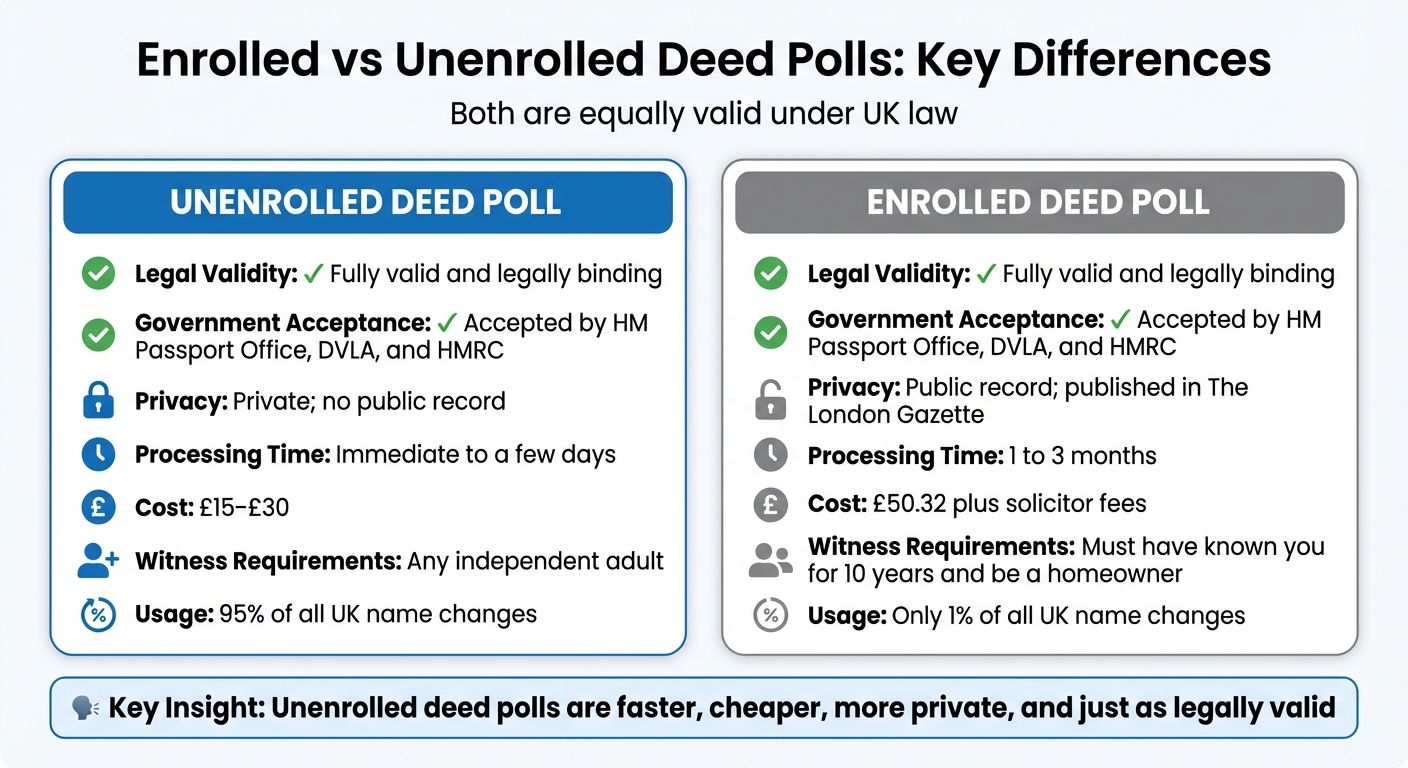
Enrolled vs Unenrolled Deed Polls Comparison UK
Under UK law, both enrolled and unenrolled deed polls hold the same legal weight. While enrolling a deed poll involves the Royal Courts of Justice and results in its publication in The London Gazette - a process that may appear more formal - this does not make the name change any more legally binding. As Lord Justice Ormrod explained:
"The purpose of enrolment is only evidential and formal. A deed poll is just as effective or ineffective whether it is enrolled or not".
Government bodies across the UK, including HM Passport Office, the DVLA, HMRC, and the NHS, recognise unenrolled deed polls as valid proof of a name change.
Comparison of Enrolled and Unenrolled Deed Polls
| Feature | Unenrolled Deed Poll | Enrolled Deed Poll |
|---|---|---|
| Legal Validity | Fully valid and legally binding | Fully valid and legally binding |
| Government Acceptance | Accepted by HM Passport Office, DVLA, and HMRC | Accepted by HM Passport Office, DVLA, and HMRC |
| Privacy | Private; no public record | Public record; published in The London Gazette |
| Processing Time | Immediate to a few days | 1 to 3 months |
| Cost | £15–£30 | £50.32 plus solicitor fees |
| Witness Requirements | Any independent adult | Must have known you for 10 years and be a homeowner |
The practice of enrolment originated over 150 years ago as a way to securely store legal documents. Nowadays, enrolment is typically reserved for specific circumstances, such as when dealing with foreign embassies or fulfilling requirements in older trust documents. For most people, an unenrolled deed poll is just as effective, while offering greater privacy, faster processing, and lower costs. This comparison highlights that enrolment does not add any legal strength, a point that will be addressed further in the next myths.
Myth 6: Unenrolled Deed Polls Cannot Be Used for Official Purposes
Contrary to what some believe, unenrolled deed polls are fully valid for official purposes in the UK. In fact, they are the standard way to change your name by deed poll in the UK. Major government departments and most private organisations accept them without hesitation.
Key institutions like HM Passport Office, the DVLA, HMRC, and the NHS process thousands of unenrolled deed polls annually. High street banks such as Barclays, HSBC, Lloyds, and Santander, alongside digital banks like Monzo and Starling, also accept them for updating account details. Beyond that, employers, schools, universities, and utility companies routinely recognise properly executed deed polls. These examples clearly show that unenrolled deed polls are trusted across both public and private sectors, reinforcing their legitimacy.
To ensure your deed poll is accepted, it must be correctly drafted and witnessed. The document should include a declaration stating that you are abandoning your previous name, adopting a new name for all purposes, and requiring others to address you by your new name. It must feature an original 'wet ink' signature, as digital signatures (e.g., DocuSign) are not permitted. Additionally, your witness must be an independent adult over 18 years old (not a relative or housemate), with their full details included .
"Government departments accept unenrolled deed polls. There's no difference in how they're treated compared to enrolled deed polls." – Deedly
For added credibility, print your deed poll on high-quality archive paper, as standard printer paper could raise concerns about authenticity. Once you've updated key documents like your passport or driving licence, other organisations will find it even easier to update their records using your new primary photo ID.
If you're looking for a hassle-free way to handle the process, consider using Name Change. This service ensures your deed poll is drafted correctly, printed on premium paper, and fully complies with legal standards, making it widely accepted by UK government departments and organisations.
Conclusion
Unenrolled deed polls are fully recognised under UK common law and serve as the standard method for legally changing your name. They hold the same legal standing as enrolled deed polls, making them equally valid in the eyes of the law.
The key to ensuring your deed poll is accepted lies in executing it correctly. This means including a clear statement that you are giving up your old name and adopting a new one, signing the document yourself, and having it witnessed by at least one independent adult over 18 who is neither a relative nor someone you live with. When done properly, this ensures acceptance by UK authorities.
For most people in the UK, unenrolled deed polls are the most practical choice. They are cost-effective, private, and quick to implement. Major organisations like the HM Passport Office, DVLA, HMRC, NHS, and many banks routinely process unenrolled deed polls without issue. Unlike the court enrolment process, which costs over £50 and can take weeks, an unenrolled deed poll can be completed immediately and gives you the legal authority to update your official documents and records. Services like Name Change are available to help ensure your deed poll meets all necessary legal standards.
In short, unenrolled deed polls are a reliable, legal, and widely accepted way to change your name. By ensuring your document is correctly drafted and witnessed, you can confidently use it across both government departments and private institutions. Thousands of people do so every year without complications.
FAQs
What should I do if an organisation refuses my unenrolled deed poll?
If an organisation declines your unenrolled deed poll, start by ensuring that it is accurately worded and properly witnessed. If the problem continues, you may need to provide extra identification or evidence of your name change. Most UK government departments accept unenrolled deed polls, so double-check that your document complies with their requirements for acceptance.
How many original or certified deed poll copies do I need?
When notifying multiple organisations, it's a good idea to order enough certified copies to handle everything efficiently. Most people find that 3 to 10 copies are sufficient, though in some situations, you might need as many as 15. Think about your own requirements carefully before deciding how many to request.
Can I use an unenrolled deed poll abroad?
Yes, an unenrolled deed poll is legally valid in the UK for changing your name. However, since it’s a private document and not officially registered with the government, its acceptance abroad can differ depending on the laws of the specific country. It’s always a good idea to check the legal requirements of the country in question before using an unenrolled deed poll internationally.