Updating Records After a Name Change: Checklist
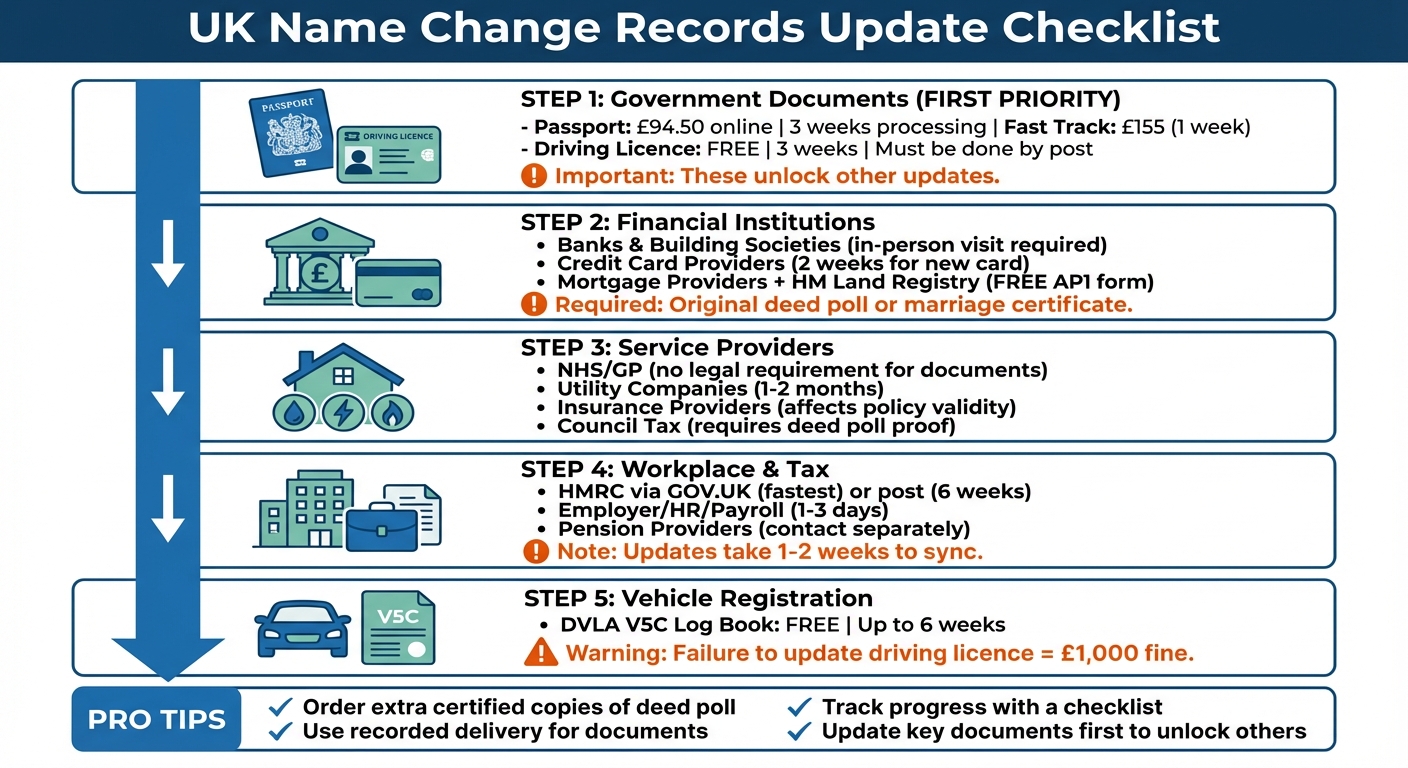
Changing your name in the UK comes with the task of updating your details with various organisations. Missing even one update can lead to issues like mismatched documents or delays in transactions. Here's a quick guide to help you navigate the process:
- Start with government documents: Update your passport and driving licence first as they’re often required for other changes. For example, updating your passport costs £94.50 online and takes around 3 weeks, while a driving licence update is free but must be done by post.
- Notify financial institutions: Banks and mortgage providers require your original deed poll or marriage certificate for updates. Visit your bank in person for quicker processing.
- Inform service providers: Update utilities, healthcare records (NHS/GP), and insurance policies. Some changes, like council tax updates, may need proof of your name change.
- Workplace and tax updates: Inform your employer and HMRC to ensure payroll, pension, and tax records are accurate. Use the GOV.UK portal or app for HMRC updates.
- Vehicle registration: Update your V5C log book with the DVLA, which is free and takes up to six weeks.
Tips:
- Order extra copies of your deed poll to speed up the process.
- Use recorded delivery when sending important documents.
- Track your progress with a checklist to ensure all updates are completed.
This guide ensures your name change is correctly reflected across all necessary records, avoiding future complications.
UK Name Change Records Update Checklist: Step-by-Step Guide
Government Documents to Update
When you change your name, updating government-issued documents should be at the top of your list. These documents act as your primary proof of identity, which you'll need to update everything else, like bank accounts or utility bills.
Passport
The HM Passport Office accepts unenrolled deed polls for name changes, meaning you don’t need to register your deed poll with the High Court. To update your passport, you’ll need to send the following:
- Your original deed poll
- Your current passport (this will be cancelled and returned with the corner cut off)
- A completed application form
- A new photo
Processing times are generally 3 weeks, but during peak times, such as summer months, this can extend to 10 weeks. The cost is £94.50 for online applications or £107.00 for paper-based ones. If you’re in a rush, a 1-week Fast Track service is available for £155.00.
"Section 17 on a UK birth certificate (issued in England and Wales) can be used to add, remove or change forenames during the 12-month period after birth registration." - HM Passport Office
It’s a good idea to order extra copies of your original deed poll before applying, as the Passport Office will keep one for their records. Also, avoid booking any travel until you have received your updated passport, as the new passport will have a different number, and any visas in your old passport may no longer be valid.
Driving Licence (DVLA)
When updating your name with the DVLA, note that you cannot do this online. You’ll need to send your application by post to DVLA, Swansea, SA99 1BN. Here’s what you’ll need:
- Form D1 (available at most Post Offices)
- Your original deed poll or marriage certificate
- Your current photocard licence
- A new photo (only if your current one is over 10 years old)
The service is free, and processing typically takes 3 weeks. Your original documents will be returned along with your updated licence. Don’t worry; you can still drive while your application is being processed.
To ensure your documents are safe, use recorded or special delivery when posting. Keep in mind, failing to notify the DVLA of a name change could result in a fine of up to £1,000. Lastly, updating your driving licence does not automatically update your vehicle registration (V5C log book) - you’ll need to handle that separately.
Birth Certificate (if applicable)
Birth certificates are considered fixed records and are rarely updated for standard name changes like those made through marriage or deed poll. However, there are exceptions:
- In England and Wales, Section 17 allows for changes to a child’s forenames within 12 months of birth registration. Only one parent’s consent is usually required.
- If parents marry or form a civil partnership after the original birth registration, they must re-register the child’s birth.
- If the natural father’s details weren’t included initially, the birth can be re-registered to add them.
The cost to correct a mistake on a birth certificate is £83 or £99.
In Scotland, the rules differ. You can apply to change a forename or surname in the birth register at any time. If the change is made after 12 months, it will be recorded as a marginal note. To proceed, contact the register office in the district where the birth was originally registered for the appropriate forms and guidance.
Once your government documents are sorted, the next step is to update your financial and banking records.
Financial and Banking Records
After updating your government documents, your next priority should be your financial accounts. Banks, credit card companies, and mortgage lenders all require original proof of your name change to update their records. Here’s what you need to know for each category.
Banks and Building Societies
Most UK banks - like Barclays, HSBC, Lloyds, and NatWest - require an in-person visit to update your name. You'll need to bring your original deed poll or marriage certificate along with a government-issued photo ID. Keep in mind, photocopies or digital scans won’t be accepted.
"Most UK banks (such as Barclays, HSBC, and NatWest) will not accept photocopies or digital scans of a deed poll. You have a responsibility to present the original physical document with a 'wet ink' signature." – UK Name Change
Your account details stay the same, but you'll receive new cards and updated statements, usually within two weeks. There’s no fee for this service. If you hold multiple products with the same bank - such as savings accounts or insurance policies - make sure to request updates for all of them.
Some banks, like Barclays, let you book an appointment in advance to save time. If visiting a branch isn’t an option, check if your bank accepts certified copies signed by a professional (e.g., a solicitor or doctor) sent by post.
Lastly, it’s a good idea to review your credit report a few months after the update. This ensures credit reference agencies have correctly linked your old and new details.
Credit Card Providers
The process for credit cards is quite similar. You’ll need to provide original documents and an updated photo ID. While some companies may accept ID in your previous name if paired with your deed poll, others prefer an updated passport or driving licence.
"Changing your name on your credit card can take anywhere from a few days to a couple of weeks. The exact timing will depend on the lender." – Fiona Peake, Personal Finance Writer, Ocean Finance
Once the change is processed, you’ll receive a new card. There’s no need to contact credit reference agencies like Experian or Equifax directly - they’ll automatically update their records once your bank and the electoral roll are updated. For joint credit cards, both account holders may need to sign the request or provide ID to confirm the change.
Mortgage Providers
Mortgage records require a separate update, as changing your name with your bank won’t automatically update your mortgage details. You’ll need to provide the same documents, such as your original deed poll or marriage certificate and photo ID. Some lenders, like Barclays, require you to mention the mortgage during your name change appointment.
Additionally, you’ll need to update your details with the HM Land Registry so that property documents reflect your new name. This involves submitting an AP1 form, which is free. However, the process can take several weeks due to notice periods, as the Land Registry must notify the registered proprietor before finalising the change.
"It's common for lenders to refuse to lend money unless your details exactly match the register. So, if you got married and remortgaged at the same time, the lender might insist you update your name with us before they'll authorise a mortgage offer." – HM Land Registry
If your property deeds aren’t updated, it could cause delays during remortgaging, as lenders require your details to match the Land Register. To avoid issues, always send original documents via recorded or special delivery to ensure their safe arrival.
Service Records to Update
Once you've updated your financial accounts, the next step is to ensure your new name is reflected across everyday services. This includes healthcare providers, utility companies, and insurers. The process for updating these records can differ depending on the organisation.
Healthcare (NHS/GP and Dentist)
Begin with your GP surgery, which maintains your NHS records. To update your name, title, or gender with the NHS, notify your GP practice. Most practices will ask for a written, signed letter along with your original deed poll or marriage certificate, though this is not legally required.
"It is not a legal requirement that you present documentation, but some GPs will consider it good practice to request this." – The Rotherham NHS Foundation Trust
Your NHS number remains unchanged unless you are updating your gender marker, in which case a new number will be issued. The time it takes to process these updates can vary from a few days to a few weeks, depending on your GP's workload. You can monitor the progress through the NHS App. However, keep in mind that updating your GP record does not automatically update other NHS services. If you're receiving hospital treatment, you'll need to inform the Medical Records Department directly.
Once your healthcare records are updated, move on to your utility accounts.
Utility Companies
Updating utility accounts is usually a simple process since accounts are typically identified by account numbers rather than names. Most providers require minimal proof of a name change, but council tax updates will need a deed poll for verification. These updates can take one to two months as they also affect the electoral roll.
Broadband and mobile providers might request proof because the name change alters your contract details and could trigger a soft credit check. To make the process smoother, have your account number, current address, and a recent meter reading ready before contacting them. If you're also changing your address, notify the providers at the same time. Promptly updating your utility bills is helpful since they can serve as proof of address for other applications.
With utilities sorted, the next step is to update your insurance policies.
Insurance Providers
Informing your insurers right away is essential to ensure your policies remain valid. Whether it's car, home, life, or health insurance, most providers will require a deed poll or marriage certificate as proof. This is especially important for car insurance, as insurers must align policyholder records with DVLA-linked databases.
The process and any associated fees can vary, so contact each provider to confirm their requirements. Make sure to update all your policies, including those for pets or private health insurance. Once your records are updated, insurers will typically issue revised policy documents for your files.
sbb-itb-bf1bef6
Workplace and Other Records
Once you've updated your insurance policies, the next step is notifying your employer and relevant government agencies. This ensures that your salary, tax records, and vehicle registration all reflect your updated legal name.
HMRC and Pension Providers
It's crucial to update your name with HMRC to keep your National Insurance and State Pension records accurate. The easiest way to do this is through your personal tax account on GOV.UK or via the official HMRC app. If you prefer postal updates, send a signed request to the National Insurance Contributions and Employers Office at HMRC, BX9 1AN. Your letter should include your NI number, old and new names, the reason for the change, and your signature.
For postal updates, original documents - such as your marriage certificate, decree absolute, or deed poll - are required, not photocopies. Make sure to send these securely. While postal updates can take up to six weeks, digital methods are generally much quicker.
Keep in mind that HMRC won't notify your pension providers for you. You'll need to contact them directly to update your name across workplace and private pension schemes. This step is essential to ensure your State Pension entitlement is recorded correctly.
Employers and Payroll Systems
Once your HMRC records are updated, inform your employer to ensure payroll and IT systems reflect your new name. Employers are legally obligated to accept a deed poll as evidence of your name change. Submit your original deed poll or a certified copy to your HR department. HR will update your contract, Payroll will adjust PAYE/NI records, and IT will handle changes like email and system access.
These updates are usually quick: HR changes take 1–3 days, IT updates within 48 hours, and payroll synchronisation with HMRC usually takes 1–2 weeks. After the updates, review your next payslip and annual P60 to confirm your new name is correctly displayed.
If you've updated your name with your bank, make sure to provide your employer with the updated account details to avoid salary payment issues. Additionally, ask your IT department to set up email forwarding from your old address to ensure you don't miss any important messages. Verify that your employer has also updated your details with the company pension provider to prevent contribution mismatches.
DVLA Vehicle Log Book (V5C)
Finally, update your vehicle registration details with the DVLA. If you own a car, you'll need to update your name on the vehicle log book (V5C). This process is typically free and takes up to six weeks.
The section you complete depends on your log book type. For new-style log books (with multi-coloured numbered blocks on the front), fill out Section 3. For older styles, use Section 6. Write your full new name, include a cover letter explaining the change, and send your completed V5C along with your deed poll to DVLA, Swansea, SA99 1BA.
If you pay vehicle tax via Direct Debit, write to DDC, DVLA, Swansea, SA99 1ZZ with your bank details and a copy of your deed poll. If your vehicle tax is due within the next four weeks, either renew it online before sending the log book or visit a Post Office to update your details and pay your tax at the same time.
Tips for a Smooth Name Change Process
Changing your name means notifying a range of organisations, which can feel overwhelming. If you are still at the beginning of the process, ensure you understand how to change your name legally before starting your notifications. A clear plan helps ensure you don't miss any important updates.
Update Key Documents First
Start with your passport and driving licence - these are crucial photo IDs that banks and government offices often require to verify your new name. As OfficialDeedPoll.org points out, "Prioritise passport or driving licence to unlock banks and HMRC". It's worth noting that failing to update your driving licence promptly isn't just inconvenient - it’s one of the legal implications of changing your name, and you could face fines of up to £1,000 if you don't comply.
Once these key documents are updated, consider ordering certified copies to make the rest of the process smoother.
Get Multiple Certified Copies
Certified copies of your updated documents can save you a lot of time. With several copies on hand, you can notify multiple organisations at once without waiting for your originals to be returned. This simple step helps you avoid unnecessary delays and extra fees.
Track Your Progress
Keeping track of your updates is essential to staying organised. Use a checklist or a spreadsheet to record each organisation you’ve contacted, the version of your deed poll you sent, and when you receive confirmation. For example, note when your new name appears on your bank statement or payslip. Ticking off completed tasks as you go ensures you don’t lose track of what’s done and what still needs attention.
Conclusion
This checklist has walked you through the key steps for updating your records after legally changing your name. While signing your deed poll is the first step, ensuring all your documents and accounts reflect your new name is what completes the process.
Start with essential government documents like your passport and driving licence, then move on to financial institutions, service providers, and workplace records. Updating everything thoroughly helps maintain legal consistency. Remember, when you sign your deed poll, you’re committing to using your new name "at all times". A checklist ensures you don’t miss anything - whether it’s informing your GP, updating insurance policies, or notifying the Land Registry.
Having certified copies of your deed poll makes it easier to update multiple records at once. This small preparation step can make the process feel far less daunting.
For added convenience, services like Name Change offer professionally prepared deed poll documents, certified copies, tracked delivery, and step-by-step guidance - all starting from £16.95. With guaranteed acceptance by UK government departments and organisations, you can focus on completing your checklist without worrying about compliance issues.
A well-organised plan transforms what might seem overwhelming into a straightforward task.
FAQs
What order should I update organisations after a name change?
After changing your name using a deed poll, your first step should be to inform key government bodies. Start with HM Passport Office, DVLA, HMRC, and the electoral register. Once these essential records are updated, move on to notifying your bank or building society, healthcare providers, employer, and utility companies. Following this sequence ensures your primary official documents are in order, which can simplify the process of updating other organisations later.
Do I need my original deed poll for every name change update?
You don’t always need to provide your original deed poll for every name change update. However, some organisations might ask for a signed and witnessed copy to confirm your name change. To make things easier, it’s smart to keep a few certified copies ready for these situations.
What happens if my records don’t match across documents?
Inconsistent records across your documents can lead to delays, confusion, or even rejections when dealing with organisations. These discrepancies might make it more challenging to verify your identity or access essential services. To prevent such problems, it's crucial to keep all your documents updated and aligned without delay.