Do Banks Accept Deed Polls?
Yes, most UK banks, including Barclays, HSBC, Lloyds, and NatWest, accept both unenrolled and enrolled deed polls as proof of a name change. To update your name, you’ll need:
- Original deed poll or a certified copy (photocopies aren’t accepted).
- Valid photo ID (e.g., passport or driving licence).
- Proof of address (e.g., utility bill, bank statement, or council tax letter, dated within the last three months).
Some banks may require you to visit a branch, while others accept postal submissions. Policies can vary, so it’s best to check directly with your bank. For business accounts or minors, an enrolled deed poll might be necessary. Updating your ID before visiting the bank can simplify the process.
Using a professional deed poll service to prepare your documents ensures it meets the legal requirements and increases its acceptance by banks and other institutions.
What is a Deed Poll?
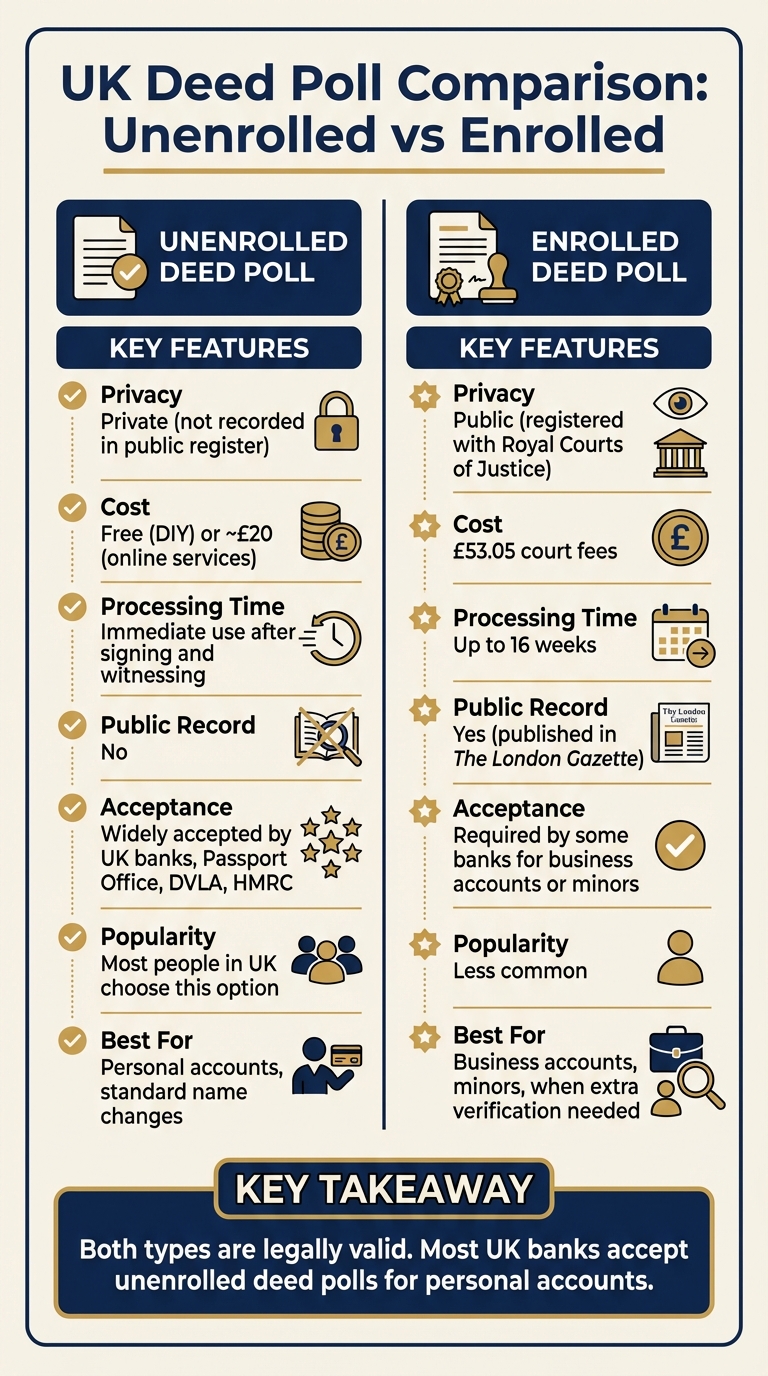
Unenrolled vs Enrolled Deed Polls Comparison for UK Banks
A deed poll is a legal document that confirms you've given up your previous name and adopted a new one for all purposes. While it isn’t a certificate, it serves as the official proof needed to update your name with UK organisations like the Passport Office, DVLA, HMRC, and banks.
To make a deed poll valid, you must sign and date it in front of an independent adult witness (someone 18 or older), who also needs to sign and include their name and address. Once signed and witnessed, the document becomes legally binding and remains valid indefinitely. However, it’s important to note that a deed poll doesn’t alter your birth certificate. Instead, it acts as a supplementary document to prove your new legal name.
Now, let’s look at the two types of deed polls: unenrolled and enrolled.
Unenrolled vs Enrolled Deed Polls: What's the Difference?
Although both unenrolled and enrolled deed polls are legally valid in the UK, they differ in terms of privacy, cost, and processing time.
An unenrolled deed poll is private and isn’t recorded in any court or public register. On the other hand, an enrolled deed poll is officially registered with the Royal Courts of Justice and published in The London Gazette, making your name change publicly accessible.
Most people in the UK opt for an unenrolled deed poll. Why? It’s quicker - you can use it immediately after it’s signed and witnessed - whereas enrolling can take up to 16 weeks. It’s also more affordable. Preparing an unenrolled deed poll yourself is free, or you can get one through online services for around £20. By contrast, enrolling costs £53.05 in court fees.
Unenrolled deed polls are widely accepted by UK organisations. For example, the Passport Office, DVLA, HMRC, and major banks like Barclays and NatWest all recognise them. According to OfficialDeedPoll.org:
An unenrolled deed poll is fully legal and recognised by UK organisations including the Passport Office, DVLA, HMRC, banks and employers.
If you’re updating your name with banks, an unenrolled deed poll is usually all you need.
sbb-itb-bf1bef6
Do UK Banks Accept Deed Polls?
Most UK banks recognise deed polls as valid proof of a name change. This includes both unenrolled and enrolled deed polls, which are generally accepted by major financial institutions. The Royal Bank of Scotland provides clarity on this:
"The bank does accept registered and non-registered Deed poll documents, see Gov.uk for more info."
To comply with anti-money laundering regulations, banks typically require either the original deed poll or a certified copy. Photocopies are not accepted, so make sure to bring the correct documents.
It's also advisable to update your photo ID to reflect your new name before visiting the bank. Many banks prefer to see an updated photo ID alongside the deed poll. Bring your original deed poll, any updated photo ID (if available), and recent proof of address for a smooth process.
Here’s a closer look at how UK banks handle unenrolled deed polls and when an enrolled deed poll might be necessary.
UK Banks That Accept Unenrolled Deed Polls
Most major UK banks, including Barclays, HSBC, Lloyds, Santander, NatWest, and RBS, accept unenrolled deed polls as long as they are properly executed. Nationwide also allows name changes but requires you to complete their specific "Change of Name" form in addition to presenting your deed poll.
For a deed poll to be valid, it must be properly executed. This means it should be signed in the presence of a witness who is over 18 and not a relative or partner.
When Banks May Require Enrolled Deed Polls
While unenrolled deed polls are generally sufficient, there are certain situations where banks may insist on an enrolled deed poll. These include cases involving minors or business accounts, where stricter verification is often required. As GOV.UK explains:
"Some organisations (such as some banks, mobile phone companies or energy providers) may only accept an enrolled deed poll to change your name on their records."
For example, when changing a child’s name or making updates to a business account, banks may request an enrolled deed poll for added assurance. Enrolled deed polls cost £53.05 and provide a higher level of verification that some institutions find necessary.
Since policies can vary between banks - and even between branches - it’s always a good idea to contact your bank directly. A quick phone call can help you confirm exactly which documents you’ll need for your name change.
Documents You Need to Change Your Name at the Bank
To update your name at the bank, you'll need three key documents: your original deed poll (or a certified copy, as photocopies won’t be accepted), a valid photo ID, and recent proof of address.
For your photo ID, banks usually request a passport or driving licence. While some banks may accept an ID under your previous name if shown alongside your deed poll, many prefer that your ID already reflects your new name. To avoid delays, it’s a good idea to change your name on your passport or driving licence before visiting your bank.
Your proof of address should be less than three months old. Accepted documents often include utility bills, council tax letters, or bank statements. This requirement ensures your address is up to date and helps banks meet anti-money laundering regulations.
If you have a joint or business account, additional signatures and proof from all parties may be required. For business accounts, some banks might insist on an enrolled deed poll. To make things easier, consider obtaining certified copies of your deed poll for any postal applications.
Why Certified Copies Matter
Certified copies are verified duplicates of your original deed poll, authenticated by professionals such as solicitors or notaries. These are especially useful for postal applications, as many banks accept certified copies instead of originals.
Having multiple certified copies can save time if you’re updating your name across several institutions. This way, you won’t have to risk sending your only original deed poll through the post.
How to Update Your Name: Step-by-Step
Once you’ve gathered your documents, here’s how to update your name at the bank:
- Contact your bank to confirm their specific requirements. Most high-street banks require you to visit a branch in person to prevent fraud. Some may need you to book an appointment, while others accept walk-ins.
- Visit the branch with your deed poll, updated photo ID, and proof of address. The bank will verify your documents, update your records, and issue new debit cards. These typically arrive within 5–10 days.
- Check linked services after the change is processed. This might involve re-adding your cards to digital wallets like Apple Pay or Google Pay. Also, ensure all standing orders and direct debits continue functioning smoothly during the transition.
How Name Change Makes the Process Easier

Getting your name change accepted isn’t just about the legal wording - it’s also about how professional the documents look. Name Change tackles a common issue with DIY deed polls: banks often reject them if they appear too informal. Their deed polls are printed on high-quality legal-grade paper and come with an official seal, making them much more likely to be accepted by banks.
Another advantage? They provide multiple certified copies as part of their service. This is important because many banks and organisations won’t accept photocopies - they need original or certified copies. With several copies in hand, you can notify multiple institutions at the same time, avoiding delays caused by waiting for a single document to be returned. On average, most customers order five legal copies to streamline the process of updating their details across various organisations. This professional approach makes it much easier to handle updates efficiently.
Name Change also guarantees 100% acceptance by UK banks and government bodies. To date, more than 50,000 UK residents have successfully updated their records using these professionally prepared deed polls.
Name Change Services and Pricing
Name Change ensures their deed polls not only meet bank requirements but also help minimise delays. They offer two simple service options:
- Standard Service (£16.95): Includes a professionally prepared deed poll printed on legal-grade paper, three certified copies, an ink stamp, tracked delivery in a sturdy board-backed envelope, a detailed guide, and a PDF archive of your documents.
- Premium Service (£24.95): Adds a gold embossed stamp for extra authority while including all the features of the standard option - three certified copies, tracked delivery, a step-by-step guide, and a PDF archive.
Both services offer same-day dispatch for orders placed before 1pm, ensuring your documents arrive quickly and securely.
Conclusion
When it comes to updating your name with UK banks, both unenrolled and enrolled deed polls are generally accepted as valid proof of a name change. Major high-street banks like Barclays, HSBC, Lloyds, Santander, and NatWest all recognise deed polls for updating account details. The key is to ensure your deed poll is professionally presented and includes all the essential legal elements, such as witness signatures, dates, and correct formatting.
That said, bank policies can vary. Some may require you to visit a branch, while others might accept submissions by post or online. A few banks might have specific preferences, such as requiring an enrolled deed poll or particular witness criteria, but these cases are uncommon. To avoid unnecessary delays, it’s always a good idea to check your bank’s specific guidelines before submitting your documents.
Having updated photo ID, like a passport or driving licence, can make the process smoother. Banks are more likely to accept a deed poll when they can verify it against updated identification. For this reason, many people choose to update their driving licence first, as it’s typically free and relatively simple.
Using professional services, such as Name Change, can help ensure your documentation meets the standards required by banks.
With the right preparation and proper documentation, updating your bank records can be a straightforward process, saving you time and effort in the long run.