Avoiding Rejection: Deed Poll Tips
A deed poll is a legal document in the UK that allows you to officially change your name. However, many are rejected due to errors in format, witnessing, or legal declarations. This can lead to delays, lost fees, and complications when updating records like passports or bank accounts. To ensure your deed poll is accepted:
- Follow Legal Standards: Include your old and new names, avoid prohibited characters, and ensure the document is printed single-sided in black ink.
- Use Proper Witnesses: Witnesses must be over 18, independent, and physically present when you sign.
- Choose Enrolled or Unenrolled: Enrolled deed polls, costing £53.05, are registered with the High Court and publicly recorded. Unenrolled deed polls are private and often sufficient.
- Prepare Certified Copies: Organisations like the Passport Office or DVLA may require certified copies rather than originals.
- Notify All Relevant Organisations: Inform banks, HMRC, the Passport Office, and others to avoid legal issues.
Mistakes can result in rejection, so double-check requirements and use certified copies for submissions. Keep your original deed poll secure and ensure consistency across all records.
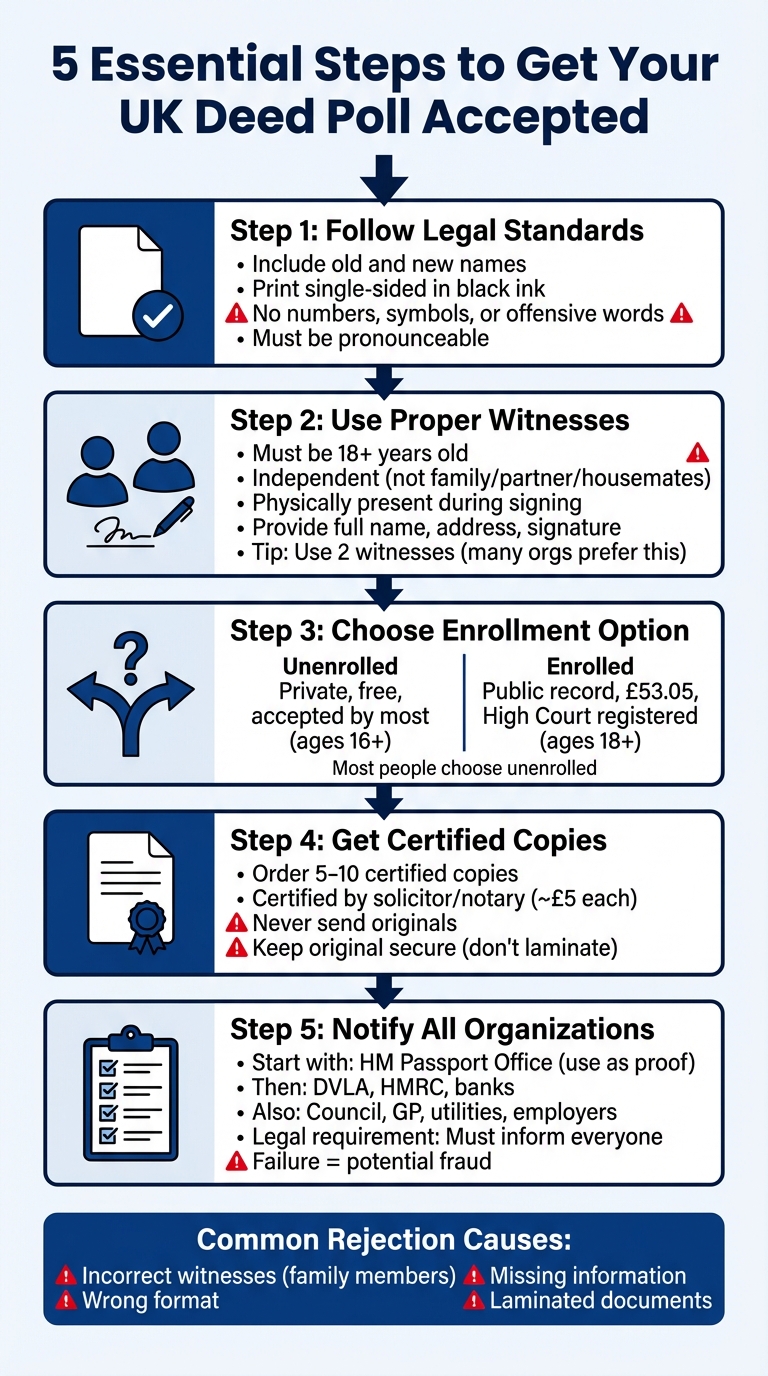
5 Essential Steps to Get Your UK Deed Poll Accepted
What Makes a Deed Poll Valid
Learning how to change your name by deed poll is just the first step. For it to be accepted by UK organisations, it must meet specific legal standards. If these aren't followed, your deed poll may be rejected, causing unnecessary delays and complications. Knowing these criteria beforehand can save you a lot of hassle.
Who Can Change Their Name
There are clear rules about who can legally change their name with a deed poll. If you're 16 or older, you can create an unenrolled deed poll. However, enrolling it with the High Court (which makes the change part of the public record) requires you to be at least 18. You also need to have the mental capacity to fully understand the implications of the name change.
Enrolling a deed poll is limited to British citizens, Commonwealth citizens, or British dependent territories citizens. Unfortunately, permanent residents living overseas cannot use a UK deed poll to change their name.
For those on the sex offenders register or listed as violent or terrorist offenders, a name change is still possible. However, you must notify the police at a designated station within three days of signing the deed poll to avoid committing a criminal offence.
Document Format and Content
The format and content of your deed poll are just as important as the decision to change your name. It must clearly state both your old name and your new name, including any middle names. This declaration confirms that you have officially abandoned your old name in favour of the new one.
The document must be printed single-sided, with no corrections, and in clear black ink to ensure it is accepted for official purposes. Your new name must be pronounceable and cannot include numbers, symbols, or punctuation (other than hyphens or standard formats like O'Hara). Names deemed offensive or against public interest will also be rejected.
Witness Rules
The role of witnesses is a critical part of the deed poll process. Witnesses must be at least 18 years old, mentally capable of understanding what they are signing, and entirely independent. This means they cannot be related to you, live with you, or be your partner.
"One of the most common causes of rejection is an incorrect witness." – UK Deed Poll Office
Your witnesses must be physically present when you sign the deed poll, as remote witnessing through video calls is not legally valid. While only one witness is legally required, many organisations prefer two. Each witness must provide their full name, current address, and signature to complete the process correctly.
sbb-itb-bf1bef6
Preparing and Managing Your Deed Poll
Once you’ve signed and had your deed poll witnessed, it’s crucial to handle and store it properly. Even if the deed poll itself is valid, poor management can lead to complications or rejection. Below are some practical tips on certification, registration, and safe storage of your document. Start by ensuring you have certified copies to avoid common issues.
Getting Certified Copies
Many organisations, including HM Passport Office, the DVLA, and banks, will ask for either your original deed poll or a certified copy. A certified copy is essentially a photocopy that has been verified by a professional - such as a solicitor, notary public, or magistrate - as a "true copy" of the original document. Ordinary photocopies won’t be accepted.
It’s a good idea to order 5–10 certified copies. This allows you to notify multiple organisations at the same time, rather than waiting for one to return your original before sending it to another. Plus, it helps protect your original deed poll from being lost or damaged in transit. Some providers offer name change services including legal copy and archiving at competitive rates, while solicitors generally charge about £5 per certified copy.
The Post Office provides an Identity Checking Service for £8.75 (covering up to three documents), but it’s important to note that HM Passport Office does not accept copies certified through this service. Always check the specific requirements of the organisation you’re dealing with before sending your documents.
Finally, it’s worth understanding the difference between enrolled and unenrolled deed polls, so you can choose the option that fits your needs.
Enrolled vs Unenrolled Deed Polls
Unenrolled deed polls are a straightforward and cost-effective option for those aged 16 or over. They’re accepted by most organisations and avoid the extra cost and public disclosure involved in enrolling. On the other hand, enrolling your deed poll with the High Court (for £53.05) makes the change public and is available to individuals aged 18 or over who are British, Commonwealth, or British dependent territories citizens.
While some financial institutions or private organisations may specifically ask for an enrolled deed poll, this is uncommon. For most people, an unenrolled deed poll will suffice.
Storing Your Documents
Your original deed poll should be stored securely alongside other important documents. Laminating the document is not recommended, as many agencies won’t accept laminated versions. Instead, use certified copies when notifying organisations, keeping the original safe.
It’s a good idea to give a certified copy to a trusted relative or friend for safekeeping, in case your original document is ever lost or misplaced. If your provider offers a digital archive service, you can use it to order replacements - typically costing around £12 for the first copy and £2 for additional ones - if the original is damaged or lost. Additionally, keep a record of all correspondence and documents sent during the name change process for your own reference.
Getting Your Deed Poll Accepted
Once your deed poll is signed and witnessed, the next step is making sure all relevant records recognise your new name. This involves systematically notifying the necessary organisations and providing the required documentation. Here’s a practical guide to help you through the process.
Which Organisations to Notify
You are legally obligated to inform every organisation that holds records under your previous name. As the Deed Poll Office warns:
"If you deliberately fail to [tell everyone who holds a record], you may be committing fraud".
Start with the HM Passport Office, as an updated passport serves as strong evidence for your new name when notifying other organisations. Then, contact the DVLA to update your driving licence and vehicle registration (V5C). Inform HMRC to update your tax and National Insurance records, which will automatically notify the DWP.
Next, address your financial institutions, including banks, building societies, mortgage providers, credit card companies, pension providers, and insurers (covering car, home, life, and medical policies). Notify your local council to update council tax records and the electoral register - this is especially important as failing to update the electoral roll can harm your credit rating.
Don’t forget other key contacts such as your GP, dentist, optician, employers (current and former), educational institutions, utility providers (gas, electricity, water, phone, mobile, internet), TV Licensing, and any clubs or subscription services. Keeping a detailed log of each organisation you contact, including dates and reference numbers, can help you stay organised.
Proof of Identity and Address
When notifying organisations, you’ll need to provide identification alongside your deed poll. Certified copies are essential, as standard photocopies will not be accepted. Many organisations will require an in-person ID check with valid photo identification.
Before sending any documents, check the specific requirements of each organisation. Some banks, mobile providers, or energy companies may insist on an enrolled deed poll rather than an unenrolled one. Ordering multiple certified copies can save time, allowing you to contact several organisations simultaneously. Updating your passport first is particularly helpful, as it can act as primary evidence for your name change with other records.
In some cases, organisations may also need proof of address - such as a recent utility bill or bank statement - especially if your address has changed.
What to Do If Your Deed Poll Is Rejected
If an organisation rejects your deed poll, reach out immediately to understand why. Common reasons include improper witnessing (such as using a family member or not having the witness present during signing), incorrect legal wording, or a requirement for an enrolled deed poll instead of an unenrolled one.
Under the Data Protection Act 2018 (UK GDPR), you can demand the correction of inaccurate data. If your deed poll and identification meet the legal requirements, organisations are obligated to update your records. If they refuse, you can send a formal "right to rectification" letter. If the issue remains unresolved after 28 days, escalate the matter to the Information Commissioner’s Office (ICO).
To strengthen your case, you can provide additional "name in use" evidence, such as a letter from your employer, GP, or a recent utility bill. Updating your government-issued photo ID first - like your passport or driving licence - can also reduce rejection rates, as these are widely accepted forms of evidence.
Name Changes for Children and Name Restrictions
When changing a name, especially for children, there are specific rules and guidelines to follow. These ensure the process is carried out correctly and legally. Once your adult deed poll is accepted, it’s essential to understand the additional steps required for children and the restrictions on name choices.
Parental Consent for Children Under 16
If you’re changing a child’s name, written consent is mandatory from everyone with parental responsibility. If even one person with parental responsibility disagrees, you’ll need to apply for a court order to proceed. Courts generally expect you to show that you’ve made genuine efforts to resolve the disagreement, so trying mediation first is highly recommended.
For teenagers aged 16 or 17, they can provide a self-signed consent letter, but it must be witnessed by an independent adult over 18 years old. However, if they are married or in a civil partnership, the adult enrolment process must be used instead.
The application process also requires an Affidavit of Best Interest and a statutory declaration from someone who has known the child for at least 10 years. This person must be a British or Commonwealth citizen and a UK householder. The statutory declaration has to be sworn before a solicitor, commissioner for oaths, or court officer.
If a court order is needed, you’ll need to file a "specific issue order" using Form C100 at your local family court. The application fee for this is £263. Once you’ve obtained the necessary parental consent or court approval, make sure the chosen name complies with the restrictions.
Names and Titles You Cannot Use
There are strict rules about the types of names and titles you can choose. These restrictions are in place to ensure names are practical, appropriate, and legally acceptable.
- Prohibited Characters: Your chosen name cannot include numbers, special characters (like @, #, or *), or emojis. However, punctuation such as hyphens (e.g., for double-barrelled names) and apostrophes (as in O’Hara) are allowed.
- Single-Word Names: Mononyms, or single-word names, often face issues with UK systems, including the Passport Office and DVLA. To avoid complications, ensure the name includes at least one forename and one surname.
- Restricted Titles: Titles such as Mr, Mrs, Sir, Lady, or Doctor cannot be added or altered. Names suggesting nobility, rank, or academic qualifications - like Duke, Professor, or Baron - are usually rejected unless you can provide proof of entitlement.
- Offensive or Misleading Names: Names deemed offensive, vulgar, or blasphemous are not allowed. Similarly, names promoting criminal activity, controlled substances, or those implying official authority (e.g., "Police Officer") are prohibited.
There have been cases where courts have intervened to prevent inappropriate names. For instance, in 2016, the Court of Appeal stopped a mother in Powys, Wales, from naming her newborn daughter "Cyanide." Lady Justice King ruled that naming a child after a "notorious poison" could lead to significant emotional harm.
Finally, keep in mind that the HM Passport Office has a character limit for names: forenames and surnames must each be no longer than 30 characters on the main passport page.
Conclusion
Changing your name can be a straightforward process when you follow the correct procedures. A properly executed deed poll ensures you meet all the legal requirements, including formatting and witnessing, as detailed earlier in this guide.
It's important to keep your new name consistent across all official records. Start by updating your primary photo ID, as this can make notifying other organisations much easier. Keep in mind that the HM Passport Office generally requires at least one document showing your new name in use, issued within the past 12 months, alongside your deed poll.
Most organisations will only accept original documents, so it’s a good idea to check their specific requirements before submitting anything.
For a smoother experience, services like Name Change (https://namechange.org.uk) can help you create and manage your deed poll. They offer extras like certified copies, tracked delivery, and PDF archiving to keep everything organised.
"A correctly executed Deed Poll is routinely used across the UK to update official records." - OfficialDeedPoll.org
FAQs
Do I need an enrolled deed poll or will unenrolled work?
An unenrolled deed poll is generally enough to change your name in the UK. It's widely recognised by government offices and organisations, meaning there's usually no need to enrol your deed poll.
Who can witness my deed poll (and who can’t)?
Your deed poll must be witnessed by someone over 18 who is not closely related to you, your partner, or anyone living at your address. Suitable choices for a witness could be friends, colleagues, or neighbours, as long as they meet these requirements. Avoid asking family members, housemates, or partners, as this could cause problems with the deed poll being accepted.
What evidence do I need if an organisation rejects my deed poll?
If your deed poll is turned down, you might need to present additional evidence to support your name change. This could include a government-issued ID displaying your new name, documents that show you're actively using your new name (like a bank statement, payslip, or council correspondence), or certified copies of your deed poll. Institutions such as HM Passport Office, banks, and other government bodies often request these documents to confirm and process your name change.