Checklist for Changing a Middle Name Without a Solicitor
Changing your middle name in the UK is straightforward and doesn’t require a solicitor. You can do it yourself using a deed poll, saving hundreds of pounds. Here’s what you need to know:
- Cost: DIY deed polls are free, or you can use online services starting at £16.95. Solicitors charge £150–£300.
- Legal Requirements: A deed poll must include your old name, new name, and address, and be signed in front of two independent witnesses.
- Who Accepts It: Organisations like HM Passport Office, DVLA, and banks accept correctly prepared deed polls.
- Updating Records: Notify key institutions (passport, driving licence, HMRC, NHS, banks) to reflect your new name.
Follow these steps to ensure a smooth process: gather documents, create and sign your deed poll, and update official records. Keep certified copies handy to avoid delays when notifying multiple organisations. A well-prepared deed poll is your key to making the change legally recognised.
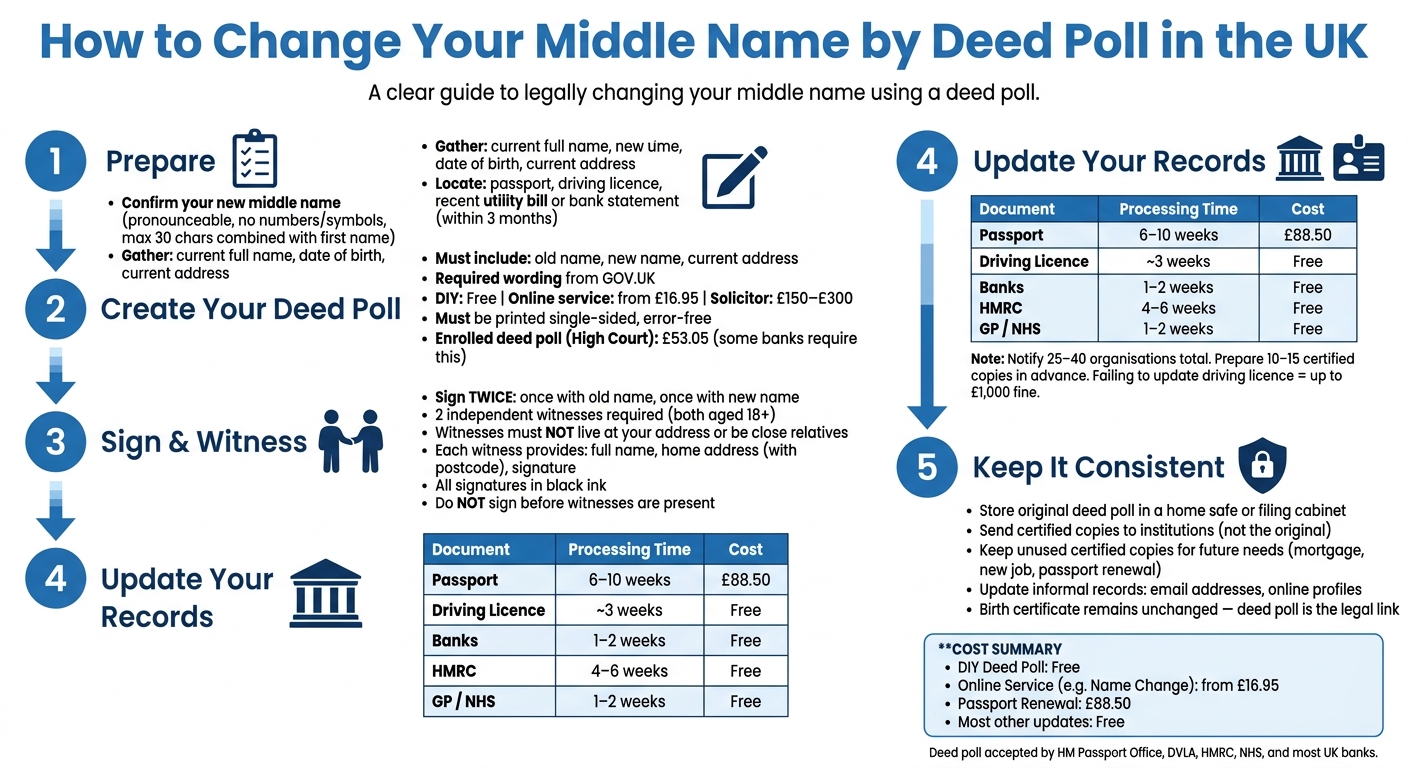
How to Change Your Middle Name by Deed Poll in the UK
Step 1: Preparing for the Name Change

Get everything in order before starting the name change process: confirm your new name and gather the necessary documents before drafting your deed poll.
Confirm Your New Middle Name
Make sure your new middle name checks all the boxes. It must be pronounceable, cannot include numbers, symbols, or punctuation (except for hyphens or apostrophes in names like O'Brien or Leigh-Anne), and must fit within the 30-character limit for first and middle names combined, as required by HM Passport Office. Remember, a deed poll cannot be used to add titles such as Sir, Lady, or Doctor.
Double-check the spelling. Even a small typo on your deed poll can lead to complications when updating official records.
Once you're confident in your new name, the next step is to collect the necessary personal information and documents.
Gather Your Personal Information
Before drafting your deed poll, make sure you have the following details and documents ready:
- Your current full name, including any existing middle names
- Your date of birth
- Your current address
You'll also need to locate your passport and driving licence, as these are the key forms of photo ID you’ll need to update first. Other organisations, such as banks, HMRC, and the NHS, will typically require valid photo ID alongside your deed poll. Additionally, a recent utility bill or bank statement (dated within the last three months) will usually be needed as proof of address.
"In the eyes of HM Passport Office, DVLA, HMRC and your bank, 'Sarah Louise Jenkins' and 'Sarah Jenkins' are two different names." - UK Name Change Team
To stay organised, create a folder (physical or digital) to keep all your important documents in one place. Include your deed poll, current ID, birth certificate, and proof of address, so you're ready to tackle the next steps.
sbb-itb-bf1bef6
Step 2: Creating the Deed Poll
Once you've gathered your documents and finalised your new name, it's time to create the deed poll. This is the official document that legally confirms your name change for use with UK institutions.
What to Include in the Deed Poll
For an unenrolled deed poll to be valid, it must include specific details. According to GOV.UK, the required wording is:
"I [old name] of [your address] have given up my name [old name] and have adopted for all purposes the name [new name]." - GOV.UK
You'll need to include your full old name, your new name (including all middle names), and your current address. HM Courts & Tribunals Service also highlights:
"You must include all the details of your new name and your old name throughout the form, including any middle names." - HM Courts & Tribunals Service
The deed poll must be signed twice - once with your old signature and once with your new one. You'll also need two independent witnesses (both aged 18 or over) to sign, providing their name and address. The document must be printed single-sided and free of errors, as any mistakes can render it invalid.
Keep in mind that some banks require an enrolled deed poll (officially filed with the High Court for £53.05). It's worth checking their specific requirements before proceeding.
With all these details in place, you can either draft the deed poll yourself or use a professional service to ensure accuracy.
Using Name Change for Deed Poll Creation
While you can write your own deed poll, even minor formatting errors can delay updates to your records. A service like Name Change offers a convenient alternative by preparing a professionally formatted document that meets the requirements of HM Passport Office, DVLA, and HMRC.
The process is quick - taking about two minutes online. For £16.95, their Printed & Posted plan provides three certified copies, an ink stamp, and PDF archiving, making it easier to update multiple organisations simultaneously without waiting for the original document to be returned. If you'd like a gold embossed stamp, their Printed & Posted Premium option is available for £24.95. Documents are dispatched within 1–2 working days via tracked delivery.
Certified copies are particularly handy at this stage. Instead of sending your original deed poll to various institutions one by one, you can submit copies to your bank, employer, and HMRC all at once. This can save you a lot of time and effort, ensuring a smoother process as you move on to the next steps of signing and submitting your deed poll.
Step 3: Signing and Witnessing the Deed Poll
With your deed poll prepared, the next step is to finalise it by signing and witnessing it correctly. This process is crucial, so handle it with precision, as there are specific legal implications of changing your name to consider.
Signing Requirements
You’ll need to sign the deed poll twice: once using your old name and once with your new name. Both signatures must be on the same document and witnessed at the same time. GOV.UK provides a template for how this should be worded:
"Signed as a deed on [date] as [old name] and [new name] in the presence of [witness 1 name] of [witness 1 address], and [witness 2 name] of [witness 2 address]." - GOV.UK
When signing with your new name, you can either keep your current signature style or create a new one. However, consistency is key - using different signatures could lead to issues when updating your records.
It’s important that you do not sign the deed poll before your witnesses are present. Signing in advance will invalidate the document.
Once this is done, double-check the details provided by your witnesses.
Role of Witnesses
Your witnesses must be independent adults who do not live at your address. Suitable choices might include a neighbour, colleague, or a friend. GOV.UK emphasises:
"Some organisations will not accept a deed poll if a witness lives at the same address or is a close relative." - GOV.UK
This rule excludes flatmates, parents, siblings, or spouses from acting as witnesses, even if you’re not related by blood. However, your witnesses don’t need to be British citizens - any independent adult who understands what they’re signing is acceptable.
Each witness must include their full name, home address (with postcode), and signature on the deed poll. Missing or incomplete witness details are a common reason for rejection by banks or government agencies. To ensure clarity, all signatures should be in black ink.
If a mistake happens during signing, it’s better to print a fresh copy of the deed poll rather than making corrections. Alterations or crossed-out errors can render the document invalid. For more information, see our guide on how to change your name legally in the UK.
Step 4: Updating Your Records
Once your deed poll is completed, the next step is ensuring all your official documents and records reflect your new name. This involves notifying around 25–40 organisations, so being organised is key.
Updating Legal and Official Documents
Start with your passport and driving licence, as these are essential for most other updates. Use your notarised deed poll as proof when contacting the relevant authorities. Here's a quick overview of the process for some key documents:
| Document | Evidence Required | Processing Time | Cost |
|---|---|---|---|
| Passport | Original deed poll | 6–10 weeks | £88.50 (online) |
| Driving Licence | Form D1 + certified copy | ~3 weeks | Free |
| Banks | Certified copy + new photo ID | 1–2 weeks | Free |
| HMRC | Photocopy or phone/online | 4–6 weeks | Free |
| GP / NHS | Photocopy or sight of deed poll | 1–2 weeks | Free |
Be aware that failing to update your driving licence promptly can lead to a fine of up to £1,000.
Notifying Banks, Employers, and Other Institutions
When contacting your bank, provide a certified copy of your deed poll along with your updated photo ID. Most banks handle name changes quickly, often within 1–2 weeks. Notify HMRC to ensure your tax and National Insurance records are accurate. This can be done online, by phone, or by sending a photocopy of your deed poll.
It’s equally important to inform your employer’s HR and payroll teams. Any discrepancies in your records could affect your National Insurance contributions and even your State Pension. Once these essential updates are complete, you can move on to notifying utilities, insurance providers, and any memberships or subscriptions at your convenience.
Providing Certified Copies Where Required
Many organisations will ask for the original deed poll or a certified copy. To avoid delays, it’s a good idea to have 10–15 certified copies prepared in advance. This allows you to notify multiple organisations simultaneously, saving time and hassle.
To stay organised, keep a simple log of your progress. Note each organisation you’ve contacted, the date, the documents sent, and whether any originals have been returned. This ensures nothing is overlooked during the process.
Once your records are updated, you’ll have consistency across all future documents, making life much easier moving forward.
Step 5: Keeping Your New Name Consistent
Once your official records are updated, the next challenge is ensuring that your new middle name remains consistent everywhere. This step is crucial to avoid potential issues and maintain clarity across all your documents and accounts.
Avoiding Name Discrepancies
One common pitfall after a name change is the "Identity Ripple Effect." This happens when some records are updated while others are overlooked, leading to mismatches. For example, if your bank has your new name but your utility provider doesn't, it could result in failed payments or account verification problems.
"Consistency is vital. Using your old name in some situations can cause confusion or even make certain documents invalid." - Mullis & Peake LLP
To avoid these issues, make sure that the spelling, spacing, and punctuation of your new name match your deed poll exactly. Even small differences can lead to administrative headaches. It's also a good idea to update informal records, such as your email addresses and online profiles, to reflect your new identity. This helps maintain uniformity in both professional and personal contexts.
Remember, your birth certificate will remain unchanged. Your deed poll serves as the official link between your original name and your new one, so ensure it's readily available when needed.
Storing Your Deed Poll Safely
Your deed poll is the key document proving your name change, so safeguarding it is essential. Store the original in a secure location, such as a home safe or a filing cabinet, alongside other important documents like your birth certificate, current photo ID, and proof of address. Keeping these together ensures you're always ready to verify your identity when required.
Whenever possible, send certified copies of your deed poll to institutions rather than the original. This minimises the risk of losing the original in transit. It's a good idea to keep a few unused certified copies in a dedicated folder for future needs, such as applying for a mortgage, starting a new job, or renewing your passport.
| Document | Storage Location | When You'll Need It |
|---|---|---|
| Original Deed Poll | Home safe or filing cabinet | Passport Office, DVLA |
| Certified Copies | Dedicated folder for active use | Banks, employers, utilities |
| Birth Certificate | Stored with deed poll | Used alongside deed poll as evidence |
Conclusion: A Straightforward Guide to Changing Your Middle Name
Changing your middle name doesn’t have to be overwhelming or expensive. By carefully following the steps outlined, you can handle the process yourself without hiring a solicitor. Staying organised and preparing thoroughly will make the process far smoother.
From drafting your deed poll to updating your records, consistency is key to avoiding future administrative headaches. If you have questions, our help and support team can guide you through the process. The primary cost to expect is the passport renewal fee, as covered in Step 4, while most other updates come at no additional charge.
For those who prefer not to draft the deed poll themselves, Name Change provides a service that ensures your document meets the requirements of HM Passport Office, DVLA, and HMRC.
"The law makes no real distinction between your first name, middle name and surname - they are all simply parts of your full legal name." - UK Name Change Team
FAQs
Do I need an enrolled deed poll for a middle-name change?
In the UK, you don't need an enrolled deed poll to change your middle name. An unenrolled deed poll is completely legal and widely accepted by organisations such as the Passport Office, DVLA, and banks. This option is private and does not make your name change public.
Enrolling a deed poll, on the other hand, is optional and involves publishing the change in The London Gazette. If you're using an unenrolled deed poll, services like Name Change can help ensure it's properly prepared for legal purposes.
Who can witness my deed poll if I live with family or flatmates?
To make your deed poll legally valid, the witnesses you choose must meet specific criteria. They cannot be family members, your partner, or anyone living with you. Instead, witnesses must be independent, at least 18 years old, and personally acquainted with you. Good options include friends, neighbours, or colleagues.
Keep in mind that organisations might reject your deed poll if a witness is too closely related to you or shares your address. Selecting the right witness is crucial to avoid any complications.
What if my new middle name won’t fit on my passport?
If your new middle name pushes the combined first and middle name fields over the 30-character limit on a UK passport, don't worry - there's a solution. The full version of your name can be printed on the observation page, while an abbreviated version will appear on the main passport page. Just keep in mind the UK’s "one name policy", which means you’ll need to use your new name consistently across all official documents, including bank accounts and driving licences.