Updating Records After a Middle Name Change
When you legally change your middle name in the UK, updating your records is crucial to avoid issues like mismatched IDs, failed transactions, or complications with legal documents. Here's what you need to know:
- Key Documents: Use your signed deed poll, photo ID (passport or driving licence), and proof of address to update records.
- Priority Updates: Start with government-issued documents like your passport, driving licence, and HMRC records. Failing to update these can lead to fines or delays.
- Financial Records: Notify banks, credit providers, and credit reference agencies to ensure consistency across your financial footprint.
- Employment and Pensions: Inform your employer and pension provider to avoid payroll errors and ensure retirement records are accurate.
- Everyday Accounts: Update your NHS records, utilities, subscriptions, and any other personal accounts.
Pro Tip: Maintain a spreadsheet to track updates, dates, and confirmations. This helps you stay organised and ensures no records are overlooked.
Focus on aligning all your records to prevent complications, especially if you're planning significant transactions like applying for a mortgage.
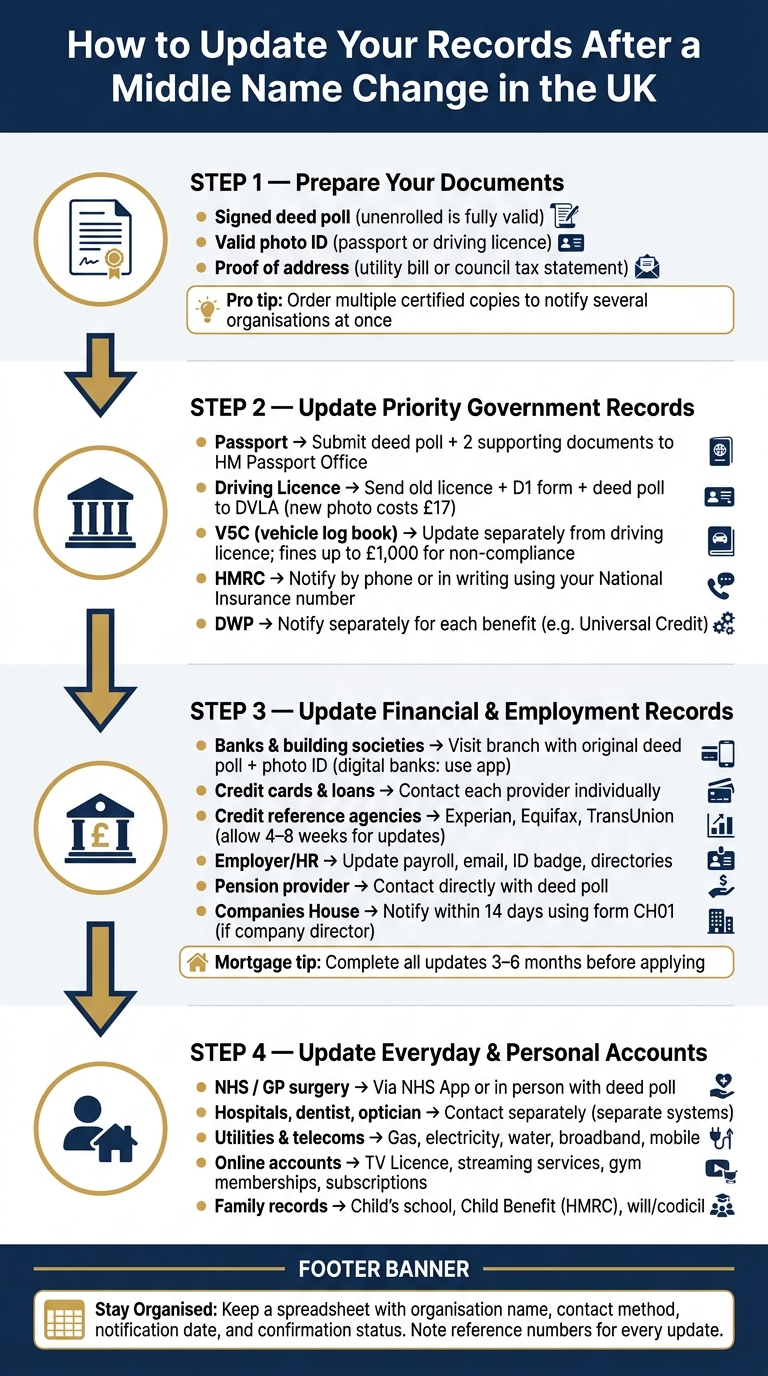
How to Update Your Records After a Middle Name Change in the UK
Preparing to Update Your Records
Get all your documents ready before reaching out to organisations to prevent unnecessary delays.
Documents You Will Need
Your signed deed poll is the key document proving your name change. Most organisations will also ask for a valid photo ID (like your passport or driving licence) and proof of address (such as a recent utility bill or council tax statement).
For passport updates, GOV.UK specifies:
"Send 2 documents that show you're using your new name. These can include a: letter from a local council or government department, driving licence, bank statement, baptism or confirmation certificate."
To streamline the process, gather your deed poll, photo ID, proof of address, and any other required documents (e.g. a letter from a council for passport updates). Use a spreadsheet to track contacts and confirmations, so you stay organised and avoid repeated requests.
Once your documents are ready, keep everything organised and update your records as soon as possible.
Keeping Track of Your Updates
With so many organisations to notify, it’s easy to lose track. A spreadsheet can help you stay on top of things. Include details like the organisation’s name, contact method, the date you notified them, and confirmation status. This way, you’ll have everything at a glance.
As Name Change suggests:
"As you update each organisation, make a note of the date and any reference numbers or confirmations they provide. This will help you keep track of the process and ensure that no organisations are missed."
Enrolled vs. Unenrolled Deed Polls
Once your documents are in order and you’re tracking updates, it’s useful to understand the difference between enrolled and unenrolled deed polls.
An enrolled deed poll is stored at the Royal Courts of Justice and becomes a public record, while an unenrolled deed poll is private and kept by you. For most purposes in the UK, including updates with HM Passport Office and the DVLA, an unenrolled deed poll is perfectly acceptable.
Enrolling your deed poll isn’t legally required and doesn’t change the validity of your name change. Name Change provides unenrolled deed polls that are guaranteed to be accepted by UK government departments, making enrolment unnecessary for typical name changes.
| Feature | Unenrolled Deed Poll | Enrolled Deed Poll |
|---|---|---|
| Public record | No | Yes (Royal Courts of Justice) |
| Accepted by Passport Office & DVLA | Yes | Yes |
| Legal status | Fully valid | Fully valid |
| Typical use | Standard name changes | Complex legal or public record needs |
sbb-itb-bf1bef6
Priority Documents and Government Records to Update First
Once you've obtained your deed poll and gathered your documents, your next step is updating government-issued records. These are the cornerstone of your identity, and getting them sorted first makes the rest of the process much smoother. Many organisations will accept your passport or driving licence as proof of your new name, so it's wise to tackle these early on.
Updating Your Passport
Your passport is one of the most important documents to update, as it often serves as primary proof of your new identity. To update it, you'll need to submit your deed poll along with two supporting documents, such as a bank statement, government letter, or your driving licence, to HM Passport Office.
"The policy's aim is to ensure the right to change names in the UK is not subject to abuse." - Home Office
If you're making a small change, like correcting a middle name's spelling, you might not need a full deed poll - two supporting documents might be enough. For dual nationals, update your non-British passport first, as HM Passport Office typically requires your foreign travel documents to reflect the new name before issuing a British passport.
Updating Your Driving Licence and Vehicle Records
Once your passport is updated, move on to your driving licence and vehicle records. Keep in mind that updating your driving licence doesn’t automatically update your vehicle registration (V5C), so you'll need to handle these separately.
To update your driving licence, send your old licence, a completed D1 form, and your deed poll to the DVLA in Swansea. While the update itself is free, getting a new photo will cost £17. Don’t worry - you can still drive while waiting for your new licence to arrive.
For your V5C, fill in your new name under section 3 (for new-style log books) or section 6 (for older ones) and send it with a covering letter to the DVLA. It’s essential to act quickly:
"You can be fined up to £1,000 if you do not tell DVLA when your name changes." - GOV.UK
To avoid delays, make sure to tax your vehicle online or at a Post Office within four weeks of updating your name.
Notifying HMRC and DWP
With your primary identity documents sorted, it's time to inform HMRC about your name change. You can do this by phone or in writing, using your National Insurance number along with your deed poll. If you're employed, let your HR department know as well to ensure your payroll records are updated.
If you receive benefits or the State Pension, you’ll need to notify the Department for Work and Pensions (DWP) separately. Each benefit, such as Universal Credit, may require an individual update through its specific service or contact point. Acting quickly on these updates helps avoid payment delays or identity verification issues down the road.
Updating Financial and Employment Records
After updating your government records, the next step is to update your financial and employment records. This ensures smooth transactions and prevents payroll errors. These updates require your deed poll as proof of your new legal name, completing the process of changing your name by deed poll to ensure identity consistency.
Notifying Banks and Building Societies
Most banks will ask you to visit a branch to update your name. Make sure to bring your original deed poll and a valid photo ID. If you're using a digital-only bank like Monzo or Starling, the process is typically handled online - check their app for instructions on uploading your documents. To save time, consider ordering multiple certified copies of your deed poll so you can notify several institutions at once, avoiding delays caused by waiting for documents to be returned.
Keep track of the date and any reference numbers provided by bank staff. This information can be helpful if there are any delays in processing your request.
After updating your bank details, don’t forget to notify your credit providers and loan companies.
Updating Credit Cards, Loans, and Credit Files
You’ll need to contact each credit provider and loan company individually, as updates aren’t automatic. Credit reference agencies - Experian, Equifax, and TransUnion - receive updates from lenders monthly, so it may take 4 to 8 weeks for your new name to appear on your credit file.
Your credit history remains intact because it’s tied to your financial footprint rather than just your name. However, it’s crucial to ensure all three credit agencies have your updated details. You can contact them directly for free, as they are legally required to maintain accurate records.
"The Electoral Roll is the 'primary source' for credit agencies. Updating your name with your local council is often the catalyst that triggers the credit agencies to verify and update your new legal name." - Prime Deed Polls
If you’re planning to apply for a mortgage or remortgage soon, aim to complete all name updates at least 3 to 6 months in advance. Mortgage lenders often require that the name on the Land Register matches your bank records. Any mismatch could lead to delays or even refusals.
Once all financial updates are complete, turn your attention to your employment and pension records.
Updating Employer and Pension Records
Notify your HR department as soon as possible. Provide your original deed poll so they can update your internal records, email address, ID badge, and any directories. Once payroll is updated, contact your pension provider directly with your deed poll to ensure your retirement fund reflects your new name.
"While your employer will update payroll, you should also contact your pension provider directly. This ensures your retirement fund is correctly linked to your new identity and avoids delays when you eventually claim it." - Prime Deed Polls
After these updates, check your next payslip or P60 to confirm your new middle name is correctly displayed. If you’re a company director, remember to notify Companies House within 14 days of the change using form CH01.
Everyday Records and Personal Accounts to Update
Once you've tackled your financial and employment records, it's time to focus on the everyday accounts where your name appears. While these updates might not seem as pressing as your passport or bank details, leaving them unchecked can lead to problems - think rejected payments or mix-ups at a GP appointment. Keep your deed poll handy for these updates.
Health Records and the NHS
Your first stop for NHS-related updates is your GP surgery. Most GP practices now offer online options for updating personal information - often through the NHS App or their website. Before making an in-person visit, check if these digital options are available. Don't forget to bring your deed poll as proof.
"When patients change their name following marriage or by deed poll, the Department of Health and Social Care requires that they give their GP practice a copy of the appropriate document as proof." - NHS England
Although updating your GP records should sync with the central NHS Spine, it doesn't always trickle down to hospitals automatically. If you're undergoing hospital treatment, contact the hospital's administration team to ensure their records are up to date. The same goes for your dentist and optician, as they maintain their own separate systems.
Utilities, Telecoms, and Online Accounts
Utility and telecom providers - like gas, electricity, water, broadband, and mobile services - often allow name updates via phone or online forms. Be prepared to submit a copy of your deed poll, either digitally or by post, depending on the provider's requirements. Check their websites for specific instructions.
Updated utility bills in your new name can also double as secondary proof of identity, which can be handy for other updates, such as those with the Land Registry. Don't overlook your digital accounts either. Make sure your TV Licence, streaming services, gym memberships, and other subscriptions reflect your new name.
"Don't forget to update your name on any online accounts, such as email addresses, social media profiles, and subscriptions. While these updates are usually informal, they help ensure consistency across all platforms." - NameChange.org.uk
Family and Child-Related Records
Family-related documents and records also need attention. For example, if your middle name is listed on school contact forms or emergency records, notify your child's school office and provide your deed poll as proof. For Child Benefit, reach out to HMRC. If you've already updated your Personal Tax Account, this change might already be underway, but it’s worth confirming.
If your will includes your middle name, it's essential to update it. This can be done with a codicil or by drafting a new document. A solicitor can guide you on the best course of action.
Addressing these everyday updates ensures your new name is recognised across the board, helping you avoid unnecessary complications.
Conclusion: Final Steps and Key Points
Once you've updated your official records and personal accounts, take a moment to review these final steps to ensure everything is in order.
Keeping your records consistent is crucial. As GOV.UK highlights, "It's common for lenders to refuse to lend money unless your details exactly match the register." Ensuring all your records align can save you from unnecessary delays down the line.
To stay organised, consider maintaining a simple update log. Jot down the notification dates and reference numbers for each update. This makes it easier to track what’s been completed and follow up on anything still pending.
Your deed poll is the foundation of all these updates. If you haven't obtained one yet, Name Change offers a legally valid unenrolled deed poll starting at £16.95. They also provide certified copies, and their documents are accepted by UK government departments and organisations. Many customers have praised their service:
"Finally a company that made it easy to change my name." - JG, Merseyside
Once your deed poll is ready, tackle your updates in this order for a smoother process:
- Passport and DVLA records
- HMRC and DWP details
- Banks, employers, and NHS
- Utilities, subscriptions, and other personal accounts
FAQs
How long does it take for my new middle name to show on my credit file?
It can take up to three months for your updated middle name to show on your credit file. If it hasn’t been updated within this timeframe, reach out to your credit reference agency to make sure your records are accurate.
Can I use an unenrolled deed poll to update my passport and driving licence?
Yes, you can use an unenrolled deed poll to officially update your passport and driving licence in the UK. This document is recognised by UK government departments as valid for making name changes.
What should I update first to avoid problems with a mortgage?
If you've changed your middle name, it's important to update your property and land records first. This step ensures that ownership details remain accurate, which is crucial for both legal and financial purposes. Once you've handled this, inform your bank and any other relevant organisations to ensure all records match. Prioritising property records helps you avoid potential complications, making it easier to update other institutions afterwards.