Double-Barrelled Surnames: UK Legal Guide
In the UK, adopting a double-barrelled surname is straightforward but requires following specific legal steps to ensure recognition by government bodies and organisations. Here's what you need to know:
- What is it? A double-barrelled surname combines two family names, with or without a hyphen (e.g., Smith-Jones or Smith Jones). Both are valid under UK law.
- Who can do it? Anyone aged 16 or over can choose this option, provided there's no intent to commit fraud.
- How to formalise it?
- Marriage Certificate: If combining surnames exactly as shown on the certificate, no further documents are usually needed.
- Deed Poll: Required for creative combinations, unmarried individuals, or changes not reflected on official certificates.
- Key steps: Update your passport, driving licence, and other records. Notify banks, employers, and utility providers to avoid inconsistencies.
Changing your surname is a personal decision, but following the correct process ensures smooth updates across all official documents.
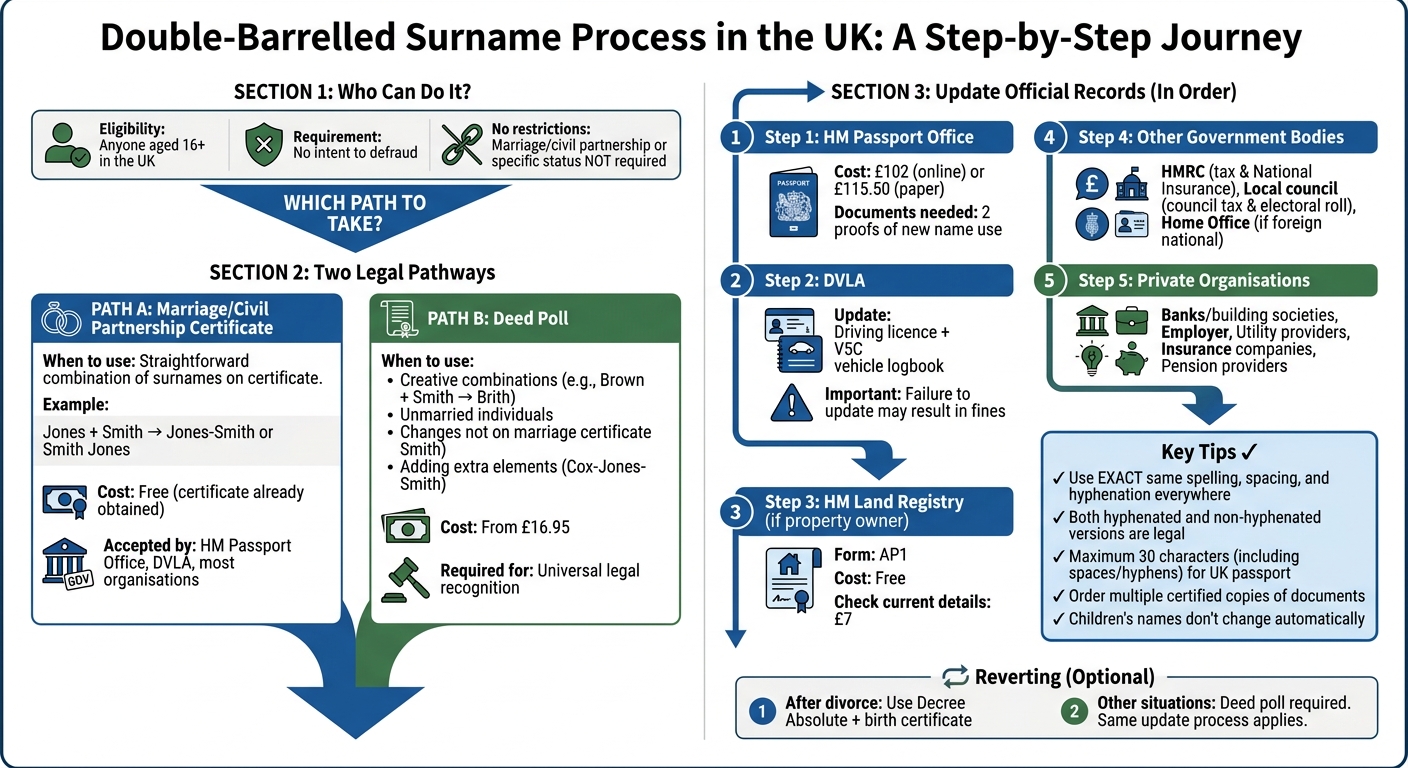
How to Legally Change to a Double-Barrelled Surname in the UK
What Is a Double-Barrelled Surname?
A double-barrelled surname combines two separate family names into one. These names can be joined with a hyphen - like Smith-Jones - or simply written with a space, such as Smith Jones. Both styles are perfectly valid under UK law, leaving the decision entirely up to personal preference.
Hyphens aren’t mandatory. While they’re often used to clearly indicate the two names form a single surname, some people prefer not to use them. However, skipping the hyphen can sometimes cause confusion, as organisations might mistake the first part of your surname for a middle name. Interestingly, the HM Passport Office allows hyphens in double-barrelled surnames, even though punctuation is usually not permitted in official names. This makes the hyphen a practical choice for many.
People choose double-barrelled surnames for various reasons. It’s a way to preserve both family names, honour heritage, or even prevent a family name from disappearing entirely.
From a legal perspective, double-barrelled surnames are fully recognised in the UK, provided they’re not used for fraudulent purposes. You can decide the order of the names, as there’s no fixed rule. While it was once common to place the man’s surname last, modern couples often decide based on what feels right to them. The UK Passport Office accepts these surnames, as long as they’re no longer than 30 characters, including spaces and hyphens.
Beyond legality, double-barrelled surnames reflect changing social norms. They’re no longer limited to certain social groups and are increasingly popular across all walks of life, including in same-sex marriages and civil partnerships, as a way to create a unified family name.
sbb-itb-bf1bef6
Who Can Adopt a Double-Barrelled Surname
Anyone aged 16 or over in the UK can choose to adopt a double-barrelled surname, as long as there's no intent to deceive or commit fraud. You don't need to be married, in a civil partnership, or hold any specific status - it’s entirely a personal decision. In the UK, surnames are treated as flexible under the law.
However, the process and required documents can vary depending on your situation. For example, married couples and civil partners often have an easier time combining surnames, while parents making changes to a child’s name face stricter rules. Unmarried individuals or partners can also create double-barrelled surnames, but they’ll need a deed poll to make it official.
Combining Surnames After Marriage
Married couples and civil partners can double-barrel their surnames after their ceremony. If you're combining your surnames exactly as they appear on your marriage or civil partnership certificate - like Jones and Smith becoming Jones-Smith or Smith Jones - the certificate itself is usually enough proof for most organisations.
However, if the format of the combined surname isn’t explicitly stated on the certificate, organisations like the HM Passport Office or the DVLA may ask for a deed poll. This is especially true if you’re creating a blended surname (e.g., Brown and Smith becoming Brith) or adding names that don’t appear on your certificate.
It’s worth noting that changing your surname doesn’t automatically change your children’s surnames. If you want to update their names, you’ll need to go through a separate process using a Child Deed Poll.
Registering Children with Double-Barrelled Surnames
When it comes to children, parents have a lot of freedom in choosing a surname at birth. You can give your child any surname, including a double-barrelled one, regardless of whether it matches either parent's surname. The name can be hyphenated or left as two separate words.
Changing an existing child’s surname is more complicated. You’ll need a Child Deed Poll and consent from everyone with parental responsibility. According to Section 13 of the Children Act 1989, if the child is under a Residence Order or Child Arrangements Order, you’ll also need specific consent or court approval to make the change. Even if you’ve changed your surname through marriage, your child’s name won’t change automatically - you must complete the legal process separately with a Child Deed Poll.
Other Personal or Family Situations
For unmarried partners or individuals, formalising a double-barrelled surname always requires a deed poll. This might be done for personal reasons, to honour both family heritages, preserve a family name, or reflect a blended family dynamic. Once you’ve completed the deed poll, you can update your official documents, such as your passport and driving licence, to reflect your new surname.
Legal Process for Adopting a Double-Barrelled Surname
In the UK, you can formalise a double-barrelled surname in two main ways: through a marriage or civil partnership certificate, or by using a deed poll. The right choice depends on your specific situation and the type of name you wish to adopt.
Using a Marriage Certificate
If you're married or in a civil partnership, your certificate can often act as legal proof when combining surnames. This works when the new surname is a straightforward combination of both partners' existing surnames. For instance, Jones and Smith could become Jones-Smith or Smith Jones. Government agencies like HM Passport Office and the DVLA typically accept this without requiring further documentation.
However, private organisations may ask for additional proof of the new surname. To avoid delays, it's a good idea to order multiple original copies of your marriage certificate when you get married.
If your chosen surname goes beyond a simple combination of the names on your certificate, you'll need to use a deed poll for full legal recognition.
Using a Deed Poll
A deed poll is necessary if your new surname doesn't clearly reflect the names on your marriage certificate. This includes cases where the combination involves creative changes (e.g., Brown and Smith becoming Brith), adding extra elements (like Cox-Jones-Smith from Jones and Smith), or if you're unmarried and want to adopt a double-barrelled surname for personal reasons.
A deed poll, signed in the presence of a witness, legally confirms your new surname. It’s a reliable way to ensure your new name is recognised universally. Services like Name Change make the process straightforward, offering printed and certified copies with tracked delivery. Deed polls are widely accepted by both government departments and private organisations.
Updating Official Records and Documents
Once you've legally formalised your double-barrelled surname, the next important step is updating all your official records. This involves notifying both government bodies and private organisations. The order in which you handle this can significantly impact how smoothly the process goes.
Government Bodies to Notify
Start with the HM Passport Office, as your passport is a primary form of identification for many other updates. The cost for an online application is £102, while a paper application costs £115.50. When applying, you'll need to provide two documents (such as payslips or utility bills) that confirm your use of the new name.
Next, notify the DVLA to update your driving licence and V5C vehicle logbook. It's important to do this promptly, as failing to update these documents could result in fines.
If you own property, you’ll need to inform the HM Land Registry. Use Form AP1 to update the register - this service is free. This step is particularly important because mortgage lenders often require that the name on your application matches the one on the property register. You can check your current details by ordering an official copy of the title register for £7.
Other key organisations to notify include HMRC (to update your tax and National Insurance records), your local council (for council tax and the electoral roll), and the Home Office if you’re a foreign national with an eVisa or Home Office Travel Document.
Once you've updated these government records, you can move on to updating private organisations.
Updating Private Organisations
This step ensures consistency across all your accounts and complements updates made with government bodies. Start with your bank or building society, as they often perform identity checks that require your documentation to match across the board. Most institutions will accept your marriage certificate or deed poll alongside your updated passport or driving licence. Keep certified copies of your documents handy, as many organisations require originals or certified versions.
Notify your employer as soon as possible so that your payslips reflect your new name. Payslips are often used as secondary evidence for updating other organisations. Additionally, contact your utility providers, insurance companies, and pension providers to ensure all your accounts are consistent. Make sure the spelling, spacing, and hyphenation of your name match across all institutions to avoid issues with credit checks or identity verification.
For those holding a non-British passport, you’ll usually need to update it with your new double-barrelled name before the UK Home Office can issue a British passport in that name.
Reverting a Double-Barrelled Surname
Switching back from a double-barrelled surname is just as simple as adopting one in the first place. In England, the law allows any adult to change their surname at any time, as long as there's no intent to deceive or commit fraud.
After a divorce, you can return to your maiden name after divorce by providing your Decree Absolute (or Final Order) and birth certificate. Most organisations, including the Passport Office and the DVLA, will accept these documents as proof. It’s also a good idea to keep your marriage certificate handy, as some institutions may require it to confirm the link between your previous and current names.
In other circumstances - whether you're still married, changing for personal reasons, or an organisation doesn’t accept your divorce documents - you’ll need a deed poll. This is a formal document that confirms you’re giving up your double-barrelled surname and resuming your previous one for all purposes. If your situation falls outside the scope of a standard divorce, you can use Name Change to process a deed poll. They provide extras like certified copies, tracked delivery, and guaranteed acceptance by UK government bodies.
Once your deed poll is ready, follow the earlier steps to update your official records. The change is legally binding, and while you can change your name again in the future, it’s important to use your reverted name consistently. This consistency helps avoid complications with credit checks or identity verification.
Summary
Switching to a double-barrelled surname in the UK is a straightforward process as long as you follow the proper legal steps. If you're changing your name after marriage or a civil partnership, your marriage certificate is usually all you need. For other situations, a deed poll is an affordable and simple option.
To ensure a smooth transition, consistency is key. Use the exact same spelling, spacing, and hyphenation when notifying organisations. Start by updating your passport and driving licence, as these are your primary forms of identification and must reflect your current name. Once these are updated, inform HMRC, your bank, employer, utility providers, and any other relevant organisations. Keeping everything uniform across institutions will help avoid complications with government databases.
In the UK, you can change your name at any time, provided you comply with the legal requirements. Whether you're adopting a double-barrelled surname or reverting to a previous name, the same rules apply. It's a good idea to order multiple certified copies of your deed poll to update multiple organisations simultaneously.
For added convenience, Name Change provides professionally prepared deed polls, certified copies, tracked delivery, and guaranteed acceptance by UK government departments. Their service ensures your documents meet the strict standards of the HM Passport Office and major financial institutions, helping to minimise delays or rejections. Starting at just £16.95, you can handle the legal aspects of your name change quickly and move on to updating your records with ease.
FAQs
Will a space (no hyphen) in my double-barrelled surname cause problems?
Double-barrelled surnames with a space are perfectly acceptable under UK law. Whether you opt for a hyphen or a space, both formats are widely recognised by government departments and other organisations across the UK.
When do I need a deed poll instead of just a marriage certificate?
If you're looking to:
- Combine surnames into a double-barrelled name
- Merge names to create a new blended surname
- Adjust the spelling of your name
- Select an entirely new family name
You'll need a deed poll rather than a marriage certificate. A deed poll serves as the formal document required to update official records with these changes.
What’s the quickest order to update my passport, DVLA and bank?
To update your passport, driving licence, and bank details efficiently, focus on your primary identification documents first:
- Passport: Start with your passport, as it’s essential for travel and serves as a key proof of identity.
- Driving licence: Notify the DVLA to update your driving licence, ensuring it reflects your current details.
- Bank: Contact your bank to update your account information and maintain consistent financial records.
Following this sequence ensures your identification is up to date for travel, driving, and financial matters.