NHS Name Change: Documents You Need
Changing your name on NHS records is straightforward if you have the right documents. Here's what you'll need:
- Proof of identity: A valid British passport, UK driving licence, or other official ID.
- Proof of address: Recent utility bills, bank statements, or council tax bills (mobile phone bills are not accepted).
- Legal name change document: A deed poll, marriage certificate, or other official document confirming your new name.
Submit these to your GP practice either online, in person, or by post. Once processed, your details will update across NHS systems. Always check with your GP for specific requirements and ensure all submissions are accurate to avoid delays.
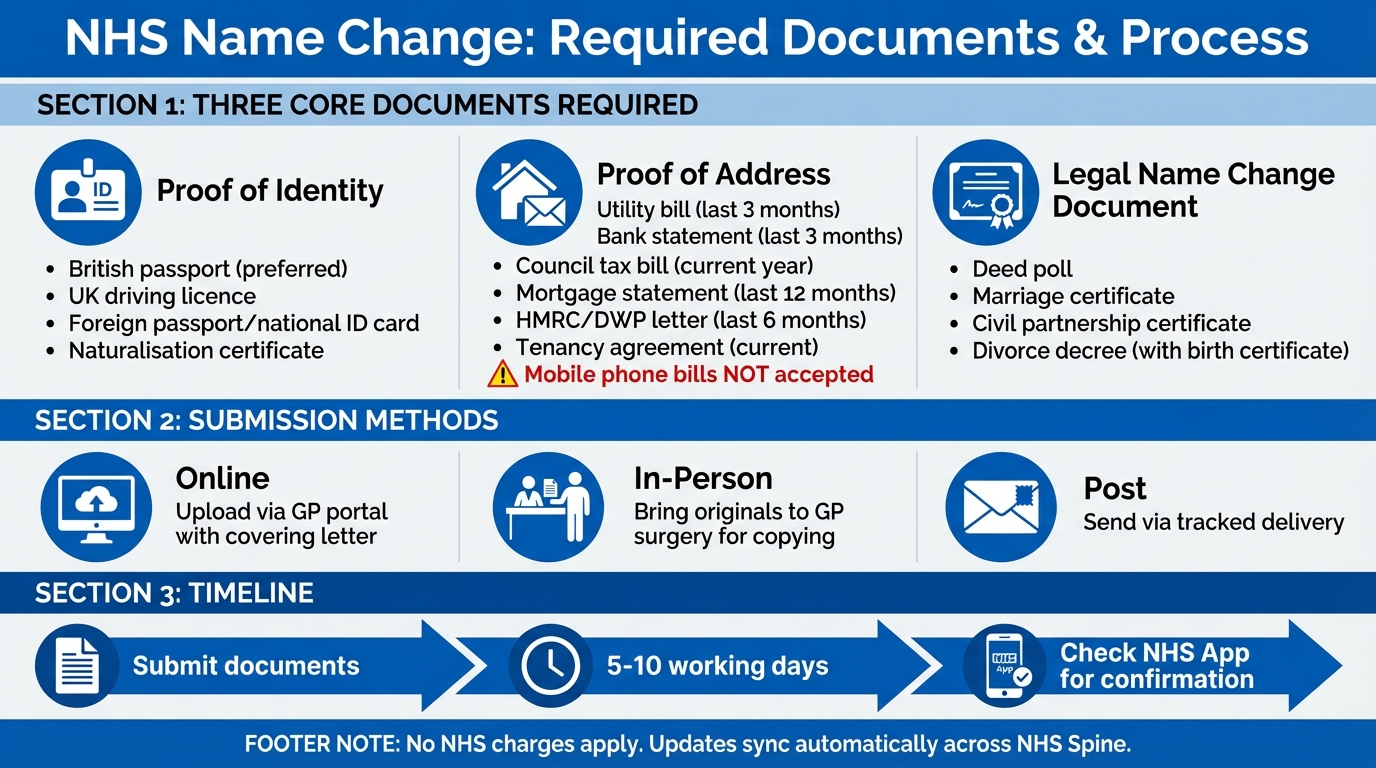
NHS Name Change Documents and Submission Process
Core Documents Required for All Name Changes
If you're planning to change your name, your GP practice will need three key types of documents. These are essential for verifying your identity and confirming your legal right to use your new name under NHS guidelines.
Proof of Identity
You’ll need to provide an official document that proves who you are. A British passport is the preferred option, but if you don’t have one, a valid UK driving licence can be used (although it cannot double as proof of address).
For foreign nationals, a passport or national identity card issued by your home country will suffice. If you’ve naturalised as a British citizen, your naturalisation certificate can also serve as proof. In rare cases, such as when protection services are involved, alternative documents may be accepted.
After proving your identity, you’ll need to confirm where you currently live.
Proof of Address
Your GP practice will require evidence of your current address. Make sure the document you provide is recent enough to meet their criteria.
| Document Type | Required Recency |
|---|---|
| Utility Bill (Gas, Electric, Water, Landline) | Last 3 months |
| Bank or Building Society Statement | Last 3 months |
| Council Tax Bill | Current financial year |
| Mortgage Statement | Last 12 months |
| HMRC or DWP Correspondence | Last 6 months |
| Tenancy Agreement | Current/Valid |
Important: Mobile phone bills are not accepted by NHS systems, so avoid using them. If your proof of address still shows your previous name, you’ll need to present it alongside a deed poll or marriage certificate to link your old and new identities. Additionally, some GP practices now accept PDF statements from online banking, but it’s a good idea to check their policy on digital documents before your visit.
Finally, you'll need to provide the legal document confirming your name change.
Deed Poll or Legal Name Change Document
This document is crucial for confirming your name change. The Department of Health and Social Care requires GP practices to have a copy of a valid legal name change document before they can update your records. Without it, they cannot process your request.
For name changes unrelated to marriage or civil partnership, a deed poll is the most commonly used document. Services like Name Change offer unenrolled deed polls that are accepted by UK government offices and organisations, including the NHS. These services often include extras like certified copies, tracked delivery, and PDF archiving, which can be handy if you need to submit the document to several organisations.
Keep in mind that your deed poll must not include restricted elements like numbers, symbols, or offensive language - these are grounds for rejection by government agencies. Additionally, UK authorities expect your new name to be used consistently "for all purposes" in your life, so you may need to show evidence of its use across various official documents.
sbb-itb-bf1bef6
Extra Documents for Specific Situations
In addition to the main documents, you may need to provide extra proof depending on your circumstances. These additional documents ensure that your name change is processed correctly and your NHS records are updated without issues. Below are the specific requirements for different situations.
Marriage or Civil Partnership
If you've decided to take your partner's surname after marriage or entering a civil partnership, you’ll need to provide an official copy of your marriage or civil partnership certificate. If the certificate isn’t in English, include a verified translation that’s signed, stamped, and dated. Make sure the name on the certificate matches the name you want on your NHS records to avoid any delays in the process.
Divorce or Name Reversion
For those reverting to a previous surname after a divorce, the required documents are slightly different. You’ll typically need:
- Your birth certificate
- Your marriage or civil partnership certificate showing both names
- A signed statement confirming that you are reverting to your former name "for all purposes" and will no longer use your married name.
Additionally, provide proof that you’ve started using your new name in daily life, such as a recent payslip or a letter from your local council. If you’ve misplaced your original marriage or civil partnership certificate, you’ll need to order a replacement before contacting your GP practice, as it’s essential for linking your previous and new names.
Gender Identity Changes
If your name change is connected to gender transition, you’ll need a deed poll or statutory declaration of name change. For those applying for a Gender Recognition Certificate (GRC), additional documents are required:
- Two medical reports: one from a gender dysphoria specialist and another from a registered doctor, such as your GP, detailing any gender affirmation treatments.
- Evidence of living in your affirmed gender for at least two years, such as updated IDs, passports, driving licences, or letters from healthcare professionals. Ideally, provide one piece of evidence for every three-month period over the two years.
Keep in mind that medical practitioners usually charge a fee for preparing the reports needed for GRC applications.
How to Submit Your Documents to the NHS
Contacting Your GP Practice
Once you've gathered all the necessary documents, the first step is to reach out to your GP surgery. They play a key role in updating your NHS records, as any changes made there will automatically sync with the NHS Spine.
Start by visiting your GP practice's website to look for a "Change of Details" form. Many surgeries now offer secure online options for updating personal information. NHS England states that all practices are required to provide an online service for patients to make updates, including name changes.
After finding the form, decide how you'd like to submit your documents.
Submitting Documents Electronically or In-Person
Once you've contacted your GP practice, you can choose the submission method that works best for you. If digital submission is an option, scan your deed poll and photo ID, then upload them via the practice's portal or email. Make sure to include a short covering letter with details like your old name, new name, date of birth, and NHS number (if you know it). This helps ensure your records are updated accurately.
If you prefer an in-person visit, bring your original legal document and photo ID to the surgery. A receptionist will check the originals and make photocopies for their records. For postal submissions, use tracked delivery to avoid any risk of your documents getting lost. Importantly, the NHS does not charge for updating your name on medical records. However, you will need to factor in the cost of a deed poll if you don't already have one.
After submitting your documents, allow about 5 to 10 working days. You can then check the NHS App to see if your name has been updated. If it has, this means the change has been successfully processed on the NHS Spine.
Tips for a Smooth Name Change
Check Your Documents Before Submitting
Before submitting any paperwork, take a moment to double-check that all names and details are accurate. If you're using a Deed Poll or marriage certificate to update your NHS records, make sure the name is spelled exactly as you want it - including first, middle, and surnames.
Only use legally recognised documents that meet UK standards. For instance, your Deed Poll must be an original or a certified copy, as photocopies are generally not accepted by government departments or health providers. If you opt for Name Change's professional service, your documents will already meet these requirements and are guaranteed to be accepted by the NHS and other UK organisations.
"It's also worth checking with the organisation you are trying to change your name with as to whether they will accept photocopies of the documentation or if they require the original." – Sarah Chapman, Paralegal | Family Law, Hegarty
Once your documents are in order, you can move forward with updating your details across other organisations.
Notify Other Organisations
Updating your NHS records is just one step in the process. To ensure consistency, you'll also need to inform other organisations where your name is on file, such as HM Passport Office, DVLA, HMRC, your bank, employer, and utility providers.
Creating a checklist can make this task more manageable. List all the organisations where your name is registered and tick them off as you notify each one. Keep in mind that updating your GP practice won't automatically update records at hospitals or specialist clinics - you may need to contact them separately. Having accurate and updated documents ensures your name is consistent across all systems, from the NHS to HMRC and beyond.
Conclusion
Double-check your completed checklist to ensure all documents meet NHS guidelines. Changing your name with the NHS requires proper documentation and a clear understanding of the steps involved. Whether you're using a Deed Poll, marriage certificate, or divorce decree, having legally recognised documents is key to successfully updating your records. A deed poll remains a dependable option for those making a name change with the NHS.
Keeping your paperwork organised helps avoid delays and ensures updates are reflected across the NHS Spine, including prescriptions, test results, and referrals. Remember, updating your name at your GP surgery will amend your central NHS record, but it’s wise to confirm with hospitals or specialist clinics that their local systems are also updated.
Make sure all submissions are either original documents or certified copies. If you opt for Name Change's professional service, your documents will comply with UK standards and are guaranteed to be accepted by the NHS and other organisations.
Once your NHS records are updated, don’t forget to notify other relevant organisations to maintain consistency across all systems. This will help ensure a smoother transition and prevent any future confusion. With these steps, you’ve completed your checklist for successfully changing your name with the NHS.
FAQs
Can I change my NHS name without a passport or driving licence?
Yes, you can update your name with the NHS using a deed poll, and you don't need a passport or driving licence to do so. A deed poll is a valid document for legally changing your name in the UK. Just make sure your deed poll complies with the legal requirements for name changes.
What if my proof of address still shows my old name?
If your proof of address still displays your previous name, reach out to your GP surgery directly. They can update your details on the NHS Spine PDS system, ensuring your records are consistent across all NHS services.
Will changing my name at my GP update hospital records too?
Changing your name with your GP doesn't mean your hospital records will be updated automatically. You'll need to contact the hospital directly and provide the required documents to have your name changed in their system too.