Top 7 Reasons Deed Polls Get Rejected
Changing your name with a deed poll is straightforward in the UK, but many are rejected due to preventable errors. These mistakes can delay updates with organisations like HM Passport Office, the DVLA, or banks. Here are the seven most common reasons for rejection:
- Improper Witnessing: Witnesses must meet strict criteria (e.g., not a relative or living with you). Some organisations prefer two witnesses.
- Incorrect Legal Wording: Missing or inaccurate phrases can invalidate your deed poll.
- Submitting Photocopies: Only original or certified copies are accepted.
- Poor Document Quality: Smudged ink, unclear handwriting, or low-quality paper can lead to rejection.
- Using Unreliable Providers: Documents from unrecognised sources may not be trusted by organisations.
- Mismatched Supporting Documents: Details on your deed poll must align with your ID documents.
- Lack of Consent for a Child’s Name Change: All individuals with parental responsibility must provide written consent.
Avoid these pitfalls by ensuring your deed poll is properly witnessed, accurately worded, and professionally prepared. Using a trusted service can help prevent delays and ensure acceptance by key organisations.
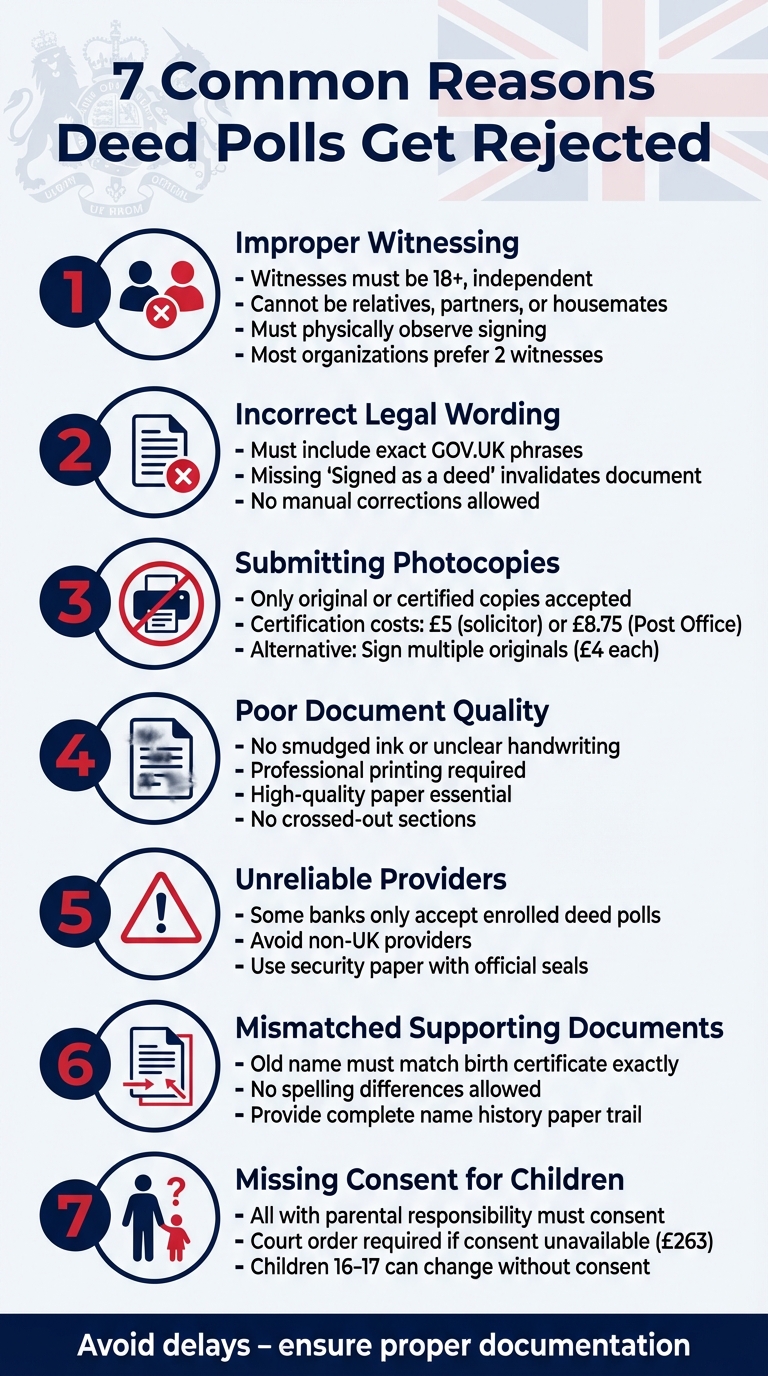
7 Common Reasons Deed Polls Get Rejected in the UK
1. Incorrect Witnessing
One of the most frequent reasons for deed poll rejection is improper witnessing. For the document to be valid, the witness must physically observe you signing it, ensuring the signature is genuine and that the name change is voluntary. If this step is not followed correctly, the deed poll can be declared legally invalid.
The witness must meet specific criteria: they must be at least 18 years old, mentally capable, and independent. This means they cannot be a relative, your partner, or someone you live with.
"Your witnesses must be independent of you. As such, your witness can be a friend, neighbour or colleague, but they may not be a relative, your partner, or someone you live with."
The process requires the witness to be in the same room as you during the signing. Both you and the witness must use permanent blue or black ink for signing, and the witness must print their full name and UK address alongside their signature.
While having one witness might meet the legal minimum, most UK organisations, such as banks, the DVLA, and HM Passport Office, prefer two witnesses. Documents with only one witness or witnesses who fail the independence test are often rejected. GOV.UK emphasises:
"Some organisations will not accept a deed poll if a witness lives at the same address or is a close relative."
To avoid these issues, select friends, neighbours, or colleagues who meet the independence criteria. If you're a British citizen living abroad, you may need to have a solicitor or notary public act as your witness. Proper witnessing is crucial to ensure your deed poll is accepted by UK organisations. Understanding how to legally change your name in the UK correctly is the first step to avoiding these pitfalls. Next, we’ll look at how errors in legal wording can also lead to rejection.
sbb-itb-bf1bef6
2. Missing or Incorrect Legal Wording
Once proper witnessing is sorted, getting the legal wording right is the next critical step to ensure your deed poll isn’t rejected. To meet UK requirements, the document must include specific legal phrases that clearly state you’re giving up your old name and adopting a new one. This declaration is essential for recognition by UK organisations.
Here’s the exact wording recommended by GOV.UK:
"I [old name] of [your address] have given up my name [old name] and have adopted for all purposes the name [new name]."
Additionally, many deed polls include a clause acknowledging that authorities may verify your name history when issuing official documents:
"I also understand that when I apply for official documents in my new name, such as a British Passport, the relevant authorities may check the history and validity of my old name [old name] and new name [new name]."
It’s crucial to avoid any errors or unclear handwriting. Government bodies like the DVLA and HM Passport Office expect the deed poll to be printed on high-quality paper and free from manual corrections. Even minor mistakes, like omitting part of your full name (e.g., middle names), can result in rejection by banks or official agencies.
The execution section must also include the phrase "Signed as a deed" to confirm its legal validity. For certain individuals, additional wording may be required. If you spot an error, resist the urge to fix it with white-out or pen; instead, print a new, error-free copy to avoid complications.
3. Submitting Photocopies or Uncertified Copies
Once you've finalised the legal wording of your deed poll, the next crucial step is ensuring it’s submitted in the correct format. Only the original executed deed poll or a certified copy will be accepted. Regular photocopies or uncertified copies are not allowed, as they can be altered and don’t provide reliable proof of identity.
Organisations like HM Passport Office and the DVLA require these documents for verification. According to the Deed Poll Office:
"A certified copy is a copy of an original document with an endorsement saying that it's a true copy of the original".
To certify a copy, you’ll need an authorised professional, such as a solicitor, notary public, magistrate, or commissioner for oaths. The certification must include the professional’s signature, printed name, occupation, address, and the date of certification. The standard endorsement reads: "I hereby certify that this is a true copy of the original seen by me".
The cost for this service varies. Solicitors typically charge around £5, while the Post Office charges £8.75 to certify up to three documents. However, note that HM Passport Office does not accept copies certified by the Post Office, so it’s essential to check the requirements of the organisation you’re dealing with.
For a simpler and potentially cheaper option, you can sign multiple original copies when executing your deed poll. Many providers offer duplicate originals for about £4.00 each. This can save you time and money compared to certifying photocopies later. Signing duplicate originals upfront can also help you avoid delays when dealing with official bodies.
4. Poor Formatting or Printing Quality
The physical presentation of your deed poll matters just as much as the legal wording and certified copies. Even if everything is legally correct, a poorly formatted or printed document might still be rejected. Banks and government offices often judge the authenticity of your deed poll by its professional appearance. Any signs of tampering, such as low-quality printing, can lead to outright dismissal.
Common formatting problems include manual alterations like crossed-out sections or handwritten corrections, as well as unclear handwriting. The UK Deed Poll Office highlights this point:
"A single error can slow your name change or lead to rejections from banks, government offices or other organisations".
If you make a mistake, you'll need to reprint the entire document. Every detail - your old name, new name, and witness information - must be crystal clear. It is also important to consider how many deed poll documents you should have to ensure you have enough originals for all your applications. Issues like smudged ink, faded text, or unreadable signatures can stall the process and might result in the document being sent back to you. Professional printing and clear handwriting are key to ensuring your deed poll is accepted without issues.
For enrolled deed polls, the standards are even stricter. The High Court requires the statutory declaration (Form LOC021) to be printed on one side only. GOV.UK cautions:
"If the forms have any mistakes in them, they will be sent back to you".
This makes it all the more important to ensure everything is correct from the start.
A professional-looking deed poll isn't just about aesthetics - it’s about meeting expectations. Documents with uneven spacing, improper margins, or amateur layouts could be flagged and rejected. Taking the time to get the formatting and printing right can save you from unnecessary delays.
5. From Unofficial or Unrecognised Providers
The source of your deed poll is just as important as its wording and format. In the UK, organisations often evaluate deed polls based on the credibility of the provider. Banks, mobile phone companies, and energy providers may reject a deed poll simply because it came from a less reliable source. This isn’t always about legal validity - it’s about trust and perceived authenticity.
Some organisations have strict policies that only accept enrolled deed polls registered with the High Court. As GOV.UK highlights:
"Some organisations (such as some banks, mobile phone companies or energy providers) may only accept an enrolled deed poll to change your name on their records".
This preference for official registration means organisations tend to inspect the document’s security and legitimacy more closely.
Even when unenrolled deed polls are accepted, the provider’s reputation plays a crucial role. Low-cost online services often lack key security features, which can cast doubt on the document’s authenticity. The UK Deed Poll Service explains:
"Our Deed Polls are printed on security paper and carry our official seal so there is no question about its authenticity. Unfortunately, we issue many Deed Polls to people who have wasted their money buying from cheap Internet sites".
Jurisdictional issues can complicate matters further. Providers operating outside the UK may not be legally registered to trade here, leading to outright rejection of their documents. For instance, the Deed Poll Office warns against a specific US-based company:
"UK Deed Poll Office is a U.S. company (registered in Delaware) that trades illegally in the U.K. whilst not registered as an overseas company... You should not make an application with this company".
To avoid these issues, it’s a good idea to check with your bank or insurance provider in advance to see if they require an enrolled deed poll. Additionally, opt for a UK-based specialist agency that uses security paper and professional formatting. While over 99% of people in the UK successfully use unenrolled deed polls, choosing a reputable provider is key to ensuring your document is accepted without hassle.
6. Discrepancies with Supporting Documents
Precision in witnessing and wording is essential, but it’s equally important to ensure your deed poll aligns with your supporting documents. Even a perfectly drafted deed poll can be rejected if its details don’t match those on your identity documents. Organisations like banks, the DVLA, and HM Passport Office will compare your deed poll with records such as birth certificates, passports, and marriage certificates. Any mismatch, even minor ones like spelling differences, can result in rejection.
Spelling errors are a common issue. A missing or extra letter in your name can lead to problems because your old name must exactly match the details on your birth certificate and passport. As GOV.UK explains:
"I also understand that when I apply for official documents in my new name, such as a British Passport, the relevant authorities may check the history and validity of my old name [old name] and new name [new name]. They may also check the information in any other supporting documents they have requested".
Another critical point is to avoid any manual changes to your deed poll. Handwritten corrections, crossings out, or the use of correction fluid render the document invalid. The UK Deed Poll Office explicitly states:
"Your Deed Poll must show both your old name and your new name clearly with no alterations or corrections".
Government agencies will not accept documents that appear altered or tampered with in any way.
To avoid rejection, ensure you how to change your name legally in the UK by providing a complete and consistent paper trail of your name history. For instance, if you’re reverting to a maiden name after a divorce, you’ll need both your marriage certificate and decree absolute. For enrolled deed polls, it’s crucial to declare your relationship status accurately and, if applicable, secure your spouse’s consent. Double-check all your supporting documents to confirm they align perfectly with your deed poll.
7. Changing a Child's Name Without Consent
Changing a child’s name without proper consent is one of the main reasons name change applications get rejected. The process for minors is far stricter than for adults, highlighting the importance of avoiding common missteps.
For children under 16, written consent from all individuals with parental responsibility (PR) is required. Organisations like HM Passport Office will reject applications missing the necessary signatures. If a passport is mistakenly issued without full consent, it can be cancelled and reclaimed.
When both parents hold PR, written consent from each parent or a court order is mandatory. A statutory declaration or deed poll alone won’t suffice.
If full PR consent isn’t obtainable, you’ll need to apply for a Specific Issue Order, which typically costs £263. The court will then perform a "welfare test" to determine whether the name change benefits the child. However, courts are generally hesitant to approve surname changes, as they often view a child’s surname as a connection to both parents. These steps underscore the importance of adhering to consent rules.
There are some exceptions to these strict requirements. For example:
- Children aged 16–17 can change their name without consent unless restricted by a court order.
- In Scotland, only one PR holder's consent is required, provided the other has been consulted.
- If a PR holder is deceased, no consent is needed, but a death certificate must be provided.
Before proceeding, confirm who holds PR. Even if a parent doesn’t have legal PR (e.g., not listed on the birth certificate), it’s wise to consult them to avoid potential disputes later on.
How Name Change Prevents Rejections
Name Change addresses the common pitfalls of deed poll rejections with a meticulous approach designed to ensure success. By eliminating frequent errors, it simplifies the process and minimises the risk of rejection.
The service uses premium, official-grade legal paper that complies with UK standards. Each deed poll is crafted with legally compliant wording that clearly outlines how to change your name by deed poll, meeting the specific requirements of various institutions. To further ensure accuracy, Name Change provides a step-by-step witnessing guide, reducing mistakes like having family members serve as witnesses - an error that often leads to rejection. This attention to detail tackles issues like improper witnessing, poor formatting, and uncertified copies, which are frequent causes of delays.
Both service plans include certified copies, which are essential for official acceptance, along with professionally printed originals that adhere to official standards. To back this up, Name Change offers a robust guarantee for peace of mind.
With a 100% acceptance guarantee, the service provides direct support in case any organisation questions your deed poll. As highlighted by the UK Deed Poll Office:
"A single error can slow your name change or lead to rejections from banks, government offices or other organisations".
This professional, detail-oriented approach removes uncertainty and delays, ensuring your name change process is as smooth as possible.
Conclusion
Deed poll rejections often happen due to avoidable mistakes - such as improper witnessing, incorrect legal phrasing, poor-quality documents, uncertified copies, mismatched supporting documents, or missing consent for a child's name change. These errors can set back your name change process by weeks or even months, creating delays with various organisations.
By tackling these problems head-on, you can ensure a smoother experience. Using a professional service can make all the difference by providing legally compliant wording, high-quality paper, certified copies, and clear guidance on witnessing. These steps directly address the common reasons for rejection.
As highlighted by the UK Deed Poll Office:
"Many people assume that simply drafting a deed poll themselves is enough to make their name change official, but not all deed polls are accepted".
Name Change offers a 100% acceptance guarantee, along with direct support if any organisation questions your document. With prices starting at just £16.95, you receive everything required for acceptance by HM Passport Office, the DVLA, banks, and other UK institutions - helping you avoid unnecessary delays.
Opt for a trusted service to make your name change process smooth and hassle-free.
FAQs
What should I consider when choosing a witness for my deed poll?
When selecting a witness for your deed poll, it's essential to follow specific guidelines to ensure the document is valid. The witness must be at least 18 years old, mentally sound, and physically present when you sign the deed poll. Avoid choosing a close relative, partner, or someone you live with, as these individuals are typically not accepted as witnesses.
Ideally, the witness should reside in the UK and include their full address on the deed poll. They are also required to sign the document in wet ink while you are present. Adhering to these rules helps ensure your deed poll is properly witnessed and minimises the risk of rejection.
What steps should I take to make sure my deed poll is legally valid and accepted?
To make sure your deed poll is legally valid and accepted in the UK, it needs to include your full personal details and be signed in wet ink in front of two independent witnesses who are at least 18 years old. The document must also adhere to UK naming rules, meaning it can't include anything offensive, misleading, or use symbols or titles incorrectly.
It's also important that the deed poll is properly formatted, uses the correct wording, and is witnessed accurately. Following these guidelines will help ensure it's accepted by organisations like the DVLA, HM Passport Office, and banks.
What can I do if I don’t have consent to change a child’s name?
If you can’t get consent to change a child’s name, you might need to seek a court order. This involves a legal process where the court evaluates the situation and makes a decision based on what’s best for the child. To strengthen your case, it’s crucial to present clear evidence showing how the name change would positively impact the child.