Updating Records After Marriage Name Change
Changing your name after marriage is more than a personal update - it requires notifying various organisations to avoid legal, financial, and practical issues. Here's what you need to know:
- Key Documents: Start with your marriage certificate. For complex name changes (e.g., double-barrelled surnames), you may need to change your name by deed poll.
- Government Updates: Prioritise your passport, driving licence, and HMRC records. Delays can lead to fines or complications.
- Financial Records: Notify banks, credit card providers, and pension schemes to ensure smooth transactions.
- Employment & Professional Bodies: Update your HR records, professional licences, and insurance policies.
- Utilities & Subscriptions: Inform utility providers, councils, and online services to keep billing accurate.
Consistency across all records is crucial. Begin with government IDs, then move to financial and employment updates. Keep certified copies of your marriage certificate handy, and maintain a log of changes to track progress.
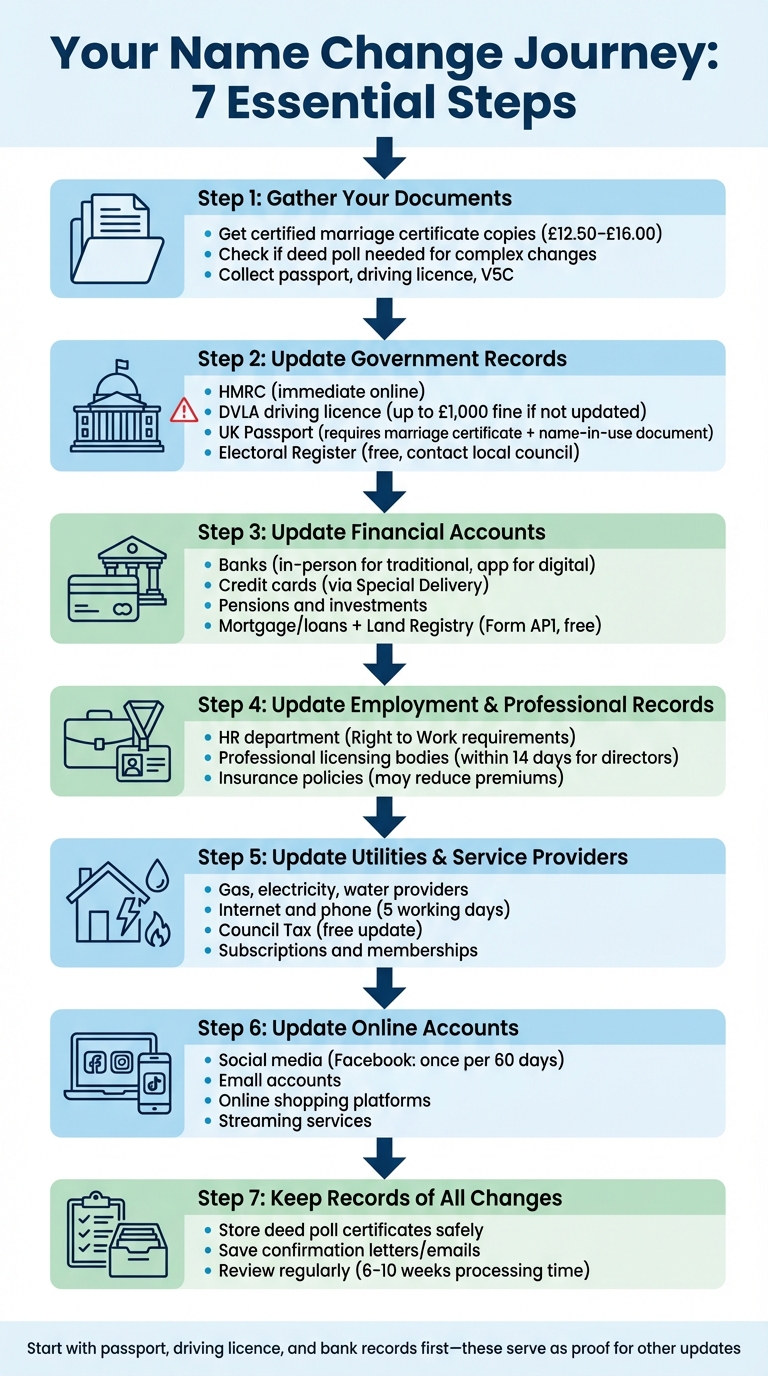
7-Step Process for Updating Records After Marriage Name Change in UK
Step 1: Gather Your Documents
Before reaching out to any organisations, make sure you have all the necessary paperwork ready. Most UK institutions won't process a name change without proper documentation, so having everything in place will save you both time and hassle. Here's what you'll need to get started.
Get Certified Copies of Your Marriage Certificate
Your marriage certificate is the key document for changing your name. Most government offices, banks, and service providers will ask for certified copies - not standard photocopies - as proof of your new name. You can request these from the General Register Office (GRO) in England and Wales, National Records of Scotland (NRS), or the General Register Office for Northern Ireland (GRONI).
It's a good idea to order multiple certified copies upfront. Organisations like the Passport Office and banks often require original certified documents, and having several copies means you can process multiple applications at the same time without delays. Standard copies cost between £12.50 and £16.00, while next-day priority services range from £38.50 to £42.00.
If you were married abroad and your certificate isn't in English, you'll need an official translation. This must be completed and signed by a professional linguist to be accepted by UK authorities.
Check If You Need a Deed Poll
In many cases, your marriage certificate will be enough for straightforward surname changes. However, if you're making more complex changes - like creating a double-barrelled surname not clearly shown on your marriage certificate, combining surnames, or altering your first name - you'll need a deed poll.
"Most government departments, banks, and service providers will accept your marriage certificate as proof of your new name." - Rebecca Franklin, Divorce lawyer Birmingham
If a deed poll is required, consider using Name Change for legally valid documents. Their standard service (£16.95) includes printed copies, three certified versions, an ink stamp, and a digital archive. The premium service (£24.95) adds a gold embossed stamp for extra authenticity.
Collect Your Personal Documents
Next, gather your current passport and driving licence. These are usually the first documents you'll need to update and will often serve as proof of identity when notifying other organisations. Other items to have ready include your V5C (vehicle logbook), recent utility bills, and financial account details.
If you own property, be sure to collect your title register information. Updating your name on the Land Register is free, but obtaining a copy of your title register for verification costs £7. This step is essential, as mismatched names between your ID and property register can cause issues with mortgage applications.
sbb-itb-bf1bef6
Step 2: Update Government Records
Once you've gathered all the necessary documents, it's time to update your government records. Acting promptly is crucial, as delays can lead to penalties or even affect your credit score. The good news is that most agencies accept your marriage certificate as proof of a surname change, so you typically won't need to compare name change methods like a deed poll for this.
Update Your HMRC Records
Make sure to inform HM Revenue & Customs (HMRC) about your name change. This will ensure all your details for Income Tax, National Insurance, Tax Credits, and Child Benefit are accurate. You can update your HMRC records easily through your online account or the HMRC app by using your National Insurance number.
Update Your Driving Licence with DVLA
It's a legal requirement to notify the Driver and Vehicle Licensing Agency (DVLA) if you've changed your name. Ignoring this could result in a fine of up to £1,000. Your marriage certificate is usually enough evidence, so there's no need for a deed poll. For your vehicle log book (V5C), simply fill out the relevant section with your new name and send the entire log book, along with a short cover letter, to the DVLA in Swansea. This service is free, but it might take up to six weeks to receive your updated log book.
Update Your UK Passport
When updating your UK passport, you'll need two pieces of evidence: your marriage certificate and a recent "name-in-use" document, such as a bank statement, utility bill, council tax letter, payslip, or medical card issued within the last 12 months. It's essential that both documents display your name exactly the same way - matching spelling, order, and capitalisation will help prevent delays. If you hold dual nationality, you must update your foreign passport before the Home Office can issue a British passport in your new name. Also, avoid sending laminated documents.
Update the Electoral Register
To update your name on the electoral register, contact your local council. This step is vital to maintain your voting rights, protect your credit score, and ensure your official identity is consistent across government systems. Typically, you won't need to provide any additional documents for a standard marriage name change, but some councils may ask to see your marriage certificate for confirmation.
The table below provides an overview of the key details for updating your records with each government department:
| Department | Method of Update | Evidence Required | Cost | Processing Time |
|---|---|---|---|---|
| HMRC | Online, HMRC App, or Phone | National Insurance number | Free | Immediate online |
| DVLA (V5C) | Post (to DVLA, Swansea) | V5C log book with your new name and a cover letter | Free | Up to 6 weeks |
| Passport Office | Online or Post | Marriage certificate and a "name-in-use" document | Standard passport fee | Varies |
| Electoral Register | Local Council | Usually none; your council may request confirmation of your new name (e.g. marriage certificate) | Free | Varies by council |
Step 3: Update Financial Accounts
Before you begin, ensure you understand how to change your name legally to ensure all your documentation is in order. Once you've updated your government records, the next step is to notify your financial institutions. Banks and lenders have strict identity verification processes due to anti-money laundering regulations, so it's important to follow their guidelines carefully. Keeping your financial records up to date ensures smooth banking operations and prevents issues like failed payments or complications with property transactions.
Update Bank and Building Society Accounts
For traditional banks like Lloyds, HSBC, and Barclays, you'll need to visit a branch in person with your original marriage certificate to make the changes. On the other hand, digital-only banks such as Monzo and Starling offer a more convenient process, allowing you to upload the required documents securely through their apps.
While your account number, sort code, and payment arrangements like Direct Debits and standing orders stay the same, your display name and bank cards will be updated. Expect your new debit card to arrive within seven working days. If you have a joint account, both account holders will receive updated cards if the account name changes.
For a quicker process, bring along your updated photo ID. Once the changes are complete, make sure to dispose of old chequebooks, as cheques signed with your previous name may no longer be valid.
Update Credit Card Accounts
To update your credit card details, you'll need to send the original documents - such as your marriage certificate - via Royal Mail Special Delivery for secure handling. If you're managing updates across multiple accounts, it might be worth ordering a multi-copy pack of your marriage certificate. This ensures you won't have to wait for one document to be returned before moving on to the next update.
Once your credit card records are sorted, don't forget to check that your pension and investment accounts reflect your new name.
Update Pension and Investment Accounts
Notify your pension providers and investment platforms, including ISA providers, about your name change. This step is essential to ensure future claims and payments are processed without delays. For workplace pensions or private schemes, any mismatch in your name could cause significant issues when it's time to access your funds.
Update Mortgage or Loan Accounts
If you have a mortgage or loan, inform your lender to update their records. However, note that this does not automatically update the Land Registry. To update the Land Register, you'll need to fill out Form AP1, which can be submitted by post and is free of charge. This step is critical for future refinancing or property sales, as lenders often require the details on the Land Register to match their records exactly.
| Institution Type | Typical Update Method | Required Documents |
|---|---|---|
| High-Street Banks | In-person branch visit | Original Marriage Certificate, Photo ID |
| Digital Banks | In-app secure upload | Digital scan of Marriage Certificate |
| Credit Card Providers | Postal application | Original document (via Special Delivery) |
| Mortgage Lenders | Phone or Post | Marriage Certificate |
| Land Registry | Postal (Form AP1) | Official copy of Marriage Certificate |
Step 4: Update Employment and Professional Records
When you change your name, it's essential to update your employment records promptly. Start by providing your HR department with your original marriage certificate or deed poll to meet 'Right to Work' requirements. If you are unsure of the process, you can learn how to change your name by deed poll to ensure your documents are in order. This ensures your payroll records align with HMRC, safeguarding your National Insurance contributions and understanding the legal implications for your future state pension entitlements. Additionally, this step ensures internal systems - like your professional email address, security passes, and company directories - are updated. While your National Insurance number stays the same, remember to update linked records, such as workplace pensions. Notify your employer, professional organisations, and insurers to ensure all records reflect your updated name.
Notify Your Employer's HR Department
Your employer will usually keep a copy of your marriage certificate to connect your previous and new names in their records. You can double-check these updates via your HMRC Personal Tax Account. If you're a company director, you must also inform Companies House of your name change within 14 days by completing form CH01.
Update Professional Licensing Bodies
If you're part of a regulated profession, such as medicine, law, or nursing, you must notify your licensing body to ensure your name matches your legal identification. For instance, organisations like the GMC, SRA, or NMC require formal updates. Many, such as the Nursing and Midwifery Council, let you make changes through online accounts like MyNMC. Typically, you'll need to upload a digital copy of your marriage certificate in a recognised format (e.g., PDF, PNG, or JPEG). In some cases, a third party, like another registered professional, may need to verify the change (as required by the NMC). Keeping your professional credentials consistent with government records helps avoid future complications.
Update Insurance Policies
Your insurance policies also need updating to reflect your new name. Contact providers for car, home, life, and health insurance directly and provide a certified copy of your marriage certificate as proof. Even if you don't change your name on a specific policy, inform your insurer of your marital status change. Married individuals are often considered lower risk, which could reduce premiums. For professional indemnity insurance, update your details immediately to avoid coverage issues. If you have health insurance, marriage qualifies as a 'life event', allowing you to adjust your plan or add a spouse outside the usual enrolment periods. Be aware that most plans require these updates within 60 days of your wedding.
Step 5: Update Utilities and Service Providers
Once you've updated your government, financial, and employment records, it's time to notify your utilities and service providers. This step ensures your billing and correspondence details are up to date. Utility bills can also serve as proof of address. Most providers accept photocopies or digital scans of your marriage certificate or deed poll, so there's no need to send original documents.
Update Utility Accounts
Start by contacting your gas, electricity, and water providers. As of mid-2025, some of the UK's largest energy suppliers include Octopus Energy (with a 24% market share), British Gas, E.ON Next, OVO Energy, EDF Energy, and ScottishPower. Many providers have online forms or email options for name changes.
For example, Utility Warehouse requires customers to download a specific change of name form and submit it via email ([email protected]) or by post, along with a copy of your marriage certificate, passport, or driving licence. Once updated, request an updated bill to use as proof of address.
Update Internet and Phone Providers
Next, notify your broadband, landline, and mobile phone providers. It's important to ensure your account reflects your legal name. Major telecom companies like BT, Sky, Virgin Media, EE, O2, and Vodafone allow you to make updates through online account forms or customer service calls. You’ll typically need to provide a copy of your marriage certificate or deed poll. Changes are usually processed within 5 working days.
Update Council Tax Records
Don’t forget to inform your local council about your name change for Council Tax purposes. You’ll need to send a copy of your deed poll or marriage certificate to your local authority. The good news? There’s no charge for updating your Council Tax records.
Update Subscription Services
Finally, remember to update your name on digital services and memberships. This includes platforms like Netflix and Disney+, online shopping accounts such as Amazon, supermarket loyalty cards, gym memberships, and magazine subscriptions. While most of these updates can be done informally through account settings, some platforms might request proof of your name change. Keeping these accounts updated helps avoid delivery issues and ensures invoices are addressed correctly.
Step 6: Update Online Accounts
Once you've sorted out your utilities and service providers, it's time to tackle your digital accounts. Start by ensuring your "Power Trio" - Passport, Driving Licence, and Primary Bank Account - are already updated. This step is crucial for keeping everything aligned and avoiding awkward situations, like mismatched names on delivery parcels and payment cards. Having your offline records in order sets the stage for updating your online presence, reinforcing your identity change across the board.
Update Social Media Accounts
Begin with the major platforms: Facebook, Instagram, LinkedIn, and Twitter. For Facebook, note that you can only change your name once every 60 days, so double-check for typos before confirming. If you manage both Facebook and Instagram through Meta's Accounts Centre, you can sync your first and last names across the two platforms simultaneously.
To update your name on Facebook, go to Settings > Accounts Centre > Profiles, input your new name, and save the changes.
"Most social media platforms make it easy to change your name, but some - especially Facebook and LinkedIn - can require that you provide proof of your name change: this is easiest if you've arranged for your photo ID to be updated first!" – Free Deed Poll
For LinkedIn, it’s best to wait until you have your updated passport or driving licence ready, as they may ask for a digital copy of your ID during the name verification process.
Update Email Accounts
Updating your email accounts is usually straightforward. Most providers, like Gmail, Outlook, and Yahoo, allow you to change your display name through the account settings. Simply log in, navigate to the settings menu, and update the name that appears when you send emails.
If you’d prefer to start fresh with a new email address that reflects your updated name, you can create a new account. To ensure you don’t miss any important messages, set up email forwarding from your old account to the new one.
Update Online Shopping Accounts
Make sure your name is updated on e-commerce platforms such as Amazon, eBay, and supermarket accounts. This ensures your payment details align with your updated bank information, preventing any authorisation issues or rejected deliveries. Most platforms allow you to update your name directly through the account settings, though some may request proof, like a marriage certificate or deed poll.
Update Streaming Services
Don’t forget your streaming subscriptions! Platforms like Netflix, Spotify, Disney+, and Apple Music typically allow you to update your name directly in your account profile. The process is simple and usually doesn’t require any additional proof of your name change.
Step 7: Keep Records of All Changes
Once you've completed all the necessary updates, keeping accurate records becomes essential. A detailed log of all changes helps avoid future issues, such as mismatches in credit files, tax contributions, or legal documents. Without a clear paper trail, you could face problems like failed payments or complications when travelling.
Store Your Deed Poll Certificates Safely
It's important to securely store multiple original copies of your deed poll. Keep one at home in a safe place and another on hand for appointments. Remember, institutions like HM Passport Office and banks won’t accept photocopies or digital versions, so always use secure, trackable post when sending originals. Your deed poll also acts as "linking evidence" for documents that won’t be reissued under your new name, such as university degrees or professional certifications.
"You should keep your Deed Poll safe as 'linking evidence' to prove those qualifications belong to you." – Prime Deed Polls
Save Confirmation Letters and Emails
Hold onto all confirmation letters, emails, and reference numbers from organisations like banks, utility companies, government agencies, and service providers. These records will help you track which updates have been completed and which are still pending using a name change checklist. Some agencies may take up to 6 to 10 weeks to process name changes. Additionally, keep recent documents issued in your new name, as many organisations require them as secondary proof alongside your deed poll or marriage certificate.
Review Your Records Regularly
Make it a habit to review your records periodically, especially before significant events like travelling, job changes, or property transactions, to ensure everything is consistent. For example, you can check the Land Register using the "Search for property information" service for £7 to confirm your name matches your legal identity. If you're moving house while changing your name, update both sets of details simultaneously to keep everything aligned across databases.
Conclusion
Updating your name after marriage involves more than a simple declaration - it sets off what could be called an "Identity Ripple Effect", requiring updates across a range of databases and organisations. If not handled carefully, inconsistencies in your records could lead to issues like failed direct debits, travel disruptions, or even problems with pensions.
A step-by-step approach is key. Begin with the most critical documents, such as your passport, driving licence, and bank records, as these serve as primary proof for other updates. Once these are in place, move on to financial institutions, employers, and service providers, ensuring that every detail - spelling, spacing, and hyphenation - is consistent throughout.
For more complicated name changes, like double-barrelling surnames, blending names, or even altering your first name, a marriage certificate alone won’t be sufficient. In these cases, you’ll need to legally change your name in the UK using a deed poll. Services like Name Change offer secure deed poll solutions that comply with the requirements of key UK institutions, including HM Passport Office, the DVLA, and major banks.
"To bridge the gap between a signed document and a fully recognised legal identity, you must embark on the administrative phase of your transition." – Prime Deed Polls
Keep a detailed record of every update you make. This will help ensure your legal identity remains consistent across all UK databases, avoiding unnecessary delays or complications in the process. A systematic approach and proper documentation will make the transition smoother and more efficient.
FAQs
What order should I update my records in after a marriage name change?
To update your records after changing your name due to marriage, here's the general order to follow:
- Passport: If you're planning to travel soon, this should be your first priority. Update your passport to avoid any issues while travelling.
- Bank and financial institutions: Inform your bank and other financial organisations. You'll usually need to provide proof, such as your marriage certificate or a deed poll.
- DVLA: Notify the DVLA to update your driving licence with your new name.
- HMRC and your employer: Make sure both HMRC and your employer are aware of the change to keep your tax and payroll records correct.
- Other organisations: Don't forget to update your details with the NHS, your local council, insurance providers, utility companies, and any subscriptions you hold.
When is a deed poll needed instead of just a marriage certificate?
If you’re looking to create a double-barrelled surname, combine surnames, alter the spelling of your name, or choose an entirely new family name, you’ll need a deed poll. This legal document is essential for more intricate name changes that go beyond simply adopting your spouse’s surname as it appears on your marriage certificate.
How can I avoid problems if different organisations show my name differently?
When you change your name, it's crucial to inform all relevant organisations and provide official proof - like your deed poll or updated passport. Using certified copies can ensure your documents are accepted without issue. Begin by updating your passport, as it's often the primary form of identification used by other institutions. Keeping your communication clear and your records consistent will help avoid any mismatches across different systems.