Who Can Witness a Deed Poll?
If you’re changing your name in the UK with a deed poll, it must be signed in front of an independent witness to be legally valid. A witness ensures the process is voluntary and helps verify the document's authenticity. Here’s what you need to know:
-
Who qualifies as a witness?
- Must be 18 or older and mentally capable.
- Cannot be a family member, spouse, partner, or anyone living at your address.
- Should ideally reside in the UK and provide their full name, address, and occupation.
-
Who cannot act as a witness?
- Relatives, romantic partners, housemates, minors, or anyone not of sound mind.
-
When is a professional witness needed?
- For international use or specific legal standards, a solicitor, notary public, or embassy official may be required.
The signing process must be done in black ink, with the witness physically present. Mistakes in choosing a witness could lead to rejection by organisations like the HM Passport Office or DVLA. Always check specific requirements to avoid delays.
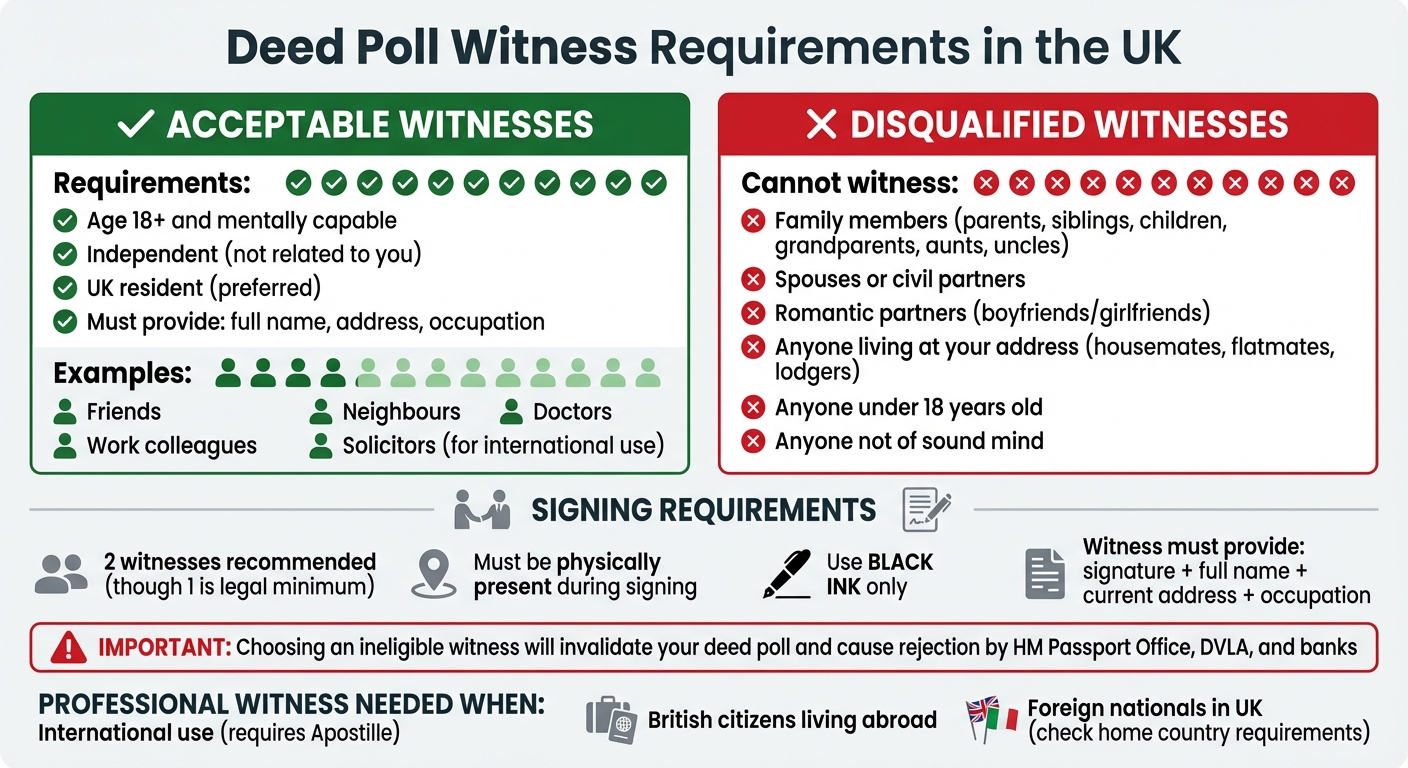
Deed Poll Witness Requirements: Who Can and Cannot Witness Your UK Name Change
What Does a Deed Poll Witness Do?
A deed poll witness plays a key role in ensuring the document's validity by confirming that you signed it willingly. This step makes the deed poll legally enforceable.
According to the Law of Property (Miscellaneous Provisions) Act 1989, the signing must occur in the physical presence of a witness. Remote witnessing isn’t permitted. The witness observes you signing the deed poll with both your old and new names, fulfilling an essential legal requirement.
"Witness signatures give legal credibility to your Deed Poll. They demonstrate that the document was executed correctly and in line with UK legal standards." – Change My Name
The witness’s role doesn’t end there. They also provide a layer of accountability by sharing their identifying details: full name, current home address, and occupation. This information is crucial for preventing identity fraud. Organisations like the HM Passport Office or the DVLA may contact the witness to confirm the document’s authenticity. However, it’s important to note that witnesses don’t need to read or understand the deed poll - they are only responsible for observing your signature.
For most institutions, two independent witnesses are required. Additionally, black ink is typically mandated to ensure the signatures are clear and legible.
sbb-itb-bf1bef6
Who Can Witness a Deed Poll?
When it comes to validating your deed poll, the role of a witness is essential. However, you don’t need to rely on a solicitor or other professional for standard UK applications. Any adult who meets the necessary criteria can act as a witness. Let’s break down the specific requirements and look at examples of who qualifies.
Requirements for Witnesses
To serve as a witness, the individual must meet a few simple but important conditions:
- They must be at least 18 years old and mentally capable of understanding what they are signing. This means they need to be of sound mind and fully aware of the document's purpose.
- Independence is key. Family members - such as parents, siblings, children, or grandparents - are not allowed. Similarly, your spouse, civil partner, or romantic partner cannot act as a witness. Even those living at your address are disqualified, regardless of their relationship to you.
- The witness must provide their full name, current home address, and occupation on the deed poll. Ideally, they should reside in the UK, as some organisations may reject documents witnessed by someone living abroad.
"The law says that anyone who is not a party to the deed can be a witness. However, we recommend that you only choose someone who is: over 18; not a close relative; and resident in the UK." – Online Divorce
Examples of Acceptable Witnesses
Based on these guidelines, potential witnesses could include friends, work colleagues, or neighbours. You might also consider professionals like teachers or doctors, though some may charge for their time.
The main requirement is that the witness is independent, knows you personally, and would be able to confirm your identity if organisations like the HM Passport Office or DVLA needed verification.
Who Cannot Witness a Deed Poll?
Knowing who is not allowed to witness your deed poll is just as crucial as understanding who can. Choosing an ineligible witness can invalidate your document, risking rejection by organisations like government bodies, banks, and employers. The HM Passport Office and DVLA are particularly strict when it comes to these requirements.
Disqualified Witnesses
Certain individuals are not permitted to act as witnesses for a deed poll:
- Family members: This includes parents, siblings, children, grandparents, aunts, uncles, and any other relatives. Witnesses must be independent, and family members cannot meet this standard.
- Partners and spouses: This category covers husbands, wives, civil partners, and even boyfriends or girlfriends. Because these individuals have a personal interest in your name change, they are not considered impartial.
- Anyone living at your address: Whether they are housemates, flatmates, lodgers, or tenants, anyone sharing your residence is disqualified. The Passport Office often rejects applications for this reason, so it’s essential to ensure your witness does not live with you.
- Minors or individuals not of sound mind: Witnesses must be at least 18 years old and capable of understanding the significance of the document. As UK Deed Poll Online explains, "The witness must be at least 18 years old. This ensures that the witness is of legal age and capable of understanding the nature and significance of the document they are witnessing".
Choosing a disqualified witness will result in your deed poll being invalid. Understanding these restrictions ensures you can decide whether you might need a professional witness.
When You Need a Professional Witness
For most unenrolled deed polls, any eligible adult can act as a witness, provided they meet basic criteria. However, in certain cases, a solicitor or notary public must act as your witness to ensure the document is accepted. This is particularly important when dealing with international requirements or specific legal standards. Let’s break down when professional witnessing is necessary.
When to Use a Solicitor or Notary
While the majority of deed polls don’t require professional witnessing, international use often does. For example, if your deed poll needs to be validated for use outside the UK, it will likely require an Apostille. This certification ensures your document is recognised internationally, but only deed polls witnessed by a UK practising solicitor or notary public can be legalised with an Apostille.
British citizens living abroad often face unique requirements. If you’re applying for a UK passport or updating your records with UK authorities while overseas, your deed poll may need to be witnessed by a solicitor, notary public, or even a British Embassy official. It’s a good idea to check with your local British Embassy or consulate to confirm whether they offer witnessing services or if you’ll need to use a local notary.
For foreign nationals living in the UK, it’s important to consult your home country’s embassy or consulate. Many countries require professional witnessing for name changes to be recognised back home. This can be particularly important for things like international marriages, overseas property transactions, foreign bank accounts, or business dealings abroad.
Professional witnesses provide an added level of impartiality and credibility that can help prevent challenges from government bodies or financial institutions. While solicitors and notaries do charge for their services, the cost of professional name change services is often a necessary investment to ensure your deed poll meets international or organisational standards.
How to Sign and Witness a Deed Poll
The Signing Process
To make sure your deed poll is legally valid, it needs to be signed and witnessed correctly. This process, known as "execution", is essential for organisations like the HM Passport Office, DVLA, and banks to accept your name change. Here's how to do it step by step.
First, gather two witnesses who can be present for the entire signing process. Both witnesses must be in the same room as you when you sign. Use a black ink pen for all signatures and written details to ensure everything is clear and legible.
You’ll need to sign the deed poll twice - once with your old signature and once with your new one. Your witnesses must watch you sign and then immediately add their signatures. Next to their signatures, each witness must clearly write their full name, current home address, and occupation. The standard format, as outlined by GOV.UK, typically reads:
"Signed as a deed on [date] as [old name] and [new name] in the presence of [witness 1 name] of [witness 1 address], and [witness 2 name] of [witness 2 address]."
Before signing, allow your witnesses to read the deed poll to confirm that you are changing your name voluntarily. If you’re creating multiple certified copies, each copy must also be signed by you and your witnesses at the same time. Finally, double-check that all fields are completed, the date is accurate, and no details have been missed.
"Without two valid witness signatures, your name change will not be recognised by many official bodies, such as the DVLA, HM Passport Office, banks, and employers." - Change My Name
Meeting Organisation Requirements
What Organisations Require from Witnesses
Knowing how to complete your deed poll correctly is only part of the equation. To avoid delays or outright rejection, it's equally important to meet the specific requirements set by UK organisations like the DVLA and HM Passport Office. These institutions carefully review the witness information on your deed poll, so it's essential to understand what they expect.
UK organisations demand complete and accurate witness details. If anything is missing or incorrect, the DVLA or HM Passport Office may reject your application. To save time and frustration, ensure your witnesses meet their criteria.
Institutions such as the DVLA, HM Passport Office, HMRC, and many banks typically require the following:
- Full witness details, including their full name, permanent address, occupation, and signature.
- Two independent witnesses, even though the legal minimum is one. This is often preferred for added credibility.
- Black ink for signing, as it ensures clear reproduction of the document.
"Some organisations will not accept a deed poll if a witness lives at the same address or is a close relative." - GOV.UK
Choosing independent witnesses is crucial. For example, banks can be particularly strict, with some branches refusing to accept unenrolled deed polls altogether, no matter how well the witnessing is handled. To avoid surprises, always check your bank's specific policy before submitting your documents.
Opting for a professional witness - like a solicitor, teacher, or doctor - can also streamline the process. Professionals often use their business address instead of their home address, which some organisations prefer for verification.
| Organisation | Typical Witness Requirements | Common Reasons for Rejection |
|---|---|---|
| HM Passport Office | 2 witnesses recommended; must be independent adults | Witness is a relative or lives at the same address |
| DVLA | 2 witnesses; full names, addresses, and occupations required | Use of pencil or non-black ink; witness not independent |
| Banks | May require 2 witnesses; some may request an "enrolled" deed poll | Unenrolled deed poll not accepted by specific branch policy |
| HMRC | Standard independent witnessing (2 people) | Incomplete witness details (missing occupation or address) |
Summary
To ensure your deed poll is valid, your witness must meet the legal criteria discussed earlier. This means they must be independent - not a family member, spouse, civil partner, or someone living at your address. Failing to meet these requirements could result in rejection by the HM Passport Office, DVLA, banks, or other institutions.
The signing process requires your witness to be physically present when you sign the deed poll. They must then immediately add their signature and any other required details. Use black ink for clarity, and if needed, sign multiple original copies to provide to different organisations.
Many UK government bodies and financial institutions prefer two independent witnesses instead of just one. This adds an extra layer of credibility and helps reduce the chance of rejection. If you’re a British citizen living abroad, you may need the services of a solicitor, notary public, or a British Embassy official to witness your deed poll for it to be recognised internationally. Check the specific requirements of the organisations you’ll be dealing with to avoid unnecessary delays.
Before signing, double-check that your witnesses meet all the necessary criteria. Confirm any unique policies with the organisations where you’ll be updating your name. Proper witnessing is crucial to ensure your name change is accepted across all official records.
FAQs
Can I use just one witness, or do I really need two?
To validly execute a deed poll, you need two witnesses. Having just one witness won't meet the legal requirements. Witnesses are crucial because they confirm the authenticity of your signature, ensuring the document is properly recognised as legally binding.
What if my only available witness lives at my address?
If the person witnessing your deed poll lives at your address, some organisations might reject it - particularly if the witness is a close relative. To minimise potential problems, select a witness who is over 18, not a family member, and based in the UK. This increases the likelihood that organisations will accept your deed poll.
Do I need a solicitor or notary to witness my deed poll?
No, you don’t need a solicitor or notary to witness your deed poll. Any independent adult over 18 can serve as your witness, provided they are not related to you and do not live at the same address.