First Name Change: Records to Update First
If I change my first name in the UK, I update my passport and driving licence first. That usually makes the rest easier, because banks, HMRC, employers and the NHS often want my new ID or proof of name use before they change their records.
Here’s the short version:
- I get my deed poll or statutory declaration ready first
- I update passport
- I update driving licence
- I update bank accounts and cards
- I tell HMRC and check National Insurance stays linked
- I update employer/payroll
- I update GP and NHS records
- I re-register for the electoral register
- I update insurance
- I finish with utilities and telecoms
A few points matter straight away:
- DVLA can fine up to £1,000 if I do not update my licence details
- The name on a flight ticket must match the passport exactly
- My National Insurance number and NHS number do not change
- HM Passport Office and DVLA usually want original documents, not scans
- Many banks will not change my name until I show updated photo ID
If I want fewer delays, I get 2 to 4 original deed poll copies so I can send documents to more than one place at once. That matters because passport and DVLA checks can take weeks, and they may hold my original papers during that time.
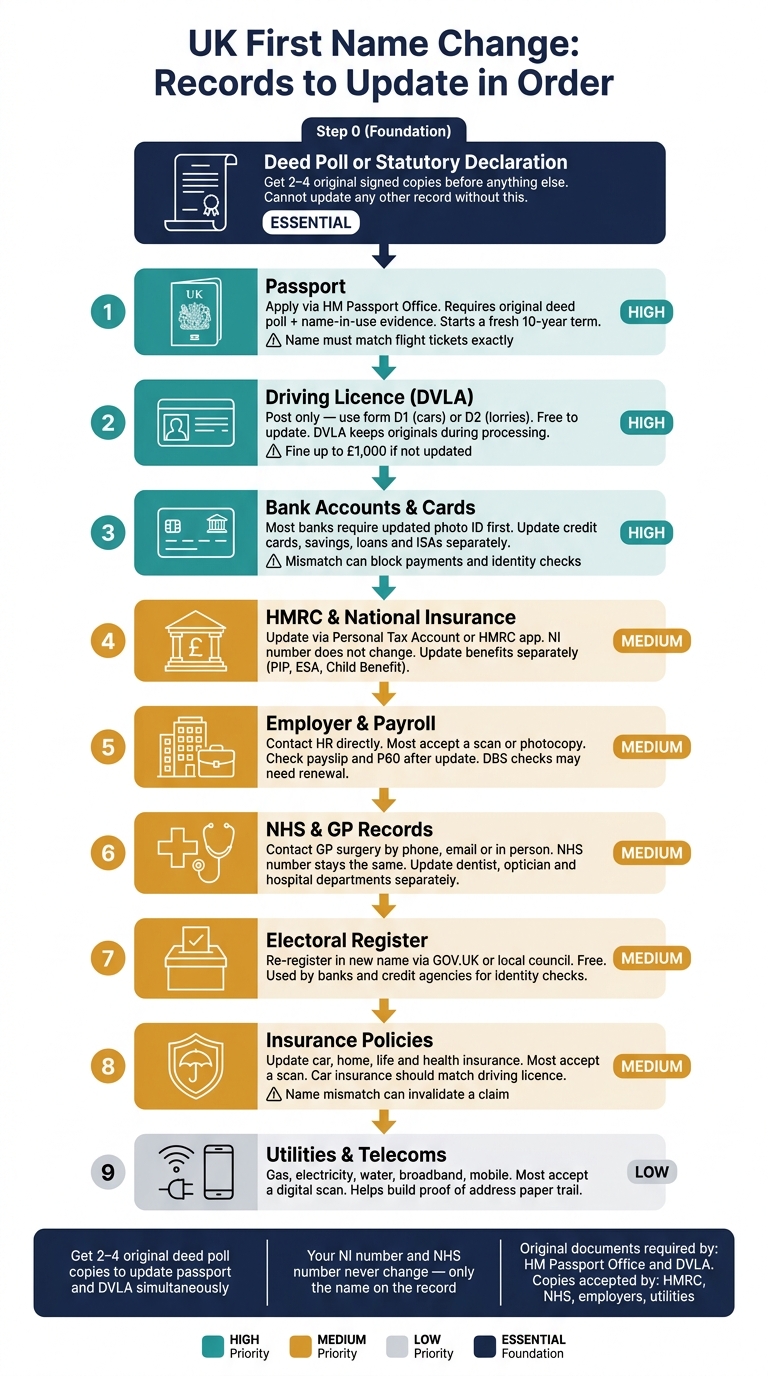
UK First Name Change: Records to Update in Order
Quick comparison
| Record | What I usually need | Why I do it early or late |
|---|---|---|
| Deed poll / statutory declaration | Proof of name change | I cannot start without it |
| Passport | Original proof + name-in-use evidence | Helps with travel and later ID checks |
| Driving licence | Original proof | Legal duty to update |
| Bank accounts | Proof + often photo ID | Used for pay, bills and ID checks |
| HMRC | Online update, proof sometimes requested | Keeps tax and pay records in line |
| Employer | Scan or copy in many cases | Stops pay and payroll issues |
| NHS / GP | Copy or scan in many cases | Keeps prescriptions and referrals in the right name |
| Electoral register | New registration | Helps with credit and voting |
| Insurance | Copy or scan in many cases | Cuts claim delays |
| Utilities / telecoms | Copy or scan in many cases | Helps build proof of address |
My rule of thumb is simple: proof first, photo ID next, finance and tax after that, then medical and household records last.
That order cuts down mismatched records and makes each next update easier. This structured approach also helps manage how long the name change process takes overall.
sbb-itb-bf1bef6
What counts as proof of a first name change in the UK?
Before you contact any organisation, it helps to know what proof they’ll accept. That depends on why you’re changing your name and who you need to tell. Get this clear first, and you’ll save yourself a lot of back-and-forth.
Unenrolled deed poll
An unenrolled deed poll is the standard proof for a personal first-name change in the UK. It’s a formal statement that says you’ve adopted your new name. HM Passport Office, the DVLA, HMRC, banks and the NHS all accept it.
Under UK common law, your name changes as soon as the deed poll is signed properly and witnessed by an independent adult aged 18 or over. That witness must not be related to you, your partner, or living with you. There’s no government approval step and no waiting period, as you do not need to enrol your deed poll for it to be legally binding.
Statutory declaration
A statutory declaration is another accepted form of proof. It’s made before a solicitor or commissioner for oaths, and HM Passport Office and the DVLA both accept it.
The catch? You’ll usually need to book in with a solicitor or commissioner for oaths, and there’s normally a fee.
Marriage or civil partnership certificate
A marriage or civil partnership certificate is not enough on its own for a first-name change. Use it only if you’re changing surname details as well.
Certified copies and originals
This is where people often get caught out. HM Passport Office and the DVLA want original signed documents. They do not accept scans or photocopies. They also keep the originals while they process your application, and that can take several weeks.
So, if you’re using a deed poll, it’s smart to order at least two or three original copies from the start. That way, you can send one to HM Passport Office and one to the DVLA at the same time instead of doing everything in a slow queue.
Employers, GPs and utility companies are usually much easier. In most cases, they’ll accept a photocopy or digital scan.
The table below shows where originals are needed and where copies usually do the job.
| Organisation | Accepts copies? | Notes |
|---|---|---|
| HM Passport Office | No | Requires original signed document |
| DVLA | No | Requires original signed document |
| Banks | Sometimes | Most require an original or certified copy in branch |
| HMRC | Yes | Can often be updated via Personal Tax Account |
| NHS / GP | Yes | Photocopies or scans accepted |
| Utilities / Employers | Yes | Digital scans or photocopies accepted |
With your proof ready, start with passport and driving licence updates first.
1. Name Change deed poll documents
With your proof in hand, start with the records that open the door to every other update. These first changes depend on your deed poll, so it makes sense to sort them before your bank, HMRC, and your employer.
For a personal first-name change in the UK, an unenrolled deed poll is the standard form of proof. It needs to be signed by hand and witnessed by an independent adult aged 18 or over. You then use that signed deed poll to ask for updated ID and other records.
Best next step
The simplest order is this: get enough original copies, then apply for your passport and driving licence at the same time. Order at least two original copies so you can update both in parallel, instead of waiting for one to come back before sending off the other.
Name Change includes three certified copies as standard with its Printed & Posted service, from £16.95. That also comes with tracked delivery and saved PDF copies for records that don’t need an original document.
Once you have your deed poll, move straight to your passport.
2. Passport
Your passport is one of the main forms of photo ID in the UK. It usually makes sense to update this first with your deed poll, because many other records tend to follow it.
Legal proof needed
HMPO accepts an original deed poll or statutory declaration, along with a recent document that shows your new name in day-to-day use. This can be something like a payslip, bank statement or council tax letter.
Why it comes first
An updated passport can make later identity checks much easier when you change your name on other records. Banks and other financial institutions often use it as supporting proof when they update the name on an account.
Risk if delayed
There is no legal deadline for updating your passport after a first name change. Even so, mixed names across different documents can slow things down during identity checks for financial or legal applications.
If you already have travel booked, this matters even more. The name on your passport must match your ticket exactly, or you may be refused boarding.
Typical update route
You must renew your passport in your new name. You can't just amend the old one.
Your new passport will also start a fresh 10-year term, instead of keeping any time left on your current passport.
Once your passport is updated, move straight on to your driving licence.
3. Driving licence
Updating your driving licence is free. For many people, it’s the next ID check to deal with after updating a passport.
Legal proof needed
The DVLA accepts an original deed poll, statutory declaration, or marriage/civil partnership certificate. If your UK passport has already been updated, you can give its nine-digit passport number instead of sending extra paperwork.
If your passport hasn’t been updated yet, include one document in your new name dated within the last 12 months.
The DVLA keeps your original documents while it deals with the application. So if you’re changing other records at the same time, it helps to have enough deed poll copies ready.
You can’t change your name online with the DVLA. You need:
- form D1 for cars and motorcycles
- form D2 for lorries and buses
You can get these forms from most Post Offices and send the application by post to DVLA Swansea. In Northern Ireland, use DVA Coleraine.
Risk if delayed
You must tell the DVLA after changing your name. If you don’t, you could face a fine of up to £1,000. On top of that, if your details don’t match, an insurance claim can turn into a headache.
Typical update route
You can keep driving while the DVLA processes your new licence. When the new one arrives, check every detail against your deed poll: spelling, spacing, middle names, and hyphens. It all needs to match exactly.
One small but common catch: updating your licence does not update your V5C logbook. Once your licence is in your new name, you can move on to bank accounts and cards.
4. Bank accounts and cards
Once your passport or driving licence is sorted, your bank should be next. There’s no fee to change your name with most banks, but many will ask for updated photo ID before they’ll amend their records.
Legal proof needed
Banks often accept an original deed poll, statutory declaration, marriage certificate or civil partnership certificate. That said, the exact rules can differ from one bank to another.
Some banks want the original signed document, or a certified copy, shown in branch. Others let you send a scan or upload it through their mobile app. It’s worth checking the bank’s process before you head to a branch or post anything.
Identity verification impact
Bank statements are often used as proof of ID or address with other providers. If your bank account still shows your old name, that mismatch can create extra hassle when you:
- set up new services
- prove your income
- go through identity checks
It’s one of those small admin jobs that can save a lot of back-and-forth later.
Risk if delayed
If your records are out of date, you may run into delays, extra checks or even blocked transfers. And if you’re paid salary or benefits into that account, a name mismatch can sometimes lead to payment problems too.
Typical update route
Timescales vary by bank and by product. You’ll usually need to tell credit card providers separately, even if they’re part of the same banking group. The same goes for ISAs, savings accounts, loans, pensions and investments - these often need their own update request.
Next, update HMRC and National Insurance so your tax record matches.
5. HMRC and National Insurance records
After your ID and bank details, HMRC is the next record to sort out. Your new name needs to match HMRC’s records, or you can run into legal implications and delays with tax, payroll, and benefits.
Typical update route
You can update HMRC through your Personal Tax Account or the HMRC app. In most cases, HMRC accepts a scan or photocopy of your deed poll or other proof. Once you’ve told them, your Self Assessment records usually update on their own.
Your National Insurance number does not change.
Benefit records are separate, so you’ll need to report name changes for those as well, including:
- PIP
- ESA
- Child Benefit
Risk if delayed
If you don’t report the change promptly, a claim may be reduced or stopped. Delays can also hold up refunds, throw off your tax code, and affect benefit payments.
Identity verification impact
It helps to keep HMRC and payroll in sync if you need to prove income for financial services or pass ID checks. It’s best to tell payroll at the same time.
Once HMRC is updated, move straight to employer payroll records.
6. Employer and payroll records
Once HMRC is sorted, update your employer next. Do this as soon as you can so your pay, tax and staff benefits stay in step.
Proof needed
Most employers will accept a scan or photocopy of your deed poll. It’s worth checking with HR first, as some firms also ask you to fill in an internal form.
If your job needs a Disclosure and Barring Service (DBS) check, it works a bit differently. An existing DBS certificate usually can’t be changed, so you’ll often need a new check.
Typical update route
Contact your HR or payroll team directly. In many workplaces, this is handled by email or through an internal employee portal.
After the change goes through, make sure all linked records have been updated, including payroll, pension and any staff benefits. Then check your next payslip and your P60 to confirm the new name is showing correctly.
Once payroll is sorted, move on to NHS and GP records.
Risk if delayed
If you leave this too long, your payroll record and HMRC record can end up not matching. That can lead to the wrong tax code and slower tax refunds. It may also make pension contributions harder to trace later on.
7. NHS and GP records
Next, update your GP record so prescriptions and referrals match your new name. Most GP surgeries will accept a copy of your deed poll. After that, you’ll need to update each NHS-linked record separately.
Typical update route
Contact your GP surgery by phone, email, or in person, and ask reception or the practice manager to change the name on your record as part of the process to change my name legally in the UK. From there, deal with each provider one by one. That includes your dentist, optician, and any hospital departments where you’re getting treatment.
Your NHS number stays the same throughout. Only the name on the record changes.
Risk if delayed
If you leave this too long, it can lead to awkward problems with prescriptions, referrals, and appointments. A prescription issued in your old name may not match your photo ID, which can cause trouble at the pharmacy, especially for controlled drugs.
Referral letters and appointment reminders sent in the wrong name can also create issues at specialist clinics.
Then update the electoral register.
8. Electoral register
Once your NHS record is up to date, the next step is the electoral register.
You don’t change the name on your current entry. Instead, you register again in your new name through the standard register-to-vote service. It’s free, and most councils will accept a photocopy or scanned copy of your deed poll.
Typical update route
Get in touch with your local council’s electoral registration office. You can find your council through your Council Tax bill or on GOV.UK. In Northern Ireland, contact the Electoral Office for Northern Ireland instead.
After you send in your new details, the council will process the change. It’s worth doing this without delay, because this record is often used for identity checks in other places too.
Identity verification impact
Banks, lenders and credit reference agencies use the electoral register to check your identity and address.
So if your bank has your new name, but the electoral roll still shows your old one, that mismatch can cause issues during credit checks or when you apply for financial products. It’s the sort of small admin gap that can turn into a headache later.
An updated entry can also help with a passport application, because it may support proof that you’re using your new name.
Risk if delayed
If you miss an election update, you could be turned away at the polling station.
Leaving your old name on the register can also create avoidable identity mismatches, especially when different organisations are checking the same details against each other.
9. Insurance policies
Once your passport, driving licence and bank details are sorted, move on to insurance. Do this after those records are updated, so each policy lines up with the ID an insurer may check if you need to make a claim.
Legal proof needed
Most insurers will accept a photocopy or digital scan of your deed poll. It helps to keep a PDF ready to upload or email, rather than hunting for it each time.
Risk if delayed
If the name on your policy does not match the name used on your claim paperwork, the insurer may hold things up while they check the details. That can turn a simple claim into a bit of a headache.
Typical update route
Contact each insurer by phone, app or online portal. If one company handles more than one policy for you, ask them to update all linked policies in a single request. It’s also worth asking if there are any amendment fees.
| Insurance type | Typical proof required | Priority level |
|---|---|---|
| Car insurance | Photocopy or scan of deed poll | High - should match your driving licence |
| Home insurance | Photocopy or scan of deed poll | Medium |
| Life insurance | Photocopy or scan of deed poll | Medium |
| Health insurance | Photocopy or scan of deed poll | Medium |
Travel insurance must match your passport and booking exactly.
Next, update utility and telecoms accounts, where scanned proof is usually enough.
10. Utility and telecoms accounts
After insurance, deal with your utility and telecoms accounts: gas, electricity, water, broadband and mobile.
Legal proof needed
Most providers will accept a photocopy or digital scan of your deed poll.
Identity verification impact
A utility bill in your new name still helps. It adds to a steady paper trail, which can make future identity checks much smoother.
Risk if delayed
There’s no legal deadline for updating utility accounts. But if you leave them as they are, you’ll have less supporting evidence for future identity checks. Mixed names across bills and official ID can also cause avoidable hassle when your identity is checked or when you apply for new financial services.
Typical update route
Most providers let you do this through an online portal, a change-of-details form or by email. If you have linked services, ask them to update everything in one go. For example, that might be a combined gas and electricity account or a broadband and mobile bundle.
| Provider type | Priority level |
|---|---|
| Gas & electricity | Low/medium |
| Water | Low/medium |
| Broadband | Low |
| Mobile | Low |
Quick comparison: priority level and requirements for each record
Here’s a quick reference for what each update needs, how to handle it, and the main risk if you leave it unchanged.
Use the table below to work out what to update first and what proof each organisation is likely to ask for.
| Record | Priority | Document needed | Update route | Main risk |
|---|---|---|---|---|
| 1. Deed poll documents | Essential | N/A (this is your proof) | Online (ordering) | Cannot update any other record without this |
| 2. Passport | High | Original deed poll | Online (application) | Denied boarding |
| 3. Driving licence | High | Original deed poll | Post only | Fine risk; weaker ID for checks |
| 4. Bank accounts | High | Original deed poll plus ID | Sometimes online; often in branch | Failed identity checks; payment and credit issues |
| 5. HMRC & National Insurance | Medium | Proof usually not needed | Online (Personal Tax Account) | Tax code errors; National Insurance contribution gaps |
| 6. Employer & payroll | Medium | Photocopy or scan usually accepted | Usually no | Salary payment delays; mismatch with HMRC records |
| 7. NHS & GP | Medium | Photocopy or scan usually accepted | Contact GP surgery | Confusion in medical records, prescriptions, or referrals |
| 8. Electoral register | Medium | New registration form | Online | Negative impact on credit score; unable to vote |
| 9. Insurance policies | Medium | Photocopy or digital scan | Usually online | Policy may be declared invalid at point of claim |
| 10. Utilities & telecoms | Low | Photocopy or digital scan | Usually online | Weaker proof of address |
If you want to avoid delays, get enough original deed poll copies first, then update your passport and driving licence.
Tips for handling the updates without delays
A bit of prep when learning how to change your name can save a lot of back-and-forth later. The main aim is simple: don’t keep sending the same proof over and over, and don’t let one update hold up the next.
Order enough certified copies
Get 2–4 original deed polls at the start, along with certified copies for later updates. That gives you enough paperwork to deal with more than one organisation at a time.
Once you’ve got your copies ready, update your photo ID first.
Start with identity and banking records
Begin with your passport and driving licence, then use those updated documents to sort out your bank.
When both forms of ID are updated, banks and building societies are often in a better position to process account changes without as much friction. It’s a small step that can make the rest of the admin far less of a slog.
Check travel bookings carefully
Go through each booking and ask the airline or travel company to amend it before you travel. Don’t assume one change will flow through to every part of the trip.
Your name on every booking needs to match your passport exactly before you go.
Keep a paper trail
Put your payslips, bank statements, council letters and confirmation emails in one folder. Paper folder, digital folder, or both - it doesn’t matter, as long as it’s all in one place.
Then use that same file when updating financial accounts and policies. It saves time, and it cuts down the odds of hunting for the same document twice.
Update linked financial accounts next
After that, update credit cards, savings, loans, pensions and insurance one by one. These records don’t always change automatically, even when they’re linked to the same bank or provider.
It’s worth checking each account separately rather than finding out later that one was missed.
Conclusion
Start with your deed poll. Then update your driving licence and passport.
After that, move on to your bank accounts, HMRC, your employer and your NHS records. Leave the electoral register, insurance and utilities until the end. That order makes life easier, because banks and other organisations often ask for photo ID in your new name before they’ll change their records.
As each update goes through, save the confirmation right away. Keep every deed poll, confirmation email and reference number together in one folder.
If you get the order right at the start, the rest is mostly simple admin.
FAQs
Can I update my bank before my passport?
It’s usually best not to. Many banks ask for photo ID in your new name, so if your passport is still in your old name, you may run into problems.
The simplest route is to update your main photo ID first, such as your passport or driving licence. Then you can update your bank and other financial records.
How long do name changes usually take?
There’s no single legal deadline for updating your records, and the timing can differ from one organisation to another.
Your name change becomes legally valid as soon as your deed poll is signed and witnessed. After that, some records can be updated quite fast, while others may take longer to process.
If you update your passport and driving licence first, the rest is usually easier. In most cases, the whole process takes a couple of weeks rather than months.
What if some records stay in my old name?
If some records stay in your old name, things can slow down. It can also lead to identity mismatches with organisations such as banks and the NHS.
There usually isn’t a strict legal deadline. But it makes sense to deal with the main records first:
- passport
- driving licence
- HMRC/National Insurance
- your employer
After that, work through the rest using your deed poll as proof. Keep notes as you go, and save any confirmation references.