Legal Requirements For Changing A Minor's Middle Name
Changing a minor's middle name in the UK requires consent from everyone with parental responsibility (PR). If all PR holders agree, the process is straightforward and can be done using an unenrolled deed poll. This document is widely accepted for official purposes, such as updating passports and school records. For a more formal record, an enrolled deed poll can be used, though it involves public disclosure and additional costs.
If consent cannot be secured, you may need to apply to the court for a Specific Issue Order, which considers the child's best interests. Mediation is often recommended before taking legal action. Note that birth certificates can only be updated within specific timeframes and conditions.
Key Points:
- Consent: Required from all PR holders.
- Unenrolled Deed Poll: Private, simpler option.
- Enrolled Deed Poll: Formal but public.
- Court Application: Necessary if PR holders disagree.
- Document Updates: Notify relevant organisations post-name change.
Follow the correct steps and ensure all documents are updated to reflect the new name.
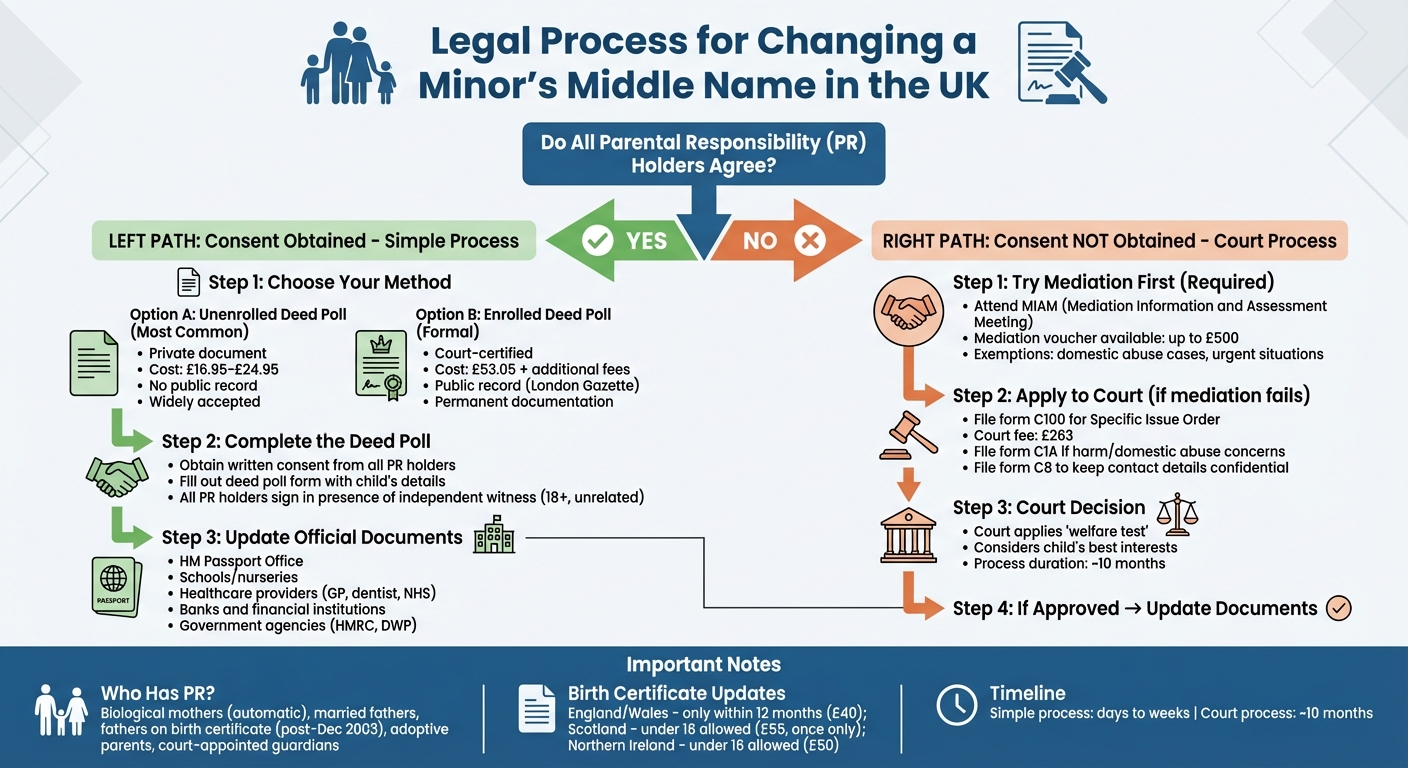
Step-by-step process for changing a minor's middle name in the UK
Parental Responsibility and Consent Requirements
Who Has Parental Responsibility?
Parental responsibility (PR) refers to the legal rights and obligations tied to a child's upbringing. According to GOV.UK:
Having parental responsibility means you have legal rights and duties relating to your children's upbringing.
This includes decisions about care, education, medical treatment, and importantly, any changes to the child's name.
Biological mothers automatically gain PR at birth. For biological fathers, PR applies if they were married to the mother at the time of the child's birth or if their name is listed on the birth certificate (for births registered in England and Wales after 1st December 2003). PR is also granted to adoptive parents, legal guardians appointed by the court, or individuals awarded PR through a court order.
Even if a parent does not live with the child, having PR ensures they retain a say in major decisions.
Knowing who holds PR is critical to understanding why unanimous agreement is required for a child’s name change.
Why All Parties Must Agree
Since PR grants each holder significant decision-making authority, all parties must consent to changing a child's name. This includes changes to a minor's middle name, which is considered a significant decision requiring unanimous written agreement from all PR holders.
This rule safeguards both the child's best interests and the rights of those with PR. Dame Elizabeth Butler-Sloss, in Re J (Specific Issue Orders), highlighted that altering a child's name is one of the key decisions that demands either the consent of all PR holders or approval from the court.
sbb-itb-bf1bef6
Changing a Middle Name with an Unenrolled Deed Poll
How the Unenrolled Deed Poll Works
An unenrolled deed poll is a legal document that allows you to officially confirm a child's middle name change using a deed poll. While it isn't officially recorded, it is still widely recognised by organisations across the UK. This document plays a key role in meeting the legal requirements for changing a minor’s name.
To start, you'll need to secure written consent from everyone with parental responsibility (PR). Once you have that, you can fill out the deed poll form with the necessary details, including the child's current name, new middle name, date of birth, and address. All PR holders must sign the document in the presence of an independent witness who is at least 18 years old and not related to the family.
Once signed, the deed poll acts as formal proof of the name change. Although UK common law allows name changes through consistent use, most organisations require official documentation before updating their records. You can use the deed poll to update key documents like passports and school records.
For the name change to be fully recognised, the new middle name must be used consistently in all settings. If the name includes accents or special characters, UK organisations will typically convert them into standard Latin characters (e.g., "é" becomes "e").
If you're looking for a straightforward way to handle this process, services like Name Change simplify the creation and use of unenrolled deed polls.
How Name Change Can Help

Name Change provides an easy-to-use online service for creating legally compliant unenrolled deed polls for minors. Their service includes three certified copies, tracked delivery, and PDF archiving. The entire process takes about five minutes.
There are two options available:
- Printed & Posted (£16.95): Includes printed documents with an ink stamp.
- Printed & Posted Premium (£24.95): Adds a gold embossed stamp for a more formal appearance.
Both options come with a detailed guide on updating official records and offer unlimited PDF downloads for extra copies if needed.
Customers often appreciate the simplicity of the service. As one customer, TH from Hampshire, shared: "Thank you for making the process so easy to understand". The documents are guaranteed to be accepted by UK government departments and organisations, eliminating the need for solicitors or legal advice.
The Enrolled Deed Poll Option
When to Use an Enrolled Deed Poll
When it comes to legally changing a minor's middle name, an enrolled deed poll offers a more formal, court-certified option. Unlike an unenrolled deed poll, this version creates a public record of the name change, providing additional legal weight.
An enrolled deed poll is officially registered at the Royal Courts of Justice in London. Once the change is recorded, details such as the old name, new name, and home address are made publicly accessible through the London Gazette. This document is widely accepted as definitive proof of a name change, eliminating the need for further evidence of consent.
Enrolled deed polls are particularly useful in situations where formal, court-approved documentation is required. This might include inheritance disputes, legal proceedings, or instances where international authorities demand more stringent proof of identity changes for travel purposes.
However, there is a notable drawback: the lack of privacy. As Sarah Chapman, Paralegal at Hegarty, points out:
The details of your change of name, including your old and new name, your home address will be permanently published on the public record and the internet.
For families seeking to change a child's middle name, this public disclosure may be a concern. In contrast, unenrolled deed polls keep such details private, making them a more appealing choice for those prioritising confidentiality. Ultimately, the decision between enrolled and unenrolled deed polls depends on the balance between privacy needs and the requirement for robust legal evidence.
How to Enrol a Deed Poll
The process of enrolling a deed poll involves several steps and requires submission of specific name change documents to the Action Department of the Royal Courts of Justice. Here's what you'll need:
- The original deed poll, signed by the child if they are aged 16 or 17.
- A written statement explaining why the name change is in the child’s best interests.
- Evidence of consent from all individuals with parental responsibility.
- A statutory declaration from a UK householder who is a Commonwealth citizen and personally knows both you and the child. This declaration must be made in the presence of a solicitor.
There is a £53.05 High Court fee to enrol the deed poll. Additional costs may include solicitor fees for witnessing the statutory declaration and charges for obtaining certified copies. Once the enrolment is complete, the name change is advertised in the London Gazette. After five years, the enrolled deed poll is transferred to the National Archives. At that stage, obtaining certified copies might require visiting the archives in person or paying an extra fee.
It’s important to note that this process is only available to children who are British or Commonwealth citizens.
What to Do When Consent Cannot Be Obtained
If all parties with parental responsibility (PR) cannot agree on a name change, the law provides two main options: going through the courts or trying mediation.
Applying to Court for a Name Change
When a parent with PR refuses to give consent, you can apply to the court using form C100 to request a Specific Issue Order under Section 8 of the Children Act 1989. This application comes with a fee of £263.
The court will base its decision on the "welfare test", which considers all relevant factors to determine whether the name change serves the child’s best interests. Changing a middle name is generally more straightforward than altering a surname.
The process of obtaining a court order typically takes about 10 months and costs £263. If there are concerns about harm or domestic abuse, you should file form C1A to inform the court of these issues. Additionally, form C8 can be used to ensure your contact details remain confidential from the other parent during the proceedings.
However, if taking legal action feels too extreme, mediation could be a less confrontational alternative.
Try Mediation First
Mediation offers a way to work towards an agreement without going to court. Before filing a court application, you are required to attend a Mediation Information and Assessment Meeting (MIAM) with a family mediator in England and Wales. The Deed Poll Office explains:
If you don't attend an MIAM, the court cannot process your court application, unless you can show evidence that you don't need to attend one.
To help with costs, a mediation voucher of up to £500 may be available. Exemptions from attending a MIAM can apply in cases involving domestic abuse or urgent situations. Additionally, those with a low income or who have experienced domestic abuse may qualify for legal aid or court fee exemptions.
Updating Official Documents After the Name Change
Once you've completed the deed poll process, it's crucial to update all relevant official records. This ensures consistency across documents and avoids potential issues in the future. Here's a guide to the key updates you'll need to make.
Which Documents Need Updating?
- HM Passport Office: Update your child's passport through the HM Passport Office. Be aware that standard fees will apply.
- Healthcare Providers: Inform your child’s GP surgery, dentist, and other NHS services to ensure all medical records reflect the new name.
-
Schools and Nurseries: Notify your child’s school or nursery to update their records. However, educational certificates already issued - such as exam results - cannot be reissued under the new name. As the UK Deed Poll Service explains:
When needed, present the deed poll alongside original certificates for verification in education or employment contexts.You will not be able to get documents such as your educational certificates changed because they were correctly issued in your legal name at the time. However... you simply produce your Deed Poll as well.
- Financial Institutions and Government Agencies: Update your child’s details with banks, building societies, and credit unions for accounts, savings, or ISAs. Additionally, inform government bodies like HMRC, the DWP, and Social Security Scotland, as well as any insurance providers or utility companies where your child’s name appears on a policy.
Keep in mind that most organisations, including the Passport Office, DVLA, and banks, will require the original deed poll or a certified copy - not a simple photocopy.
Birth Certificate Limitations
It's also important to understand the restrictions surrounding birth certificates. In England and Wales, changes to forenames (including middle names) on a birth certificate can only be made within 12 months of the original registration. This process costs £40. After this period, the birth certificate remains a historical record of the details at the time of birth.
In Scotland and Northern Ireland, the rules are more flexible. For children under 16, name changes can be officially recorded on birth certificates at a cost of £55 in Scotland and £50 in Northern Ireland. However, in Scotland, this change can only be made once per child.
For most families, the deed poll serves as the essential legal document linking the original birth certificate to the updated name. Typically, you’ll need to present both documents together for official purposes.
Conclusion
Changing a minor's middle name in the UK is a straightforward process, but it hinges on following the correct legal steps and obtaining full parental consent. In England, Wales, and Northern Ireland, this consent is a legal requirement.
"Children's names are important and in any situation of dispute, either the consent of the other parent or the leave of the Court is an essential prerequisite, certainly where both parents have parental responsibility."
The most common method for making this change is through an unenrolled deed poll. This private legal document is widely accepted by organisations like the Passport Office and DVLA. It avoids the added complexity and expenses associated with court enrolment.
In Scotland, the process differs slightly. Parents or guardians can use the National Records of Scotland's official recording service to update a child's birth or adoption certificate, as long as all individuals with parental responsibility provide their consent.
If consent from all parties with parental responsibility cannot be secured, applying to the court for a Specific Issue Order becomes necessary. Before taking this step, mediation is recommended to settle disputes without resorting to formal legal action. Once the name change is approved, ensure all official documents are updated using the original deed poll or a certified copy.
FAQs
How do I prove who has parental responsibility?
To demonstrate parental responsibility, you'll need official documents. These could include a birth certificate listing the parent’s details, a court order that grants responsibility, or legal agreements such as a parenting plan. For certain cases, like a minor’s name change or other legal proceedings, courts might ask for additional evidence.
What if one parent with PR won’t agree?
If one parent with Parental Responsibility (PR) does not agree to a child's name change, the other parent cannot make the change on their own. In such cases, the parent seeking the change must apply to the court for permission. This is usually done by filing a specific issue order, which allows the court to decide whether to override the other parent's refusal.
Will my child’s birth certificate be updated?
A child’s birth certificate usually remains unchanged after a name change because it acts as a historical record of the birth details. That said, corrections can be made if there were errors in the original information. In some situations, re-registration or officially recording the name change might also be an option.