Parental Consent Rules for Changing a Child's Name
Changing a child's name in the UK isn't as simple as filling out a form. If you're considering it, here's what you need to know:
-
Who Needs to Agree?
- Everyone with Parental Responsibility (PR) must provide written consent.
- PR is automatically held by mothers and, in many cases, fathers (if married to the mother or listed on the birth certificate after 1 December 2003).
-
What If Someone Disagrees?
- If one PR holder refuses, the matter must go to Family Court for a Specific Issue Order (£215 in England & Wales).
-
Special Cases:
- A Child Arrangements Order (CAO) makes the process stricter. Written consent from all PR holders or court approval is required.
-
Age Matters:
- Children aged 16+ can change their name without parental consent unless a court order restricts it.
-
Using a Deed Poll:
- A Deed Poll is needed to formalise the process, but it won't alter the birth certificate.
Changing a child's name is a legal process that requires cooperation or court intervention. Always prioritise the child’s welfare and explore mediation before escalating disputes.
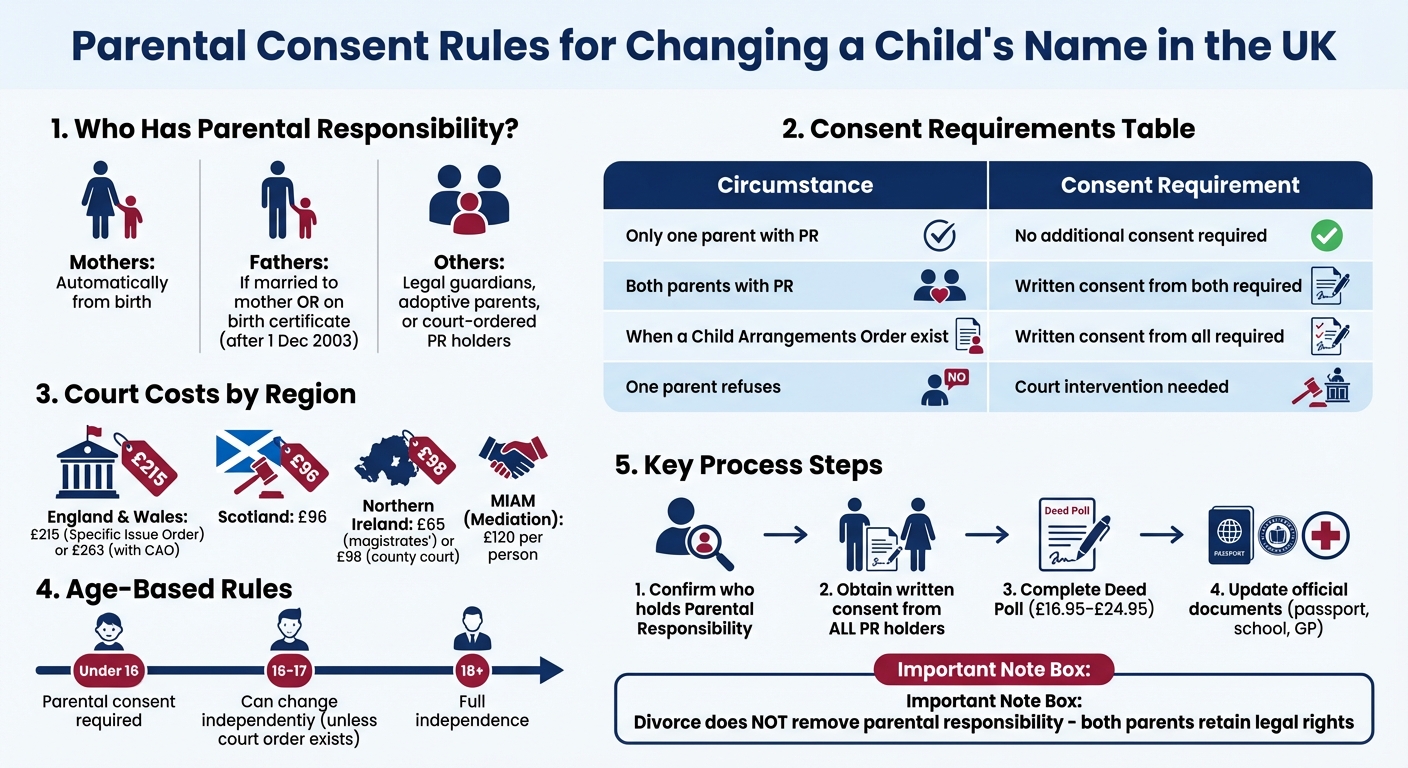
UK Parental Consent Requirements for Changing a Child's Name
What Consent is Needed to Change a Child's Name Under 16?
Changing a child's name under the age of 16 requires consent, which depends on who holds Parental Responsibility (PR). PR gives individuals the legal authority to make decisions about a child's upbringing, including their name.
Who Has Parental Responsibility?
Parental Responsibility can be held by different individuals depending on the circumstances. Here's how the process works:
- Mothers automatically have PR from the moment of birth.
- Fathers gain PR if they are married to the mother at the time of birth or if their name is listed on the birth certificate (for births registered after 1 December 2003).
- Others with PR may include legal guardians, adoptive parents, or individuals granted PR through a court order, such as a Child Arrangements or Special Guardianship Order.
As Mr Justice Holman of the High Court for England & Wales explains:
"Where only one person has parental responsibility for a child... that person has the right and power lawfully to cause a change of surname without any other permission or consent."
Understanding who holds PR is crucial, as it determines when and whose consent is required for a name change.
When Is Consent Required?
If only one person holds PR, they can change the child's name without needing anyone else's approval. However, if multiple people share PR, written consent from all parties is required - this applies to changes of both forenames and surnames.
Yashmin Mistry, a family law expert from JPC Law, summarises it well:
"In England and Wales, you can change your child's name if you have parental responsibility (PR). But if more than one person has PR, you'll need the written consent of everyone else who holds it."
Even when using a Deed Poll, organisations like the Passport Office will insist on documented consent from all PR holders.
| Circumstance | Consent Requirement |
|---|---|
| Only one parent with PR | No additional consent required |
| Both parents with PR | Written consent from both required |
| When a Child Arrangements Order exists | Written consent from all required |
| One parent refuses | Court intervention needed |
Exceptions to Consent Rules
If only one person holds PR, they can proceed without needing anyone else's consent. However, if consent is withheld by another PR holder, the matter must be resolved through the Family Court. In such cases, the court will issue a Specific Issue Order, guided by the Welfare Checklist, to ensure the child's best interests are prioritised.
Before taking legal action, it’s recommended to explore mediation or negotiation to resolve disputes. Courts are generally cautious about approving changes that might sever a child's connection to a parent, particularly in cases involving surname changes, which often carry significant emotional and familial importance.
sbb-itb-bf1bef6
Consent Rules When a Child Arrangements Order Exists
When a Child Arrangements Order (CAO) is in place, changing a child's name becomes more complex. Even if you have Parental Responsibility, you’ll need either written consent from everyone with Parental Responsibility or permission from the court. This builds on the general rules about name changes for children.
What is a Child Arrangements Order?
A Child Arrangements Order is a legal ruling that decides where a child lives and how much time they spend with each parent, usually following a separation. It also grants shared Parental Responsibility to those named in the order. This means that big decisions, such as changing the child’s name, must be agreed upon by all parties involved.
Under Section 13 of the Children Act 1989, if the CAO specifies who the child lives with, no one can change the child’s surname without written consent from all individuals with Parental Responsibility or permission from the court.
If you can’t get the required consent, you’ll need to apply to the Family Court under the Children Act 1989. Court fees vary depending on where you live in the UK:
- £263 in England and Wales
- £96 in Scotland
- £65 (magistrates’ court) or £98 (county court) in Northern Ireland
How Does a Court Decide on Name Changes?
When disputes remain unresolved, the court steps in, focusing entirely on the child’s welfare. Judges rely on the statutory Welfare Checklist, which considers factors like the child’s wishes (depending on their age and maturity), emotional and physical needs, and how the change might affect their identity and relationships.
Courts are especially cautious when it comes to surname changes. In the case of Dawson v Wearmouth, the court emphasised:
"Other things being equal, it is in the long-term interests of the child that the name by which he is known should also be the name which appears on his birth certificate."
The surname is often seen as an essential link to a parent's identity. As the Deed Poll Office explains:
"The court tends to resist consenting to changes of surname, because... the child's surname is seen as an important link to their father (or mother, as the case may be), and an important part of the child's identity."
That said, courts are more open to double-barrelled surnames, as they maintain ties to both parents. First name changes, on the other hand, tend to face less resistance since they don’t carry the same familial significance.
Before taking the matter to court, try contacting the other parent and consider mediation. Courts expect disputes to be resolved outside of litigation whenever possible. You’ll usually need to attend a Mediation Information and Assessment Meeting (MIAM), which costs around £120 per person, to show that you’ve made an effort to settle the issue without court involvement.
What Happens If One Parent Does Not Consent?
When parents cannot agree, legal measures are in place to ensure the child's welfare takes priority. If one parent refuses to give consent, you can apply to the Family Court for a Specific Issue Order under Section 8 of the Children Act 1989. However, you must first show that you have made a genuine effort to communicate and reach an agreement with the other parent.
Specific Issue Orders for Name Changes
In England and Wales, before applying to court, you are required to attend a Family Mediation Information and Assessment Meeting (MIAM). Once this step is completed, you can submit your application using Form C100. If concerns about domestic abuse or the child's safety exist, you should also include Form C1A. Additionally, if you need to keep your contact details confidential, you must submit Form C8.
The fees for these applications vary depending on location:
- £215 in England and Wales
- £96 in Scotland
- £65 (magistrates') or £98 (county court) in Northern Ireland.
Once your application is filed, the court will review the situation and decide whether the name change is in the child's best interests.
Factors Considered by the Court
The court's decision is guided by the welfare test, which focuses on what benefits the child the most. Judges take into account several factors, including the child's own wishes (depending on their age and understanding), their emotional and educational needs, and any potential risks involved. Courts are particularly cautious about changing a child's surname, as it is considered an essential part of their identity and a lasting connection to both parents.
If you can demonstrate that the other parent's absence or behaviour negatively impacts the child, your case becomes stronger. Courts often prefer double-barrelled surnames as a way to maintain ties to both parents.
When Can a Child Decide to Change Their Name?
In the UK, the ability to legally change a name shifts from parental control to personal autonomy as a child grows older. While younger children require parental consent, those aged 16 or 17 can make this decision independently, marking an important step in asserting their identity.
Name Changes at Age 16 or 17
Once someone turns 16, they have the legal right to change their name without needing parental consent. The Deed Poll Office explains:
"Once you're 16 years old, it's legally your own decision to change your name" (Deed Poll Office).
However, there are exceptions. If a court order - such as a Child Arrangements Order, Residence Order, Special Guardianship Order, or Care Order - is in place, the individual must still obtain written consent from all those with parental responsibility. Alternatively, they can apply to the court for a Specific Issue Order. These restrictions typically remain valid until the individual turns 18.
Using a Deed Poll for Name Changes
For individuals aged 16 or 17, a deed poll is the standard way to officially change a name. This legal document provides proof of the new name and is recognised by UK government departments, passport offices, and other organisations.
Services like Name Change make the process straightforward, offering an online platform to create an unenrolled deed poll. This ensures the new name is accepted by all relevant authorities, making the transition smooth and legally binding.
This shift in legal rights at 16 highlights the transition from parental oversight to personal responsibility, empowering young individuals to take control of their identity.
How Divorce Affects Parental Responsibility and Consent
Changes in Parental Responsibility After Divorce
There’s a common misunderstanding that divorce somehow changes a parent’s legal authority over decisions like a child’s name. The truth is, divorce or separation doesn’t automatically affect parental responsibility. Both parents retain their legal rights and obligations towards their child, even after the divorce is finalised. This means that decisions like changing a child’s surname - whether to reflect a new partner’s name or revert to a maiden name - require the consent of both parents. No single parent can make this decision alone.
Lawhive clarifies this point:
"Divorce or separation does not in any way remove parental responsibility from either parent. They will still retain the legal rights and duties toward the child."
While a divorced adult can revert to their maiden name using their marriage certificate and decree absolute, these documents don’t grant the authority to change a child’s name. Changing a child’s name is a separate legal process and requires the agreement of all parties with parental responsibility.
Resolving Disputes Between Divorced Parents
Because divorce doesn’t alter parental rights, disagreements over a child’s name must follow specific legal procedures. In most cases, parents are required to attend a Mediation Information and Assessment Meeting (MIAM) to attempt to resolve the issue with the help of a neutral mediator. However, if there’s evidence of domestic abuse, mediation is not mandatory.
When mediation doesn’t lead to an agreement, the matter can be escalated to court. There are two main legal routes:
- A parent seeking to change the child’s name can apply for a Specific Issue Order.
- A parent opposing the change can apply for a Prohibited Steps Order, which prevents the change without their consent.
Filing Form C100 to request a Specific Issue Order in the Family Court comes with a fee of £255. Ultimately, the court’s decision will centre on the child’s welfare. Factors such as the child’s age, their feelings about the name change, the reasons behind the request, and the potential impact on the child’s sense of identity will all be considered. As Lawhive explains:
"The court will always prioritise the child's welfare in all decisions related to name changes."
Using Deed Polls for Children's Name Changes with Consent
Overview of the Deed Poll Process
Once you’ve secured written consent from everyone with parental responsibility (PR), the deed poll process completes the legal steps for changing a child’s name. The first step is confirming the PR holders, as previously outlined.
A professionally drafted Child Deed Poll will include both the current and new names, meeting all UK legal requirements. It’s important to note that while a deed poll doesn’t change the birth certificate (which remains a historical record), it provides the legal authority to update other official documents now and in the future. Many services can prepare a Child Deed Poll quickly once all necessary details and consents are provided.
After the deed poll is finalised, use it alongside the original consent forms to update key records such as the child’s passport, school records, and GP registration. HM Passport Office requires the original deed poll and consent documents - photocopies are not accepted. Following this process ensures the name change is legally recognised and compliant with all relevant regulations.
How Name Change Ensures Legal Compliance

Name Change offers a secure service tailored to meet UK legal standards, providing professionally prepared deed poll documents and consent forms in line with the Children Act 1989.
The Printed & Posted service, available for £16.95, includes printed documents, three certified copies, an ink stamp, a board-backed envelope, a guide, and a PDF archive. For those seeking a more formal touch, the Premium service costs £24.95 and includes a gold embossed stamp. Both services are widely accepted by official bodies such as HM Passport Office, schools, and healthcare providers.
Practical Tips for Using Deed Polls
To ensure a smooth transition to the new name across all records, consider these tips:
- Confirm all PR holders before ordering the deed poll to avoid delays or rejections.
- Store the original deed poll safely, as most organisations require the original document or a certified copy - not a standard photocopy.
- When updating official records, start with the child’s passport, then move on to school records and GP registration. This helps maintain consistency across all legal identities.
If there’s a need to add a father to a birth certificate to grant him parental responsibility, contact the General Register Office directly. A deed poll cannot address this issue. Finally, remember that changing a child’s name without full PR consent violates the Children Act 1989 and invalidates the deed poll.
Conclusion
Changing a child's name in the UK is a significant legal step, deeply linked to identity, relationships, and a sense of belonging. As Yashmin Mistry from JPC Law explains:
"Changing a child's name is never just paperwork it's deeply tied to identity, relationships, and belonging."
The process requires written consent from everyone with parental responsibility. Even after divorce or separation, this requirement remains unchanged.
If disagreements occur, the family court steps in through a Specific Issue Order. This process, which prioritises the child's welfare, can take up to three months. Before turning to the court, parents must attend a Mediation Information and Assessment Meeting (MIAM), unless exceptions like domestic abuse apply.
Once consent is secured, a deed poll finalises the name change and provides the necessary legal authority to update official records. Services like Name Change offer a practical solution, starting at £16.95, including certified copies, tracked delivery, and documents recognised by HM Passport Office and other government agencies.
Understanding who holds parental responsibility and securing the required consent is key to avoiding delays or complications. Whether you're working through an amicable agreement or handling a contested case, following the proper legal steps ensures a smooth transition while protecting your child's best interests.
FAQs
Who counts as having Parental Responsibility?
Parental responsibility involves the legal rights and obligations a parent holds regarding their child’s care and upbringing. This extends to making key decisions that shape the child’s life, including choices like changing the child’s name.
Can I change my child’s name after divorce without the other parent’s consent?
No, you cannot change your child’s name after a divorce without obtaining written consent from everyone who holds parental responsibility. This is a legal requirement designed to ensure that all individuals with a say in the child’s welfare agree to such an important decision.
Will a deed poll change my child’s birth certificate?
A deed poll allows you to change your child’s surname, but it does not alter their original birth certificate. If you need to update the birth certificate, this typically requires a separate legal process, such as securing a court order.