Can Minors Change Their Name by Deed Poll?
Yes - but the rules depend on age, parental responsibility, and any court order.
If I want the short version, it looks like this:
- Under 16: a person with parental responsibility must deal with it
- Under 16: everyone else with parental responsibility must agree in writing
- Age 16 or 17: the young person can usually sign their own unenrolled deed poll
- If there is a dispute: the case usually goes to family court using Form C100
- Court fee for a Specific Issue Order: £263
- Enrolled deed poll fee: £53.05
- A deed poll does not change the birth certificate
That means the main question is not just the child’s age. It is also who has parental responsibility and whether any order already limits a name change.
Here’s the quickest way I’d break it down:
| Age | Who can start it | Consent position | Usual route |
|---|---|---|---|
| Under 16 | Person with parental responsibility | All people with parental responsibility must agree | Unenrolled deed poll |
| 16–17 | Young person | Usually none | Unenrolled deed poll |
| Any age where there is a dispute or court order | Court may need to decide | Consent issue or legal restriction | Form C100 / court order |
A few points catch people out:
- Divorce does not end parental responsibility
- An unmarried father may still have parental responsibility
- A care order, special guardianship order, or child arrangements order can limit a change
- If one person with parental responsibility says no, a deed poll alone is not enough
- HM Passport Office, schools and GPs can usually update records after the deed poll is signed
So if I were checking this for my own family, I’d start with three things: age, parental responsibility, and court orders. Once those are clear, the path is usually much easier to work out.
The Legal Rules: Age, Parental Responsibility, and Consent
Parental responsibility (PR) decides who can say yes to a child’s name change if the child is under 16. So the main point isn’t just the child’s age. It’s who has PR and whether every person with PR agrees in writing.
Who has parental responsibility
A birth mother has PR automatically from birth. A father has PR automatically if he was married to, or in a civil partnership with, the mother at the time of birth.
For unmarried fathers, PR can be gained in a few ways. This includes being named on the birth certificate registered on or after 1 December 2003, entering into a parental responsibility agreement with the mother, marrying the mother later, or getting a court order.
PR can also sit with other people or bodies, including adoptive parents, legal guardians, step-parents with an agreement or order, and in some cases a local authority under a care order.
| Who Holds PR | How They Acquired It |
|---|---|
| Birth mother | Automatic at birth |
| Father | Automatic at birth if married to or in a civil partnership with the mother |
| Unmarried father | Named on the birth certificate registered on or after 1 December 2003, PR agreement, later marriage, or court order |
| Step-parent | PR agreement or court order |
| Legal guardian | Appointment as guardian |
| Adoptive parent | Adoption order |
| Local authority | Care order |
One point catches people out: divorce does not end PR. That means both parents will usually still need to agree.
When everyone agrees and when they do not
If all PR holders agree, things are fairly simple. You just need written consent from each person with PR to move ahead.
If they do not agree, you cannot deal with the change informally. If even one person with PR objects, the parent must apply for a Specific Issue Order using Form C100. At that stage, the court looks at the child’s welfare rather than what either parent wants.
Special points for 16- and 17-year-olds
The position shifts at 16 and 17. A 16- or 17-year-old can usually change their own name by unenrolled or enrolled deed poll without parental consent.
There are some exceptions. These can apply where there is:
- a care order
- a child arrangements order with a "lives with" provision
- a special guardianship order
Once consent is clear, the next step is choosing the correct deed poll route.
sbb-itb-bf1bef6
How to Change a Minor's Name by Deed Poll
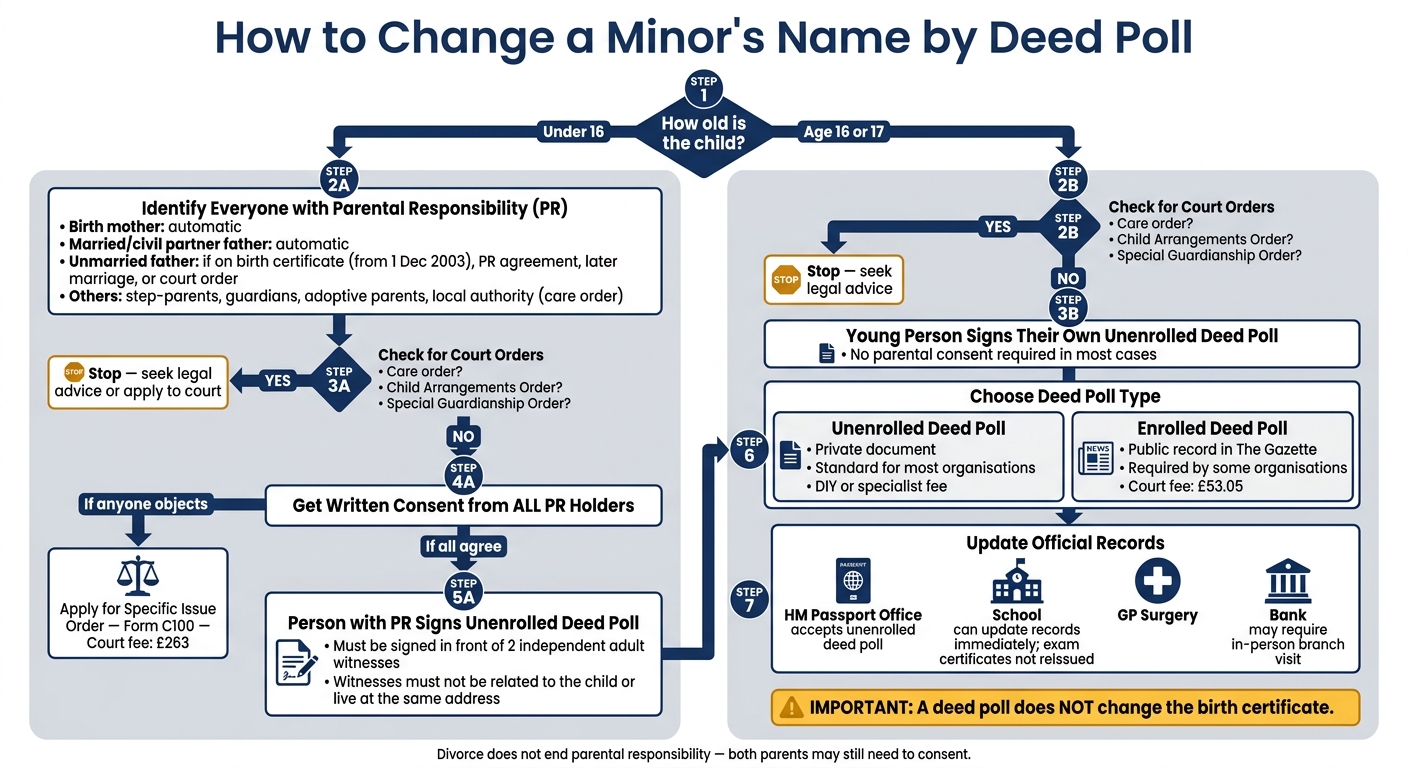
How to Change a Minor's Name by Deed Poll: Step-by-Step Guide
Once you've got consent from everyone with parental responsibility, the process is usually pretty simple. The main choice is between an unenrolled and enrolled deed poll. For most families, an unenrolled deed poll is the standard option.
Using an unenrolled deed poll
An unenrolled deed poll is a private document. In the UK, it's the usual route for changing a child's name.
For a child under 16, someone with parental responsibility signs the deed poll on the child's behalf. The document must be signed in front of two independent adult witnesses who are neither related to the child nor live at the same address. If the child is under 16, everyone with parental responsibility must agree before it is signed.
At 16 or 17, the young person signs their own unenrolled deed poll.
Once it's signed, you can use the deed poll to update official records.
When an enrolled deed poll may be used
An enrolled deed poll is registered with the Royal Courts of Justice, which means there is a public record. A notice is then published in The Gazette. In most cases, this route only makes sense if a particular organisation asks for it. If there are safeguarding concerns, a judge can allow limited details to appear in The Gazette.
| Feature | Unenrolled Deed Poll | Enrolled Deed Poll |
|---|---|---|
| Privacy | Private document; no public record | Published in The Gazette |
| Typical use | Standard for schools, GPs and HM Passport Office | Used when a specific organisation requires it |
| Process | Signed by the person with PR + 2 witnesses | High Court forms, a statutory declaration and court sealing |
| Public record | None | Public record at the Royal Courts of Justice |
| Cost | DIY or specialist service fee | £53.05 court fee plus potential solicitor fees |
Updating passports, schools, and GP records
Signing the deed poll is just the first part. After that, you'll need to tell each organisation that holds the child's details. The main ones are HM Passport Office, the child's school, and their GP surgery.
HM Passport Office accepts unenrolled deed polls. For 16- and 17-year-olds, passport applications are handled as adult applications, so parental consent is not legally needed for the passport name change.
Most organisations will ask to see the original deed poll or a certified copy. For children under 16, updates will usually need the deed poll and consent from those with parental responsibility. Schools can often update their own records straight away, but exam certificates are not usually reissued. In practice, the deed poll is shown alongside the original certificates to confirm identity.
If the child has a bank account, the bank may ask for an in-person branch visit. If a parent opened the account, the parent may also need to be involved in the update.
If exams are coming up, speak to the school's exams officer as early as you can. That gives the school time to register the new name with awarding bodies before certificates are issued.
A deed poll cannot be used to change a birth certificate.
If consent is disputed or a court order is in place, the case moves to the court route.
When Court Approval or Legal Advice May Be Needed
If consent isn't there, or a court order already affects the child, this no longer stays a deed poll matter. It moves into the court process.
Disputes about a child's surname or first name
When one parent or another person with parental responsibility does not agree, the deed poll route stops. At that point, the issue usually goes to family court.
The parent must apply for a Specific Issue Order using form C100. The court fee is £263. Before that, courts expect parents to have tried to sort things out between themselves.
Courts treat a child's name as part of their identity. So they look at name-change requests with care. A change will only be approved if it is in the child's best interests. That includes the child's age, emotional needs, and wishes.
Separation on its own is usually not enough. The court may also look at things like:
- a parent's serious criminal history
- a risk of abduction
- a long period of estrangement lasting several years
If there is a dispute, the court decides on the basis of the child's welfare, not what either parent wants.
Court orders and safeguarding concerns
Some court orders can limit a change before the court even gets to the welfare question. For example, a Child Arrangements Order with a "Lives With" provision can restrict a name change until the child turns 18.
A parent can also apply for a Prohibited Steps Order to stop the other parent making a change without consent.
If a person with parental responsibility cannot be traced after reasonable attempts, a court order is still needed before the change can go ahead. And if safeguarding is part of the picture, ask the court to limit what is published in The Gazette.
"The only exception to this [consent of everyone with parental responsibility] is a court order allowing a change of name without the consent of everyone who has parental responsibility." - Enfield Council
Even if the formal change is blocked, organisations may still record the child's everyday name on an informal basis.
Conclusion: Key Points to Check Before Changing a Minor's Name
If you're ready to move ahead, use this checklist before you sign anything. Start with the basics: the child's age, who has parental responsibility, and whether any court order is in place. Then pick the right deed poll. In most cases, an unenrolled deed poll is enough. An enrolled deed poll creates a public record and may be needed if an organisation asks for it.
A simple checklist before you begin
- Check whether the child is under 16 or 16–17 - children under 16 need someone with parental responsibility to act for them. Young people aged 16–17 can usually sign for themselves, unless a court order says otherwise.
- List everyone with parental responsibility - divorce does not end parental responsibility, so both parents may still need to be involved.
- Get written consent from every person with parental responsibility - for children under 16, this needs to be sorted before anything is signed.
- Check for any order that limits a name change - a care order, child arrangements order or special guardianship order can limit or stop the process.
- Choose the right deed poll - check whether the organisations you need to update want an enrolled or unenrolled deed poll.
- Gather the documents you need - this usually includes the child's birth certificate and any consent forms or court papers.
If any consent is missing, or a court order applies, stop there and sort that out first.
FAQs
Can a child choose their own new name?
Yes, it depends on your child’s age.
If your child is 16 or 17, they can make their own unenrolled deed poll and choose a new name for themselves.
If your child is under 16, someone with parental responsibility must make the name change on their behalf. You’ll also need written consent from everyone with parental responsibility, unless a court order says otherwise.
What proof of consent do organisations usually require?
Organisations will usually ask for the deed poll as proof of the minor’s new name.
Some, including certain banks or government agencies, may accept only an enrolled deed poll. So it’s worth checking their rules first before you send anything off.
They’ll also usually ask for written consent from everyone with parental responsibility, or a court order.
For 16- or 17-year-olds, some organisations may also want a witnessed letter of consent from the young person themselves.
Will a name change affect existing legal documents?
A deed poll does not automatically update every legal document. What it does do is give you proof of your new legal name, which you can then use to change your records with banks, employers, the DVLA, HM Passport Office, and other organisations.
If your deed poll is enrolled, you can also use the sealed deed and the Gazette notice as proof. For child name changes, a public record may be published in The London Gazette. And in some cases, certain organisations will only accept an enrolled deed poll.