How to Update Student Records After Name Change
If I change my name, I need to update legal records and day-to-day records separately. That is the main point. In most UK schools, colleges and universities, my degree certificate, transcript, visa record and Student Finance details need my legal name, while class lists, email display name and learning systems may use a preferred name.
Here’s the short version:
- Legal-name changes usually need proof, such as a deed poll, marriage certificate, statutory declaration or final order.
- Preferred-name changes often do not need proof and may be done in a student portal.
- Past certificates are often not changed once issued, so I should act before graduation.
- International students usually need their student record to match their passport and visa details exactly.
- Exam boards and Student Finance England may need separate updates.
- In many places, one request does not change every system.
A common mistake is thinking one email to the university fixes everything. It often doesn’t. Registry, IT, exams and ID card services may all handle different parts of the record.
Quick comparison
| Record | Legal name | Preferred name |
|---|---|---|
| Degree certificate | Yes | No |
| Academic transcript | Yes | No |
| CAS / visa records | Yes | No |
| Student Finance records | Yes | No |
| Class register | No | Usually yes |
| Email display name | No | Usually yes |
| VLE such as Moodle or Canvas | No | Usually yes |
| Student ID card | Depends on institution | Depends on institution |
My best route is simple: gather proof first, check the institution’s process, send the request to the right office, then check each system one by one.
That way, I’m less likely to end up with mixed records when exams, finance or graduation dates get close.
sbb-itb-bf1bef6
Which names can be changed on education records
Before you contact the institution, check what kind of change you need. In many cases, it’s either a legal update or a display-name change. Use your legal name for formal records, and your preferred name for day-to-day use.
Legal name on records, exams and certificates
Your legal name appears on degree certificates, academic transcripts, visa documents and Student Finance records. Institutions ask for this because they have to meet rules linked to fraud prevention, immigration and reporting.
If you want to change your legal name on official records, you’ll need proof of the name change. That might be a deed poll, marriage certificate or statutory declaration.
If you’re an international student, your university record will usually need to match your passport exactly. If it doesn’t, you could run into problems with your visa or your Confirmation of Acceptance for Studies (CAS).
Preferred name for day-to-day use
A preferred name - sometimes called a chosen name or display name - can often be updated without documentary evidence. In many cases, you can change it yourself through a self-service portal.
It’s often used for things like:
- class registers
- email display names
- virtual learning environments such as Moodle or Canvas
Some institutions also let you show a preferred name on your student ID card.
A preferred-name update does not change legal records. It usually updates display fields only, not core legal records or award documents. Social titles such as Mr, Ms and Mx can also usually be changed without evidence.
Record type and name used:
| Record Type | Legal Name Required? | Preferred Name Allowed? |
|---|---|---|
| Degree certificate / parchment | Yes | No |
| Academic transcripts | Yes | No |
| Visa and immigration documents (CAS) | Yes | No |
| Student Finance records | Yes | No |
| Class / attendance registers | No | Yes (usually) |
| University email display name | No | Yes |
| Virtual learning environments | No | Yes |
| Student ID card | Varies by institution | Varies by institution |
Once you know which records need your legal name, gather the documents the institution is likely to ask for.
Documents to gather before contacting the institution
Get your paperwork together first. Most institutions won’t deal with a legal name change unless you send proof, and the proof they want depends on the legal reason for the change.
In most cases, institutions will accept one of these documents:
- a deed poll
- a marriage or civil partnership certificate
- a statutory declaration
- a decree absolute or final order
A properly signed deed poll is accepted by most institutions. If you’re going back to a previous name after divorce, they’ll often ask for the decree absolute or final order, plus your original birth certificate.
Once your evidence is ready, check the institution’s own change-of-name process before you send anything.
Use certified copies instead of originals
Posting original documents is risky. If they go missing, replacing them can cost money and take time.
A safer option is to use certified copies. These are photocopies that a solicitor or another authorised professional has marked as true copies of the original.
This also makes life easier if you need to update your records in more than one place. It’s far simpler to have several certified copies ready from the start than to keep mailing originals back and forth.
Check the form, ID and processing requirements
Before you submit your request, look at the student records or registry pages on the institution’s website. Many universities, including York and St Andrews, ask for a dedicated change-of-name form as well as your evidence.
If you’re an international student, update your passport or eVisa first. The name on your student record usually needs to match your visa or travel documents. Also check which photo ID the institution accepts, because some won’t accept a driving licence.
It’s also worth checking the deadline. Send everything in before exam entry or graduation so your records can be updated in time.
With the right documents and ID in place, you can move on to the request itself.
How to update records at schools, colleges and universities
The process changes from one institution to another, but it usually follows the same path: contact the records office, send proof, then check which systems have been changed.
Schools and further education colleges
Start with the office that controls the records. Then ask what updates on its own and what does not.
For pupils, a parent or guardian will usually need to make the request. Contact the school office directly and ask for its name change process. Send the evidence the school asks for, then check which records it will update.
Be clear on one point from the start: is the school changing a legal record, a display name, or both? That matters more than people think.
Ask whether the change applies to:
- legal records
- registers
- library access
- ID cards
Some schools change everything in one go. Others handle legal and preferred name changes as two separate steps. It’s worth clearing that up early, so you’re not left chasing bits of the system later.
Universities and higher education providers
Universities often split records between Registry, IT and ID services. So one request usually won’t change everything.
At university level, the Registry or Student Records office is usually the main place to start. Check the student records or registry section of your university’s website first, as many institutions have a set process. Requests are often made through the student portal, where you can submit the request and upload your deed poll or other evidence.
Once your record has been changed, don’t assume the rest will follow. Display names in email systems often change on their own, but the email address usually needs a separate IT request. Ask the registry team whether the VLE will also show the change, or whether that needs its own request. A replacement ID card will often need to be requested separately too.
At collegiate universities, tell your college and, if needed, your department as well.
Before the change is treated as done, check each system one by one. That extra check can save a lot of back-and-forth later.
Past records, exam entries and certificates
New records can usually be changed once the institution accepts your legal name change. Past records are different. Most institutions will not change past records or certificates after they have been issued.
Exceptions are rare. They are usually limited to administrative error or safeguarding grounds. If you think your case may fit one of those, contact the awards office or Student Registry directly and ask about its policy.
If your award is still pending, get the change sorted before the certificate is issued.
Exam boards and final checks
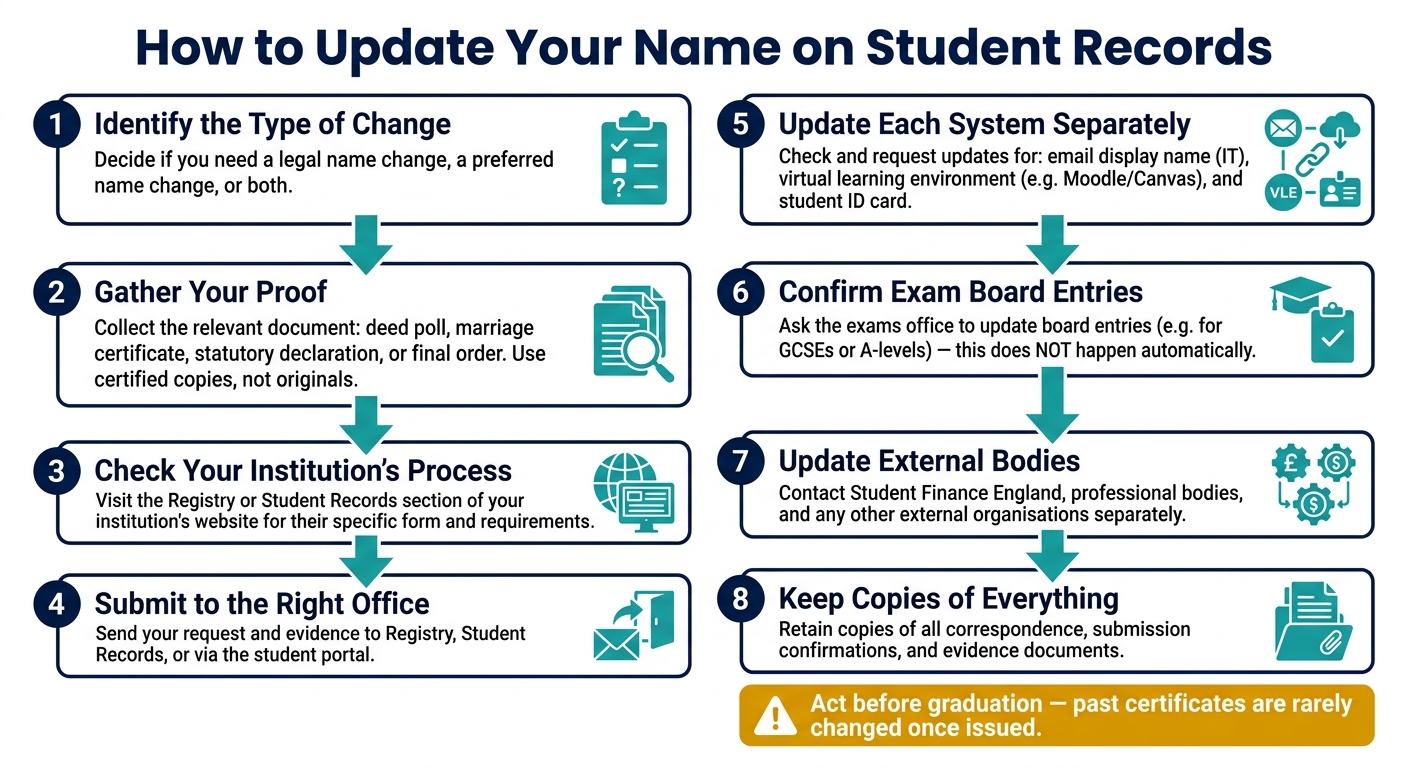
How to Update Your Name on Student Records: Step-by-Step Guide
Make sure exam and external records match
Once the institution updates its own record, there’s one more job to do: sort the systems it doesn’t update for you. Some records change inside the institution. Others need a separate request.
If you're at school or college, the exams office must also update your exam board entries. An internal record change does not update exam-board entries by itself. If that step gets missed, your GCSE or A-level certificates could be issued in your old name, and fixing that later can be a headache.
External organisations need their own update as well. Student Finance England will not get the change from your university. You need to contact it yourself through your online account or by post, with a signed, dated covering letter and a copy of your evidence. Processing can take several weeks, so it’s best not to leave it until the last minute.
For regulated courses such as Medicine or Dentistry, make sure your university record matches your photo ID before registration. If the details don’t line up, registration can be delayed.
You should also tell every external body that relies on your student record. Keep certified copies ready in case any of them ask for proof.
Key steps to complete the update
Use this order so nothing slips through the cracks.
- Submit the right type of change request - legal name, preferred name, or both, to the right office.
- Send proof to the right office - a deed poll, marriage certificate, or other accepted document.
- Confirm exam-board entries - ask the exams office if board entries need a separate update.
- Update external bodies separately - email, virtual learning environment, ID card, and any external accounts such as Student Finance England or professional bodies.
- Keep copies of everything sent - correspondence, submission confirmations, and evidence documents.
FAQs
Who should I contact first?
First, update your main identity documents, such as your passport, travel document or biometric residence permit. These are often checked first, so it helps to sort them before anything else.
Once those documents are updated and you have your deed poll, contact your university’s student records office or student services department. If you’re not sure who handles this, ask your Student Centre or administration team about the process.
Can I change my email address too?
Yes, you can usually update your university email address to match your new name. But that’s often a separate step from changing your formal student record.
It may not happen on its own, so contact your institution’s IT Service Desk directly. Some universities may ask you to confirm that your legal name has been changed officially. Others let you make certain profile changes through self-service portals.
What if my certificate has already been issued?
If your certificate has already been issued, most educational institutions won’t change the name on it after the fact. That’s because the certificate records the official details that were in place when the award was made.
Your best option is usually simple: keep the original certificate and use your deed poll to connect your previous name to your current one.
There are some exceptions, but they’re usually limited to cases like an administrative error or certain situations involving gender identity changes.